The EU’s New Arctic Strategy

Opportunities for Europe’s Digital Sovereignty
SWP Comment 2026/C 34, 18.08.2026, 7 Seitendoi:10.18449/2026C34
ForschungsgebieteTo date, the Arctic has played only a minor role in European efforts to achieve digital sovereignty. Yet digital infrastructure in the High North is a key component of this endeavour. The European Union’s (EU) Arctic Strategy, which is due to be updated this year, should therefore not be limited to traditional security issues. This is particularly true in light of hybrid threats in the Baltic Sea region. Of particular importance are European projects to expand Arctic submarine cable infrastructure, which constitute critical infrastructure. However, these initiatives require an ambitious EU that recognises its capacity to deliver innovation and sustainability in the development of green technologies.
In January 2026, the EU High Representative for Foreign Affairs and Security Policy, Kaja Kallas, attended the Arctic Frontiers conference, held annually in Tromsø, Norway. There, she stated that a new EU Arctic policy was needed, “one that reflects the times we live in and the world we want to see, including a secure Arctic”.
To date, the (European) Arctic has played only a minor role in discussions on how to safeguard Europe’s security and defence. Yet the expansion of Arctic submarine cable infrastructure is a key means of securing the continent’s digital sovereignty. However, this aspect has been neglected in discussions on the EU’s Arctic Strategy to date. One reason is the wide range of security threat scenarios in the region. Three groups of actors merit particular attention in this context:
-
the five Arctic coastal states, namely the United States (including Alaska), the Kingdom of Denmark (Greenland), Russia, Norway (Svalbard) and Canada, often referred to as the A5
-
the three “small Arctic states” of Finland, Sweden and Iceland
-
the Arctic Council, the central intergovernmental forum for cooperation among Arctic states, including representatives of Indigenous peoples as Permanent Participants
All eight Arctic states are members of the Arctic Council. Six EU member states (Germany, France, Italy, the Netherlands, Poland and Spain) hold observer status. Each of the three groups of stakeholders deals with different challenges in terms of geopolitical interests, the state of infrastructure and Europe’s efforts to have a say in the High North.
Following Russia’s full-scale invasion of Ukraine in February 2022, the EU suspended its cooperation with Moscow in the Arctic. For the EU, this means exploring new forms of cooperation as well. Whereas Denmark is an EU member state, Greenland and the Faroe Islands are not part of the EU. Nevertheless, in 2024 the European Commission opened an office in the Greenlandic capital, Nuuk. The EU took a clear and united stance against US President Donald Trump’s territorial claims to the island. Norway and Iceland are not members of the EU but are part of the European Economic Area.
Diverging priorities
Norway takes a somewhat ambivalent approach to Arctic policy: While pursuing its own interests in the region, it also supports EU engagement there. Sweden is interested in a strong EU role in the Arctic, although so far this has mainly focused on establishing an environmental policy frame-work. Finland, like Norway, supports the EU’s efforts to obtain observer status in the Arctic Council. Since submitting an application to this effect in 2013, the EU has been permitted to participate in the Council’s deliberations as a de facto observer, although no formal decision has yet been taken on the matter. In view of Russian, US and Chinese interests in the Arctic, a strategic partnership between the EU and Canada is under discussion, for example.
The EU’s current Arctic Strategy, which was presented in 2021 under the title “A stronger EU engagement for a peaceful, sustainable and prosperous Arctic”, is set to be replaced by an updated version later this year. The public consultation phase for this ended on 16 March 2026. Back in November 2025, the European Parliament had already voted by a large majority in favour of strengthening the EU’s role in Europe’s High North. It regards the Arctic as a region integral to Europe’s security.
The new Arctic Strategy is expected to address cross-cutting issues such as science and research, technology, connectivity and innovation, as well as the rights of Indigenous peoples. During the consultation process, European research institutes called for international (terrestrial) climate research to remain a strategic priority. However, this will need to be aligned with the Commission’s priorities, including sustainable prosperity, competitiveness, security and defence. Above all, the digital sovereignty sought by the EU could serve as a cross-cutting theme, linking existing priorities such as climate and environmental protection, sustainable and inclusive development, and enhanced international cooperation.
Submarine cables as critical infrastructure
It is in Europe’s interest to press ahead with the protection of critical maritime infrastructure in the three key sectors of energy, food and communications. The sabotage of the Nord Stream 1 and 2 gas pipelines in 2022 also placed the issue on Germany’s policy agenda and brought it into the spotlight of public attention. In 2024, several submarine cables linking Germany and Finland, Sweden and Lithuania, and Finland and Estonia were damaged. In 2022, one of the two cables connecting Norway to Svalbard was out of service for 11 days after being damaged. A new project is now being planned to replace the existing cable system once it reaches the end of its operational life. From 2028, “Arctic Way” is intended to connect the Norwegian mainland with Svalbard’s main settlement, Longyearbyen, and, for the first time, to establish a link to the uninhabited Norwegian island of Jan Mayen. Observers believe that security and military considerations lie behind this project.
Germany, the EU and NATO are currently endeavouring to strengthen their international cooperation and set priorities in response to the changing threat landscape. Nevertheless, cable projects are unlikely to play a prominent role in the updated Arctic Strategy. However, Europe’s digital sovereignty depends on the EU’s engagement in the High North. It would therefore be advisable to address this concern in the new strategy paper.
Challenges for the EU
In its foreign policy strategies of recent years, the EU has recognised the need for resilient digital infrastructure. A 2022 study commissioned by the European Parliament’s sub-committee on Security and Defence (SEDE) states: “European governance of cable protection and resilience still lags behind and needs improvement. The EU and its member states will have to address the vulnerabilities in European digital connectivity.” As part of the digital strand of the Connecting Europe Facility (CEF) – an EU funding programme (2021–2027) designed to support the expansion of trans-European infrastructure – and in line with the EU Action Plan on Cable Security (February 2025), the Commission is investing 347 million euros in strategic submarine cable projects. Of this amount, 20 million euros will be allocated to repair capabilities.
Ninety-seven per cent of global intercontinental data traffic continues to flow via around 500 submarine cables, despite advances in satellite technology. The digital infrastructure of the High North, including trans-Arctic submarine cables, has long been recognised as a strategic hub for Europe’s digital sovereignty, including by third countries. Although the idea of such cable projects is by no means new, it is now being pursued strategically and with public funding for the first time. The Arctic has thus been designated as one of 13 priority areas for Cable Projects of European Interest (CPEI). According to a January 2026 report by the Commission’s Submarine Cable Infrastructures Informal Expert Group, there are three reasons for this.
First, 90 per cent of data traffic between Europe and Asia currently passes through the Bab al-Mandab strait in the Red Sea, making it vulnerable to disruption and insufficiently redundant. Geographically, the Arctic Ocean is ideally suited to providing alternative and secure data routes from Northern Europe to Asia – particularly as it lies far from regions with high levels of maritime activity and piracy. Second, trans-Arctic routes are significantly shorter, which results in lower latency, that is, less delay in transmission. The real-time data transfers this would enable would particularly benefit international financial trading. Third, a connection between Greenland and the EU is of increasing importance, both geopolitically and economically. The EU’s investment of 20.5 million euros in the “Tusass Connect” cable system can reasonably be understood as a response to threats to Greenland’s sovereignty.
However, Arctic cable projects present the EU with a number of challenges. In other regions of the world, submarine cables are increasingly being built by corporations such as Meta, Google, Microsoft and Amazon. Yet these US Big Tech firms have not emerged as investors or stakeholders in trans-Arctic projects. This is hardly surprising, given that these projects are primarily intended to advance Europe’s digital autonomy. The situation differs with regard to data centres in the Nordic countries, which would benefit directly from the cable projects. In 2024, for example, Google was granted permission to purchase land in the Finnish municipalities of Muhos and Kajaani in order to further expand its cloud and data centre infrastructure.
Furthermore, the cable projects are ambitious in legal, financial and practical terms. Harsh environmental conditions in the Arctic mean that technical challenges and high maintenance costs must be expected. Sea ice complicates necessary repairs, as cable-laying vessels must either be ice-classed or accompanied by icebreakers. Effective communication with the governments and industry partners involved will also be required. It will be important to work towards a swift and pragmatic implementation of the plans, rather than allowing them to remain mere visions for the future.
Two Arctic routes for submarine cables
In principle, there are two possible Arctic routes for submarine cables. They are complementary and, through interconnected landing points in Northern Europe, Alaska and Japan, could provide redundancy across the entire system: the West Arctic Passage (EU Priority Area 2a) and the Polar Passage (EU Priority Area 2b). The total cost of cable projects across Priority Area 2 (the Arctic) is estimated at around 4.3 billion euros. Both routes offer further benefits beyond the expected enhancement of Europe’s geopolitical resilience.
The first route connects Germany, Sweden, Norway, Ireland, Denmark, Iceland, Greenland, Canada, the United States (Alaska), Japan and South Korea, following the path of the Northwest Passage. The “Far North Fiber” submarine cable planned along this route is due to be operational by 2029 and is funded through CEF Digital. As the route runs along the Canadian Arctic Archipelago, it will be possible to provide remote communities and settlements with broadband internet via various connection points and links.
|
Map
|
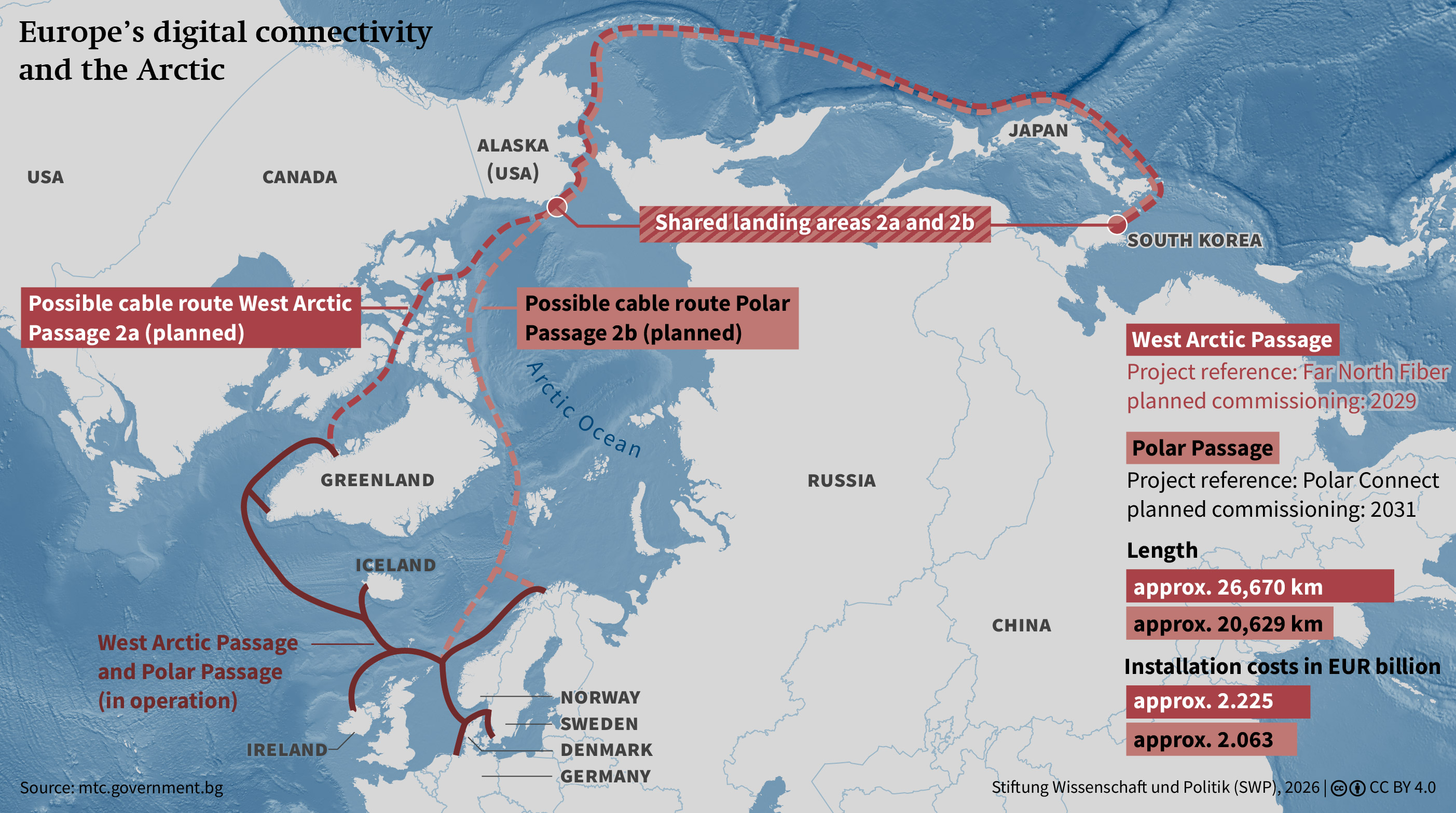
The second route follows the polar route through the central Arctic Ocean, running from Scandinavia along the north coast of Greenland to Asia. The project includes the “Polar Connect” cable system, which is due to come into operation from 2031. Key participants include NORDUnet – a consortium of the National Research and Education Networks (NRENs) of Norway, Sweden, Finland, Denmark and Iceland – the Swedish Polar Research Secretariat and the Swedish Research Council. At the same time, the government in Stockholm is planning to build a new icebreaker. “Polar Connect” is also funded by CEF Digital.
What is distinctive about this cable system is that it is intended to follow the shortest possible route through the Arctic Ocean, thereby ensuring correspondingly low latency. “Polar Connect” is also supported by considerations of security, economic benefit and international cooperation. The project places particular emphasis on enabling scientific research and environmental monitoring. This is to be achieved by integrating sensor systems. These include, for example, SMART (Science Monitoring and Reliable Telecommunications) and DAS (Distributed Acoustic Sensing) – technologies designed to provide research data for geology, seismology, oceanography and marine biology. This initiative has been particularly well received by the scientific community, as the Arctic Ocean is highly significant for climate change but remains under-researched. It must be borne in mind, however, that the stakeholders involved may face issues relating to data ownership, management and access.
Beyond the opportunities for Europe’s digital sovereignty, it would be advantageous to embed Arctic cable projects within the green and digital innovation ecosystem that is already emerging in the Nordic countries. When it comes to Arctic connectivity, the EU’s strength lies above all in combining innovation and sustainability.
The Nordic countries as a digital hub
The new Arctic Strategy presents the EU with an opportunity to take a proactive and united stand in support of European security interests and values with regard to its digital infrastructure. The OECD’s 2025 report “Navigating Global Transitions in European Arctic Regions” identifies four major thematic areas relevant to the region’s socio-economic development: a) sustainable development in the context of demographic change, b) competitiveness and connectivity, c) promoting the green transition and addressing the challenges of climate change and d) strengthening multi-level governance and cross-border cooperation.
For the Nordic countries of Norway, Sweden and Finland, the EU’s digital infrastructure strategies are improving opportunities for strengthening local economies and integrating the North into the global economy. A Copenhagen Economics study commissioned by NORDUnet concludes that submarine cables connecting the Nordic countries and Japan could contribute 1.4 billion euros annually to Nordic gross domestic product, provided that the connection is fully utilised. The expansion of trans-Arctic fibre-optic cables, which promise increased internet bandwidth and lower latency in exchanges with Asia and North America, would not only entail direct and indirect investment in cable infrastructure; it would also increase productivity and reduce trade costs in other sectors. Furthermore, it is hoped that spillover effects will attract new data centres and create jobs, which could help to retain people in the region.
The risk that the High North will develop merely into a transit region remains low. For one thing, even the transit of international data traffic to the FLAP region (Frankfurt, London, Amsterdam, Paris) would bring economic benefits. For another, from the national perspective of the countries concerned, there are strong arguments in favour of ensuring an appropriate balance between transit and regional data traffic.
Innovation and sustainability
The High North is investing in green technologies and digital autonomy – two key elements for achieving the EU’s climate, environmental and digital targets by 2030. Initiatives such as the “Digital Europe Programme” and the European Digital Innovation Hubs (EDIH) strengthen intra-European cooperation and promote the scaling up of digital solutions. This presents a further opportunity to align the EU’s new Arctic Strategy over the long term with its green and digital “twin transition”. The region serves as a model for reconciling digitalisation and sustainability; it is home to leading technology companies, start-ups and research centres that are driving European innovation. A good example is LUMI (Large Unified Modern Infrastructure), Europe’s fastest and most energy-efficient supercomputer, which is also part of the “EuroHPC Joint Undertaking” initiative. Located in Kajaani, northern Finland, it is powered entirely by hydropower and uses natural cooling systems. Its waste heat also supplies around 20 per cent of the district heating in the municipality.
By 2030, information and communication technology will account for more than a fifth of global electricity consumption. The Nordic countries are well placed to expand digital infrastructure in a cost-effective manner. According to the aforementioned study by Copenhagen Economics, for example, they save 150 million euros annually because their electricity and cooling costs are lower.
Furthermore, the High North is home to a research infrastructure that encompasses world-leading Earth observation and climate monitoring, which benefits from resilient digital infrastructure. The EU promotes scientific excellence in the Arctic, among other ways, through the European Polar Coordination Office, which is based in Sweden. The regional cable projects could form part of a forward-looking strategy and would complement the EU’s objectives for both the green and digital transition. This is a cross-cutting issue that touches on climate action, geopolitical and security positioning, and economic resilience; it is therefore particularly worthwhile for the EU to pursue pragmatic implementation in this area.
European potential for a secure Arctic
The EU provided swift and united support to Greenland when the Trump administration laid claim to the island. Once again, this incident highlighted the significance of the security situation in the Arctic. Whilst seven of the eight Arctic states are NATO members, the EU has recognised that no security issues are exclusively Arctic in nature. Rather, the region is a priority for the EU that deserves central consideration within a European security strategy.
Particularly in the area of digital sovereignty, this opens up opportunities that extend beyond hard security issues. The development of a resilient and sustainable digital infrastructure in Europe’s High North offers the chance to address the challenges of climate change, the need for scientific research and the needs of local communities in equal measure. To realise the potential of this issue in the EU’s new Arctic Strategy for 2026, inclusivity should be pursued on three levels: firstly, cooperation between the EU and the Nordic countries; secondly, the societal impact of digital connectivity; and thirdly, the selection of priorities and implementation of the strategy paper.
As regards the first point, the EU’s strength lies in its rules-based approach and its focus on multilateral cooperation. New security partnerships offer promising starting points in this regard. The EU is playing an increasingly important role in trans-Arctic cable connections, particularly with regard to their objectives and funding. However, initiatives and plans for regional submarine fibre-optic cables have so far been driven primarily by the interests and substantive contributions of the eight Arctic states. The EU’s task is to ensure coherence among development projects. The 2021 EU Arctic Strategy already refers to the promotion of Arctic connectivity through the CEF. It would be desirable to build on this in the revised strategy.
In this sense, the EU can position itself as a catalyst for Nordic cooperation. Given the societal significance of the projects, an inclusive dialogue with the countries concerned that extends beyond the level of national governments appears essential. At the same time, recent analyses suggest that promoting a broad understanding of security – as advocated in the Nordic countries – would strengthen the EU’s role as a legitimate actor in the Arctic.
On a second level, it will be necessary to promote digital infrastructure for people living and working in the Arctic, including through pan-Arctic solutions. Cooperation with the Arctic Economic Council (AEC) would be one option, as it has published several reports on expanding broadband connectivity in the Arctic states. The Arctic Council’s 2021 Reykjavík Declaration likewise emphasises the importance of communication networks in relation to public services. Considerations about human security play an important role for the states concerned in their dealings with their own populations; this encompasses the provision of education and telemedicine as well as digital inclusion. For example, access to broadband internet has been a legal right for Finnish citizens since 2010. Various Indigenous organisations are also campaigning for digital equity.
Thirdly, neither the High North nor the Arctic should be regarded as a niche issue within the EU. On the contrary, the region offers the EU an opportunity to take a holistic approach to security issues, incorporating climate action, societal transformation and critical infrastructure. Responding to hybrid threats in a united manner certainly falls within the EU’s scope for action. However, the revised Arctic Strategy should be more closely aligned with other functional sub-strategies, such as the EU’s International Digital Strategy and those in the fields of security and defence. It is in the Union’s interest to continue investing in European Arctic research. Although the main focus of Europe’s polar research lies on Antarctica, global ocean observation is emerging as a new priority. Terrestrial research in the European Arctic, as well as social science research on the Arctic, should not be overlooked in research funding.
Finally, it is clear that an updated Arctic Strategy will also require further institutional commitments. Arctic issues are cross-sectoral within the EU and are coordinated by the Directorate-General for Maritime Affairs and Fisheries (DG MARE) and the European External Action Service (EEAS). The European Parliament has called for the mandate of the EU Special Envoy for Arctic Affairs to be strengthened, or even for a dedicated unit for the region to be established within the EEAS. The willingness to engage in partnerships with Indigenous representatives remains important.
The EU is not expected to obtain official observer status in the Arctic Council in the foreseeable future. In the absence of such status, the EU is unlikely to commit personnel and institutional capacity to the body as a mere funder with no decision-making authority. Ambitious and reliable partnerships in Europe and the North Atlantic, particularly with Canada, are therefore of central importance. The EU’s pursuit of technological and digital sovereignty is a cross-cutting issue that should gain greater prominence both in its external relations and in the new Arctic Strategy.
Dr. habil. Annegret Bendiek is a Senior Fellow in the EU / Europe Research Division at SWP.
Svenja Holste is a Research Fellow at the Institute for World Society Studies at Bielefeld University.
This work is licensed under CC BY 4.0
This Comment reflects the authors’ views.
SWP Comments are subject to internal peer review, fact-checking and copy-editing. For further information on our quality control procedures, please visit the SWP website: https://www.swp-berlin.org/en/about-swp/ quality-management-for-swp-publications/
SWP
Stiftung Wissenschaft und Politik
German Institute for International and Security Affairs
Ludwigkirchplatz 3–4
10719 Berlin
Telephone +49 30 880 07-0
Fax +49 30 880 07-100
www.swp-berlin.org
swp@swp-berlin.org
ISSN (Print) 1861-1761
ISSN (Online) 2747-5107
DOI: 10.18449/2026C34
(English version of SWP‑Aktuell 33/2026)