The Tigray Region in the Grey Zone between War and Peace

The Conflict Between the TPLF and the Ethiopian Government Has the Potential to Escalate beyond the Country’s Borders
SWP Comment 2026/C 29, 22.07.2026, 8 Seitendoi:10.18449/2026C29
ForschungsgebieteTensions between Addis Ababa and the Tigray Region are gradually mounting. Miscalculations could even trigger another large-scale war, although the parties involved may not directly seek one. Since the war in northern Ethiopia ended in November 2022, no new, stable political order has emerged. Tigray remains suspended between war and peace. Responsibility for this lies with both the Ethiopian government and its partner in peace, the Tigray People’s Liberation Front (TPLF). Having lost power in the national government in 2018, the TPLF has yet to find a new role for itself; instead, it has been marked by internal power struggles and characterised by authoritarian tendencies. Conversely, the Ethiopian government has not done enough to facilitate the return of internally displaced persons and restore Tigray’s territorial integrity. A renewed outbreak of hostilities could draw in Eritrea, Sudan and other regional actors. Germany and the European Union (EU) should firmly commit to crisis prevention in order to avoid further escalation in the already tense Red Sea region.
Relations between the TPLF and the Ethiopian government resemble a strategic game: Every move by one side prompts a response from the other. Accompanied by threatening rhetoric, both sides are testing how far they can go. Violence is part of their established repertoire.
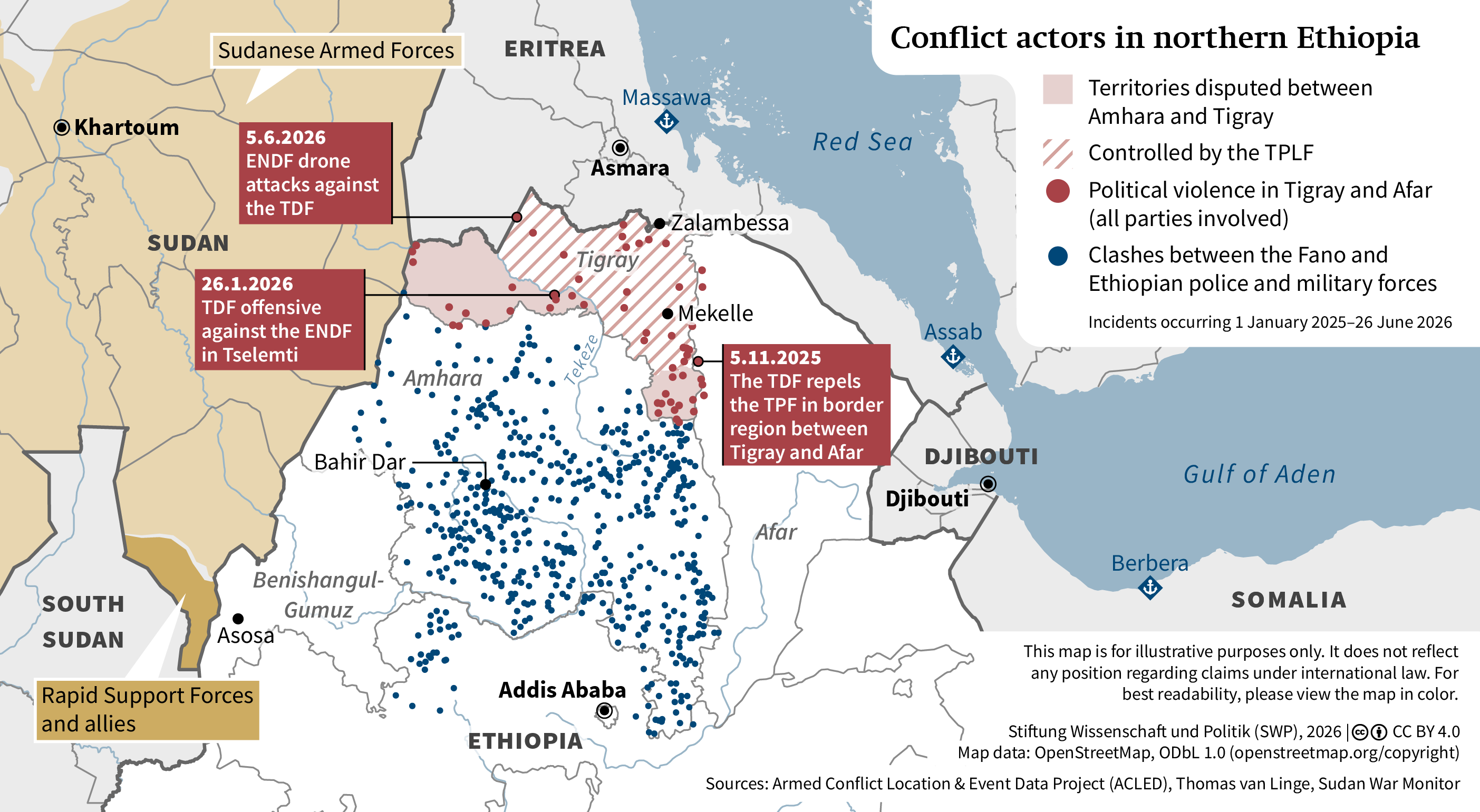
On 8 April 2026, the Ethiopian government extended the mandate of the Tigray Interim Regional Administration (TIRA) by one year. General Tadesse Worede was to remain president in Mekelle. The TPLF, which was not consulted on the extension (though it had been involved in Tadesse’s appointment a year earlier), did not recognise the decision. Instead, it reinstated the regional parliament, which had emerged from elections organised unilaterally in 2020. On 5 May 2026, that parliament elected TPLF chairman Debretsion Gebremichael president of the regional government. This administration, in turn, is not recognised by the Ethiopian government. Debretsion’s regional government stripped Tadesse of his powers. At the same time, the Tigray Defense Forces (TDF) – the regional government’s armed forces – are recruiting new fighters. Since last year, armed actors from Tigray have repeatedly engaged in brief violent clashes, with the Ethiopian National Defense Forces (ENDF) intervening on several occasions with drone strikes.
This is not some obscure political power struggle confined to the local level. The war from 2020 to 2022 was one of the deadliest armed conflicts worldwide in recent decades. The Pretoria Agreement, which ended the war, hangs by a thread. Ethiopia is the most populous country in the strategically important Horn of Africa region.
The Pretoria Agreement’s fault lines
The cessation-of-hostilities agreement signed by the TPLF and the Ethiopian government in November 2022 in Pretoria, South Africa – after mediation by the African Union (AU), the Intergovernmental Authority on Development (IGAD) and the United States – remains an important framework for relations between Tigray and Addis Ababa, in the absence of alternatives.
The Pretoria Agreement brought about a noticeable improvement in living conditions in Tigray in the first few months following its signing. Hostilities ceased and the government lifted the economic blockade of the region and restored essential services (electricity, banking, telecommunications) that had been suspended during the war. The TPLF handed over its heavy weaponry under AU supervision.
The TPLF agreed to dissolve the regional government it had formed unilaterally in 2020 and, in consultation with Addis Ababa, establish an interim regional administration in March 2023. From the outset, however, the interim administration found itself in a difficult position, as it was also held accountable by the people of Tigray for the Ethiopian government’s failings.
These failures are particularly evident in three key areas concerning the implementation of the Pretoria Agreement. The first concerns the status of areas that belonged to the Tigray Region before the war and were occupied by Amhara militias and the ENDF at the start of the conflict. These include the Western and Southern Zones of the local administration, as well as Tselemti south of the Tekeze River (see map). The neighbouring Amhara Region claims these areas, which had in fact not formed part of Tigray prior to 1991. The Pretoria Agreement merely states that their status should be resolved in accordance with the Constitution. However, the steps necessary for a constitutional settlement have not yet been taken.
The Western Zone of Tigray is of strategic importance. Sesame and cotton are grown there on large agricultural estates for export. The Ethiopian government fears that the TPLF could link up with armed groups across the border with Sudan and organise its own supply lines.
Second, closely linked to this territorial issue, is the plight of internally displaced persons. During the civil war, around 1.9 million people were displaced within and from Tigray. More than three years after the Pretoria Agreement, around 750,000 people remain displaced in the region, according to the UN High Commissioner for Refugees mainly from areas controlled by Amhara forces. With a total population of around six million, this represents a considerable burden. Displaced people who have been able to return to the disputed areas often find their homes destroyed or occupied. They also lack access to essential services. Without a mutually agreed resolution regarding political control of these areas, returns will remain difficult.
The third area of concern is the demobilisation, disarmament and reintegration (DDR) of TDF soldiers. In Tigray alone, around 274,000 people have been registered for the DDR programme. Some 63,000 people have gone through the DDR process in Tigray to date. However, the process has stalled since 2025. Many of the soldiers live in poorly supplied camps. In some cases, the TIRA has allocated more than half of its budget solely to the fighters still awaiting demobilisation. These funds were consequently unavailable for the region’s development.
These unresolved issues also stood in the way of the region’s reintegration into Ethiopia’s political system. No elections were held either for a new regional parliament or to elect Tigrayan representatives to the parliament in Addis Ababa, although the Pretoria Agreement had stipulated this. The entire Tigray Region was excluded from the general elections that took place on 1 June 2026.
The TPLF’s search for a role
Following the devastating war in northern Ethiopia, an intense debate began within the TPLF and among the Tigrayan elite more broadly. How had violence on such a scale come about? How much responsibility lay with the TPLF, which had dominated Tigray’s politics for five decades, and how much compromise could still be reached with Addis Ababa?
|
Key actors in the conflict ENDF: Ethiopian National Defense Forces (regular armed forces) TDF: Tigray Defense Forces (Tigray’s regular security forces) TIRA: Tigray Interim Regional Administration (stripped of power since May 2026) TPLF: Tigray People’s Liberation Front (political party) TPF: Tigray Peace Force (a splinter group of the TDF, pro-Addis Ababa) |
The discussions also touched on the fundamental question of Tigray’s place within Ethiopia’s state structure. Since the end of the 19th century, political elites from Tigray and Amhara had been competing for supremacy in Ethiopia. The rivalry escalated into several violent conflicts, such as the civil war against the Derg military regime from 1974 to 1991. The TPLF subsequently controlled the state and the economy for 27 years as part of a coalition of parties, until Abiy Ahmed, who is from Oromia, came to power in 2018. Under Abiy’s more centralised rule, the TPLF is unlikely to be able to play a national role any longer. However, according to an academic from the region, many Tigrayan elites, including those in the TPLF, simply cannot accept their peripheral status.
In the post-war discussions, the interim administration was a bone of contention within the TPLF. Abiy prevented TPLF Chairman Debretsion from becoming its head, whereupon the TPLF Central Committee elected Getachew Reda – its chief negotiator in Pretoria and former Minister of Communications – whom Abiy eventually appointed in March 2023. Getachew’s government was caught between the uncompromising stance of the TPLF leadership led by Debretsion and the delaying tactics of the federal government in Addis Ababa.
In August 2024, the power struggle within the TPLF erupted into the open. The TPLF convened a party congress at short notice, which Getachew and other members of the TIRA boycotted. Shortly afterwards, Getachew and 15 others were expelled from the party. Getachew’s position soon became untenable. After the TPLF had already taken over parts of the administration with the help of security forces, Abiy dismissed Getachew in March 2025 and, following negotiations with Debretsion, replaced him with Tadesse Worede. Tadesse had previously headed the TIRA’s Peace and Security Bureau and, in that capacity, had controlled the TDF.
However, replacing the regional president did not resolve the underlying problems. Tadesse soon encountered difficulties and resistance similar to those faced by his predecessor.
At the same time, relations between the TPLF and the Ethiopian state deteriorated. The National Election Board of Ethiopia (NEBE), which also oversees the political party system, had only re-registered the TPLF in 2024 (following its ban during the war) subject to certain conditions. The TPLF was required to hold a party congress to elect a leadership and adopt a constitution. The TPLF refused to comply with the legal framework, as this would have required it to register as a new political party, thereby renouncing its historical continuity. Furthermore, the TPLF argued that, as a signatory to the Pretoria Agreement, it was already recognised as a political party. In May 2025, the NEBE ultimately revoked the TPLF’s registration. From the Ethiopian government’s perspective, the TPLF therefore no longer exists as a legal entity. This complicates the initiation of direct talks.
The TPLF also faces a legitimacy problem within Tigray itself. On two occasions – March 2025 and May 2026 – it replaced previously legitimised interim administrations in Mekelle, partly through the use of force. Opposition politicians from Tigray report that they and their supporters are occasionally harassed and arrested. The TPLF has declared a “zero tolerance” policy towards media outlets that promote the agenda of its opponents. Tens of thousands of people, mainly young people from Tigray, have left Ethiopia in search of work, usually heading for the Arabian Peninsula. In this situation, the TPLF benefits from the grey zone between war and peace in which Tigray finds itself. Its constant warnings about the Ethiopian government’s machinations help it to justify its own extra-legal measures.
Abiy the juggler
The Ethiopian government under Prime Minister Abiy faces its own challenges. It aims to drive forward the country’s ongoing political and economic transformation, moving away from the ethnic federalism and developmental-state model established under TPLF rule, and towards a unitary state and a controlled opening of the market economy.
Abiy must balance the interests of various groups without becoming dependent on them. He appears to be pursuing a strategy of dividing the opposition and thereby weakening it. A controversial national dialogue, which could pave the way for constitutional amendments, is also part of his toolkit. However, no consultations for the national dialogue have taken place yet in Tigray itself.
Addressing and resolving the outstanding issues in the implementation of the Pretoria Agreement would have meant jeopardising fragile relations with key groups. Clarifying the territorial status of Western Tigray by means of a referendum, which the government had proposed, would have required determining who was eligible to vote, particularly among people displaced from Tigray and new arrivals from Amhara.
The same applied to the government’s commitment to ensure the withdrawal of all “non-ENDF” troops, meaning primarily Amhara militias and Eritrean forces. Although Eritrean troops withdrew from central Tigray, they remained present in the north-east of the region, particularly in Zalambessa and Irob.
The government in Addis Ababa also capitalised on tensions within Tigray, which it actively fuelled, at least in certain instances. TDF fighters dissatisfied with the TPLF’s course split off in 2025 and began to form their own militia under the name Tigray Peace Force (TPF, Hara Meret in Tigrinya). The ENDF appear to be supporting the TPF with ammunition, rations and pay. In November 2025, the ENDF deployed drones against the TDF as it pursued the TPF across the border into Afar.
In May 2026, Getachew, together with his new party, Simret, and other parties, founded the “Peace and Change Council”, which also includes TPF members. The coalition is led by General Tsdadkan Gebretensae, who commanded the TDF during the war and served as vice-president of the TIRA under Getachew. The Peace and Change Council aims to remove the TPLF from power in Tigray “by any means necessary”, as stated at its founding. Getachew has officially served as Abiy’s adviser on East Africa, with the rank of minister, since April 2025.
“Tsimdo” and Eritrea’s interests
For its part, the TPLF is cooperating with its former arch-enemy, Eritrea. Initial contacts reportedly took place as early as the beginning of 2024 in Dubai, when Getachew met with Eritrean representatives on behalf of the TPLF and – according to Debretsion – with Abiy’s encouragement. A strategic objective of the TPLF is to ensure that it can no longer be cut off from the world by the government in Addis Ababa, as happened during the previous war.
As part of this rapprochement, Eritrea launched the “Tsimdo Selam” initiative in 2025. Representatives of Tsimdo describe it as a “grassroots peace movement” between related peoples in the border region of Ethiopia, Eritrea and Sudan. However, given the actors involved in this alliance, Addis Ababa views the initiative as an anti-Ethiopian alliance comprising the TPLF, Eritrea, the Fano (from Amhara) and other opposition movements, which it claims is preparing a joint military offensive.
Eritrea has come a remarkable way – from fighting alongside the ENDF against the TPLF to becoming an ally of the TPLF against the Ethiopian government. For President Isaias Afwerki, the threat environment has since shifted. Since 2023, Abiy has regularly spoken of Ethiopia’s right to access the sea and described the Red Sea as Ethiopia’s “natural boundary”. In November 2025, Ethiopian Foreign Minister Gedion Timothewos stated that Ethiopia had long had sufficient grounds to wage war against Eritrea, but was refraining from doing so out of a sense of responsibility.
Against this backdrop, Eritrea has an interest in overcoming its regional isolation without abandoning its existing totalitarian model of rule. That model also relies on constantly emphasising the threat of external interference, particularly by Ethiopia, in order to justify the continued militarisation of society.
There is a widespread willingness in the region to cooperate with a former enemy when that enemy is regarded as the “lesser evil” compared with the principal adversary, as discussions with various political actors in Ethiopia have shown. This calculation shapes the TPLF’s relations with Eritrea, those of the Fano with the TPLF, and also relations between the Peace and Change Council and the government in Addis Ababa. The actors assume that they can exploit each other’s interests for their own ends. It is a tactical collaboration, not a strategic alliance.
Regional entanglements
Tensions in northern Ethiopia involve not only Eritrea but also other regional actors that could contribute to an escalation and link it to ongoing armed conflicts.
For instance, Ethiopia’s relations with the Sudanese Armed Forces (SAF), which control most of the border with the neighbouring country, have deteriorated significantly in recent months. Since late 2025, Ethiopia has become one of the principal transit countries for supplies to the Rapid Support Forces (RSF) from the United Arab Emirates (UAE), as evidenced by dozens of suspicious cargo flights per month and satellite imagery from Benishangul-Gumuz. The SAF also accuses Ethiopia of facilitating Emirati drone strikes against Sudanese targets, citing, among other evidence, the flight data of a Turkish-made Akıncı drone shot down in May 2026.
Addis Ababa, for its part, views the presence in Sudan of Army 70 – an armed group from Tigray with links to the TPLF – with concern. Army 70 has intervened in the war there on the side of the SAF. The group reportedly comprises several thousand fighters who could operate from the Sudanese border in the event of a potential conflict over Western Tigray.
Furthermore, Eritrea is strengthening its ties with Egypt, which is in dispute with Ethiopia over control of Nile waters. In June 2026, Asmara and Cairo agreed to cooperate in various sectors, including the maritime economy. Egypt also intends to participate in developing the ports of Assab and Massawa – precisely those ports in which Abiy has expressed an interest through his rhetoric on access to the sea.
Another factor influencing the region is the rivalry between the UAE and Saudi Arabia. The UAE is one of Abiy’s closest financial and military partners, whereas Saudi Arabia views further militarisation of the Red Sea with scepticism. In 2020, Riyadh established the Red Sea Council, a regional initiative of the littoral states, of which Eritrea is a member. The blockade of the Strait of Hormuz reinforces the economic importance of the Red Sea for Saudi oil exports. Transnational smuggling routes for Iranian weapons and military materiel in the Red Sea also affect Riyadh’s security interests. Saudi Arabia has in the past attempted to mediate between Ethiopia and Eritrea. However, these efforts failed because the negotiations did not address the military use of Assab, a key interest for Ethiopia.
Sporadic violence and risks of war
Tensions between the TPLF and Addis Ababa are gradually escalating, without, so far, reaching a full-blown crisis. Both sides presumably do not wish to risk a repeat of the devastation of the last war, but have already shown that they remain prepared to use military force to advance their interests. Since the TPLF took power in March 2025, there have been several clashes between the TDF and the ENDF. At the end of January 2026, TDF units advanced across the Tekeze River into Tselemti, and a few days later also into areas of Southern Tigray. Heavy fighting ensued, during which the ENDF also deployed drones. The clashes ended, however, when the TDF withdrew to their original positions. Tadesse, then head of the TIRA, said on regional television: “The force we sent was not sent to ignite a war. It was sent to carry out a manoeuvre-type operation, to create pressure so that the issue of displaced persons’ return and our sovereign territorial rights would move forward as a renewed agenda and elicit a response.” The Ethiopian government responded to the incident by massing troops along the borders with Tigray for several months.
The pressure on the TPLF to act is real, despite all its self-justification. There are shortages of cash, fuel and medicines. Since October 2025, Addis Ababa has fallen behind on its transfers to the regional administration in Tigray. Public-sector employees, such as teachers, are not being paid. The population is caught in the crossfire between the TPLF and Addis Ababa.
The politicisation of the TDF is further exacerbating the conflict. The TDF emerged as a cross-party resistance movement with many volunteers following the ENDF’s first offensive in 2020/21. However, in January 2025, TDF commanders openly sided with Debretsion and supported the TPLF’s takeover of the regional administration. There are now reports of forced conscription. In June, the regional assembly passed legislation to mobilise troops and established a command post under Debretsion’s leadership. Resorting to forced recruitment confirms reports that the TDF cannot rely on a substantial proportion of its troops being willing to fight. War fatigue is widespread, particularly given the prospect of a possible civil war within Tigray.
For both the TPLF and Abiy, the legitimacy of any potential military action is of great importance. Each side seeks to portray the other as the aggressor. The TPLF repeatedly warns of the risk of war in open letters to international actors such as the AU, the United Nations and Western embassies. Conversely, the Ethiopian government warns international partners of alleged war preparations by the TPLF and Eritrea.
Neither the TPLF nor the Ethiopian government can fully control the escalation. There is a risk that smaller militias, such as the Tekeze Guards in Amhara-controlled Western Tigray, the TPF in Afar or the TPLF’s Army 70 in Sudan, might undertake military actions driven by local motives. The ENDF or TDF might then feel compelled either to follow their respective local partners or to respond to the limited actions of the militias. In this tense atmosphere, it is essential that reliable channels of communication are in place to ensure that miscalculations or misunderstandings do not escalate into a major conflict.
International entry points for prevention
International actors should press strongly to break the current spiral of escalation. A renewed outbreak of hostilities in northern Ethiopia could easily spill over into neighbouring countries. It is not yet too late to prevent the next war in the Horn of Africa. The TPLF and the governments in Addis Ababa and Asmara should cease their threats; the TPLF should register as a political party, and Addis Ababa should end Tigray’s economic isolation. These actors are likely to take such steps only if the other sides also cooperate. This requires international mediation.
The AU is taking the lead as mediator through its reinstated Special Envoy, Olusegun Obasanjo, who visited Mekelle in mid-June 2026. Other potential actors include the governments directly involved in the Pretoria Agreement: the United States, Kenya (with former President Uhuru Kenyatta) and South Africa. Saudi Arabia and Turkey could also play a constructive role, particularly at the intergovernmental level, if they so wish.
Mediation will only succeed if it is genuinely impartial and if the various levels of negotiation are properly coordinated. Unilateral pressure on one side of the conflict is likely to prove counterproductive. The United States runs the risk of having breached precisely this fundamental prerequisite with its recent measures. For instance, it lifted its ban on arms exports to Ethiopia and imposed visa restrictions on TPLF leaders. The European Commission, too, must ask how conflict-sensitive its decision was to resume budget support for Ethiopia, even though its call – made three years earlier – for an investigation into war crimes had not been heeded. In a statement, the EU delegation to Ethiopia criticised the TPLF for its unilateral actions, but not the Ethiopian government for the economic isolation of Tigray. It is also clear, however, that public pressure is unlikely to deter the parties involved from further escalation; one-sided rhetoric could instead encourage them to take risks.
The German government should ensure that EU institutions adopt a balanced position towards the parties to the conflict. The German and European role should not be limited to supporting the ongoing AU mediation, particularly as the AU has traditionally been reluctant to criticise its host country, Ethiopia.
The most important lever for influencing the Ethiopian government lies in the multibillion-dollar programmes run by the World Bank and the International Monetary Fund (IMF), within whose governing bodies EU member states wield considerable influence. Germany should advocate for a joint message to the Ethiopian government that another large-scale war would jeopardise the successful continuation of these programmes. The IMF itself has already highlighted precisely this risk. The IMF and the World Bank should also take a more critical view of Ethiopia’s high gold exports, a substantial share of which originates from informal mines in Tigray.
Germany and the EU should also raise the crisis in Ethiopia in discussions with extra-regional partners such as Egypt, Saudi Arabia, the UAE, Israel and Turkey. A key shortcoming following the Pretoria Agreement was that its implementation was not accompanied by a regional dialogue mechanism for security in the Horn of Africa. The current geopolitical rivalry in this region could at least be mitigated through greater communication, transparency and regular dialogue formats involving the states in the region and the external actors mentioned. Establishing a joint format will be difficult due to these rivalries; therefore, international special envoys will need to continue to work intensively to maintain these channels of communication and coordinate their efforts. As a matter of preventive diplomacy, this engagement is more necessary than ever.
Dr Gerrit Kurtz is an Associate in the Africa and Middle East Research Division at SWP.
This work is licensed under CC BY 4.0
This Comment reflects the author’s views.
SWP Comments are subject to internal peer review, fact-checking and copy-editing. For further information on our quality control procedures, please visit the SWP website: https://www.swp-berlin.org/en/about-swp/ quality-management-for-swp-publications/
SWP
Stiftung Wissenschaft und Politik
German Institute for International and Security Affairs
Ludwigkirchplatz 3–4
10719 Berlin
Telephone +49 30 880 07-0
Fax +49 30 880 07-100
www.swp-berlin.org
swp@swp-berlin.org
ISSN (Print) 1861-1761
ISSN (Online) 2747-5107
DOI: 10.18449/2026C29
(English version of SWP‑Aktuell 35/2026)