The Return of Power Politics to the Market: Theory and Practice of the Geoeconomic Zeitenwende
SWP Research Paper 2026/RP 07, 15.04.2026, 109 Seiten
doi:10.18449/2026RP07
Forschungsgebiete-
The return of power politics to the market is a defining feature of the geoeconomic Zeitenwende, as is currently being experienced in international politics. This has brought renewed attention to the long-standing conventional wisdom that economic activity can not only generate prosperity but also promote foreign and security policy objectives.
-
The analysis and strategy of foreign, security, and economic policy require a clear conceptualisation of the term “geoeconomics”. This is necessary not least to weigh the costs and benefits of geoeconomic measures in a well-founded manner, and to assess their prospects for success more realistically.
-
The contributions to this research paper focus on the theoretical and conceptual foundations of geoeconomic thought and examine selected empirical case studies of geoeconomic action in functionally defined policy areas.
-
In order for German geoeconomic policy to become more effective and coherent, the following approaches are recommended: first, the establishment of interagency structures for the cross-cutting task of geoeconomics; second, the expansion of communication and coordination with relevant stakeholders from the business sector and academia; and third, the strengthening of international cooperation with like-minded partners.
Table of contents
2 Introduction: In Search of a New Relationship between Power Politics and the Market *
2.1 Return of power politics to the market
2.2 The “geoeconomic Zeitenwende”
2.2.2 Economy as a resource of power
2.3 Geoeconomic thought and action
2.4 Overview of the individual contributions
3 Normative and Theoretical Foundations of Geoeconomic Thinking
3.1 A brief history of the concept of geoeconomics
3.2 Geoeconomics: Between the strategic exercise of power and cooperative prosperity
3.3 Normative divergences between schools of geoeconomic thought
4 Geoeconomics and International Order
4.1 What is “the” international order?
4.3 Geoeconomic drafting of regulations
4.4 Geoeconomic options for action by liberal democracies
5 The Significance of Space in the Geoeconomic Zeitenwende
5.1 Volume and infrastructure: Implications for geoeconomic thinking
5.1.1 Volumetric turn: Vertical expansion of political spaces through technological advances
5.1.2 Infrastructures: The link between space and power
6 Technology and the Geoeconomic Calculus of Governments
6.2 State control over technology
6.3 Technology companies as instruments of geoeconomics?
6.4 Geoeconomic frames as a risk for Europe
7 Geoeconomic Action in EU Trade and Investment Policy
7.1 Actors and instruments of geoeconomic action
7.2 Conflicting goals and recommendations for action
8 Energy Policy at a Geoeconomic Zeitenwende : The EU between Market and Power
8.1 Energy policy between market and power
8.2 Foreign and security policy objectives of EU energy policy: From market to power?
8.2.1 Defensive overarching goal and instruments: Minimising risks and vulnerabilities
8.2.2 Offensive overarching goal: Changing the behaviour of external actors
8.3 Challenges and options for action
9 Metallic Raw Materials: Security of Supply as a Geoeconomic Task
9.1 High dependence on Chinese actors
9.2 European coordination in the raw materials sector
9.3 The European raw materials strategy: Challenges and options for action
9.4 Further policy recommendations
10 Agricultural and Food Policy: Long Geoeconomic Tradition and New Priorities
10.1 Market, power, and space: Tradition of a strong state and major technological influence
10.2 Security of supply as a central geoeconomic goal of agricultural and food policy
10.2.1 Defensive objectives: Protection against vulnerability
10.2.2 Offensive objectives: Political stabilisation by securing supplies in third countries
10.3 EU agricultural and food policy over time: Back to the old narrative of food security
11.1 Global health policy under pressure
11.2 Development cooperation and medical supply chains as levers
11.3 Defensive and offensive instruments in health policy
11.4 Risks of fragmentation and the potential of strategic partnerships
11.5 Recommendations for German and European policy
12 Chinese Geoeconomics in Space: Military Interests Dominate
12.1 Instruments and policy integration at the interface with space
12.2 China’s space activities in Africa: Areas of engagement
12.3 China’s space programme prioritises power over markets
12.4 Implications for Germany and Europe
13 Digital and Cyber Policy: The EU’s and India’s Pursuit of Digital Sovereignty
13.1 Digital sovereignty in comparison
14.1 China and the EU as actors in currency power politics
14.2 Central bank digital money as a new theatre of currency power politics
14.3 Outlook: Digital currencies as a theatre of geoeconomic action
15 How Off-Balance-Sheet Fiscal Agencies Can Expand Fiscal Space to Finance Geoeconomic Challenges
15.1 Off-balance-sheet fiscal agencies in Germany’s current fiscal ecosystem
15.2 Off-balance-sheet fiscal agencies as a means of pursuing geoeconomic objectives
15.3 The question of fiscal sustainability: Funding in the financial system
16 Conclusion and Recommendations
16.1 Policy recommendations for Germany and Europe
16.1.1 Establishment of inter–agency structures
16.1.2 Communication and coordination with relevant stakeholders
Issues and Conclusions
Descriptions, explanations, and recommendations regarding foreign policy as well as foreign trade policy increasingly refer to the concept of geoeconomics. In fact, the use of economic and technological measures in foreign policy practice is becoming more frequent and intensive, especially in those countries that have the necessary resources of power at their disposal, such as the United States and the People’s Republic of China. This poses a particular political challenge for Germany and Europe, where the focus of economic value creation lies in industrial processing. Europe and Germany are therefore heavily dependent on rules-based access to global supply and markets, and are thus vulnerable economically.
The undifferentiated use of the term “geoeconomics” is quite problematic in this context. In most cases, it is unclear whether it is being used as an analytical framework, a model, an instrument, or a strategy. Furthermore, the underlying normative and theoretical assumptions remain unclear, as do the differences and similarities to related concepts such as geopolitics. The dilemmas and costs associated with the use of economic and technological measures are all too often ignored. These conceptual ambiguities and inconsistencies carry the risk that foreign policy instruments will lose coherence, credibility, and legitimacy. For the purposes of analysis and practical policy-making, it is therefore necessary to clearly conceptualise geoeconomic thought and action, not least so that the costs and benefits of such measures can be weighed in a well-founded manner and their prospects for success assessed more realistically.
In view of this state of affairs, this research paper examines the fundamental assumptions and practices associated with the increasing permeation of power politics into international economic relations. The growing interconnectedness of world politics and the global economy can be understood as a return of power politics to the market. It has brought renewed attention to the long-standing insight that economic activity not only generates prosperity but also promotes foreign and security policy objectives. However, when foreign economic relations are primarily driven by political interests, the potential gains in efficiency and prosperity through free trade, cross-border division of labour, and rules-based competition take a back seat.
Although pursuing political objectives through economic means is a centuries-old practice, the high degree of digital and economic interconnectedness distinguishes today’s globalised world from that of earlier eras. The extent of cross-border flows of goods, services, capital, information, and people has resulted in complex interdependence. If such connections are selectively restricted or suspended altogether, this can pose an existential threat, particularly to companies, but sometimes also to entire economies and societies. Moreover, digitalisation and technological developments not only open up more opportunities for the instrumentalisation of economic ties for the purpose of power politics, but they also create specific vulnerabilities and risks.
In view of these challenges, the pursuit of economic security has become an integral part of the national foreign trade policy of all major economic powers. The most important goals here are to secure supply chains for critical inputs, protect critical infrastructure, and prevent unwanted technology outflows. The European Union (EU) and its member states do not have sufficient decision-making structures and defensive instruments at their disposal to respond adequately to such risks and ward off potential dangers. On the other hand, the offensive use of economic or technological (coercive) measures is problematic. However, the prospects for the success and political effectiveness of such measures appear rather uncertain.
Against this backdrop, the contributions to this research paper focus on the fundamentals and characteristics of geoeconomic thought and action. The overarching aim is to derive practical guidance and knowledge that can be put into action by foreign and security policy decision-makers in Germany and Europe. In the first part, four contributions examine both the theoretical and conceptual foundations of geoeconomic thought and the key categories of space, the international order, and technology. In the second part, nine contributions build on the conceptualisations of geoeconomic thought developed in the first part. Here, selected empirical case studies of geoeconomic action in different regional contexts are examined in functionally defined policy areas.
Based on the respective findings, three overarching recommendations are formulated for geoeconomic action addressed to the German government. First, this cross-cutting task should be institutionally anchored within the National Security Council in the Federal Chancellery and supported by an interagency structure in order to break down institutional silos and ensure coherence and decision-making capabilities in view of different ministerial responsibilities at the German and European levels. Second, existing communication channels should be further expanded, and even closer coordination with relevant stakeholders from business and academia should be facilitated. Third, cooperation with like-minded partners such as allied states and international institutions should be intensified.
Introduction: In Search of a New Relationship between Power Politics and the Market***
*Hanns Günther Hilpert and Sascha Lohmann
The term “geoeconomics” is currently enjoying a remarkable resurgence in foreign and security policy discourse, and it has become firmly established in the vocabulary of German and European decision-makers. It appears in the names of bureaucratic units as well as in the terminology of multinational companies; it can also be found in the justification for the Bundestag’s relaxation of the so-called debt brake on defence spending.**1 Whether used as a noun or an adjective, the term generally refers to the phenomenon that (power) politics and (market) economics are increasingly intertwined.2 It was originally coined in the Weimar Republic to describe the emerging incongruity between political and economic spheres.3
Even though the term is widely used in politics and economics, the existing conceptualisations of geoeconomics are rather diffuse and have so far been of little operational relevance in political practice.4 In both applied and basic research, the term has been used since the early 1990s to analyse the foreign policy of states, or groups of states, that is primarily conducted through economic means.5 On the one hand, it is employed to examine foreign trade outcomes and processes that are largely determined by geographical factors such as access to raw materials. In most cases, “geoeconomics” is meant to describe offensive or defensive objectives of national security policy that are pursued exclusively or predominantly through economic and technological measures – or, conversely, for economic objectives pursued through political means or coercive measures.6 On the other hand, the term is understood as an ascribed status (“geoeconomic power”), or used to describe a change of (elite) discourse in which economic relationships are securitised – to the point of concluding that not only is there a reorientation in foreign policy priorities taking place, but even a paradigm shift.7
When the term is used as an analytical framework, model, instrument, or strategy, however, the normative and theoretical assumptions on which it is based remain as unclear as the differences and similarities vis-à-vis related concepts such as economic statecraft, strategic foreign trade policy,8 economic diplomacy, economic warfare,9 and economic power.10 This also applies to the more state-centred concept of geopolitics. The latter focuses primarily on those political outcomes and developments determined by geography, and which are primarily influenced by diplomatic means, or through military measures.
The oftentimes unsubstantiated use and mostly vague conceptualisations of geoeconomics provide the grounds to examine the term from multiple perspectives in this research paper. The overarching question is how to think and act in light of the increasing permeation of power politics into international economic relations and sectoral developments.
Return of power politics to the market
With the renaissance of the term “geoeconomics” in politics, economics, and science, the interrelationship between politics (power) and economics (market) is once again drawing attention.11 In the following, the term “market” refers to the exchange of economic goods (goods, services, land use, capital, intangible rights and obligations) as it largely takes place in the course of autonomous, voluntary decisions made by suppliers and purchasers for mutual benefit and on the basis of the price mechanism (“bottom-up”). These exchanges can, in turn, give rise to complex interdependencies that connect individuals, companies, and markets across national borders.12 In a narrower sense, power refers to interventions by political actors (“top-down”) backed by state authority that specifically change market-based outcomes, processes, and incentive structures, particularly through legal acts. The return of power politics to the market has brought renewed attention to the long-standing insight that economic activity can not only generate prosperity but also promote foreign and security policy objectives.13 At the same time, this is not merely a return to a geopolitics whereby state action overrides economic considerations.14 Rather, the relationship between the market and power politics is undergoing a profound transformation. Political considerations do not replace economic decisions, but incentive structures are being specifically changed in order to steer market forces rather than override them.
At the conceptual level, models, principles, and ideas of order are returning as points of reference for international politics and economics, based predominantly on assumptions derived from the realist school of thought, according to which international relations unfold in an anarchic system. Nation-states acting as key players (polarity) fight for their own survival, while distrusting each other.15 Since expecting the worst ensures the best chances of survival, trust is seen to be a high-risk investment, whereas cooperation would merely be a transactional zero-sum game. The ensuing pursuit of security results in a structural dilemma because measures that may only be aimed at self-help and self-defence can appear threatening to the outside world, thereby triggering corresponding reactions, even if underlying intentions are indeed purely defensive.16 At the same time, the previously dominant liberal paradigm of economic interdependence promoting peace is losing its appeal – although this has been inadequately described by the much-cited but overly simplistic slogan of “change through trade”.17
If the priority is to contain the risks resulting from externalities of economic interdependence, potential prosperity gains through free trade and rules-based competition recede into the background, especially when asymmetrical dependencies exist. If the focus is on the risks arising from vulnerabilities that may be exploited, relative gains become more important but at the expense of the absolute gains that accrue through cross-border economic transactions. The return of power politics to the market is therefore accompanied by considerable losses in efficiency. If economic dependencies are exploited, this also undermines the normative and theoretical assumptions of liberal political and economic theory, which include, for example, the strict separation of political and economic spheres, each assigned its own functional logic. The repoliticisation of international economic relations also changes scientific and practical interests in knowledge production. The focus is then less on the peace-promoting aspects and more on the conflict-exacerbating effects of trade.18
However, state power politics, which uses economic and technological means to achieve foreign and security policy ends, has been a practice of political communities for centuries. What is new and historically unprecedented, however, are the conditions under which economic measures are employed today. As a matter of fact, a high degree of interdependence distinguishes today’s globalised world from that of earlier eras. European and German foreign and security policy thus faces entirely new challenges. Even selective restrictions on economic transactions can pose an existential threat to companies, and sometimes also to entire economies and societies. This brings into focus the dependence on large supply and markets and the resulting vulnerabilities. Beyond trade, digitalisation and technological developments (emerging and foundational technologies) are opening up new channels for an instrumentalisation of international economic relations through power politics. Risk reduction in the form of de-risking, or even decoupling, motivated by foreign and security policy has a significant impact on international financial and trade flows. Under the buzzword “geoeconomic fragmentation”, this development is being discussed in economics and applied sciences as a consolidating trend.19
As a strategy, geoeconomic action can take a defensive or offensive approach. Interdependencies can give rise to asymmetrical dependencies, which represent a potential vulnerability and thus an economic and political risk that must be guarded against. Offensively, mutual economic interdependencies and those that result from them can be used as a resource of power. There is intense debate about how vulnerabilities can be reduced or even exploited in a targeted manner to pursue defensive or offensive objectives. The offensive use of economic or technological (coercive) measures is certainly problematic. The outlook for success and the political effectiveness of such measures are uncertain. The resulting losses in prosperity that inevitably accompany such measures can be further exacerbated by undesirable reactions and countermeasures from those directly or indirectly affected.
The “geoeconomic Zeitenwende”
Shifts in the relationship between power politics and the market have already been intensively debated and analysed in the past, whenever it became apparent that governments were closely linking their security and economic policies – for example, in transatlantic relations.20 However, it was not until the coronavirus pandemic began in early 2020 and Russia’s war of aggression against Ukraine, which violated international law and escalated into a full-scale invasion in February 2022, that the belief in free trade as a driver of economic globalisation was fundamentally shaken. With the resulting disruptions to supply and production chains worldwide, the threshold to a new era appeared to have been crossed. This was accompanied not only by a fundamental realignment of European security policy but also by changes in economic and financial policy.21 It was also necessary to fundamentally rethink central assumptions about the relationship between power and the market. The starting point was and is that Europe faces major challenges in a turbulent world and that Germany is no longer – as then Defence Minister Volker Rühe ironically remarked in the 1990s – “surrounded by friends”. The German and European economic models would be threatened if transport routes and international supply and production chains were to be substantially restricted. Freedom and prosperity in Europe would then be existentially endangered.
The return of power politics to the market strikes Germany and the EU at the heart of their self-conception as integrative and multilateralist actors. It affects a continent that is extremely vulnerable in a digitally connected and economically interdependent world. Since Europe’s comparative advantage and the focus of its economic value creation lie in industrial manufacturing, it is heavily dependent on reliable access to global markets for supplies and sales. In addition, unlike the United States, China, India, and Russia, Europe is poor in energy and raw materials and faces limits on their extraction from domestic sources. Therefore, the barriers to accessing raw material deposits have a painful and immediate impact on Europeans. This has been demonstrated by the halt in Russian natural gas supplies in the wake of Moscow’s invasion of Ukraine, which has led to an 80 per cent increase in gas prices.22
Exports contributed 42 per cent – and imports 38 per cent – to Germany’s gross domestic product in 2024.23 This means that the Federal Republic is more closely intertwined with the global economy than any other G20 member. Although Germany has benefited more than others from advancing globalisation and trade liberalisation in the past, it is also more exposed in the current upheaval. This applies to its dependence on international supply chains as well as on the foreign demand for goods and services from German companies. Meanwhile, Europe – far from being a driving force and trendsetter in international politics – is being challenged by external military and economic interventions, whether overt or covert. These include attacks on maritime infrastructure, for example by commercial merchant ships, as well as embargoes on critical raw materials. At the same time, the EU and its member states do not yet have sufficient decision-making structures and defensive instruments at their disposal to respond adequately to these risks and avert dangers. It seems increasingly questionable whether the promise of prosperity that has characterised Germany – for example with its long-standing status as the “world export champion” – can be fulfilled in the future.
Economic security
The issue of economic security has become an integral part of the national foreign trade policy of all major economic powers. The most important goals here are: stable, resilient supply chains for critical inputs; the protection of critical infrastructure; securing the supply of raw materials, including food; protection against coercive economic measures by third parties; and the prevention of unwanted technology outflows. How and why economic security measures are taken ultimately depends on the specific situation. For example, if former trading partners become strategic rivals or even adversaries, it may become politically urgent to reduce foreign trade ties with them. On the other hand, it would be negligent in terms of security policy to refrain from taking steps to reduce risk, if not to decouple. Appropriate measures could include greater diversification of markets for supplies and sales, or the expansion of domestic production capacities beyond the defence industry. This may be economically costly – gains in national sovereignty tend to come at the expense of prosperity and economic efficiency.
Economic security strategies should always be part of a broader national security strategy that also includes military, technological, and diplomatic elements. In Europe and Germany, the link between economic and national security has only recently been emphasised more strongly. However, numerous measures have already been taken at the European level to maintain and increase economic security.24
Economy as a resource of power
The mercantilist pursuit of economic prosperity as the basis for diplomatic and military instruments of power is a historically well-known phenomenon. The same applies to the approach of exploiting foreign economic vulnerabilities in order to influence the foreign policy of other states and international politics as a whole.25 Historical examples include the economic blockade imposed by Athens against Sparta’s ally Megara, which helped trigger the Second Peloponnesian War (431–404 BC), and Napoleon’s Continental Blockade against England (1806–1813). More recent instances include the Coordinating Committee for Multilateral Export Controls (COCOM), an informal export control regime designed to deny Western technology to the countries of the former Eastern Bloc (1949–1994); the oil embargo imposed by the Organization of the Petroleum Exporting Countries (OPEC) in the wake of the 1973 Yom Kippur War; and, last but not least, the extensive sanctions against Russia imposed by the G7 countries, among others, in response to the full-scale invasion of Ukraine. The security policy dimension of the economy has always played a prominent role, particularly in the control of imports and exports, capital movements, and payments.26
The most important government measures in offensive power politics are sectoral or comprehensive embargoes (restrictions on the export of goods and services), boycotts (restrictions on imports from the target country), limitations on payments and capital transactions, and the imposition of quotas, tariffs, or targeted sanctions against natural and legal persons. A prerequisite for an offensive approach is, first and foremost, control over access to raw materials, goods, and services, as well as to the relevant trading centres and networks as (im)material hubs. The accelerated development of such control can be understood as an instrument and goal of geoeconomic action, alongside the development of critical technologies. Given the associated deterrent and threat potential, such efforts are comparable to military armament.
The economic power of a country or group of countries is essential for exercising geoeconomic power. In order to develop and maintain capabilities, actually use foreign economic integration as a source of power (e.g. through market access restrictions), and shoulder foreign and defence policy burdens, a corresponding economic potential is required. It is obvious that the major economic powers are more likely to have the necessary human resources and institutional structures at their disposal. For example, a boycott can only be effective if the volume of imports is sufficient. Historically, economic power and dynamism, particularly in the case of the Federal Republic of Germany, formed the basis for expanding its own foreign policy scope and gaining increasing influence in Europe and internationally.27 In this respect, economic growth is fundamentally conducive to the geoeconomically motivated accumulation of power. However, embargoes and boycotts, as well as the policies of de-risking or even decoupling, which entail high losses in efficiency and growth, can reduce a country’s own political influence.
Geoeconomic thought and action
As difficult and problematic as geoeconomics proves to be as a government policy, it seems imperative to examine its foundations and consequences. To be sure, financial liberalisation and the deregulation of cross-border capital and payment transactions, which have been advanced since the mid-1980s under the liberal paradigm, are not being reversed. Simultaneously, it is impossible to ignore the fact that international economic relations have taken on a dimension of power politics. The market logic behind increasing prosperity and maximising profits is steadily being influenced by power politics. Those pursuing it aim to reduce unfavourable economic vulnerabilities or to dismantle asymmetrical dependencies through decoupling.
As challenging as this new environment may be, Germany and the EU must adapt their foreign policy and foreign economic relations in order to assert themselves in a geoeconomic world. It will not be enough to reactively adjust to the new situation. Rather, what is needed is a conceptual examination of the phenomenon of economic and technological measures being increasingly employed to pursue foreign and security policy interests. To this end, it is urgent to conceptualise geoeconomic thought and action so that possibilities and constraints can be assessed on the basis of existing opportunities and risks, and the prospects for the success of corresponding strategies can be better evaluated. This research paper aims to generate practice-relevant guidance and knowledge that can be put into action in the new geoeconomic Zeitenwende.28
Overview of the individual contributions
In the first part of the research paper, four contributions explore the central foundations of geoeconomic thought. Christian Pfeiffer provides a theoretical and conceptual genealogy of the term geoeconomics by tracing its ideological origins back to the Weimar Republic. In doing so, he contrasts two main normative trends: a realist, control-oriented approach that focuses primarily on how economic measures are used to exercise geopolitical power; and a liberal, cooperation-oriented approach that emphasises interdependence, integration, and openness. In the highly normative debate on geoeconomic action, the author argues that a responsible and credible foreign trade policy requires making deeply rooted and often hidden basic assumptions visible and reflecting on them appropriately.
In his article, Hanns W. Maull discusses the implications of the increasing instrumentalisation of international economic relations for power politics. Geoeconomic thought challenges the existing international order(s). These orders are characterised by growing normlessness, as previously effective norms, rules, and laws lose their binding force. Whereas liberal world orders rely on cooperation, rules, and openness, according to the author, geoeconomic models of order – especially those of authoritarian states – strive for the preservation of power, hierarchisation, and strategic control over economic dependencies. Liberal democracies face the challenge of utilising geoeconomic strategies in a way that does not jeopardise their political principles and social openness.
Nadine Godehardt uses current academic debates to demonstrate the relevance of space for geoeconomic thought. Although the reference to geographical spaces hardly plays a role anymore, the prefix “geo” now stands as a code for the recognition of the reality of power politics but also for a shift towards the latter. Geoeconomic action creates and structures spaces that go beyond traditional static geographical definitions. A deeper understanding of the “geo” in geoeconomics therefore requires connecting space and power, with governments and global actors securing state sovereignty through control over various physical and non-physical spaces such as infrastructures and volumetric dimensions (such as outer space). The world order is becoming increasingly fragmented, while a potentially inter-imperial structure is emerging, in which countries such as China and the United States are expanding their power through spatial control. In view of this development, it is crucial for decision-makers to take dynamic spatial effects into account so that their own economic or technological measures can be designed effectively and marginalisation can be avoided.
Daniel Voelsen highlights how geoeconomic thought is changing governments’ views on technology. Technology is increasingly being looked at from a “realist” perspective and understood primarily as a material resource that can be used to strengthen positions of state power. This is accompanied by an inherent tension between the pursuit of national control and quick results (which the author characterises as excessive) on the one hand, and long-term innovation capacity on the other. For Europe, there are considerable risks in being drawn into a power-politics-driven technology race or even fuelling it itself.
In the second part of the research paper, nine contributions examine geoeconomic action on the basis of empirical case studies. The authors analyse defensive and offensive objectives across various policy areas, as well as the economic and technological instruments employed to achieve them. They evaluate the latter in terms of their consequences and draw practical conclusions for German and European policy. Two of the nine contributions go beyond a functional analysis and conduct a comparative examination of the respective geoeconomic preconditions, objectives, strategies, and options for action by various regional actors (the EU, India, China) in specific policy areas (digital and cyber policy, and monetary power politics). The series concludes with an exploratory contribution that outlines the possible role of external fiscal agencies in overcoming geoeconomic challenges.
Peter-Tobias Stoll and Dorothée Falkenberg trace how the EU is increasingly pursuing foreign and security policy goals in addition to economic ones in its trade and investment policy. This reorientation is manifested in approaches such as “open strategic autonomy” and the “strategy to strengthen economic security in Europe”. In doing so, the EU must navigate the conflict of objectives between security, sustainability, and free trade, and ensure effective coordination across different actors and policy areas.
Jacopo Maria Pepe focuses on European energy policy, whereby energy is no longer viewed solely as an economic commodity, but increasingly as a strategic instrument of power. In doing so, the EU is moving away from its traditional market-centred approach in order to pursue security and foreign policy objectives more vigorously. These are primarily defensive and designed to ensure security of supply and build resilience. Despite new instruments and measures to minimise risk, the EU will continue to face structural dependencies and institutional weaknesses in its Common Foreign and Security Policy (CFSP) for the foreseeable future, which will limit its scope for action.
Melanie Müller explains Europe’s strategic challenges in the supply of mineral raw materials. In the course of the digital and green transformation, the industrial needs and demands have changed and increased at the same time. There is a high degree of import dependency in this geopolitically contested sector, especially from China. With the Critical Raw Materials Act (CRMA), the EU is pursuing a coordinated strategy to increase domestic production and diversify imports. However, for it to be implemented, it is necessary to overcome obstacles in areas such as mining and recycling, strengthen the foreign policy dimension of the strategy, and involve the private sector more effectively. This, in turn, requires increased European coordination and targeted government intervention.
Bettina Rudloff and Rocco Görhardt explain that agricultural and food policy has always been shaped by geoeconomic action. Key factors here are space, technology, the vulnerability of food supplies, and the role of the state. The article identifies security of supply as the primary goal of geoeconomic action, referring to historical processes, theoretical assumptions such as the Thünen model, and the influence of technology, for example in the wake of the Green Revolution. Their focus is on both defensive strategies such as self-sufficiency, and offensive approaches such as the use of food aid for political stabilisation. They also discuss the unintended effects that these types of measures can have and how EU agricultural policy has developed over time.
Michael Bayerlein and Pedro A. Villarreal note the radical changes occurring in global health policy. Multilateral cooperation in this field is increasingly being overshadowed by foreign and security policy interests, and health is becoming an instrument of national power. This finding necessitates a new conceptual approach on the part of Germany and the EU. On the one hand, it is important to protect one’s own people and the global population from health risks, and on the other hand, to safeguard the national economic interests related to health. This creates tension between defensive and offensive goals. The authors advocate a “Global Health Architecture 2.0” as an alternative approach that emphasises cooperative, horizontal collaboration (“co-development”). The aim is to promote resilience, justice, and mutual benefit instead of relying on unilateral dependencies or confrontational measures.
Angela Stanzel and Juliana Süß turn their attention to the space realm, which has become an arena for state power politics. China is striving to become the leading space power by 2045 and a global superpower by 2049. The space programme of the People’s Republic primarily serves military interests in the pursuit of power politics in space. Beijing is integrating its ambitions into geoeconomic projects such as the Belt and Road Initiative (BRI) and its offshoots: the Digital Silk Road (DSR) and the Space Information Corridor (SIC). In this way, it is attempting to expand its global influence, especially in Africa. According to the authors, China’s opaque approach, which is geared towards civil-military fusion, poses a challenge for Europe, one that must be met by developing and expanding Europe’s own capabilities and international partnerships.
Annegret Bendiek and Tobias Scholz compare the EU and India in their respective quests for digital sovereignty. Both actors are confronted with security threats and geoeconomic shifts, prompting them to rethink their digital and cyber policy approaches. The EU is striving to achieve digital sovereignty by completing the single market and regulating it towards “open strategic autonomy”. In doing so, it is setting global standards and pursuing strategic dependency management. India, on the other hand, is focusing more on national security and a targeted decoupling from China. The two actors are united in their desire to reduce technological dependence; build domestic capacities in key technologies such as semiconductors, 5G, and AI; and strengthen their market and geopolitical power through bilateral cooperation.
Hanns Günther Hilpert and Paweł Tokarski focus on the strategic dimension of power in international monetary policy under the current conditions of dollar dominance. The authors compare the monetary power politics of the EU and China, analysing the extent to which the strategies of the two actors contribute to strengthening the autonomy and resilience of their respective currencies. Whereas China is pursuing an active, geopolitically motivated course in this area, the EU remains largely passive, as political fragmentation, conflicting economic objectives, and institutional barriers make it difficult to pursue a coherent strategy. Digital central bank currencies are increasingly becoming an important instrument, with China clearly ahead of Europe in this development.
Armin Haas, Moritz Kapff, and Steffen Murau outline ways in which governments can increase their foreign and security policy capabilities at the fiscal level. Beyond a state’s core budget, a complex “fiscal ecosystem” of “off-balance-sheet fiscal agencies” such as special funds and development banks offers untapped scope for financing additional foreign and security policy priorities. This approach is a centuries-old practice, but one that has been stigmatised under the label of “shadow budget”. Germany faces considerable challenges that entail increased financial requirements and have already led to exceptions regarding the debt brake, as in the case of the special fund for the German Armed Forces. The possible use of such agencies must not only be carefully designed in terms of legal status, revenue models, and debt options. It also requires a thorough consideration of fiscal sustainability and a departure from simplistic narratives about government budgets.
Part I Geoeconomic Thought
Normative and Theoretical Foundations of Geoeconomic Thinking*
Since the end of the Cold War, the concept of geoeconomics has experienced a remarkable renaissance – both in strategic debates and in research. In light of China’s rise, the erosion of the liberal world order, and growing geoeconomic tensions, economic power is increasingly being understood as a geopolitical resource once again. The concept of geoeconomics not only serves to analyse and describe shifts in the global order, but also functions as a normative-performative model for action: It structures perceptions, conveys values, creates political realities, and defines the scope for foreign policy action.1
The normative dimension of geoeconomic thinking has developed over time. Even in the interwar period, the term was controversial and an expression of competing liberal and national conservative ideas about order. Today, different normative premises continue to shape the geoeconomic debate. On the one hand, there are the proponents of the so-called realist approach, who focus on control, self-sufficiency, and geopolitically motivated economic policy; on the other, there are the advocates of liberal models, who emphasise interdependence, competition, and rule-based cooperation. The following reconstruction of geoeconomic schools of thought aims to present their ideological foundations in all their normative diversity. This understanding is a prerequisite for ideologically and strategically classifying the current challenges in the formation of foreign economic order.
A brief history of the concept of geoeconomics
Concepts such as geoeconomics are not static terms, but rather the expressions of historical processes of interpretation. Meanings, connotations, and applications are subject to constant change, influenced by ideological currents, political power relations, and intellectual discourses. The historical classification of the concept helps to reveal traditional lines of thought and normative assumptions – an important step in dealing with politically sensitive terms such as “geoeconomics” and “geopolitics”. Historical reflection is also a question of political responsibility: As Bachmann and Toal show2 by using the example of the term “Lebensraum”, the unreflective adoption of historically burdened concepts can have far-reaching political consequences. The term “geoeconomics” is no exception. Its origins in German thinking during the interwar period have been largely forgotten, yet it remains highly relevant to current debates about national economic interests and international order.
Arthur Dix (1875–1935), a national conservative journalist and scholar, used the term as early as the 1920s, thus making one of the earliest conceptual contributions to the geoeconomic debate. His writings, such as Geoökonomie: Einführung in die erdhafte Wirtschaftsbetrachtung (Munich, 1925), were aimed at academic and political circles. For Dix, geoeconomics meant the inescapable linking of the economic policy objectives of all states to geographical conditions – in particular soil and climate – and their population growth potential.3 This “earthly view” of economic processes was understood as complementary to geopolitics, which he limited to the spatial orientation of foreign policy. He made a clear distinction between the “state body” as the subject of geopolitics and the “economic body” as the subject of geoeconomics.4 For Dix, geoeconomics was an instrument used by the state to position its own economy in international competition. Space was understood as a politically structuring category. Dix’s perspective reflects an authoritarian-national worldview: Geoeconomic thinking is an expression of a collective claim to power that places economic planning at the service of national self-assertion. This understanding continues to shape realist geoeconomics today, as is clearly shown in Hanns W. Maull’s remarks on the long-term implementation of the geoeconomic drafting of regulations in this research paper.5
The fixed elements in the concept of realist geoeconomics are control, ownership, and demarcation of scarce economic spaces.
To this day, realist geoeconomics is rooted in a territorially bound understanding of the state. According to its doctrine, geographical location, natural resources, and strategic position are constants that determine foreign policy behaviour and international power structures. Economic competition follows classic boundaries, and economic space is understood as a geopolitically expanded space. Space appears as a scarce commodity and a source of power and prosperity: Political and economic order are thought of as anchored in geographically fixed spaces. This idea implies a zero-sum logic: A state’s gains in space and power inevitably come at the expense of others. The fixed elements of the thinking in terms of exclusive orders that follows from these premises are control, ownership, and demarcation. In addition, the realist understanding of space is deterministic: Location or positioning in space determines interests, scope for action, and strategic goals. The state appears as a territorially bound actor whose power derives from the control of space. This claim to exclusivity over space goes hand in hand with a normatively conservative and dichotomous worldview – “us” versus “them”: Economic spaces are to be conquered and secured, exchange is seen as a threat, and economic competition as a zero-sum game.
In contrast, Wilhelm Röpke (1899–1966), a liberal economist and critic of National Socialism, developed a market-oriented, individualistic conception of geoeconomics. Here, geographical conditions have an integrating effect on national economies and create structural links between states and economic spaces. Since these are never completely congruent, the pressure for geoeconomic expansion arises, which favours political rapprochement. Economic integration is thus both a consequence of geographical conditions and a precursor to political integration. Even seemingly self-sufficient states cannot escape this dynamic in the long run. Röpke regarded protectionist and autarkic policies as reactionary counter-movements that are ultimately powerless against the forces of economic differentiation and geoeconomic integration. His view that geographically determined economic interdependence has a politically integrating effect is still reflected today in liberal theories of international relations, especially in works that emphasise economic interdependence as a peace-promoting factor.6
In contrast to realist geoeconomics, which is fixated on territory, advocates of liberal geoeconomics recognise the deterritorialisation of economic power. They are convinced that technological progress, digital networking, and global interdependence have relativised the strategic importance of geographical location. Since the Industrial Revolution, and reinforced by the knowledge economy, “land” has receded into the background as a factor of production. Intangible resources such as knowledge, technological capacities, and networks have gained in importance – factors that are not primarily tied to territory. Proponents of liberal geoeconomics understand space as the result of political and economic practices: dynamic, relational, and open. According to their theory, power no longer derives from physical control over space, but from positioning in global interaction networks. National territories lose their exclusive status in favour of functional interdependencies. This understanding of space as a multidimensional, relational network of intangible infrastructures beyond classic territorial boundaries is consistent with the “volumetric turn” described by Nadine Godehardt in her article. Liberal geoeconomics thus offers a conceptual foundation for understanding novel spatial logics, such as transnational digital infrastructures and satellite-based networks, as geoeconomically relevant spaces of order.
This liberal approach opens up a normatively inclusive horizon: Instead of maximising control over limited spaces, liberal geoeconomics strives for functional networking, coordination between actors, and flexible adaptation to continually changing spaces. Economic exchange is conceived as a positive-sum game in which integration creates prosperity. Röpke’s approach thus represents a strand of geoeconomic thinking that understands economic integration as a driver of political cooperation, thus forming a normative counterweight to authoritarian concepts of geoeconomic statehood.
Geoeconomics: Between the strategic exercise of power and cooperative prosperity
Current research distinguishes between two analytical approaches: a means-based approach, in which economic means are used to achieve political goals; and a goal-oriented approach, in which political means serve (private) economic ends. In both models, the state is the primary actor. Today, the means-based approach dominates political practice and academic discussion: Geoeconomics appears to be a continuation of classical geopolitics with economic means of power such as sanctions, investment controls, and export restrictions. The goal is to enforce strategic political interests.7 Two opposing, ideal-typical paradigms shape the debate: a realist, power-centred model and a liberal, prosperity-oriented one.
Realist geoeconomics rests on a confrontational paradigm (zero-sum game): Market mechanisms are instrumentalised to pursue geopolitical rivalry. States compete for trade flows, production sites, and strategic industries, much like they compete for territory. Foreign economic strength (means) does not primarily serve to increase prosperity, but rather to assert foreign policy and secure power (goal) – analogous to geopolitics. In contrast, liberal geoeconomics strives for mutual prosperity (positive-sum game): It sees economic interdependence as an opportunity for peace, stability, and prosperity. The state does not act as a dominant coordinator, but as a framework provider that enables economic freedom and recognises non-state actors as partners – in line with institutional theories of international relations.
A key difference lies in the choice of instruments: Realist geoeconomics relies on short-term coercive measures such as sanctions or trade bans, which exploit asymmetrical power relations. These measures are prone to escalation, inefficient, and economically damaging in the long term: Opportunity costs and long-term loss of competitiveness are systematically neglected. Free trade and fair competition are hampered, resulting in market distortions, uncertainties, and isolationism. In contrast, liberal geoeconomics relies on long-term cooperation instruments such as trade agreements, investment partnerships, and technology transfers. Its means are not coercion, but incentives: Economic interdependence creates political stability. The focus is not on short-term political gain, but on sustainable wealth creation through the conscious consideration of long-term effects and added value for society as a whole.
Under the influence of realist geoeconomics thinking, economic processes are becoming politicised in terms of security policy: Trade with authoritarian states is increasingly perceived as a threat, markets lose their role as spaces for voluntary cooperation, and investment and trade come under general suspicion. The result is a preventive security logic: Trade barriers are erected in the name of national security, markets fragment, and economic cooperation gives way to mistrust. Examples of such an approach include the US tariffs on steel and Chinese tariffs on Australian barley and wine. Such measures reduce predictability and impair rational decision-making.
Ultimately, a fundamental difference in the relationship between goals and means becomes apparent: Realist geoeconomics follows a linear causal model – political goals are defined externally, and economic means are used solely as instruments. The liberal approach is based on the belief in a recursive relationship: The deployment of economic means can transform political preference structures, for example when trade cooperation encourages political rapprochement. Geoeconomics thus becomes a normative expression of foreign policy philosophies – either authoritarian and control-oriented or cooperative, participatory, and development-friendly.
Normative divergences between schools of geoeconomic thought
A key normative distinction between realist and liberal geoeconomics concerns the question of what constitutes national interests – and who defines them. Proponents of realist geoeconomics follow an objectivist approach: National interests are assumed to exist objectively, to be rationally derivable, and to fall primarily within the authority of state elites or experts. The state appears as a homogeneous entity (“black box”), with social preferences playing a subordinate role.8 This understanding draws on Dix’s illiberal geoeconomics, which advocated technocratic steering of national economic interests. It carries paternalistic implications and poses normative challenges for democratic theory: Only “real” experts are supposed to know what is in the best interests of the nation.9 In the 1990s, for example, US corporations such as Chrysler and Ford supported geoeconomic narratives, with the result that supposedly independent experts called for industrial policy interventions to rescue the US automotive industry.10
In contrast, a liberal geoeconomic approach is based on a subjective understanding of national interests. The state appears as an expression of diverse social perspectives, which justifies an inclusive claim in terms of democratic theory: Foreign policy should be as participatory as domestic policy.11 This thinking is in the tradition of Röpke, who understood economic policy decisions as processes requiring legitimisation. Non-state actors are regarded as active co-creators of geoeconomic policy; their involvement is a prerequisite for the acceptance and effectiveness of foreign economic measures. The German Foreign Office, for example, relied heavily on consultations with civil society, economic, and scientific actors when developing foreign policy guidelines12 – as well as for specific decisions such as the sanctions against Russia.13
Realist geoeconomics relies on coercion, pressure, and intimidation, whereas its liberal counterpart emphasizes voluntariness, reciprocity, and positive incentives.
A second key difference lies in the operational logic. Realist geoeconomics relies on confrontational means such as coercion, pressure, and intimidation to assert relative advantages over other states.14 Economic instruments are primarily understood as resources of power, and non-state actors in a target state are instrumentalised and delegitimised. This approach follows a zero-sum logic that tends to exacerbate rather than mitigate geopolitical tensions. In contrast, liberal geoeconomics advocates a cooperation-oriented approach: Economic relations are based on voluntariness, reciprocity, and positive incentives. Political pressure arises – if at all – from democratic expectations at home, not from external coercion. Power is interpreted not as control but as empowerment. Economic interdependence and joint value creation promote long-term stability and cooperative relationships.
A third normative distinguishing feature concerns the relationship to economic freedom and property. Realist geoeconomics regards economic means as strategic resources under state sovereignty. Property rights are subordinated to the primacy of national security. Companies become instruments of state interests, and state-capitalist tendencies and market distortions are an inevitable side effect. Liberal property norms are curtailed in the name of national and economic security. In contrast, liberal geoeconomics regards economic freedom and property protection as cornerstones of the liberal order.15 State control is exercised solely through the establishment of frameworks and democratic legitimisation, not through control. Property is respected, not exploited for geopolitical purposes. Whereas the realist variant pursues short-term gains in power, liberal geoeconomics takes a long-term, efficiency-oriented, and socially integrative approach. Its normative premises strengthen international cooperation, competition, and a rules-based order, and counterbalance authoritarian development models such as the Beijing Consensus.16
Final consideration
Geoeconomic thinking is more than a technocratic question of foreign economic control or a mere calculation of ends and means: It touches on fundamental normative decisions about the relationship between state and society, power and cooperation, and freedom and control. Realist and liberal approaches represent competing worldviews with different political, economic, and social implications. The current revival of nationalist and illiberal narratives in the spirit of Dix’s national economic interest shows that geoeconomics is not only an analytical tool, but also a normatively charged project whose theoretical assumptions must be critically examined. Current debates on economic sovereignty, strategic autonomy, and geoeconomic rivalries often bear the hallmarks of a way of thinking that is closer to Dix than to Röpke in terms of the history of ideas. Against this backdrop, it is the task of political decision-makers and academia to understand geoeconomics not only as an instrument of power, but also as a malleable model of order.
At the same time, the development of ideas gives cause for cautious optimism. Even proponents of realist traditions of thought such as Edward Luttwak recognise that historical patterns do not represent immutable guidelines for the future. Confrontational logics can be overcome – for example, by redirecting geopolitical rivalries towards common global challenges such as environmental and climate protection: International institutions such as a “Super-GATT” could systematically defuse geoeconomic conflicts and steer them towards cooperation.17
Geoeconomic thinking formulates “the logic of war in the grammar of trade”, according to Edward Luttwak in a highly acclaimed essay from 1990.1 More generally speaking, according to this interpretation, geoeconomics deals with how national foreign policy goals can be pursued using economic means. The focus here is not primarily on the geography of economic activities.2 On the one hand, geoeconomic thinking is associated with the departure from a global perspective, in which geography and national borders no longer seem to matter. On the other hand, geoeconomic thinking is usually positioned in the context of geopolitics, and thus commits itself to a “realist”, that is, power- and security-centred view, of international relations.3 Some implications of viewing economic activity through the lens of power politics for the international order are outlined below.
What is “the” international order?
The term “international order” (or “the international order”) is currently often used in a rather imprecise manner.4 Like any political order, the international order is a system of principles, norms, and rules that are intended to regulate behaviour in the society to be ordered – and in practice are largely followed, thus creating a degree of behavioural certainty and predictability.5 Every political order is based on power structures created to enforce the rules and regulations; however, these structures are not identical with the order, but merely form its basis.6 The respective principles, norms, and rules of political orders can vary greatly; they are determined by the dominant ideologies of the time. The international order (also: world order) is the largest, most comprehensive political order, encompassing global society and the community of states.7 The institutions of the United Nations represent this world order, with its most important organs performing legislative (Security Council, General Assembly), executive (Secretary-General and Secretariat), and judicial (International Court of Justice) duties that differ from the functioning of corresponding organs in a nation-state order.
While it is therefore entirely justified to speak of the international order, it should also be noted that this order by no means consists solely of its central organs and institutions, but also encompasses many sub-orders, which in turn are based on the orders of the nation-states.8 The sub-orders relate on the one hand to specific regions, such as Europe, East Asia, and North America, and on the other hand to specific functional contexts, such as international trade, climate change, and the civilian and military use of nuclear energy. There are horizontal and vertical interactions (“interferences”) between the levels and the individual sub-orders; stabilising and destabilising effects can influence other (sub-)orders across the boundaries of sub-orders.
The current state of the international order is much more complex than is generally perceived.
In summary: The current international order is much more complex than is generally perceived. In fact, analytically, at least three levels of political order can be distinguished: the lowest level of the nation-state, the middle level consisting of regional or functional sub-orders, and the global level. Developments at these three levels of order and in the segments of the middle level – the diverse sub-orders – are by no means synchronous in terms of timing or content. As justified as it is to view the world order as currently being in a state of upheaval, it does not follow that this applies equally to all its sub-orders. Although the regional security order in OSCE Europe, for example, is undergoing fundamental change, that of East Asia is (still) characterised by stability – albeit an increasingly precarious one. This also applies to functional sub-orders: The world trade order has been undergoing a process of profound change for some time, while9 the international monetary order and the constitution of the international financial markets appeared to be largely robust until recently.10 Finally, at the level of nation-state orders, very different developments are taking place, with liberal democracies around the world coming under increasing pressure and autocratic regimes on the rise.11 From this perspective, the upheaval in the international order presents itself as a multidimensional, multifaceted process of change full of risks in which the old, liberal world is wrestling with a new, geoeconomic world.12
Liberal orders
What characterises a liberal world order? Its historical development provides different answers to this question. The most important features of the first liberal world order in the second half of the 19th century were free trade, free capital markets, and an international monetary order based on the gold standard, but also the right to exclusive colonial empires. In domestic politics, liberalism paved the way for the rule of law, for political participation through elected parliaments (although the right to vote was granted on a very selective basis), and for the abolition of slavery as a concrete expression of the commitment to universal freedom and human rights.
In 1945, the United States and the United Kingdom made a new attempt to establish a liberal world order. However, this failed: The project was quickly overshadowed by the East-West conflict and replaced by the world order of the Cold War. Nevertheless, it survived as a sub-order for the First (Western) World and large parts of the Third World in the Global South. Economically, the central principles of this order were the gradual liberalisation of world trade and a currency system of fixed exchange rates, with the dollar as the key reserve currency. In this order, the state took on an active role both internally and externally with the aim of promoting reconstruction, modernisation, industrialisation, and development, and ensuring full employment and social security. Political liberalism emphasised universal human rights, the right of peoples to self-determination (decolonisation), political participation (universal, equal, and free elections), and social balance (the welfare state).13
The fixed exchange rate system collapsed in the early 1970s and was replaced by a hybrid system in which rates were determined by the interaction of foreign exchange markets and central banks, thus leading to fluctuations. At the same time, national economies became increasingly open to international capital flows. The liberal world order subsequently underwent another significant transformation: the neoliberal shift since the late 1970s. Neoliberalism sought to reduce the influence of the state and replace it with private actors and market processes; deregulation and privatisation supplanted the principle of social balance.14 With the end of the East-West conflict, this neoliberal variant of a liberal international order established itself as the universal order. The Washington Consensus – the idea that economic policy should primarily organise the withdrawal of the state from the diverse tasks it had taken on in order to create space for market processes – represented the common denominator of this neoliberal ideology.
Despite these differences in detail, there are also a number of similarities that all liberal political orders share. These include the economic principles of (international) division of labour, modernisation and industrialisation through the increasingly efficient use of resources, and the opening of national economies and societies to all forms of exchange with others – from trade in goods and services to capital flows, migration, and tourism to the exchange of scientific knowledge, information, and cultural products. The result was the expansion, intensification, and acceleration of globalisation processes: Economic liberalism is therefore linked to globalisation. Politically, liberalism advocated universal human rights, individual and collective self-determination, the rule of law, the containment of power through procedures of separation and interlocking of powers, and the participation of the population in political decisions. War and the use of force were to be curtailed and treated as taboo, and legal norms were also to determine intergovernmental relations. Fundamental differences between the various forms of liberal regulatory policy concerned – and continue to concern above all – the importance of social balance, the handling of the implications of different individual and collective identities, and the role of the state in the economy and society.15
Democratic domestic policy and geoeconomics are compatible when foreign policy risks and threats are perceived.
Liberal models of governance reveal clear similarities in key principles and norms for the organisation of domestic and international politics. The concurrence of an eroding liberal international order with the rise of authoritarian regimes over the last 20 years is therefore by no means coincidental: Just as liberal regulatory policies are linked domestically and internationally, the same is true of authoritarian regimes. However, this link between authoritarian domestic policy and geoeconomic foreign policy is not inevitable; there are exceptions. Singapore, for example, is an authoritarian state that, due to its specific position and location, pursues a consistently liberal foreign economic strategy while supporting sanctions against Russia. Conversely, the foreign economic policies of the European Union, but also of the United States, have by no means been consistently liberal in the sense of open markets; democratic domestic policy and geoeconomics are particularly compatible when foreign policy risks and threats are perceived.
Geoeconomic drafting of regulations
In a geoeconomically oriented international order, the principles of national security and power competition dominate. Technological innovation16 and economic exchange17 follow the logic of acquiring potential power advantages through technological and economic superiority, while identifying possible vulnerabilities that could lead to political blackmail. Power-oriented thinking favours the hierarchisation of social relations in political orders; therefore, spheres of influence – in which major powers bind smaller neighbouring states to themselves and keep them dependent – play a significant role in geoeconomics. The reference to the nation-state promotes nationalism as an important guiding principle. The combination of the hierarchical function of power politics with the idea of the nation or the people of the state gives rise – not necessarily, but often – to nationalist ideologies, in which one’s own nation is overvalued. These can also include patriarchal forms of social policy that attempt to suggest to the people that their well-being is a priority for the state.18
Two variants of geoeconomic order concepts can currently be distinguished. The first, revisionist variant is long-term oriented and strives for a gradual but far-reaching restructuring of the international order. The main aim here is to reshape the world order in line with the preferences of authoritarian regimes, thereby creating harmony between domestic and global political structures. This variant relies on a mixture of power politics and economic sanctions, but also on economic incentives and persuasion/conviction through diplomacy and cultural influence. The People’s Republic of China is a prime example of this variant.19 Its revisionist efforts include attempts to reinterpret existing norms of international law in line with its own ideas.20 However, democratic states such as Brazil, South Africa, and India also support a fundamental restructuring of the world order, as demanded by other states from the Global South.
The second variant aims primarily at destroying the liberal international order from within and externally but offers no alternative concept that goes beyond asserting the particular claims to power of the ruling regime. Although representatives of this variant formally advocate multilateralism, in practice they are unwilling to be bound by multilateral agreements. This variant relies primarily on power politics in the form of subversion, coercion, and violence; the central principle here is the right of the stronger. Vladimir Putin’s Russia21 and also Donald Trump’s America represent this second variant of geoeconomic order concepts.
Although in the era of globalisation of international economic relations little attention was paid to the manifestations of interdependence between national economies,22 they are now taking centre stage in geoeconomic thinking. These interdependencies are generally asymmetrical. Particularly when they affect critical areas of a state’s economy as a whole, there are risks and dangers due to structural shifts that exacerbate existing vulnerabilities or create new ones, as well as in the wake of crisis-induced disruptions in interdependent relationships. These can be caused by natural disasters or accidents (such as the days-long blockage of the Suez Canal by a damaged container ship), but can also result from actors exploiting the economic vulnerabilities of others for their own political purposes (“weaponising interdependence”).23
Structural aspects that receive particular attention in geoeconomics include shifts in the relative competitiveness of key industries, in technological innovation potential, and between currencies and capital markets.24 In the long term, these shifts can not only create new vulnerabilities but also have repercussions on the economic, political, and military power relations between states. These risks and dangers can be contained and reduced, however, through smart industrial policy.
Geoeconomic options for action by liberal democracies
An economic policy in which objectives geared towards national security and power play a major role is at odds with liberal democratic domestic policy, as there is a specific danger of a security state emerging in which domestic policy is subject to the dictates of defence against (real or imagined) external threats.25 Geoeconomic thinking can also cause similar problems when it neglects the liberal credo of efficiency through competition and comparative cost advantages in favour of national security considerations. However, in democratic states, decision-makers inclined to pursue geoeconomic policies are under greater pressure to justify themselves to organised interests, civil society actors, and a critical public. Moreover, democratic societies generally have less to fear from openness than authoritarian or totalitarian systems. By venturing into geoeconomic policies, they are therefore better equipped to make decisions that take efficiency criteria into account, and that remain open to corrective measures, when they feel compelled to pursue power and security policy objectives. From such a geoeconomic perspective, there are two major problem areas: dealing with acute disruptions to international economic relations as a result of natural disasters, accidents, or politically motivated interventions; and structural shifts in economic power relations.
In order to manage the risks and dangers that can arise from sudden disruptions in international economic relations, the first line of defence will be to eliminate the causes of the disruption, whether these are intentional or unintentional. The range of available options extends from specific technical measures to remedy the cause to military intervention. If there are no convincing alternatives, or if they prove to be insufficient or ineffective, the economies affected must bear the costs caused by the disruption.
Two key concepts in this context are economic flexibility and social resilience.
Two key concepts in this context are economic flexibility26 and social resilience.27 Flexibility in this context means the ability to adapt economic processes as quickly and cost-effectively as possible in response to the effects of the disruption. Functioning competitive markets are generally characterised by a high degree of flexibility, but they also have specific weaknesses, such as costly side-effects (externalities). Flexibility can also be systematically enhanced, for example by ensuring that production processes can be swiftly adapted to specific shortfalls. International agreements can help to spread the impact of disruptions across many shoulders, thereby facilitating adaptation. Any mobilisation of flexibility reserves during crisis situations will entail additional costs. These costs must be borne by those affected and by society as a whole; the distribution of these burdens requires political decisions.
Resilience refers to the ability of states, societies, and economies to bear these costs and resolve the associated conflicts constructively. Whether and to what extent it exists is difficult to assess in advance, but social conditions (such as, for example, a high degree of legitimacy of the political order and strong social cohesion) that may promote resilience can be identified.
The state has a wide range of industrial and innovation policy measures at its disposal for dealing with structural shifts in economic power relations.28 Here, too, it is a matter of intelligently balancing power and security policy objectives with considerations that seek to take into account the effectiveness and efficiency of the decisions envisaged, while remaining open to corrective measures.
International economic relations are likely to experience greater constraints and more frequent crisis-related disruptions in the coming years amid intensifying power and security conflicts between the major powers. However, the advantages of open economies are likely to remain intact. Global regulatory frameworks – such as that of the World Trade Organization – will probably become less important, while plurilateral agreements between like-minded states will gain prominence. The terms on which national economies remain open will thus become more selective and conditional, which in turn will make global governance through universal regulatory frameworks more difficult, dangerously weakening global problem-solving capabilities.
In the geoeconomic discourse of politics and science, the spatial aspect often plays only a subordinate role. The focus is usually on: the centrality1 of certain actors in their relationships and networks; the diversity of economic, financial, and industrial policy regulatory instruments; or the ability of governments to use their country’s economic strengths to achieve political, economic, or technological goals – or even to enforce their attainment. However, the significance of space – the understanding of “geo” in the term “geoeconomics” – remains rather unclear, or “space” is understood in a similarly static way as in classical geopolitics. “Geo” then refers primarily to the impact of geographical factors on economic processes and forces (e.g. in the context of discussions about locational advantages).2
Although geoeconomic activity takes place in a spatial – inter- or transnational – context, there is rarely any comprehensive discussion about the characteristics of the spaces that are constituted by corresponding practices. Furthermore, thinking about geoeconomics seldom takes into account any preliminary work from spatial economics, let alone from other disciplines such as geography, anthropology, or sociology.3 In this respect, the prefix “geo” often only establishes a reference to the concept of power, which in the case of geoeconomics primarily involves the use of non-military means as an alternative to direct warfare.4 This greatly narrows the understanding of the spatial effects of geoeconomic practices, which both create and structure spaces.
Research in political geography is particularly helpful for rethinking the concept of space in geoeconomic thinking and practice. Here, the understanding of space is not limited to territorially distinct nation-states that act with or against each other internationally.5 Rather, according to political geography, governments and transnational corporations constitute and control very different physical and non-physical spaces through practices such as economic corridors, sanctions regimes, infrastructural systems, production networks, and supply chains. The key here is an understanding of space that is not determined solely by geographical boundaries. According to this view, spaces also materialise in ecosystems, networks, and infrastructures to which the logic of classical territoriality is increasingly being extended. In this sense, space is more closely linked to power. Knowing where actors exercise control, centrality, or even sovereignty is crucial to understanding how and why they do so.6 This does not diminish the importance of the nation-state. On the contrary, geoeconomic practice is mostly about securing state sovereignty. This is further strengthened by controlling spaces beyond one’s own borders (the traditionally defined territory); control in this context means that states make other actors dependent on them, or they themselves become independent of other actors.
In view of the geoeconomic Zeitenwende, it will be important for politics and academia in the long term to look not only at how states use “economic and technological measures […] to pursue foreign and security policy interests”,7 but above all at where they do so. At the same time, the debate on the term “geoeconomics” is once again focusing more on the state as a central actor. This alone is a development that results directly from geoeconomic practice and reinforces the focus on securing state sovereignty and territorial integrity. The relationship between power and space is coming into focus, especially questions about how geoeconomic thinking and practice reorganise spaces. This is happening at a time when the fragmentation of both the post-war order (after 1945) and the order that emerged after the end of the Cold War is progressing, creating significantly more uncertainty in the world.
Volume and infrastructure: Implications for geoeconomic thinking
In the wake of the ongoing fragmentation of power relations amid this geoeconomic Zeitenwende, the question of which spaces are structured – and how – is of particular interest. Volume and infrastructure offer two perspectives that reveal the connection between power and space in a unique way.
Volumetric turn: Vertical expansion of political spaces through technological advances
With the term “volumetric turn”, geographers emphasise the focus on vertical spaces, from underground to outer space. This requires a multi-layered understanding of territory that is significantly more complex than equating territory with the geographically determined borders of a sovereign nation-state or focusing on the horizontal (“flat”) expansion and control of territory.8 Geographer Stuart Elden also argues that territory is a process rather than a result. This is essentially similar to what is increasingly understood as “assemblage”, that is, the meaning of territory is continually reconstituted by heterogeneous accumulations of diverse elements (people, technologies, mechanisms, ideas).9
Control over volumetric spaces from underground to outer space characterises the geoeconomic Zeitenwende.
According to this volumetric understanding, territory is not only defined horizontally in terms of area as a place or (state) territory, or defined by fixed boundaries on maps, but increasingly encompasses new spaces that are opened up by technological developments or revealed due to climate change.10 The term “volume” characterises spaces such as the atmosphere, the deep sea, the polar regions, the (geological) subsoil, and outer space.
For the geoeconomic Zeitenwende, this also means that issues related to control, dependence, and autonomy are extending to increasingly complex volumetric geographies. The analyses in an anthology by Franck Billé on “voluminous states” underscore that spaces previously beyond the reach of human intervention are becoming increasingly important for states.11 It is about extending the traditional logic of territoriality to spaces beyond what governments mark as territory under their sovereign rule. This has two consequences: First, geoeconomic practices are expanding into space as volume. In the process, the connections between spatial dimensions and their use will become more important. One example of this is the communication between global navigation satellites (e.g. GPS, BeiDou, Galileo) and modern transport systems, which improves positioning, safety, and efficiency. What is relevant for thinking and acting in the geoeconomic Zeitenwende is how these connections between dimensions (and infrastructures) give rise to path dependencies, for example through the compatibility of global navigation systems and the associated transport systems. If, for example, an actor decides to use the Chinese BeiDou system – or if the Chinese government makes this system available to that actor on the basis of an agreement – this increases the likelihood that the actor will import Chinese high-speed trains in a second step. Second, geoeconomic practices organise and structure volumetric spaces. Furthermore, actors transfer the classical logic of territoriality – the claim to control over a specific, limited space – to volumetric spaces, particularly through non-military means.
From an everyday perspective, the volumetric turn seems almost self-evident. Modern life is hardly conceivable without the interconnection of different spatial dimensions; this applies, for example, to mobile payments via smartphone or the handling of containers in the port of Hamburg. The understanding of space as volume once again underscores the co-constitution of power and space. Furthermore, this view prepares us for a future in which space will be of even greater importance for geoeconomics (and geopolitics).12 The concept of the “terrestrial trap”, which Enrike van Wingerden and Darshan Vigneswaran contributed to theory formation in international relations, can also be applied to other social science disciplines.13
In the debate so far, there have been few conceptual approaches that extend beyond the Earth’s surface (“flat-Earthism”) or take into account conditions that make human life difficult (“human habitationism”).14 As a first and necessary step, political actors must therefore understand that their power also extends vertically into all dimensions of space. Discussions about the “lunar economy” already indicate where developments are heading. The moment when economic activities connected to the moon – the production and use of resources there – become part of our everyday lives still seems a long way off. However, such ambitions are already tangible, as evidenced by both NASA’s Artemis programme and China’s plan to establish an international research station on the moon (International Lunar Research Station, ILRS).
Infrastructures: The link between space and power
The current debate on geoeconomic thinking and practice is dominated by the understanding of infrastructure as a strategic means of achieving political, economic, and technological goals. The development of physical and non-physical infrastructure outside a country’s own territory can therefore be exploited by states for their own ends. As Farrell and Newman show, existing infrastructure networks and the dependencies on governments associated with them are increasingly being used as weapons (“weaponised interdependence”).15 In view of a geoeconomic Zeitenwende, this is a central aspect insofar as it reverses the liberal assumption that the development of mutual economic dependencies promotes peace. The fragmentation of power relations in the current interregnum of world order promotes the understanding of infrastructures as a strategic instrument of non-military warfare. Farrell and Newman even refer to the United States as an underground empire in which control of infrastructures establishes a form of power that is far more subtle than purely military force. However, this approach also focuses on the question of power; in this case, in particular, it refers to how the US government repurposes certain infrastructures and networks as strategic instruments of power. As a result, the spatial aspect of infrastructures recedes into the background once again.
Infrastructure shapes space and enables connectivity within that space.
However, for geoeconomic practice – for example in the context of a strategic foreign infrastructure policy – it is also important where infrastructures are created (e.g. in countries, towns, cities, or municipalities) and which spaces are constituted by infrastructures (e.g. transport hubs, communication networks, economic zones). It is space that determines how a state can, for example, gain control or create targeted dependencies. In this respect, infrastructure connects power and space in a unique way while affecting space in two ways: It directly shapes space and, at the same time, enables connectivity within that space, specifically the flow of people, goods, and data.16 This duality of infrastructure’s effects underscores the opportunities that arise for geoeconomics when the spatial perspective is taken into account. An analysis of the spatial effects of infrastructure can help to identify more precisely the options for targeted influence by states. In the interests of selecting appropriate geoeconomic measures, decision-makers should therefore develop a deeper understanding of infrastructure as a link between power and space.
Outlook: More peripheries, more dependencies, and the emergence of a new inter-imperial world order?
In the post–Cold War order, the prevailing view was that mutual dependencies had a stabilising effect on the international system. In the current interregnum, this view is dissolving, and the desire of states for greater autonomy (and thus fewer dependencies) is steadily increasing.
Geoeconomic practices are reinforcing a new understanding of centre and periphery.
The geoeconomic practices are now changing the classical understanding of the nature and relationship between “centre” and “periphery” in international relations. That, in turn, has implications for how the realm of international politics will be organised in the future. The boundaries of the new peripheries rarely coincide with those of nation-states; nor are they necessarily areas that are geographically close to the centre of the controlling actor (e.g. the United States or China), or simply remote (but fixed) areas such as steppes or deserts. Rather, the newer peripheries are smaller spheres of influence with very different shapes and sizes. They are created, for example, by an actor’s control over digital, economic, or financial infrastructures, supply chains, or transnational value chains.17 At the same time, the practices of the major powers are characterised by an increase in vertical or volumetric expansion, as opposed to the traditional horizontal expansion of spheres of influence. All of this underscores the emergence of new types of empires.
A particularly good example of this is the activities of the People’s Republic of China in the Xi Jinping era. Chinese practices are increasingly exhibiting characteristics of an imperial nature, not because the People’s Liberation Army is occupying other countries militarily,18 but because China is exerting greater control over infrastructure and aims to build a network of intermediaries – contacts with political and economic elites – in third countries that support the influence of Chinese companies, for example, or because the People’s Republic is asserting its discursive authority in important regional and international organisations.19
Another indication is the targeted occupation of space through infrastructure projects, such as the creation and development of artificial islands in the South China Sea.20 However, it is also about Chinese practices that focus, for instance, on controlling specific technical ecosystems; for example, Chinese actors are establishing, acquiring, or operating satellite ground stations, data centres, undersea fibre optic cables, and hardware/software network infrastructure in several countries on a long-term basis. This is evident, among other things, in China’s relations with African countries, such as Ethiopia in the Horn of Africa.21 Furthermore, from China’s perspective, the benefit of organisations such as the Forum on China-Africa Cooperation (FOCAC) does not lie in the member states ceding sovereignty to China (and recognising China’s exclusive authority); it is more subtle, often symbolic, and ultimately functional in nature. In these forums, the Chinese government often pushes for the signing of memoranda of understanding as a framework for future business deals or initiates the conclusion of agreements on further economic cooperation.
All of this points to the impact that geoeconomic practices can also have on the shaping of global spaces. The dynamic realignment of centre-periphery relations opens up the possibility that an inter-imperial world order could emerge in the future, characterised by the parallelism of different empires. This development is further accelerated by increasing indifference and disregard for applicable international norms. This behaviour is most strikingly demonstrated by Russian President Vladimir Putin, who, since the full-scale invasion of Ukraine in 2022 at the latest, has been using every means at his disposal to establish a new Greater Russia. But the United States under Donald Trump’s second presidency is also prioritising its own interests, with little regard for applicable national and international law or relevant international institutions, whether it is the International Criminal Court, the World Health Organization, or the World Trade Organization. The fact that President Trump has laid claim to territory or control over areas such as the Gaza Strip, Greenland, Canada, and Panama clearly underscores the end of America’s role as a power that respects and protects liberal international rules and norms. In a sense, the United States is transforming from a subtle “underground empire”, as Farrell and Newman described it, into a “visible empire”.
The developments observed in China, Russia, and the United States have concrete implications for Europe and Germany, which now run the risk of being marginalised. It cannot therefore be ruled out that the spatial and political power implications of the geoeconomic Zeitenwende mark the first step on the road to an inter-imperial world order.
In the academic debate on the relationship between technology and international politics, two main strands can be distinguished. One, rooted in the realist tradition, conceives of technology as an instrument of power. As a human-made artifact, it is treated as a resource that, in combination with others, shapes the relative balance of power among states. The other strand, informed by social constructivism, emphasises that the production and use of technology are deeply embedded in broader social practices. From this perspective, technology is not merely a material product of intentional state action; it also continuously structures the context within which states interact.1
Throughout history, governments’ engagement with technology has largely been shaped by the instrumental perspective.2 This is immediately apparent in the military sphere, where access to certain technologies is regarded as a significant advantage over other states.3 Furthermore, states seek access to technological capabilities because they form the basis for economic activity.
Technology can be used as an instrument to create cross-border spheres of influence.
The resurgence of geoeconomic policy frames in recent years – that is, the emphasis on power politics in economic exchanges – is also characterised by this instrumental understanding of technology.4 In particular, this kind of framing goes hand in hand with ideas about the role of the state, which seemed outdated within the paradigm of globalisation but never entirely disappeared: Central, though often unspoken, is the assumption that states can and should deliberately steer technological development in order to pursue their national interests. Furthermore, it is assumed that technological competition between states amounts to a zero-sum game. This is combined with an explicitly spatial component, namely the idea of using technology as a tool to create cross-border spheres of influence.5 This latter aspect reveals the instrumental understanding of technology in its purest form, and it threatens to become a self-fulfilling prophecy: The more that states base their actions on this understanding, the more influential this kind of framing becomes.
Technological innovation
Technology is a volatile resource of power. New scientific findings, advances in manufacturing processes, or new applications can significantly change the importance of individual technologies. For example, the prominent position of German companies in the development of the combustion engine since the 19th century has been an important foundation for Germany’s economic strength. If all-electric drivetrains become the norm in the future, Germany will lose a technological advantage that it has enjoyed for a long time.
Companies are therefore under pressure to keep their fingers on the pulse of technological developments through continuous investments in research and development and, in the best-case scenario, to gain an advantage over their competitors through their own innovations. For governments, this presents the pressing challenge of creating the conditions for technological innovation. To this end, they have a range of policy instruments at their disposal, which can be broadly divided into three categories:
-
Governments can create a legal and regulatory environment that promotes innovation. This includes, for example, establishing a patent protection system as an incentive for investment in research and development.
-
In addition, governments and parliaments can lay important foundations for innovation, for example by investing in school education and scientific research or by providing support in the form of intergovernmental agreements on access to raw materials.
-
Finally, states can also provide direct financial support for technological research and development. Options for this include grants to public research institutes, military research facilities, and universities, as well as tax breaks and subsidies for corporate research. Government agencies can also provide targeted economic incentives by acting as “anchor customers”.
Depending on their economic and administrative capacities, all states strive to advance technological developments in their own countries through a mix of measures from these three categories. However, since geoeconomic policy frames are gaining ground again, tensions inherent in the idea of state-directed innovation promotion are rising. This is because genuine innovation is so demanding and unpredictable that it is difficult to reconcile with the administrative logic of nation-states.
One of the prerequisites is a social environment of openness in political, cultural, and social terms that allows and promotes creativity in a comprehensive manner. Related to this, innovation depends on the value of education and research being understood and upheld across society. The required openness also means not forcing scientific and creative exchange into the straitjacket of national territoriality. The unpredictability of innovation is particularly evident because time frames cannot be planned. Decades may pass before a breakthrough is achieved in a particular field, but several innovations may follow in quick succession. An inevitable consequence of this unpredictability is that many supposed innovations fail.
All of this is a challenge for states. In democratic states, and in some authoritarian states as well, governments are under pressure to convince their populations that the use of public resources is paying off. Therefore, research funding is often provided on the premise of producing presentable results as soon as possible – which, however, hinders genuine innovation.
Nevertheless, most governments are now pursuing the goal of taking a leading role in individual technologies, or at least being an important location for work on these technologies. This is reflected in the titles of numerous government strategies focused on specific technologies.6
There is nothing wrong with the ambition to challenge established technology leaders. The problem arises when governments merely react to existing trends or ignore the resources that will be needed to achieve their goals in the long term. Such announcements can become a trap if they raise exaggerated expectations – and thus squander the trust that is necessary to secure public support for long-term innovation promotion.
Governments therefore need to explain why broad, long-term investment in the necessary conditions and foundations of technological innovation is worthwhile; or, in other words, why foregoing short-term results is more profitable in the long run.
Probably the best-known example of this type of innovation funding is the US Defense Advanced Research Projects Agency (DARPA). Founded in 1958 in response to the so-called Sputnik shock, its stated goal is to use ambitious research funding to avoid technological surprises that could be caused by developments in other countries. In 2024, DARPA’s budget amounted to US$4.1 billion (around €3.4 billion at September 2025 exchange rates).7 The Federal Agency for Breakthrough Innovation (SPRIND), founded in Germany in 2018, is seen as an attempt to promote genuine innovation in a similar way, with a long-term focus that goes beyond the narrow constraints of budgetary law. In 2024, SPRIND had €220 million at its disposal for this purpose.8
State control over technology
It is part of the self-image of modern states to be able to control events within their territory. In democratic states, this claim to authority is transformed through the notion that societies, through democratic procedures, actively and autonomously shape their own future.9
With the return of geoeconomic framings in the “realist” tradition, the tensions inherent in the idea of nationally constituted, territorially bound sovereignty are increasing. In the most recent phase of globalisation since the 1990s, many governments pursued a policy of exercising restraint in favour of global economic activity. However, in view of the rise in power politics in international economic relations, expectations of the state are once again growing.10 Technology, however, is one of those phenomena that are inherently difficult for states to control.
Legal requirements governing the use of physical artifacts within a country’s territory are still relatively easy to enforce, namely by means of state coercion. For instance, detailed requirements for vehicles – from private cars to airplanes – have long been standard practice.
The control of technology is commonly justified by referring to the risks that may arise for individuals or society as a whole. When perceived through a geoeconomic framing, two additional motives come into play: first, the hope of maintaining a technological advantage over other states, in accordance with the zero-sum logic described above; and second, the concern of becoming technologically dependent on other states, that is, the fear of losing control.
However, both motives are at odds with how the development, dissemination, and use of technology have changed. First, many technological end products today are combinations of various types of hardware and software that are assembled via complex international supply chains. Second, numerous technologies can be used for both military and civilian purposes (dual use). Third, software and connectivity are becoming increasingly important for almost all products and services.
This last point in particular poses a new challenge for states. More and more devices, such as cars and manufacturing machines, can now be modified in terms of their functionality – even after completion of the product and delivery to the client – by means of software updates. In addition, software is much more difficult to control along territorial borders than physical artifacts. If a state is not willing to isolate itself from the outside world as radically as North Korea has, for example, there is a high risk that other states will gain access to advanced software developments. Therefore, if a state’s technological advantage over others is based on these developments, it can quickly evaporate.
This problem can be observed in the efforts of various US administrations to use export controls to prevent advanced technology from reaching China. This includes, above all, technology for the use and development of artificial intelligence (AI).11 Not surprisingly, the US government is focusing primarily on hardware such as high-performance computer chips. The ultimate impact of these measures can only be assessed in retrospect. It seems plausible that they have slowed AI development in China somewhat. However, the Chinese company DeepSeek caused a stir in the spring of 2025 when it unveiled its AI model: It was precisely the hardware limitations due to export restrictions that apparently provided the incentive for innovation in software, that is, the actual AI model.
Here, too, it becomes evident that adopting a geoeconomic framing carries the risk of overestimating the role of states in accordance with the logic of an interstate zero-sum game. Because technology in many cases cannot be territorially controlled – or only at disproportionate cost, as the example of North Korea illustrates – the logic of a zero-sum game ultimately proves ineffective in this regard.
Technology companies as instruments of geoeconomics?
The concentration of economic power in the hands of a few companies as such is nothing new; after all, Big Tech was preceded by Big Tobacco and Big Oil. It is also well known that such a concentration of economic power shapes societies and manifests itself politically in a variety of ways.
However, an important difference is that the economic power of Big Tech builds on a much more dynamic foundation. The product of petroleum and the associated business model have changed little over the past decades. In the field of modern technologies, on the other hand, even global market leaders can be displaced at any time by new technological developments. Today’s large companies are responding to this by continuously investing in research and development – but also by regularly buying up potential competitors.
Over the past few years, the dominance of a small number of US companies has solidified. In terms of market capitalisation, these currently include Apple, Amazon, Meta, Microsoft – alongside more recent entrants in the wake of developments in artificial intelligence, namely OpenAI and Nvidia. Their biggest competition comes from Chinese companies such as Baidu, Alibaba, Tencent, and Huawei. In certain sectors, globally influential corporations from other countries also play an important role. Taiwan Semiconductor Manufacturing Company (TSMC), for example, is currently the leader in the production of semiconductor chips.12
The United States and China are determined to use technological dominance to influence the policies of other countries.
As described in the previous section, many governments are trying to secure the technical supremacy of “their” companies in line with a zero-sum game logic. The aim is to export as much as possible – thanks to international market dominance – and to exploit the associated economies of scale without relinquishing their decisive military or economic advantage. For countries such as the United States and China, a further goal is to use technological dominance to influence the policies of other countries.13
The firms, however, operating transnationally and being publicly traded, repeatedly reject accusations that they are acting as agents of their countries of origin. Not least, they strive to allay the fears of their customers in other countries.14
What becomes apparent here is that instrumentalising technology companies for the pursuit of foreign and security policy objectives is complex and fraught with tensions. First, the global influence of major technology firms rests to a significant extent on the fact that they are not perceived as political actors. The more intensively governments seek to assert control over these companies and harness them for political purposes, the more their global market position comes under pressure. Second, the global power of large technology firms stems from the scale they have attained – one that can pose a challenge even to the most powerful states. Third, the very size of such firms can itself become an obstacle to innovation when they maintain a quasi-monopolistic position over extended periods and face little genuine competition.
This presents the governments in Beijing and Washington with the challenge of allowing their technology companies enough freedom to be internationally successful and innovative without concentrating economic power in a way that could become a political or economic problem in their own countries. In China, the Communist Party has deliberately consolidated its control over technology companies in recent years.15 In the United States, too, there were indications during Joe Biden’s term that antitrust laws could be used to curb the power of US companies.16 However, with Donald Trump’s return to office, a new pact between the government and corporations appears to be emerging: As long as corporations accept Trump’s comprehensive claim to power, he is prepared to grant them extensive leeway and aggressively represent their interests abroad.17
Geoeconomic frames as a risk for Europe
For the rest of the world, the resurgence of “realist” geoeconomic thinking in technology policy entails considerable risks. The governments in Washington and Beijing are united in their view that they are central actors in a global confrontation that is being waged in large part over access to cutting-edge technologies. The relative strength of the two rivals depends, among other things, on their ability to dominate key markets. Once framed in zero-sum terms, this dynamic risks further fragmenting the global landscape into competing technopolitical spheres of influence.
Seen through this lens, it is not in the interest of either the United States or China to curb the international market power of major technology firms. As a result, there is reason to fear that the technological asymmetry between these companies and the rest of the world will become further entrenched – and possibly even intensify. Sooner rather than later, this is likely to dampen the economic prospects of other states and to constrain their political autonomy.
This poses a conceptual challenge, not least for the liberal market economies of Europe.18 They must reckon with the reality that powerful states are increasingly distorting global markets through geoeconomically driven policies, thereby shaping the behaviour of multinational corporations. At the same time, they need to respond in ways that do not reinforce these distortions. This task becomes all the more challenging when the goal is to preserve a European internal market that remains as little politicised as possible.
A key element of such a response would be a genuinely strategic – above all long-term – innovation policy. An example of how this balancing act might succeed in the context of short- to medium-term measures would be a more rigorous application of existing European competition law, possibly even a further expansion of the relevant legal framework. Such steps could counteract the geoeconomically driven concentration of market power in many technology sectors and thereby create greater scope for competition and innovation.
What measures such as these have in common is that they are suitable as a response to geoeconomic conflict frames without having to be justified by arguments stemming from power politics. This presents an opportunity to put the regulatory concepts that have long shaped Europe’s economy into practice and to defend them in public discourse. However, such a policy requires a willingness to endure severe political conflicts with the United States and China. In the calculations of these states, such policy approaches pose a threat to their geoeconomically understood positions of power, which are currently being established and expanded through state intervention in market economy processes.
Part II Geoeconomic Action
Geoeconomic action is commonly described as “a tendency in international relations to use economic policy instruments to pursue foreign policy goals in the areas of security or geopolitics”.1 The preconditions for this were already created in the European Union (EU) with the Treaty of Lisbon. Since entering into force in 2009, this treaty has stipulated: “The common commercial policy shall be conducted in the context of the principles and objectives of the Union’s external action.”2 In practice, however, the EU is caught between its common trade policy, which falls within its exclusive competence, and an intergovernmental foreign and security policy, which is the responsibility of the member states. An escalating geopolitical landscape has led the EU’s trade and investment policy – within the scope of its competences – to undergo a “geoeconomic shift”,3 marked by the pursuit of foreign and security policy goals alongside economic ones. The challenge is to align the priorities and working methods of the EU and its member states in order to develop instruments that are both economically effective and geopolitically strategic, without jeopardising the internal coherence of EU foreign policy.
With its 2021 trade strategy entitled “An Open, Sustainable and Assertive Trade Policy”, the EU is taking on these challenges for its trade policy. Openness and sustainability are now complemented by another guiding principle: assertiveness. This refers to various aspects that include not only the enforcement and stability of the rules-based order, but also – in view of its erosion – the enforcement of the EU’s rights and interests, the defence against economic coercion, and the resilience of the EU. This trade strategy introduces the concept of open strategic autonomy, which has since shaped the EU’s political discourse. In parallel, the EU is rapidly developing “autonomous measures”, that is, unilateral instruments which are in part supposed to advance sustainability while also meeting the abovementioned requirements of economic effectiveness and geopolitical strategy.
Whereas the 2021 trade strategy was developed exclusively by trade policy actors, the 2023 European Economic Security Strategy was developed jointly in cooperation with EU foreign and security policy actors. This strategy aims to strengthen the EU’s own competitiveness,4 protect the EU from risks to economic security, and cooperate with as many third countries as possible that share similar concerns or interests regarding economic security. The formula “promote, protect and partner” sums up this approach. Protection and cooperation fall within the scope of trade policy as part of the EU’s external action.
The European Commission is highlighting this strategic reorientation by, among other things, renaming its Directorate-General for Trade to the Directorate-General for Trade and Economic Security for the 2024–2029 legislative period.
Actors and instruments of geoeconomic action
In practice, the geoeconomic reorientation of the EU’s trade strategy means that traditional actors in EU trade policy are working more closely with actors in foreign and security policy. The Directorate-General for Trade and Economic Security (DG TRADE) in the European Commission, the Committee on International Trade (INTA) of the European Parliament, and the Foreign Affairs Council (FAC) in its trade configuration are developing existing instruments and creating new ones. The latter are intended to enable the EU to respond to geopolitical pressure and new challenges through its trade and investment policy. For this to succeed, trade policy actors must coordinate with actors from the Common Foreign and Security Policy (CFSP). The CFSP, in turn, is the responsibility of the member states, is implemented and coordinated by the European External Action Service (EEAS), and is subject to the High Representative of the Union for Foreign Affairs and Security Policy (HR/VP).
The European Economic Security Strategy clearly highlights the nexus between trade and security.
The Economic Security Strategy was jointly presented by the European Commission and the HR/VP in 2023. The fact that the HR/VP, as a non-economic actor, was involved in the development of an economic security strategy illustrates the geoeconomic reorientation of EU trade and investment policy.
A closer look at who is responsible for the trade and investment instruments mentioned in this strategy clearly reveals the nexus between trade and security. Although the instruments do not fall within the CFSP’s remit, according to the EU’s division of competences, they are increasingly linked to it (see Table 1, pp. 46f.). The trade and investment policy instruments that most clearly exemplify the trade–security nexus and are considered exemplary of the EU’s shift towards geoeconomic action can be found in the second pillar of the strategy (“Protect – Protection from economic risks and threats”): the 2019 Regulation on the screening of foreign direct investments, the 2023 Anti-Coercion Instrument, and the review of investments in third countries announced for 2025.
The screening of foreign direct investments in the EU was strengthened in 2019 by a cooperation mechanism designed to ensure that strategic sectors are protected from takeovers by foreign entities that could jeopardise public order or security. Since then, the EU has expanded this framework from a voluntary cooperation framework to a mandatory, harmonised system covering almost all member states. Since 2024, indirect investments by third-country companies in EU companies, as well as additional sectors classified as sensitive, have also been brought within the scope. From 2025, outbound investments in advanced technologies are also expected to be monitored. The instrument against economic coercion introduced in 2023 also fits this geoeconomic reorientation of EU trade policy by enabling the EU to respond with countermeasures such as trade or investment restrictions, thereby protecting its sovereignty. The instrument was discussed in the context of the trade tensions with the United States but has not yet been applied (as of March 2026).
Conflicting goals and recommendations for action
In a (neo-)liberal understanding, cross-border trade aims to ensure – and at the same time enclose – a global space that is removed from state influence and allows market actors to develop freely. State intervention serves primarily to combat protectionism as well as establish and maintain a framework in which competition can take place, discrimination can be ruled out, and sustainability can be guaranteed. In this understanding, trade policy is based on the mutual benefits of the international division of labour and its contribution to growth, prosperity, and development for all. This is reflected in the World Trade Organization (WTO) as a multilateral form of governance.
With the wide range of free trade agreements already in place, states and groupings of states such as the EU are creating spheres of influence in this global space based on exclusive preference and cooperation in bilateral and regional formats. This already hints at the beginnings of a “geoeconomic” pattern. The geoeconomic shift will only take place programmatically when strategies for economic security are developed – as the EU and, previously, Japan and the United States have already done in a similar fashion. With such strategies, the desired autonomy of the market and the economy as an ordering ideal is increasingly being reshaped as foreign- and security-policy priorities are set.
From a geoeconomic perspective, the image of a global market gives way to the idea of a parallelogram of forces: Rival trading powers understand the strength and resilience of their own economic sphere and trade flows as influencing factors, and they identify with the success or failure of their economic entities. In this sense, power is returning to the market. Security must be understood as a relational concept: The more actors follow security policy patterns in international economic relations, the more pressure there is on others to do the same.
In its strategy for economic security, the EU defines the three fields of action listed in the table below: promote, protect, and partner. In doing so, it links the areas of economic policy addressed in the strategy with the aspect of security. Protect and partner refer specifically to trade policy.
Strengthening the EU’s own competitiveness, as described in the field of action “Promote – Promoting competitiveness and innovation”, is an important task of EU internal market and internal economic policy.
In terms of the action area protect, the 2021 trade strategy, with its concept of open strategic autonomy, served to protect European companies, the internal market, the autonomy of the EU, and the open, rules-based global trade order. This applies even more strongly to the unilateral instruments introduced in recent years, which are listed in the action area “Protect – Protection against economic risks and threats”.
The EU is working to stabilise the WTO using the instruments listed in the action area “Partners – International Cooperation and Multilateralism”, operating within the framework of the organisations and cooperation initiatives identified there. The aim is to defend the open, rules-based global trading system, which channels security-related initiatives through an exception clause in WTO law. This clause acts as a “safety valve”, allowing countries to deviate from the general rules for reasons of national security, albeit subject to restrictive conditions. Following a complaint by Ukraine that Russia was blocking the transit of Ukrainian goods through its territory, the WTO dispute settlement body clarified that it would review whether such conditions were met, within narrow limits. In contrast, the United States insists on determining this itself and obliges other states to recognise this legal position in trade agreements.5 In the interests of maintaining the regulatory system, the EU should oppose this. Initiatives to restore the WTO and its functions should also continue to be supported. Particular mention should be made here of the Multi-Party Interim Agreement on Dispute Settlement, in which 57 WTO members have agreed on a provisional appeal procedure. It is intended to replace the WTO’s appellate body, which is blocked by the US veto, and deserves full support.
Free trade agreements are becoming increasingly important as a well-established instrument of EU trade policy.6 They serve a clearly defensive purpose by securing market access for the EU, thereby supporting the diversification of trade flows and, in turn, de-risking. In times of increasing erosion of the WTO, they can act as a kind of safety net to ensure an open, rules-based global trading system. However, trade agreements can also be used offensively, for example to deepen friendly relations. In addition to cumbersome and demanding free trade agreements, so-called mini-agreements are also an option, for example on investment and raw materials issues or on digital trade. The EU can also act “proactively” by not considering certain actors for agreements, thereby sending a signal.
When negotiating trade agreements the EU must clearly define its priorities.
However, it cannot be overlooked that it is often difficult for the EU to determine what kind of trade agreement it should seek with which partner or partners, what priorities it should set, and how consensus can be reached.7 Here, the values-based nature of the EU’s foreign policy is at odds with interests in securing energy and raw materials and obtaining access to foreign markets. Whether negotiations on a free trade agreement with Saudi Arabia are to be initiated or the investment agreement with the People’s Republic of China is to be concluded, these questions are particularly evident in both cases.
|
Pillar/instrument |
Responsible Directorate-General of the European Commission |
Responsible formation in the Council of the EU |
Responsible committee of the European Parliament |
Reference to CFSP |
||
|
Partners – International cooperation and multilateralism |
||||||
|
Free Trade Agreements |
DG Trade |
Foreign Affairs Council (Trade) |
INTA |
can be taken into account |
||
|
Global Gateway |
DG INTPA |
Not responsible |
AFET, DEVE, opinion: INTA |
HR/VP involved |
||
|
Multilateral organisations and cooperation (e.g., WTO, UN, MDBs, G7/G20, TTC) |
DG CNECT, |
Foreign Affairs Council |
AFET, INTA, and parliamentary delegations |
EEAS and HR/VP usually involved |
||
|
Directorates-General (DGs) of the European Commission: CNECT Communications Networks, Content and Technology COMP Competition ECFIN Economic and Financial Affairs GROW Internal Market, Industry, Entrepreneurship and Small and Medium-sized Enterprises INTPA International Partnerships TRADE Trade and Economic Security |
European Parliament committees: AFET Foreign Affairs DEVE Development ECON Economic and Monetary Affairs EMPL Employment and Social Affairs IMCO Internal Market and Consumer Protection INTA International Trade ITRE Industry, Research, and Energy JURI Legal Affairs TRAN Transport and Tourism |
|||||
|
MDBs Multilateral Development Banks TTC Trade and Technology Council |
||||||
|
Source: Authors, based on the trade- and investment-related instruments explicitly mentioned in the “European Economic Security Strategy”; European Commission, Joint Communication to the European Parliament, the European Council and the Council on a “European Economic Security Strategy”, JOIN(2023) 20 final (Brussels, 20 June 2023), chapter 3, https://eur-lex.europa.eu/legal-content/EN/TXT/HTML/ ?uri=CELEX:52023JC0020. |
||||||
This difficult choice highlights the multifaceted and complex conflicts of interest confronting trade policy at this geoeconomic Zeitenwende. This is by no means limited to the obvious case of trade and investment being restricted in favour of security, and thus for foreign and security policy purposes. In individual cases, there may even be a convergence of interests when a free trade agreement secures access to a market and at the same time helps to deepen relations with a friendly partner. However, free trade agreements in particular can give rise to a less obvious but significant conflict of interest with the sustainability goals of EU trade policy. These goals include the need to guarantee decent work, environmental protection and, increasingly, other areas of human rights protection. If, however, trade and security interests call for the rapid conclusion of trade agreements, it can happen that concessions have to be made on sustainability goals.
The EU is thus faced with the challenge of ensuring coherence between the objectives of security, sustainability, and trade in its trade and investment policy. In addition, it must establish a tailored alignment with internal policies to promote competitiveness, which is also addressed in the Economic Security Strategy. This requires coordination between various actors and policy areas with different competences and institutional anchoring: Specifically, the implementation of the Economic Security Strategy requires trade policy to be coordinated with foreign and security policy. However, since the strategy not only provides for external measures in the sense of trade policy, but also internal measures to promote competitiveness and the internal market, coordination with these policy areas and the responsible Directorate-General (DG GROW) is also necessary. The same applies to coordination within the various fields of sustainability policy.
It is important to overcome conflicting objectives through coordination because the geoeconomic transition, with its diverse measures, entails costs and disadvantages. It reduces trade and undermines its wealth-promoting function; it can also fuel protectionism and create bureaucratic hurdles that particularly affect small and medium-sized enterprises. The numerous bilateral and unilateral actions and measures also undermine the multilateral approach of the global trade order and its important legitimising function. Overall, the task here is to realise competing objectives by weighing advantages and disadvantages and striking a balance wherever possible. This task can hardly be solved solely through coordination between the EU institutions involved and the relevant ministries in the member states. The knowledge of dependencies, vulnerabilities, options for action, and potential disadvantages – in short, risk knowledge – lies with companies and the broader economy. It is therefore essential that the EU and the member states develop mechanisms and procedures to bring businesses and economic actors – and their expertise – into the coordination process.
Energy has a dual nature: It is both an economic commodity and a strategic instrument of power. At this geoeconomic Zeitenwende, the power dimension is gaining importance: Political interests and state interventions have increasingly made energy relations “securitised”. The concentration of fossil and mineral resources, oligopolistic supply structures, and the technological complexity of green energy sources are reinforcing this development. Energy is thus once again becoming a geopolitical lever, for example through price controls, infrastructure controls, and technological dominance.1 This represents a paradigm shift for the European Union’s (EU) traditionally market-based role as a net importer. The EU has long relied on its liberalised internal market and international cooperation to secure its energy supplies; even in the wake of the energy transition, the market took precedence over geopolitical considerations.
The geoeconomic Zeitenwende is now forcing a rethink: EU energy policy is becoming increasingly intertwined with technology, raw materials, and industrial policy. The goals associated with it are no longer focused solely on security of supply in the conventional defensive sense, but on reducing dependencies and building resilience. At the same time, energy policy is increasingly being used to pursue offensive, security, and foreign policy objectives. Sanctions, purchase and export bans, and the setting of normative and technological standards are employed in this policy area to change the behaviour of third parties and to enforce the EU’s own interests.2
At the same time, structural dependencies and institutional weaknesses significantly limit the EU’s scope for action, so that the Union will continue to achieve its goals primarily through defensive means. This requires the accelerated expansion of renewable energy sources, technological openness (including natural gas and nuclear power), a completed energy union, and closer cooperation between member states, EU institutions, and the energy industry.
Energy policy between market and power
Energy policy has traditionally been shaped by the tension between the market and state power. Whereas a market-driven model for organising national energy systems relies on liberalisation, deregulation, market forces, and the effect of price signals, a state-centred model is based on the strategic role of the state as regulator and subsidiser, the influential role of state-owned energy companies, and the negotiation of long-term purchase and supply contracts. The duality between these two approaches has always shaped international energy relations, especially between exporting and importing countries.3
The main task of energy-poor importing countries has traditionally been to ensure the security of supply, whereas energy-producing exporting countries have focused on securing the demand for their resources. A narrow definition of energy security gives top priority to a sustainable, secure, and affordable supply in energy policy.4 Such a definition is based exclusively on a commercial, market-based understanding of energy. The factors to be considered here are supply and demand, efficient market allocation, pricing, and international market relations. The geological and geographical concentration of resources, technological developments, political preferences and ambitions, and geopolitical upheavals are ignored.
However, the geographical concentration of resources and infrastructural connections has always shaped energy markets and the relationships between producers and consumers. This factor is particularly significant for fossil fuels and renewable energy resources, albeit to varying degrees. Gas and oil resources are often geographically concentrated, which underpins the market power and political power of countries that produce and export energy and energy sources. Renewable energy sources such as solar and wind, on the other hand, are less geographically concentrated than fossil fuels, which in theory reduces the risk of asymmetric dependencies. However, the geology and spatial concentration of the critical minerals required for many green technologies remain crucial in a post-fossil fuel energy system. Unlike in the fossil fuel world, green energy sources are also more technology- and industry-intensive. As a result, in addition to the geographical concentration of resources and infrastructure, the factors of technological development and industrial value creation can also create market dominance and encourage market-distorting practices in a green energy system.5
Energy is thus an increasingly globally traded commodity, whose availability continues to be regulated and ensured by well-functioning market mechanisms. However, in times of geopolitical tensions, the fragmentation of the political world order, and an erosion in the acceptance of multilateral institutions, energy trade and the shaping of energy relations are not only being left to market mechanisms and private market actors – they also represent a central task of the state. Its ability to influence pricing, trade flows, and infrastructure as well as to leverage technological and industrial dominance is political capital that can be used as a geoeconomic instrument. This approach can either serve defensive purposes – ensuring energy supplies through diversification, redundancy, and securing supply chains – or it can be offensive, for example by restricting energy relations through sanctions, purchase bans, supply stops, or targeted contract and pricing policies in order to pursue foreign and security policy interests vis-à-vis external actors.6
Foreign and security policy objectives of EU energy policy: From market to power?
The foreign and security policy dimension of energy policy has become significantly more important, particularly since the coronavirus pandemic and Russia’s war of aggression against Ukraine. The closer linkage of energy policy with security policy goals poses major challenges for the EU. Until 22 February 2022, EU energy policy was primarily market-oriented and focused on preventing market dominance in the internal market. As early as 2007, the EU and its member states began to pursue a coordinated energy policy. The Treaty of Lisbon (2009) created a supranational basis for this. The Energy Union package, adopted in 2015, was intended to provide a strategic anchor for energy security. However, the initiative achieved only moderate success.7 The focus was on liberalisation and market integration of the gas and electricity sectors, though it was not possible to establish an external energy policy with full sovereign powers (and this is still lacking). During this period, climate policy also took precedence over security of supply and competitiveness. Although the EU clearly and assertively prioritised climate targets with the Green Deal, the integration of energy and climate foreign policy served primarily to promote global climate protection measures. Energy diplomacy and security of supply receded into the background.8
Since the coronavirus pandemic – and even more so since Russia’s war of aggression against Ukraine and the resulting upheavals on the energy and raw materials markets – the politically motivated instrumentalisation of energy interdependencies (“weaponisation”) has increased. For the EU, this means that it must realign its energy policy goals, priorities, and instruments – both with regard to fossil fuel supplies and the energy transition.
Decarbonisation now has a geoeconomic function in addition to its climate policy function.
Although decarbonisation and the green transformation remain important drivers of EU energy policy, a shift can be observed in the attitude towards the energy trilemma – the tensions among the goals of sustainability, competitiveness, and security of supply. The main focus is now on minimising risks by building industrial resilience, autonomy, and independence, as well as on making greater use of regulatory, economic, and industrial policy instruments to exert geopolitical influence on external actors. Therefore, decarbonisation now has a geoeconomic function as well as a climate policy one. In line with this shift in priorities, the EU and its member states are implementing a wide range of new economic and technological measures that are based on a comprehensive, partly revised legal and regulatory toolbox. This increasing use of energy policy as a geoeconomic instrument of power also reveals the persistent financial, economic, and institutional limitations of EU action.
Defensive overarching goal and instruments: Minimising risks and vulnerabilities
The EU remains heavily dependent on fossil fuel imports, especially natural gas supplies. In 2023, imports accounted for 58 per cent of its energy consumption. The import share for natural gas was 90 per cent (Germany: 95 per cent).9 This dependence will remain in the medium term. A significant reduction in gas demand is unlikely before 2030, and only if electrification and hydrogen can replace natural gas at scale.
Even in a post-fossil fuel energy system, the EU will remain import-dependent, especially for hydrogen, solar and wind technologies, and mineral raw materials. Ninety-seven per cent of solar cells and silicon wafers (semiconductors incorporated into solar modules) come from China. The EU is also dependent on imports for critical raw materials such as iridium, platinum, nickel, lithium, and cobalt.10
Given this dependence on imports, the EU’s energy policy pursues primarily defensive goals, focusing on security of supply and risk minimisation. Diversifying fossil fuel imports, expanding renewable energy sources, securing critical raw materials, and maintaining and developing its own industry and technological leadership are intended to strengthen its resilience and independence in the energy sector.
Since the start of the war of aggression against Ukraine, the EU has reduced its dependence on Russia in the gas sector by switching to alternative suppliers such as Norway, the United States, Qatar, and African countries, and by enforcing other pricing and supply mechanisms on the global liquefied natural gas (LNG) market. At the same time, it has expanded strategic energy reserves, introduced binding targets for gas storage levels, extended LNG infrastructure, and improved crisis response mechanisms.11
Renewable energy sources are becoming increasingly relevant not only for climate policy, but especially for security policy. The accelerated expansion of wind and solar energy and the use of hydrogen are intended to reduce geopolitical risks.12 Following the start of Russia’s full-scale invasion of Ukraine, the EU raised its target for the share of renewable energy sources in gross final energy consumption from 32 per cent by 2030 to 42.5 per cent. Member states are being called upon to aim for 45 per cent, to be delivered through the revised Renewable Energy Directive adopted in 2023. The EU Green Deal and the RePowerEU plan, in turn, envisage building 80 to 120 gigawatts of solar and wind capacity by 2030 for hydrogen production alone.
Expanding infrastructure for green energy sources is at the top of the agenda. Projects such as the Hydrogen Backbone for the development of a European hydrogen transport network, offshore wind farms in the North Sea, and grid expansion promote Europe’s energy and industrial independence from the EU’s perspective and also broaden the Union’s geopolitical scope for action. The EU is therefore investing in strategic energy-infrastructure projects; around €1.25 billion has been made available for this purpose, for example through the Connecting Europe Facility (2024).13
Nevertheless, the EU remains heavily dependent on imports for key technologies such as batteries, solar modules, and electrolysers (devices for producing mostly green hydrogen), as well as for the procurement, refinement, and processing of raw materials. At the same time, the Union’s production capacities remain limited, despite its stated ambition to achieve technological leadership in areas such as the production of hydrogen. The Critical Raw Materials Act therefore aims to promote domestic production, recycling, and strategic partnerships. It is flanked by the Clean Industrial Deal, which seeks to strengthen European industry in decarbonising.14
Against this backdrop, nuclear energy remains a controversial but strategically important element of EU energy policy. For countries such as France, Finland, and Czechia, nuclear power has long been a key factor in their efforts to achieve climate targets. In view of current geoeconomic challenges, nuclear energy is becoming even more important, as it can contribute to the diversification of supply and technological sovereignty.
In addition to diversification and building resilience, protecting critical energy infrastructure is increasingly a priority. The EU is strengthening security measures, particularly for pipelines, power grids, and refineries. Attacks such as those on the Nord Stream 2 gas pipeline highlight the need for tighter security measures and better coordination, especially in maritime areas, and particularly in the North Sea and Baltic Sea regions. However, these measures remain largely the responsibility of the member states.15
Offensive overarching goal: Changing the behaviour of external actors
Even though defensive goals take priority, the EU is increasingly resorting to instruments designed to actively counter the geopolitical challenges being posed, primarily by Russia and China. It is using its market and regulatory powers by imposing sanctions and export controls, limiting foreign influence, promoting international partnerships, and advancing the development of technological standards.
Economic restrictions, such as embargoes on services and technologies that play an important role in the energy sector, are aimed at weakening the Russian energy industry. The oil boycott and the EU’s goal of discontinuing Russian gas supplies by 2027 are also intended to deprive the Kremlin of financial resources. Direct oil imports from Russia have already fallen from 25 per cent to 3 per cent, while gas imports have fallen by almost two-thirds, from 45 per cent to well below 20 per cent.16
The EU is also tightening controls on strategic investments in critical (energy) infrastructure and key technologies in order to limit geopolitical influence.17 The accompanying measures include screening foreign investments and imposing trade restrictions in sensitive areas such as hydrogen, wind power, and batteries.18
In order to reduce dependence on fossil fuels, stabilise energy supplies, and tap into new green markets, the EU is also intensifying international energy partnerships. In particular, cooperation on renewable energy sources and hydrogen is intended to create new green markets in line with EU standards and regulations.
Finally, and relatedly, the EU is working to establishing global technology standards, for example to support the global scale-up of a hydrogen economy (H2 Global, European Hydrogen Bank, and hydrogen regulations) and in connection with carbon border adjustment mechanisms (CBAM).19 Setting these standards is not only intended to create convergence in climate policy, but also to strengthen the EU’s position in global supply chains and to offset competitive disadvantages for its own energy-intensive industry resulting from decarbonisation costs.
Challenges and options for action
Despite new instruments and measures, the EU’s geoeconomic approach to energy policy remains limited. On the one hand, complex external dependencies persist, as external actors are gaining increasing influence; on the other hand, the institutional structure of the EU makes a coherent approach difficult, particularly given the strong role of member states in target-setting, implementation, and financing.
The EU remains dependent on imports for fossil fuels, renewable, and nuclear energy. Following the move away from Russian gas, dependencies have merely been shifted. In the LNG sector in particular, dependence has increased on US supplies under rigid contractual terms. Purchasing from alternative suppliers such as Qatar continues to involve geopolitical risk. In addition, Europe also faces price competition from Asian buyers, while dominant suppliers such as the United States and Qatar link their energy exports to geopolitical and trade-policy objectives.
A possible resumption of Russian pipeline gas purchases – for example in the wake of deals between the United States and Russia – could provide relief, but it would revive dependencies and undermine the goal of strategic autonomy. Geoeconomic measures such as sanctions – for example against Russia and China – have proven to be of limited effectiveness or even counterproductive, as demonstrated by Russia’s persistently high revenues from oil sales and dependencies in green value chains.
The phase-out of fossil fuels creates new dependencies and harbours new risks for the EU.
The energy transition remains sensible not only in terms of climate policy but also geoeconomically. However, phasing out fossil fuels entails new risks: Developing alternative technologies, supply chains, and partnerships creates new dependencies. With hydrogen, for example, the EU is dependent on imports – especially from China – despite its technological strength. The scarcity of raw materials such as lithium, cobalt, and nickel, as well as China’s market power in batteries and key components, make restrictive measures against the People’s Republic risky and ineffective.
A renaissance of nuclear power also brings new vulnerabilities: The EU is dependent on Kazakhstan, Canada, Australia, and Russia for uranium imports. Russia holds a dominant market position, particularly in uranium enrichment and fuel element production, which poses security risks.
Institutionally, the EU’s foreign policy clout also remains limited. The Commission is responsible for the internal market, while member-state governments continue to make important energy-policy decisions. This division of competences prevents the Union from acting in a strategically coherent manner in the geoeconomic sphere. The Energy Union remains incomplete, and the focus on the internal market often falls short of what is required for the new geopolitical reality.
All of this means that offensive instruments such as sanctions or investment restrictions have too little effect and that the EU, as an energy-intensive net importer, must continue to pursue its geoeconomic goals primarily through defensive means: diversification, resilience, and strategic investments. Building resilient infrastructure and coordinated gas-storage and procurement systems – along with an innovation-driven industrial policy – is essential but not sufficient.
The EU must establish targeted partnerships for critical raw materials and clean energy. The trade agreements it concludes should be more strategic and more closely linked to energy, climate, and industrial policy. At the same time, the EU must treat emerging partner countries as equal partners, especially as they often view EU initiatives such as CBAM critically.
Ultimately, the geoeconomic Zeitenwende requires a realistic assessment of the EU’s capacity to act in energy policy. Where supranational solutions are lacking, it is advisable to aim for flexible formats and closer cooperation between member states, the Commission, and the private energy sector so that Europe can genuinely use its market power strategically.
The question of how the Federal Republic of Germany and the European Union (EU) can secure their supply of raw materials is not fundamentally new. However, demand for metallic raw materials has risen sharply in recent years, as they are needed for the energy and mobility transition, digitalisation, and the defence industry. German and European companies in particular are highly dependent on imports from third countries. This is due to industrial structures as well as the fact that only a limited volume of metallic raw materials are mined and processed in the EU.
At the same time, the raw materials sector is widely seen as geopolitically contested. China plays a significant role in the supply chains of metallic raw materials, and Russia’s war against Ukraine has sharpened the awareness of German and European actors – governments and companies alike – about the risks of unilateral dependence on authoritarian states. China has repeatedly imposed export restrictions on raw materials in the past. More broadly, geopolitical competition between states for access to raw materials has intensified.
The diversification of raw material supply chains is now high on the agendas of Germany and the EU. The political measures taken so far are a step in the right direction, but they are not sufficient for the EU to hold its own in a changed geopolitical environment.
High dependence on Chinese actors
The importance of global raw material supply chains for geoeconomic activity stems from the dominant role played by Chinese actors. They occupy a central position at all stages of the supply chains for metallic raw materials. Put simply, raw material supply chains can be divided into four stages (see Figure 1, p. 56): (stage 1) the extraction of raw materials in industrial or artisanal mining, (stage 2) the processing of ores in smelters and refineries, (stage 3) the industrial processing of raw materials, and (stage 4) recycling.
The first stage of the raw materials supply chain – extraction – is largely located in countries of the Global South, that is, in Africa, Latin America, and Asia. However, Chinese actors are involved in extraction worldwide, both through state-owned enterprises and private companies. German companies in this sector are often more involved in the exploration of raw materials – that is, in identifying deposits and assessing technical feasibility, which corresponds to the stage prior to mining.1 Some German companies do engage in mining, but rarely on a large scale. Major raw materials companies such as Glencore, Anglo American, and Rio Tinto are based outside the EU.
In the second stage, China has established itself as a leader over the past 15 years. According to the Federal Institute for Geosciences and Natural Resources (BGR), Chinese actors account for 41 per cent of global smelting and refining production.2 Some German companies also process raw materials locally. Germany also has expertise in smelting and refining, such as in the copper sector, where it accounts for 2.5 per cent of global production.3 This does not change China’s dominant position in many raw material supply chains. For European buyers, the People’s Republic has thus become a kind of bottleneck.4
|
|
|
Source: based on SWP Research Paper 1/2023, 14; see https://www.swp-berlin.org/publications/ assets/Research_Paper/2023RP01/images/2023RP01_RawMaterialsDiplomacy_003.png. |
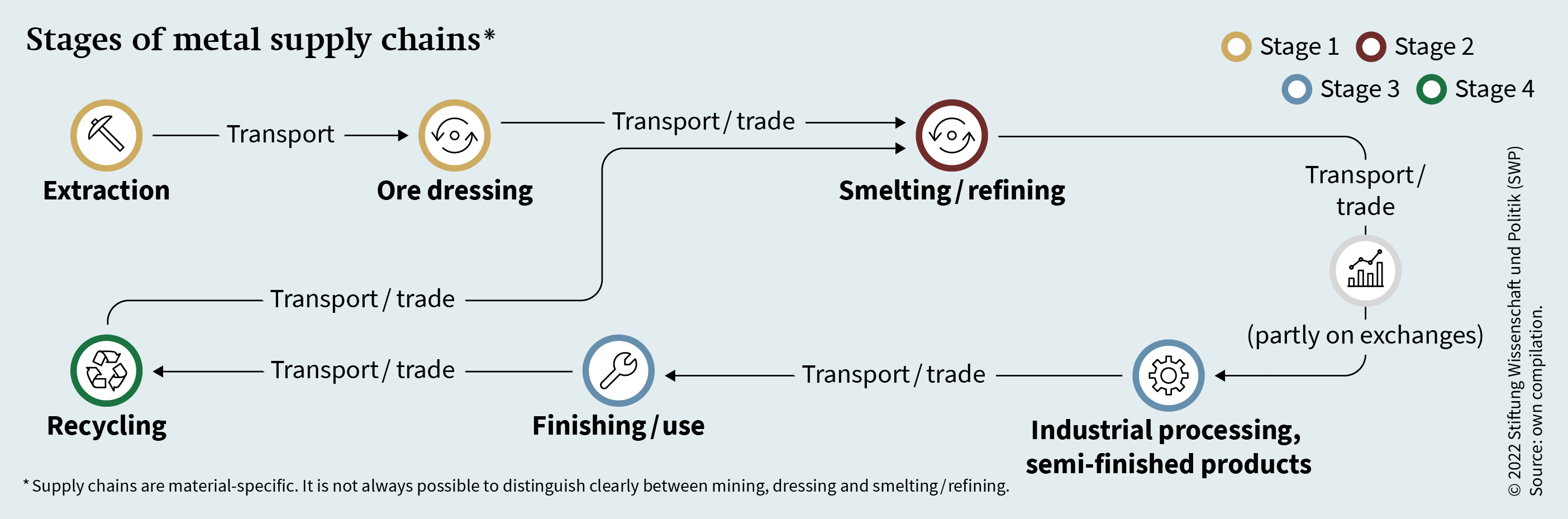
This concentration creates a risk that China could instrumentalise or even weaponise supply chains. German and European companies that are largely active in the third stage of the value chain – industrial processing – are particularly at risk. This affects Germany’s key industrial sectors, including the automotive sector, the chemicals industry, mechanical engineering, and the metals and electrical industries. They depend on metallic raw materials that are now rarely mined or processed in the EU.
European coordination in the raw materials sector
The EU has strengthened European cooperation on securing raw materials. Since 2011, it has maintained a list of critical raw materials, rooted in the EU Raw Materials Initiative of 2008. The list, which is updated every three years, is based on a comprehensive methodology for assessing criticality and focuses on raw materials that are particularly important for production in the EU. Whereas the first version contained 11 raw materials, it has grown to a total of 34 in the latest update from 2023.5 In 2020, the EU also published an action plan with concrete measures to strengthen security of supply in the raw materials sector. Political pressure to act, however, did not emerge until 2022 in the wake of Russia’s invasion of Ukraine. In January 2023, the Federal Ministry for Economic Affairs and Climate Protection (BMWK) presented a key issues paper entitled “Paths to a sustainable and resilient supply of raw materials”.6 This strategy already emphasised the need for closer coordination at the European level, with Germany seeking to join forces with Italy and France.7
In March 2023, Brussels presented the Critical Raw Materials Act (CRMA), through which the EU and its member states aim to secure the supply of raw materials to European companies. This marked the first time that the EU has taken a coordinated and strategic approach to securing raw materials, after member states had previously focused primarily on their own supply. The European Commission plays a key role, as it chairs the Critical Raw Materials Board, which is composed of representatives from the member states and is responsible for implementing the CRMA. The Act does not cover all 34 critical raw materials, but a subset of strategic raw materials – 17 materials central to the green transition, digitalisation, the defence and defence industrial base, and the space sector, and whose availability is particularly at risk due to growing geopolitical competition. The EU has set specific targets for the period up to 2030. It aims to expand the extraction, processing, and recycling of strategic raw materials in the EU, while also diversifying import sources. By the beginning of the next decade, no more than 65 per cent of any strategic raw material should come from third countries.8
Figure 2
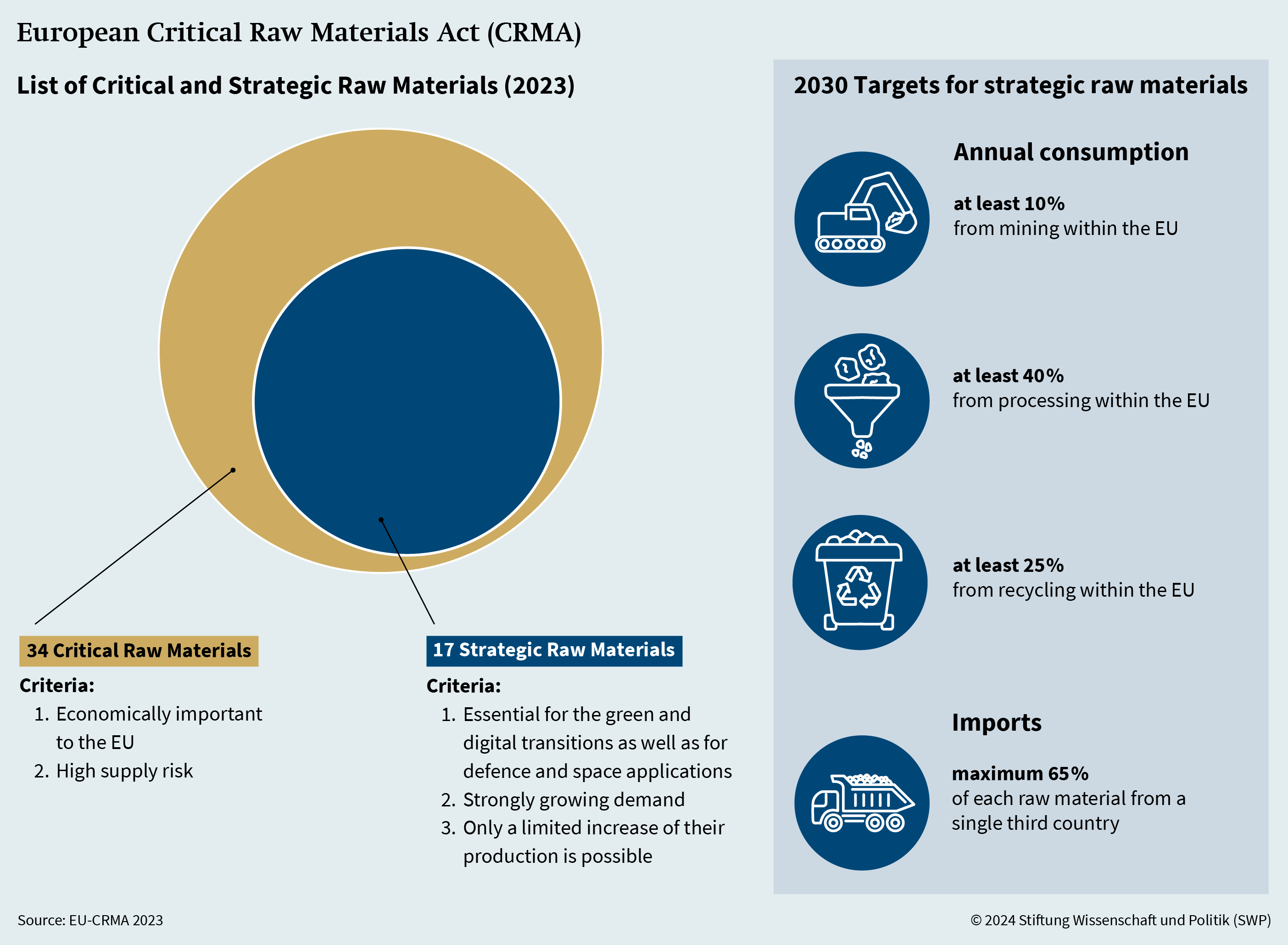
Source: EU-CRMA; based on: Meike Schulze, Security of Supply in Times of Geo-economic Fragmentation: Enhancing the External Dimension of the EU’s Raw Materials Policy, SWP Comment 15/2024 (Berlin: Stiftung Wissenschaft und Politik, April 2024), 2; see https://www.swp-berlin.org/publications/assets/Comment/2024C15/images/2024C15_SecurityOfSupply_001.png.
The European raw materials strategy: Challenges and options for action
Implementing the CRMA comes with a number of challenges for which the EU has not yet found satisfactory answers.
Revitalising mining and processing, and boosting recycling in the EU.
The CRMA’s targets are ambitious – both in terms of specific target ranges and the time frame. The first challenge is to increase extraction and processing for the relevant raw materials in the EU. The hurdles for developing new mines are already high. It can take between 10 and 20 years from exploration to the opening of a mining site, especially since some European countries have substantial bureaucratic hurdles as well as restrictive environmental and sustainability standards for such projects.
The EU now wants to accelerate the process and move forward with implementation more quickly. In March 2025, the Commission published a list of strategic raw materials projects in the EU, in line with a target set out in the CRMA. The list includes 47 projects in 13 EU countries, selected by the Critical Raw Materials Board from more than 100 proposals. The projects cover 14 of the 17 strategic raw materials, with a particular focus on raw materials for battery production.9
Civil society has reacted critically to the revival of mining in the EU.
The EU wants to support these projects with financing and in finding European buyers. In addition, the approval process is to be accelerated and should take no longer than 27 months. However, high environmental and sustainability standards are to be maintained in implementation.10 This will also be necessary because the revival of mining in the EU in particular is viewed critically by civil society. In Spain and Portugal, affected communities are already mounting strong resistance to plans to expand mining. Similar reactions are to be expected in other member states.11
The ambitious recycling targets also pose challenges. To date, the recycling rate for the EU’s 34 critical raw materials is just 8.3 per cent,12 and for rare earths it is only 1 per cent.13 Recycling is energy-intensive and therefore often costly, especially for complex products.14 In addition, many products are not designed to be easily recycled, or there is little information available about which raw materials they contain.15 Furthermore, many relevant products are not collected after use, or they are sent abroad, meaning they are not recycled in the EU,16 which must therefore significantly increase efforts in this area to achieve its targets.
The foreign policy dimension. The CRMA’s objective of diversifying supply chains through new partnerships with actors in other regions of the world also remains a challenge for the EU. While China has long been a well-established player in a wide range of countries, competitive pressure has increased further in recent years. Saudi Arabia and the United Arab Emirates have shifted their focus away from fossil fuels and towards diversifying their portfolios. Both Gulf states have recently invested more heavily in the raw materials sector in Africa and Latin America in order to expand their strategic influence and secure profitable projects.17
Up to Donald Trump’s return to the White House in January 2025, the EU could still rely on joint coordination with like-minded states in the raw materials sector and, in particular, on the supportive role of the United States. In 2022, Washington launched the Minerals Security Partnership (MSP), under whose umbrella the following like-minded partners in the raw materials sector are to cooperate: Australia, Canada, Finland, France, Germany, India, Japan, South Korea, Sweden, the United Kingdom, and the EU. The MSP set four priorities: diversifying and stabilising supply chains, increasing investment, promoting ESG (environmental, social, governance) standards, and scaling up recycling. The initiative thus became a showcase for the “friendshoring” strategy.18 During the Trump administration, this cooperation lost priority and is now set to be replaced by the “FORGE” initiative, through which the United States seeks to compete more directly with China. Germany and the EU are also key partners in this effort. However, given the administration’s strong emphasis on national interests, the extent to which this partnership will function cooperatively remains uncertain.19
Germany and the EU should therefore also create room to counteract the risks of overreliance on Western partners and to approach resource-rich countries in the Global South. These countries are also seeking to diversify their supply relationships, not least because heavy dependence on raw material exports to China has become an economic risk. They are also pursuing deeper integration into global supply chains – moving beyond their narrow role as raw material suppliers towards establishing processing industries. It is therefore a positive signal that the EU announced the ReSourceEU Action Plan in December 2025, which aims to improve the coordination of European projects and their financing. The EU must use this initiative to underpin long-term, stable raw materials partnerships.20
Involvement of the business community. The third challenge is the difficulty of bringing industry on board with diversification efforts. This is perhaps the EU’s real Achilles’ heel. As recent studies show, only a small number European companies have made genuine efforts to diversify their supply chains in the raw materials sector.21 A fundamental rethink on the part of commercial actors is needed. Many geopolitical risks have long been apparent, and there are also economic risks for companies that depend on raw material imports. This is particularly true given the high level of dependence on China. Supply disruptions could arise, for example, if the Sino-American trade dispute intensifies or tensions between China and Taiwan escalate.22 Greater diversification should therefore also be in the companies’ own interests. The aim here is to readjust the relationship between the market and the state.
Policy-makers face the challenge of intervening more strongly in supply chains without undermining market mechanisms.
There are repeated calls for the state to stockpile raw materials. However, such approaches are difficult to implement. Not only would companies have to share sensitive information with government agencies, but market interventions would also be necessary, which could lead to shortages and drive prices higher, especially if procurement were organised at the European level.23 It would also be of limited help to create incentives for corporate stockpiling, as this could have similar price effects on the markets.24 Finally, the question arises as to whether it is reasonable to expect the public sector to use tax revenues to supply companies that have not attempted to diversify, even though the geopolitical risks are well known.
Political actors have repeatedly warned of the impending dangers, but it is becoming increasingly clear that voluntary action without immediate pressure to act will not lead to the desired results. Policy-makers are therefore faced with the challenge of intervening more directly in the management of raw material supply chains without undermining market mechanisms. Cautious measures such as the imposition of concentration tariffs are already being discussed,25 but concrete details have not been provided on how these could be implemented in the raw materials sector. Another option would be to introduce diversification requirements for companies in order to actively promote the de-risking of the European economy. Any such obligations would need to be far-reaching enough to encourage companies that have so far remained inactive to diversify their supply chains. However, they must not be set at such an ambitious level that European companies end up competing against one another.26 German and European actors must engage in a discussion without ideological blinders.
Ultimately, the EU should do more to facilitate greater cooperation between European companies. Since Europe lacks large raw materials companies, the EU’s partnerships depend on bringing together those at the second and third tiers of the supply chains. These companies must be prepared to carry out additional processing in other countries or invest there in raw materials projects and conclude long-term offtake agreements. In the gas sector, joint European tenders have already been successful in this regard.27 However, there have been no efforts so far – either in the member states or at the European level – to encourage companies from different EU countries to make joint purchases or investments in resource-rich countries. Doing so is necessary to underpin EU raw materials partnerships and other resource cooperation formats with concrete offers. Greater political efforts are needed here, and national and European business and industry associations will need to play a more active role.
Further policy recommendations
The EU’s efforts to date to secure Europe’s supply of raw materials are a step in the right direction, but they are not currently sufficient. Additional measures are needed, and the EU is capable of taking them. Beyond providing further financial resources, this requires a stronger political commitment, improved European coordination, and a willingness to intervene in a more targeted manner in certain areas. A useful addition would be to create the position of a “European raw materials commissioner”. This would give Europe’s efforts a recognisable public face both at home and abroad. The German government could advocate for such a position at the European level.
At the same time, Germany and the EU should be careful not to further fuel the “race for raw materials”. That requires more sensitive language. The raw materials community is increasingly talking about a “war” or “fight” for raw materials. Such exaggerated rhetoric is inappropriate and counterproductive given the polarised geopolitical environment, especially since these narratives are noticed abroad. Within the EU, they are also not conducive to increasing the public’s acceptance of raw materials extraction. It makes much more sense for German and European decision-makers to specify the type of cooperation they are interested in – and to make attractive offers to potential trading partners.
Agricultural and Food Policy: Long Geoeconomic Tradition and New Priorities
Agriculture and the policy areas that affect it have always been significantly influenced by geoeconomic factors: For example, the spatial dimension is inherent in food production. Another factor is vulnerability: Ensuring a secure food supply, which is vital for both individuals and countries, is also a political objective. Food security is a human right that must be protected. This means that the state, as a public actor, also has an important role to play vis-à-vis market actors.
Market, power, and space: Tradition of a strong state and major technological influence
The influence of space on agriculture is a classic subject of research: According to the “Thünen model” of location theory, agricultural production is arranged in rings around a market centre1; perishable vegetables are therefore grown closer to the market, whereas grazing takes place farther away. Location factors also influence trade flows, insofar as trade and transport connect the place of production with the point of consumption. Maritime food transport routes, especially those that pass through straits, are vulnerable to disruptions and risks such as natural disasters, accidents, and conflicts. For example, the Russian attack on Ukraine rendered the Black Sea passage, which is essential for grain supplies in Africa, impassable for a long time.
Technological advances have increased agricultural productivity and improved security of supply, for example through machinery and chemical fertilisers.2 In the 1960s, the “Green Revolution”, which was also supported by development aid, enabled productivity gains in the Global South through machinery and irrigation technology, new high-yield varieties, fertilisers, and pesticides. At the same time, however, this also resulted in dependencies on the respective technology providers – for instance, for countries in the Global South on the Global North.3 A more recent example of how technology can make agriculture independent of natural location factors is technology- and resource intensive greenhouse production in Qatar.4
Agricultural production is also exposed to risks that can arise from market failures due to public goods or external effects such as positive (conservation of endangered animal breeds) and negative sustainability impacts (nitrate pollution of groundwater). Since the market is not necessarily able to regulate these effects sufficiently, government intervention is relevant to maximise welfare. Whether food security should be guaranteed as a public good by state intervention or privately through the market is the subject of many scientific studies, some of which are contradictory. Thomas Hobbes and Carl von Clausewitz already saw food security as part of – and a requirement for – political security, which is a classic public good, and therefore a task for the state.5 According to these authors, food security can also be pursued through military means, or conflicts can be decided by starving the enemy, a tactic that was later classified as a war crime under international law.6
Food security is recognised in international law as a human right in the 1966 UN Social Covenant. This establishes state obligations to protect, which also extend to conflict situations and the protection of infrastructure that enables access to food.
Overall, the state is a central actor in the agricultural and food policies of most countries, but market actors are interlinked with it: On the one hand, market and interest groups try to influence the state’s actions in their favour; on the other hand, the state relies on private actors to fulfil many of its public tasks. This can be seen, for example, in the protection of so-called critical infrastructure, which also covers the food economy in many countries. According to this approach, the state imposes security-related obligations on private actors, such as maintaining redundant systems for running the business on electricity, for example, or the duty to report on inventory levels.7
Security of supply as a central geoeconomic goal of agricultural and food policy
According to the definition of the Food and Agriculture Organization (FAO), food security has four distinct dimensions, all of which can be affected by geoeconomic activity: (1) The physical availability of food in a country, which can be based on domestic production, imports, reserves, or food aid; (2) access to food, which can be ensured logistically through appropriate market and transport structures, and economically through suitable prices and incomes; (3) usability, which includes other supplies such as energy and water as prerequisites for food production; and (4) stability over time across all three dimensions.8
Defensive objectives: Protection against vulnerability
Supplying the population has always been important for political elites, not least as a means to secure their own power: Even before and at the beginning of the French Revolution, rising flour prices repeatedly led to unrest. The Arab Spring was also fuelled by protests over high food prices.9
A common guiding principle of many governments is therefore that their country should be able to supply itself with food and be as independent as possible of food supplies from other countries.10 This focuses on the first FAO dimension (physical availability), excluding imports and food aid. The degree of self-sufficiency focuses on food availability as well as on domestic production, expressing the proportion of food produced in the country itself in relation to domestic consumption.11 In the European Union (EU), this degree is well above 100 per cent for many agricultural products such as cereals and animal products, meaning that surpluses can be exported. In contrast, the figures for vegetable oils, fruit, and nuts are significantly lower, meaning that imports are required in these areas.12
Even more pronounced supply vulnerabilities become apparent when looking at nutritionally essential components such as vitamins and amino acids: The EU has concentrated its imports of these components on a few suppliers from a small number of supply regions. If there are disruptions in supply chains or in relations with certain supplier countries, there are few viable options for substituting suppliers. The same applies to compound fertilisers, whereas the sourcing of specialised fertilisers, such as phosphate fertilisers, is somewhat more diversified.13 For the case of the EU, its dependence on the international supply of fertiliser differs across fertiliser components and is especially high for phosphate and potash. Additionally, the imports are dominated by very few supply regions, among which are Russia, Morocco, and Egypt (see Figure 1).
Offensive objectives: Political stabilisation by securing supplies in third countries
Food aid is often explicitly framed as an instrument of political stabilisation, although neither the outbreak of conflicts nor the flight from conflict-affected countries can be clearly and solely attributed to supply disruptions.14 In Russia’s war of aggression against Ukraine, Moscow was criticised for using the deliberate creation of supply shortages as a war strategy (“weaponisation”)15 by having Russian troops destroy agricultural production facilities, seize Ukrainian harvests, and make the Black Sea passage impassable for transport. Furthermore, supply-related political disputes arose as a result of sanctions; under international humanitarian law, goods such as medicines and food are to be exempt from any sanctions.16 Sanctions in force not only affect supplies for the population of the sanctioned state itself, but also potentially global supplies if a major agricultural exporter such as Russia is unable to deliver as many agricultural products as a result. Within this context, Russia accused the West of creating hunger with its sanctions policy.17 This signifies that such measures, their effects, and communication about them are caught between competing geoeconomic objectives between the West and Russia.
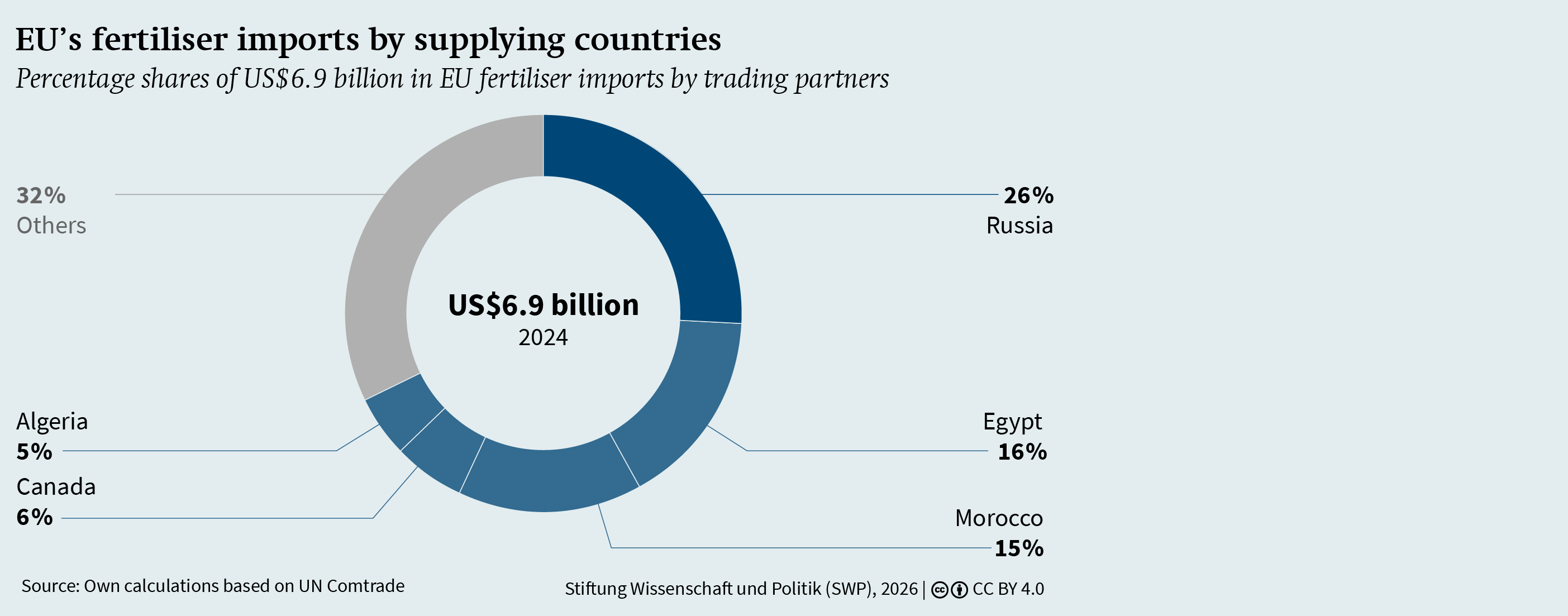
The EU is also a major agricultural exporter. With a 17 per cent share of global wheat exports in 2023, it was just behind Russia (20 per cent) and Australia (18 per cent). Its main export destinations are in Africa, followed by Saudi Arabia.18 The EU’s importance as an exporter would increase up to 23 per cent if Ukraine were to join the EU in the future, the shares of other countries rises, too, depending on an overall assessed increase of trade volume – but less (see Figure 2, p. 66).
After the Russian invasion, tensions arose between Europe’s contribution to global food supplies and environmental protection objectives. A decision to set aside agricultural land for biodiversity reasons, which was mandatory for receiving subsidies, was halted despite criticism grounded in ecological concerns.19 In the interest of global security of supply, production volumes could not be reduced.
Some geoeconomic effects may result indirectly from defensive supply objectives. Argentina, India, and China, for example, often restrict their exports in order to secure domestic supply, which in turn drives up world market prices at the expense of import-dependent countries. The EU’s agricultural policy, which in the past was strongly focused on increasing production, led to surpluses, some of which were exported and distorted international competition. Trading partners strongly criticised this practice. The 1994 Agreement on Agriculture of the World Trade Organization (WTO) attempts to curb such indirect effects by locking in commitments to reduce tariffs and subsidies and by setting requirements for their market-neutral design.20
EU agricultural and food policy over time: Back to the old narrative of food security
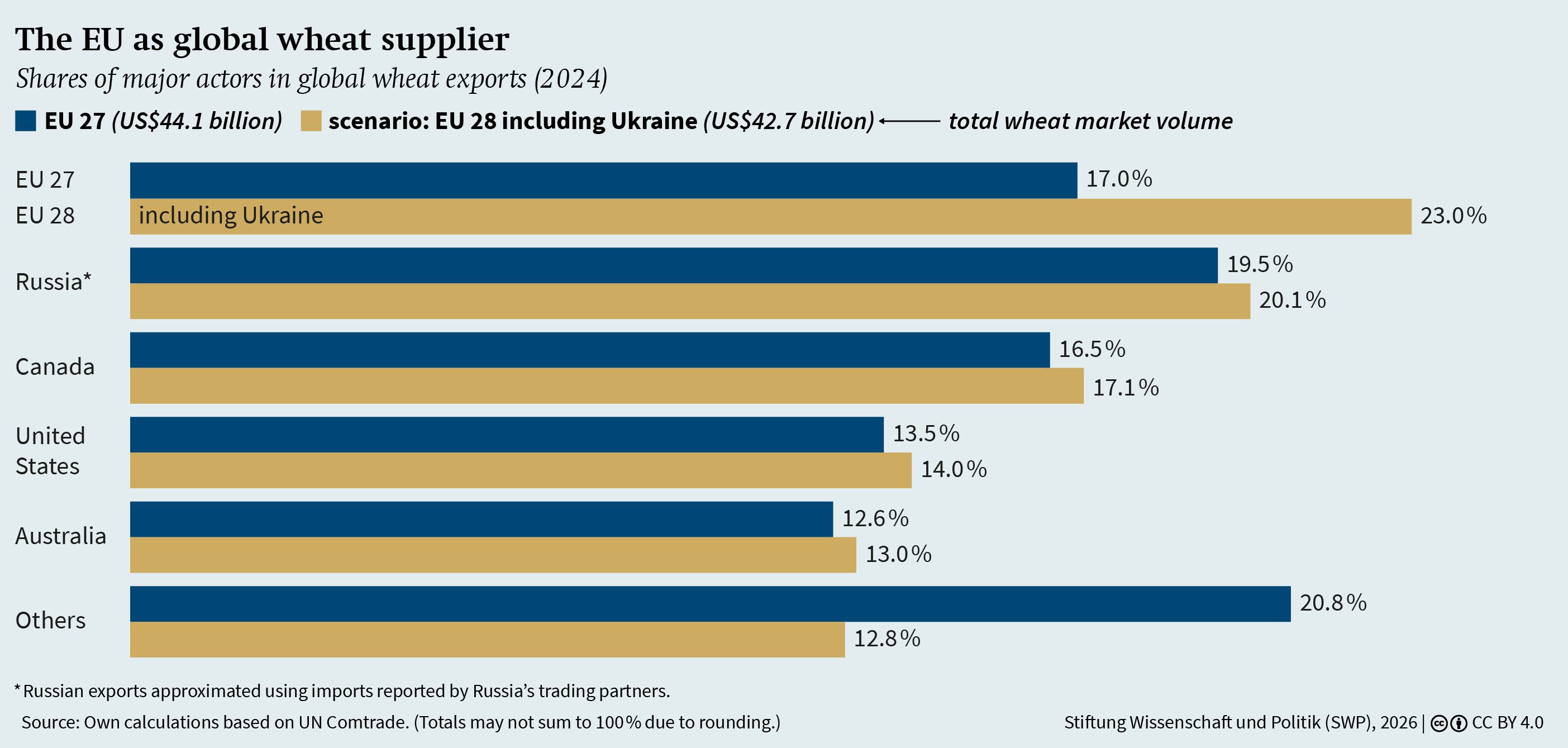
Since the Treaty of Rome in 1957, the objectives of the Common Agricultural Policy (CAP) have included ensuring a secure food supply for the population at reasonable consumer prices and increasing agricultural productivity. Since the outbreak of the COVID-19 pandemic in 2020, and exacerbated by Russia’s full-scale invasion of Ukraine in 2022, the supply objective, which has been important in the EU since the inception of European agricultural policy, is regaining significance and increasingly being supplemented by security policy objectives (Table 1).21
Agricultural and food policy has always been shaped by, and oriented towards, geoeconomic factors.
The geoeconomic dimension of agricultural and food policy is not new; it has always been influenced by or geared towards geoeconomic factors such as space, technology, and security of supply. It is not easy to clearly identify the geoeconomic effects of this policy area: Food and agricultural policy often has unintended geoeconomic side effects – such as supply risks for third parties as a result of export restrictions imposed in the interest of securing domestic supply.
However, there has been a general shift in geoeconomic priorities in agricultural and food policy over time. After the Green Revolution, for example, the focus shifted from technology (the 1960s) to security, as is currently the case in many countries as well as in the EU. An analysis of changed geoeconomic conditions, which may then lead to new and more explicit geoeconomic policy strategies than before, requires a case-by-case examination of vulnerabilities. These vary between individual product groups or food components and countries.
Geoeconomic Engagement in Global Health Policy: Towards a “Global Health Architecture 2.0” through Liberal Geoeconomics
Global health policy under pressure
Global health policy encompasses all public and private measures aimed at tackling cross-border health challenges. Multilateral cooperation in global health policy is currently being overshadowed by predominantly nationally defined foreign and security policy interests. States are exploiting health policy initiatives to expand their spheres of influence. Strategies such as vaccine diplomacy or bilateral health cooperation serve not only humanitarian purposes, but are increasingly being employed as a geoeconomic instrument.1
This turn towards power politics is creating tensions between defensive interests and offensive objectives – tensions that Germany, too, must contend with. On the one hand, it is important to secure supply chains, strengthen preparedness and responsiveness, and reduce vulnerabilities. On the other hand, the aim is to set global standards and safeguard economic interests. These trade-offs2 are putting pressure on Germany to turn a set of individual approaches into a coherent strategy.3
This requires a conceptual rethink. Two objectives should be paramount: first, to protect the population from acute and long-term health risks, and second, to ensure the stability of health-related economic interests. These objectives could be achieved in two ways: either through unilateral national action, which would disrupt the stabilisation of the global health architecture, or through cooperation that redefines global health and strengthens it through partnership.
In line with its self-image, Germany should strive for a new global health architecture, a “Global Health Architecture 2.0” which is based on partnership and horizontal cooperation, that is, co-development.4 In this context, interventions would be developed in a context-sensitive manner, together with the communities affected and in exchange with the scientific community. Investments would be understood as partnerships based on mutual benefit and equality, while respecting norms of international law.
Development cooperation and medical supply chains as levers
International development cooperation is increasingly being drawn into geoeconomic competition, with some states seeking to instrumentalise it for reasons of power politics. This also applies to global health policy, which is closely linked to the development of resilient systems and the fight against disease. Financial support is often tied to political or economic conditions. The structural power imbalance allows donor countries to use their engagement as a means of exerting pressure – for example to push through raw-materials and trade agreements, or to demand allegiance. By 2020, 11 of the 15 most important trading partners of the United States were once recipients of US foreign aid, including in the health sector.5
This instrumentalisation became particularly apparent during the COVID-19 pandemic. China pursued vaccine diplomacy by specifically expanding economic ties as part of the Health Silk Road.6 This includes, for example, support for building up institutions such as the Africa Centers for Disease Control and Prevention. Russia intensified bilateral cooperation in the health sector, for example in Uganda. At the same time, Western actors partially withdrew from multilateral initiatives such as Gavi, the Vaccine Alliance.7 This reflects the growing transactional understanding of global health, in which short-term national interests supplant long-term global health security, and it encourages a deepening of this approach.
The geoeconomic dimension of health policy, which is characterised by a return of power politics to the market,8 can be observed particularly clearly in medical supply chains. Countries with control over raw materials, active pharmaceutical ingredients, or production capacities are clearly using these supply chains (market) as a means of exerting foreign-policy pressure (power). Export controls have led to shortages of protective equipment and active pharmaceutical ingredients. The antibiotics sector is extremely vulnerable, as the production of ingredients – above all, pharmaceutical compounds (starting and supporting materials as well as active pharmaceutical ingredients) – is heavily concentrated in China.9 From a legal perspective, the distinction between legitimate protection measures and political pressure often appears ambiguous. Under international law, namely World Trade Organization (WTO) law, trade restrictions are only permissible if they are necessary and no less restrictive alternatives exist. Demands for favourable trade agreements or political support are not an acceptable reason for restricting exports of medical goods, among other things. In this way, WTO law would, in principle, counteract the increased geoeconomic use of these measures.
China uses its dominant market position in antibiotics, masks, and equipment as a foreign trade instrument to assert its foreign and security policy interests. The United States is also increasingly taking foreign trade measures in the health sector. Citing “free riding” by other countries in drug pricing, Washington announced that it would introduce tariffs.10 The aim is to ensure access to medical and especially pharmaceutical goods by repatriating production and strengthening the US health industry. Such measures put pressure on the rules-based WTO system.
Defensive and offensive instruments in health policy
The European Union (EU) and Germany have established instruments to protect their interests and pursue their objectives. Defensive measures focus on reshoring pharmaceutical production capacities and establishing strategic stockpiling systems.11 The aim is to achieve greater security of supply in the face of external shocks and to counter political influence. Specifically, the EU is promoting the expansion of local production facilities for drugs and personal protective equipment. Subsidies are intended to maintain critical capacities and to be able to ramp them up quickly in a crisis. At the same time, coordinated stockpiling of strategic medical goods such as antibiotics, protective equipment, and ventilators is being established to bridge temporary shortages.
Defensive health policy measures are reaching their financial and regulatory limits.
These measures are coming up against financial and regulatory limits, especially in the case of generic drugs. Permanent subsidies would create fiscal constraints and increase costs in health care systems that are already under strain. Higher labour costs, in turn, could jeopardise the profitability of generic drugs. Stockpiling provides only limited protection and carries the risk of artificial shortages and inefficiencies, for example due to products that have passed their expiration date.12 In addition, external developments limit the scope for action. The United States is pursuing an aggressive industrial policy in the health care sector with tariffs and reindustrialisation incentives to regain domestic capacity and influence global pricing. This poses challenges for the European health care industry.13
Offensive objectives can be pursued through institutional capacity-building, technology transfer, and regulatory harmonisation. One example is the partnership between the European Medicines Agency and the African Medicines Agency, which is currently being established, promoted by the European Commission. The latter is to base its decisions on the approval of new drugs on those of the European Medicines Agency. The World Health Organization (WHO) refers to this as “regulatory reliance”.14 Ten million euros were made available in 2024 to support this, including for training by the Paul Ehrlich Institute. In the long term, the integration of European standards strengthens regional structures and Europe’s position in the multilateral order.
Risks of fragmentation and the potential of strategic partnerships
International cooperation is essential for Germany if it wants to achieve its objectives. These include protection against pandemics and reducing external dependencies in the medical supply chain. The European strategy of open strategic autonomy should not be understood as a retreat from multilateralism. It aims to selectively reduce dependencies while remaining capable of acting within a rules-based system.
Developments in the United States reveal the geoeconomic dimension of health policy strategies. Tariffs, reindustrialisation incentives, and price regulation could increase pressure on transnational companies, many of which are based in Germany and other EU member states. Without accompanying pricing measures, there is a risk of short-term price increases for patent-protected drugs and generics. Lost revenue could be compensated for in third countries, which would undermine the stability of national health systems.
These external factors collide with an institutionally fragmented European health governance landscape. Trade policy is negotiated at the EU level,15 but drug pricing policy remains the responsibility of the member states. The fragmented market makes coherent strategies difficult and complicates investment decisions by pharmaceutical companies.
Recommendations for German and European policy
To secure medical supply chains, strengthen pandemic preparedness and response capabilities, and proactively pursue health policy objectives, Germany should push ahead with the creation of a resilient and equitable “Global Health Architecture 2.0”. This requires an integrated approach that coherently combines global health, geopolitics, and economics in the spirit of a liberal geoeconomy.16 Instead of short-term coercive measures such as trade restrictions on critical goods, liberal geoeconomic thinking relies on long-term cooperation instruments, such as health partnerships.
A core element would be increased horizontal cooperation in the sense of “co-development” with low- and middle-income countries.17 Sustainability, regional value creation, and mutual benefit would be at the centre. The targeted promotion of local generic drug production, for example in South Africa or Nigeria, could stabilise regions and advance the diversification of global supply chains. Such partnerships also increase the resilience of European health systems. Germany has strengthened vaccine production capacities in Africa through technical advice without direct financial contributions. Regulatory cooperation has helped to reform national frameworks to encourage investment by European pharmaceutical companies in Senegal, South Africa, and Ethiopia.18 In this way, Germany is helping to accelerate the establishment of the African Medicines Agency. In addition, the German government has announced a donation of €600 million to Gavi. This multilateral initiative can purchase vaccines from African manufacturers at reasonable prices and distribute them across the continent. The growth of these companies gives countries more autonomy to meet long-term needs and respond more quickly to health emergencies.
Germany and the EU should not copy the US’s aggressive measures in the health sector.
Germany and the EU should not copy the aggressive measures of the United States in the health sector. The unclear legal situation and potentially destabilising effects make such steps risky. Instead, forward-looking contingency plans are needed. This includes examining defensive regulatory options such as targeted price controls for products most at risk. In addition, temporary subsidies could be considered to cushion knock-on costs, provided that companies commit to price stability. A prerequisite is close coordination between the German government, the European Commission, and the member states on whether and to what extent such measures are compatible with EU competition law.
Instead of reshoring production and pursuing large-scale stockpiling, global supply chains should be further diversified through strategic partnerships. Such an approach would be in line with the principle of “co-development” within a “Global Health Architecture 2.0”. This would enable the joint development of new production capacities with those countries in the Global South that want to reduce their dependence on imports from China. This would ensure greater resilience on both sides and create an independent European path without reshoring and economic pressure.19
In the long term, the German government – above all the Federal Ministry of Health, the Federal Ministry for Economic Cooperation and Development, and the Federal Foreign Office – should promote initiatives that strengthen the multilateral health architecture. This includes substantially expanding Germany’s role in existing mechanisms such as Gavi and the Global Fund to Fight AIDS, Tuberculosis, and Malaria. Germany’s expertise in pharmaceutical production and regulatory processes would provide a solid foundation for exerting credible and strategic influence internationally. Consistent use of this potential would contribute to a “Global Health Architecture 2.0” that combines sovereignty, solidarity, and resilience.
For the People’s Republic of China under Xi Jinping, the space realm is of great strategic importance. According to the Space White Paper published in 2022, the Chinese space programme is intended to contribute to the economic, scientific, and technological development of the People’s Republic, help ensure national security, protect interests, and, more generally, “build up its overall strength”.1 Specifically, Beijing aims to use the programme to advance innovation, modernise its military, expand its space industry, and strengthen international cooperation in this area. For Xi Jinping, the envisaged rise as a space power is a milestone on the way to realising the “Chinese dream” of restoring China to great power status by 2049. Xi’s “space dream” (hangtian meng) is part of this overarching goal.2
The People’s Republic is aiming to become the leading space power (hangtian qianguo) by 2045. This means overtaking the current most powerful actor in this sphere: the United States, whose status is based not only on its military strength but above all on the commercial successes of private companies – a factor that plays a major role in China’s competition with the country. Unlike in Europe, where space activity (and the satellite services it enables) is usually not regarded as a strategic priority, China sees its presence in space as an essential aspect of being a major power. The country’s ambitions as a space power can be seen in the milestones to be achieved in each of the policy areas mentioned in the white paper. For example, the People’s Republic wants to develop satellites for intelligence purposes as well as anti-satellite missiles, further equip its Tiangong (“Heavenly Palace”) space station, and land a space probe on the far side of the moon. Other milestones involve the expansion of China’s space infrastructure – including an increase in ground stations – the growth of the space industry (through the expansion of satellite communication services and the BeiDou navigation satellite system, which is now in operation, as well as through commercialisation), and the development of a network of international partnerships.
These partnerships are in part interwoven with the Silk Road Initiative (Belt and Road Initiative, BRI) – the project through which China advances its economic and political interests globally. As early as 2015, Chinese scientist Shi Yinhong saw the BRI as a tool with which China was seeking to achieve its desired status as a strategic economic power. From this position, it would then be able to use its economic influence for political ends.3 China’s connectivity and infrastructure initiatives, which now also include space, are examples of how the Chinese leadership under Xi Jinping combines power and the market.4 Here, China’s goal of becoming a space power is subordinate to the larger goal of being a global power. In addition to gaining prestige, China’s presence in space also expands its military capabilities, which in turn are intended to reinforce its status as a major international actor.
Instruments and policy integration at the interface with space
The BRI is one of China’s principal instruments for elevating its global standing and projecting soft power. The BRI focuses on expanding infrastructure, opening up new markets, and improving connectivity. The Digital Silk Road (DSR) is a component of the BRI. Here, the focus is on expanding global digital infrastructure, for example through the roll-out of 5G technology, fibre-optic cables, satellite ground stations, and mobile payment platforms. The increased connectivity achieved in this way is one facet of China’s space activities, which is why the expansion of the DSR can also be attributed to Beijing’s efforts to become a space power. This connection is most evident in another component of the DSR: the project of the Space Information Corridor (SIC). The SIC is intended to strengthen internet and telecommunications connections between BRI partner countries. China’s growing space capabilities (satellites, ground stations, telecommunications systems) are to be put to use here.
Building infrastructure that serves China’s ambitions as a space power has geopolitical implications.
Developing such infrastructure – including the construction of ground stations (e.g. in Iran in 2015 and Saudi Arabia in 2016) – has geopolitical implications for China’s ambitions as a space power. Chinese ground stations abroad could be used not only for civilian but also military purposes, such as espionage or the collection of sensitive data. With the construction of a mega-satellite constellation to provide internet services, China is also attempting to challenge the global leadership position of the US space company SpaceX – a position the firm currently holds economically as well as politically through its Starlink network.5
China is also using the partnerships it has forged under the BRI and DSR to deepen economic and geopolitical cooperation in the space sector. A particular focus is on Africa, where the People’s Republic can generate path dependencies through infrastructure to open up new markets and offer space services.6
China’s space activities in Africa: Areas of engagement
Beijing has already concluded more than 20 bilateral space partnerships with African states. The corresponding agreements usually provide for the exchange of information, but also for the construction of the aforementioned infrastructure in the respective countries.
Africa offers China a suitable stage, both geographically and economically, for its ambitions to become a space power: Some regions on the equator are ideal locations for rocket launches, as less fuel is needed to reach space. A Chinese spaceport is already being planned in Djibouti and is scheduled to be completed in 2027. However, there are still some legal hurdles to overcome before it can be put into operation.7 After a 30-year period of use, the spaceport is to be transferred in full to the administration of Djibouti.
From a legal perspective, the ground stations built by China are a different proposition, as they will remain in Chinese hands even after completion, and there is a general lack of transparency regarding exactly what radar data is collected and for what purpose it is used. For this reason, third countries such as Australia, Sweden, and Chile have already terminated their cooperation with China regarding access to their ground stations.8 In Namibia, on the other hand, a Chinese-operated satellite control and monitoring station has been in place since 2001, and another centre has been built in Ethiopia.9 In some cases, the technologies were provided free of charge – Egypt, for example, has already received a satellite as well as a satellite-assembly plant.10
Given the growing number of satellites in space and the increasing integration of satellite services into modern life and defence, governments around the world are eager to develop and expand their space capabilities. China offers many African countries access to its satellite markets, allowing Chinese companies to build on existing networks. Huawei and ZTE, for example, have already taken a leading role in expanding telecommunications infrastructure in Africa – Huawei has built up to 70 per cent of Africa’s 4G infrastructure.11
Providing the infrastructure – and the resulting technological dependence – offers China options for political leverage.12 This creates an opportunity to monitor, control, or even restrict the flow of information. With the economic projects described above on the African continent, the Chinese leadership is thus expanding its geoeconomic scope for action.
The People’s Republic is also likely to have the opportunity to fill the financial shortfalls and void in power politics left by the US withdrawal from development cooperation. Here, Beijing can link the DSR and the SIC to other partners offering rapidly expanding capabilities in the space sector. Although US service providers such as the market leader Starlink are theoretically also available in African countries (agreements simply need to be reached with countries that are not yet “connected”), the costs for the services are designed for individual end users and are comparatively high.13
China’s space programme prioritises power over markets
State-initiated space activities and commercial projects cannot be clearly separated in China owing to the special role played by state-owned enterprises. The same applies to the distinction between civilian and military purposes. In this reading, China’s space programme and its use of the space domain primarily serve military interests, namely surveillance, communication, reconnaissance, and possibly the deployment of weapons systems in orbit. Like all other areas of political activity, the People’s Republic views space through a civil–military lens. This also encompasses infrastructure projects related to space, including the SIC.
Space travel and the use of space primarily serve China’s military interests.
In the case of the People’s Republic of China, the relationship between power and the market – between the economic and geoeconomic dimensions of space projects, and the rationale of power politics – must always be seen in the context of the “civil-military fusion” concept, which officially became a national strategy in 2017 with the establishment of the Central Commission for Integrated Military and Civilian Development. When analysing this programme, it quickly becomes clear that the military dimension has the highest priority: The civil and commercial sectors are expected to integrate with the military and defence-industrial base. This is intended to ensure that scientific and technological innovations simultaneously advance military development and – specifically with regard to space – that space-related technologies and investments are transferred from the commercial to the military sector.14
The “dual-use dilemma” applies across many areas of space activity. For example, satellite services often have intrinsic military uses in addition to civilian ones, without the need to modify the satellite hardware. Notably, Chinese Earth-observation satellites, which are believed to be primarily for military purposes, are particularly prevalent in the Indo-Pacific region. The data they collect can be used to monitor climate change parameters, agricultural developments, and the scale of natural disasters.15 However, they can just as easily detect troop movements and the deployment of mobile weapons systems. The US Department of Defense has already stated that the People’s Liberation Army is striving for “space superiority” because this would give it the ability to control the information sphere established in orbit and deny adversaries its use. China is aware that this is a crucial prerequisite for success in the theatres of modern information warfare.16 This requires a robust satellite network that serves military purposes. Civilian (economic) use of space is subordinate to this overriding goal.
Accordingly, China relies largely on state-owned enterprises for the development of its space programmes; private actors play only a minor role. Nevertheless, the commercial aspects of space activities are important for China, because by establishing a profit-oriented space industry, the People’s Republic can, for example, reduce the costs of space services, promote technological innovation, and create new jobs. For this reason, China opened its commercial space sector to private investment as early as 2014.17 Since then, the sector has grown and achieved some important breakthroughs (e.g. in satellite launches).18 However, due to the security-policy sensitivity of the Chinese space programme, private-sector ventures in this area remain under state control and are merely an adjunct to the state-run space industry.
Implications for Germany and Europe
European countries – and also the European Union (EU) as an increasingly autonomous space actor – should focus primarily on two measures: investing in their own capabilities and initiating partnerships on a transparent basis. Europe must expand its own scope for action and reduce its dependence on non-EU countries, such as the United States, wherever possible. It is undisputed that countries are now extremely dependent on the space-based information sphere and the services provided by satellites – civil and economic, but also military. For example, 10 per cent of the EU’s gross national product is only made possible by satellite navigation.19 Nevertheless, space-based services have long been regarded in European capitals as a nice-to-have rather than an essential service requiring investment. As a result, Europe has only scattered capabilities in orbit, has made comparatively little investment in space activities, and has only a rudimentary space strategy. As in other defence matters, the prevailing assumption was that the United States would provide the capabilities and processes.
In a highly dynamic geopolitical environment – one in which Europe’s defence architecture, resting in particular on US support, is increasingly being called into question – it is now becoming apparent that major investment gaps need to be closed. The Draghi Report of 2024 has already pointed out that over the last 40 years, only between 15 and 20 per cent of the total amount spent by the United States during this period has been invested in the European space sector.20 Therefore, an exchange of information with third countries would be of great benefit. This could also create a basis of trust for deepening cooperation in the future, such as through the expansion of the space component of the EU Government Gateway.21 The fundamental problem in Europe is that the EU itself is still in the process of building up its capabilities and, in some cases, does not have sufficient financial resources to position itself autonomously. Against this backdrop, it is also essential for the German federal government to develop a plan that clearly identifies where its own capabilities can be strengthened and where there is still room for improvement. The announced Space Strategy for Security and Defence is a first step in the right direction.
In a highly dynamic geopolitical environment, it is now clear to Europe as a space actor that key investment gaps must be closed.
In addition, the EU and its member states should develop plans to offer third countries cooperation and opportunities to present themselves as responsible partners. A basis of trust could be created by the EU providing satellite services and establishing data streams. The recently launched Africa-EU Space Partnership Programme is an important first step in this direction. The project is part of the EU Global Gateway initiative and primarily supports capacity-building – including in relation to the newly established African Space Agency – intensifies the EU-Africa dialogue, and strengthens cooperation with the local private sector.22 Compared to China’s extensive infrastructure projects, the programme seems modest. Nevertheless, it offers the EU the opportunity to present itself as a trustworthy and responsible partner.
In order for third countries to participate in infrastructure projects at a later stage, transparency, participation rights, and, where applicable, credit structures would have to be defined within the EU in such a way that Europe does not lose its strategic autonomy. In addition, European countries could make greater efforts to involve third countries more closely at the diplomatic level: Discussions on arms control and the sustainable use of space are ongoing within the United Nations. Countries that do not have their own space systems are particularly concerned with regard to, for example, space debris and the risks associated with mega-constellations. As developments in this area continue, orbit may soon cease to be a safe and sustainably manageable operating environment.
It is essential to address these concerns, for example by raising them in multilateral forums, but also by encouraging commercial actors to change their behaviour. The latter can best be achieved through legislative action by national governments. The European Commission’s draft space law, which places emphasis primarily on resilience, sustainability, and the safety of space activities, is a first milestone on the way to achieving this.23 It is also important to include nations that are not (yet) present in space, as this offers their governments a seat at the table, allows their concerns to be heard, and encourages them to behave responsibly in space24 – a posture for which China is not known, given its opaque manoeuvres and projects.
Digital and Cyber Policy: The EU’s and India’s Pursuit of Digital Sovereignty
In view of geopolitical tensions in their respective neighbourhoods, fragile supply chains, and intensifying technological competition, the European Union (EU) and India aim to strengthen their resilience and expand their scope for action. Since the military clashes between India’s and China’s armies in 2020, China – as a “systemic rival” – has become the focus of risk assessments by the EU and India. As a geopolitical actor, an alternative manufacturing location, a growing sales market, and a potential partner, India is gaining renewed relevance for cooperation with Europe. Both actors are investing in trusted infrastructure, for example in the allocation and licensing of 5G/6G spectrum, artificial intelligence (AI), and cybersecurity. In this context, India offers not only a large sales market, but also a growing technology and innovation ecosystem. This is strategically important for the EU, as it enables the Union to underpin its efforts to achieve digital and technological sovereignty. In the pursuit of digital sovereignty, geoeconomics can be understood as the continuation of geopolitics by other means.
Digital policy involves shaping the digital transformation of society, the economy, and the state. Cyber policy focuses on security and stability in the digital realm, especially in cyberspace. At the heart of both areas are technologies such as AI, cloud computing, blockchain, 5G, and the Internet of Things. Digital policy creates the enabling environment in which innovation and digitalisation become possible. Cyber policy protects that environment to ensure trust and security. Without security (enabled by cyber policy), there can be no sustainable digitalisation (enabled by digital policy) – and without digital innovation, there can be no modern security policy. India and the EU regulate information and communication infrastructures, and all applications built on them, in rder to regain sovereignty and fulfil their respective protective functions.1
In both the EU and India, a fundamental trade-off has intensified in recent years between a more open economic policy, on the one hand, and the requirements of national security and internal-market protection, on the other. As a result, efforts to achieve greater sovereignty and strategic interdependence are now gaining momentum.2 The availability of digital technologies is a key power source for the EU’s and India’s capacity to act in security and economic policy.3 This includes, above all, access to advanced hardware (e.g. semiconductor chips, and IT and network infrastructure) and software (e.g. digital platforms and apps), but also expertise in key technologies such as AI, quantum computing, and blockchain. Innovations – and the capabilities and application areas they enable – consistently increase the need for a high level of cybersecurity. These developments contribute to states perceiving digital technologies today not only as tradable goods and services, but increasingly also as sources of power, and of risk.4
For many years, the EU and India have pursued the political objective of strengthening their technological and digital sovereignty.5 Key exogenous drivers include structural conditions such as the Sino-American conflict, and regional conflicts in Asia and Europe. However, the endogenous drivers of the EU’s and India’s pursuit of digital sovereignty differ significantly. Within Europe, the EU is focusing on achieving a fully integrated (digital) single market. In its external relations, it pursues trade-policy approaches such as de-risking, re-shoring, and friend-shoring. It does so to diversify essential supply and value chains, and to broaden access to resources, in order to safeguard the stability of the digital single market.6 In view of its rivalry with China, India is also pursuing a policy of de-risking and re-shoring to become more independent from its most important supplier and, at the same time, its largest rival. In addition, India is attempting to position itself as a beneficiary of friend-shoring by European countries and the United States. In this sense, geoeconomics can be understood here as the continuation of geopolitics by means of market-policy instruments.
Digital sovereignty in comparison
The EU and India are united in their pursuit of digital sovereignty. However, the associated efforts to exercise greater political control over the market manifest themselves in very different ways. This applies both to the justification for market regulation and to the implementation of policy decisions.
The EU has attached growing importance to digital sovereignty since well before Commission President Ursula von der Leyen took office. This objective was already on the digital agenda in the 2000s, as part of the EU’s efforts to assert itself as a global actor. In order to secure competitiveness and influence in relation to digital infrastructures, data, and technologies, the EU is, in effect, pursuing a concept of “strategic dependency management”7 vis-à-vis third-country actors. In doing so, the EU is attempting a difficult balancing act, namely regulating between the Treaty-anchored openness of the internal market in the neoliberal understanding, on the one hand, and authoritative control over a possible market-distorting monopoly position held by individual companies, on the other. Nevertheless, the political ambition of the “geopolitical” European Commission has increased since von der Leyen took office, as reflected in the current Commission’s guiding principles of “open strategic autonomy” and “digital and technological sovereignty”.
Digital and technological sovereignty has also become a tenet of major industry associations in Europe.
The pursuit of digital and technological sovereignty has become a catchphrase not only in national industrial policy, but also among major industry associations in Europe. The EU’s understanding of digital sovereignty is supported internally by integrated digital markets, fundamental rights to information, as well as participation rights for citizens, and externally by the setting of global standards through new bilateral and multilateral partnerships. These dynamics reinforce one another.8 The EU is thus establishing itself as a relevant regulatory power vis-à-vis market actors from third countries by leveraging its attractiveness as an economic power and tying access to the single market to European norms – from data protection and AI ethics to cybersecurity.9
The fundamental principles of the EU single market form the basis on which Europe’s pursuit of digital sovereignty is built, both internally and externally. Four key principles are relevant here: non-discrimination, mutual recognition, the direct effect of EU law, and sanctions and enforcement mechanisms to ensure compliance with the law.10 These principles ensure that uniform rules apply to all market participants in the internal market, including in the digital sphere. In principle, this initially entails vendor neutrality, meaning equal treatment of market participants regardless of their geopolitical interests.
These principles were not called into question in the past during the transatlantic dispute over data protection and data security. On the contrary, they constituted a significant source of power for the EU vis-à-vis the United States, because major US hyperscalers – cloud providers such as Google and Amazon Web Services – depend on access to the world’s largest single market. They operate scalable IT infrastructures and services that can be used in Europe, and worldwide, particularly in the areas of cloud computing, data processing, and data storage. Conversely, they are not only infrastructure suppliers but also beneficiaries to the same extent, given their dependence on this market to maintain their business model.11
India, by contrast, has enacted only a small number of regulatory provisions in the areas of digital and cyber policy. As it is currently the fastest-growing G20 economy with strong software and outsourcing sectors, India benefits greatly from open market access and seeks global customers for IT services. In all areas of hardware and AI development, India is becoming highly dependent on China and the United States. Since 2020, the debate in India about a geoeconomic shift has gained momentum. In May 2020, deadly clashes broke out along the Sino-Indian border, reigniting a border dispute that has existed since 1962. The regional rivalry between the two countries has strengthened the importance of India’s executive branch. It is now looking for new instruments to reduce the country’s economic dependence on China, while at the same time increasing cybersecurity. After the clashes, there were political demands for the border issue to be resolved before “normal” trade relations with China could be restored. In other words, the geopolitical conflict dominates and dictates the scope for geoeconomic action. These events led India to seek closer security cooperation with a range of newer partners – notably the United States, Israel, and France – in order to diversify its defence cooperation. India is also working to encourage its strategic partners, primarily through security cooperation, to increase their engagement in the Indo-Pacific region.
In the debates about vulnerabilities arising from one-sided dependencies on suppliers, digital technologies, which invariably also have a dual-use character, play a key role in the competitiveness of economic areas. For both India and the EU, the pursuit of digital and technological sovereignty implies a new political balance between economic and security requirements in the areas of hardware, software, and AI.12
Hardware
A global shortage of semiconductors in 2020 and 2021 led to production stoppages in industries ranging from the automotive industry to medical technology and revealed how dependent Europe is on a small number of non-European semiconductor-producing countries such as Taiwan, South Korea, Japan, China, and the United States. This is why the European Chips Act was launched. The regulation came into force in September 2023 and is intended to strengthen Europe’s competitiveness and resilience in semiconductor technology. This initiative aims to double Europe’s share of global chip production to 20 per cent by 2030 – an ambitious goal given that Europe’s market share was only around 10 per cent in 2020. To this end, public and private investment of more than €43 billion is to be mobilised by 2030 to expand research capacities (as part of the “Chips for Europe” initiative), build new semiconductor factories in Europe, and enable better control of supply chains.13 The Chips Act also created a European semiconductor coordination mechanism to bring member states and industry together and enable them to respond quickly and jointly in the event of a crisis.
In addition to semiconductor chips, the hardware dimension also includes telecommunications and network infrastructure. As early as 2019, EU member states developed a 5G toolbox with the support of the EU to minimise risks from untrusted equipment suppliers – a balancing act between open markets and security interests. The exclusion of Chinese companies Huawei and ZTE from 5G/6G spectrum tenders in member states shows that the principle of non-discrimination (in principle, all providers are allowed to supply) can certainly conflict with the diverging security considerations of the member states.14 The EU is attempting to solve this problem through transparent criteria such as technical testing and diversification, so that member states can secure their critical network infrastructures in accordance with internal market law.
In the wake of the border dispute with China, India excluded Chinese companies from its 5G infrastructure.
In India, the policy process surrounding 5G infrastructure is paradigmatic of how power and markets are being rethought in digital and cyber policy. Chinese suppliers Huawei and ZTE were initially still permitted to participate in the bidding process. However, as the dispute with Beijing continued, criticism over the possible involvement of Chinese companies grew. The main fears were new cybersecurity and dependency risks.15 In the context of military escalation in the border stand-off with China, India’s Cabinet Committee on Security finally decided in 2020 to impose stricter requirements for the procurement of telecommunications equipment.16 This measure was decisive in requiring the Department of Telecommunications – within India’s Ministry of Electronics and Information Technology – to classify vendors as trusted before they could participate in the final spectrum auctions.17 Of the bidding companies, only Huawei and ZTE were not cleared, meaning that the Telecom Regulatory Authority of India could not permit the Chinese suppliers to participate in the network roll-out. The process that led to this decision reveals the strong position of the executive branch: First, it initiated the legal norms on its own, and second, it has exclusive authority to decide which Chinese suppliers are excluded from India’s 5G network.
India is also seeking to develop its own capacities in the semiconductor industry, thereby further entrenching its pursuit of digital sovereignty vis-à-vis Beijing. In 2021, New Delhi launched the India Semiconductor Mission, through which the government is promoting the construction of domestic research and manufacturing facilities.18 In terms of foreign policy, Taiwan and the United States are India’s most important partners. In 2023, the United States and India signed a Memorandum of Understanding on a Semiconductor Supply Chain and Innovation Partnership.19 As a result, leading US companies such as Micron Technology, Lam Research, and Applied Materials decided to invest in India’s market.20 India has also recently succeeded in attracting investment in Taiwan. While the US company Foxconn has so far only expressed interest, Taiwan’s Powerchip Semiconductor Manufacturing Corporation has already entered into a joint venture with Tata Electronics to manufacture AI chips in India.21 Even as decoupling from China is discussed publicly, structural dependencies on raw materials and components remain.
Software
Large online platforms, cloud providers, and data-driven services are increasingly shaping markets and society in the EU. Due to their market-dominant position, these firms occupy so-called gatekeeper positions in the internal market. Through amplification, which strengthens impact mechanisms, and microtargeting, which enables targeted influence over consumers, they can intervene deeply in the democratic processes of societies. The EU uses its competition and antitrust laws to enforce the integration policy requirements of the internal market on all market participants. As a result, the major gatekeepers of the information and communication infrastructure are becoming the focus of the EU’s regulatory requirements.22 This market is dominated primarily by US corporations, as well as Chinese providers in certain areas and a small number of European software companies such as SAP. The EU sees itself challenged to find its own path – one that promotes innovation and also defends European values such as free competition, data protection, and consumer protection. The chosen regulatory approach is primarily motivated by integration policy, in line with the principles of the internal market.
The Digital Markets Act (DMA) and the Digital Services Act are key pieces of legislation in the EU’s digital strategy.23 With the DMA, the Council has issued strict requirements in 2022 for so-called gatekeeper platforms (e.g. certain online marketplaces, app stores, and search engines) to prevent distortions of competition. For instance, these powerful actors may no longer give their own services an unfair advantage or deny access to competitors. Both legal acts reinforce the principles of the single market: mutual recognition (uniform rules throughout the EU), non-discrimination (the same obligations for all major actors, regardless of origin), and enforceability (the threat of heavy fines for violations). These platform rules ensure that European companies have fair market opportunities, and that users are protected from abuse. From a geoeconomic perspective, in which economic dependencies also appear as a security risk, strict regulation serves, among other things, to curb the dominance of tech giants in other areas of European life. Accordingly, under Article 2 of the Treaty on European Union, digital sovereignty also means that, in the European legislative process, digital spaces should be shaped not according to the terms and conditions of a few corporations, but according to democratically legitimised rules that involve civil society.
In India, the pursuit of digital sovereignty also extends to software and internet platforms that are as independent from China as possible. The Indian executive is following the logic of national security to make it more difficult for Chinese software companies to establish a presence in the domestic market. The ban on more than 200 Chinese apps in the summer of 2020 is emblematic of India’s response to the military border dispute between the two countries.24 The bans on TikTok and WeChat in particular should be understood as political messages, as they represent China’s success in the global platform economy. The banned apps include products from major, and important, digital service providers such as Alipay, whose licence was also revoked on grounds of “sovereignty and integrity […], defence capability […], security of state and public order”.25 India blocked Chinese apps again in 2025, signalling to domestic consumers and the government in Beijing that Chinese software is considered untrustworthy. These measures differ from India’s past reactions to China in that they are less protectionist and more clearly motivated by security considerations.
Artificial intelligence
AI is regarded as one of the key technologies of the 21st century. The United States and China currently have a significant lead over the EU in this area.26 Europe is pursuing a dual strategy in the geopolitical competition: It wants to foster innovative AI development while also establishing clear rules to ensure that AI is deployed in accordance with European values. In doing so, the EU faces criticism that European AI regulation could be detrimental to AI innovation in Europe. However, others argue that these specialised, sector-specific approaches could create market leaders in areas such as health and environmental technology.27
The EU is “exporting” its vision of ethical AI: transparency, non-discrimination, and human oversight.
With the AI Act, the EU created the world’s first comprehensive legal framework in 2024 to regulate this (potentially) disruptive technology. This legislative package is built around a risk-based approach: Depending on the area of deployment, graduated requirements apply. AI associated with unacceptable risks (such as AI systems used by the state for social scoring, or manipulative practices that can cause serious harm to people) is prohibited throughout the EU.
Since 2023, Europe has been positioning itself not only internally but also externally as a global norm-setter through the EU’s inclusive policy-making processes for the AI Act.28 From the outset, the EU has incorporated its ethical requirements for AI (human-centred AI) into the relevant bilateral and multilateral dialogues at the United Nations, the Organization for Economic Co-operation and Development, and the Council of Europe. In this way, it has been able to shape global processes for establishing norms. While other economic areas are still debating the issue, the EU has taken early action and established concrete precedents, as global companies will have to align their AI products with EU standards if they do not want to exclude 450 million potential consumers. In this sense, the EU is “exporting” its vision of ethical AI – namely transparency, non-discrimination, and human oversight – to other regions. This gives it soft power and influence in global technology governance.
In parallel with legislation, the European Commission has established initiatives such as the AI Innovation Package and test environments (sandboxes) to promote the development and deployment of trustworthy AI. The aim is to turn “Trustworthy AI made in Europe” into a seal of approval for product safety. Strict regulation in a large market (e.g. California) can lead companies worldwide to adopt higher standards in order to maintain market access (the “California effect”). In this respect, it can be assumed that higher AI product standards go hand in hand with a competitive advantage because users and companies prefer AI solutions they can trust. The EU’s early agenda-setting was largely motivated by the requirements of the Charter of Fundamental Rights and primary law rather than economic considerations. In recent years, only a few generative AI-supported language models – known as large language models (LLMs) such as Llama and Mistral – have been able to gain a foothold in the European market. DeepL’s translation service is a good example of this.
India, like the EU, cannot keep pace in AI development with the global heavyweights of the United States and China. However, in recent years it has become the second-largest country of origin for open-source models, just behind the United States. India has recently presented its AI ambitions and vision to the world as the 2026 host of the AI Impact Summit. Nevertheless, no Indian company has yet been able to create an LLM capable of competing with ChatGPT or DeepSeek, for example.29 With the launch of the India AI Mission in early 2025, the government initiated a national programme to make India a leading nation in the development and deployment of AI.30 The stated objective is to design its own models and become independent of LLMs from other countries, especially China. However, with only about US$1 billion invested in its AI research and development, India risks falling even further behind its archrival China, which claims to have invested US$137 billion.31 In February 2025, India’s Ministry of Finance also prohibited its employees from using ChatGPT and DeepSeek.32 Beyond this measure, India’s approach to AI is not explicitly geoeconomic; it is better understood as navigating digital sovereignty. In doing so, the country also wants to further differentiate its partnerships with Western countries. In February 2025, it hosted an international AI summit together with its close partner France, and it has recently agreed on greater cooperation with countries such as the United States and the United Arab Emirates. Here, India is primarily interested in secure supply chains and foreign direct investment.
Outlook
The EU and India share the conviction that they can remain relevant locations for the production of high technology by jointly advancing their digital location policy through bilaterally coordinated labour-market and growth potential. Both India and the EU see their pursuit of digital autonomy and digital sovereignty as a framework for increasing their economic and market power in geopolitical competition.
The greatest difference lies in their divergent risk assessments based on security-policy considerations. In India’s case, government intervention in the market is more strongly motivated by national-security imperatives. According to this logic, the market is to be steered pre-emptively so that new uncertainties do not translate into fresh volatility for the digital economy and trade.
The EU, on the other hand, is attempting to diversify unilateral dependencies on key resources and supply chains through its economically motivated ex post de-risking in order to reduce existing vulnerabilities for the internal market. At its core, this is about optimising market conditions in accordance with the contractually defined constitutive principles of the internal market. Major legislative packages such as the Digital Compass 2030, legal acts including the European Chips Act, the DMA, and the AI Act, as well as numerous toolboxes, underpin the EU’s ambition to become a global leader in a “human-centred” digital economy.33
A central forum for bilateral coordination between the EU and India is the EU-India Trade and Technology Council (TTC), which was established in 2023. In February 2025, both sides agreed on specific areas of cooperation to create more interoperable digital infrastructures and enable the mutual recognition of electronic signatures for cross-border digital transactions.34 In semiconductor development and telecommunications, the EU and India intend to cooperate on chip-design research. In addition, a cooperation agreement was concluded between the EU’s 6G Smart Networks and Services Industry Association and India’s Bharat 6G Alliance.
The cooperation projects illustrate how technological innovation and research are being promoted as part of a strategic dependency management in areas where the EU and India can develop their own competitive advantages in response to the growing strategic rivalry between the United States and China, without having to choose sides. Admittedly, the starting points for digital policy differ: on the one hand, the EU’s liberal, principles-based internal-market logic; on the other, India’s geopolitically oriented, ambitious digital and cyber policy. The joint initiatives on security- and confidence-building norm-setting processes in the United Nations can be important starting points for safeguarding multilateral institutions.35
Currency Power Politics in a Dollar-Dominated World: China, the EU, and Central Bank Digital Currencies
The purpose and task of monetary and exchange-rate policy is to safeguard the internal and external value of money and, in a broader sense, to promote macroeconomic stability. Past experience has prompted the majority of G20 and OECD countries to enshrine central bank independence in constitutional law to protect monetary policy from political influence. Contrary to what is sometimes suggested from an economic standpoint, however, monetary policy is not an exclusively technocratic domain. In fact, beyond their economic functions, money and currency also have political and foreign policy dimensions.1 Money supplies and the monetary and currency systems are not only economic matters; they are also inherently geoeconomic factors.2 This is particularly true when a national currency is in demand beyond the country’s borders and is used, for example, for payments, investments, or reserve holdings. The widespread international use of a currency gives the government of the issuing country geoeconomic leverage to act and shape policy.
Currently, the most important trend in the international financial system is its rapid digitalisation. In this context, liberal geoeconomics – which is conceptually based on technological progress, digital networking, and transnational interdependence – provides a theoretical basis for analysing the global role of money.3 When a dominant currency is deployed on international markets for geoeconomically motivated purposes, currency policy becomes currency power politics.4 Examples of this include the exploitation of extraordinary financing advantages, the stabilisation of friendly states in times of crisis (or the targeted destabilisation of enemy states in the event of conflict), and the use of financial sanctions (against state and non-state actors).5
The global monetary order is constituted and shaped by rules, conventions, institutions, and actual events on the international financial markets. The dominance of the US dollar is striking.6 However, the long-term trend is for the United States’ weight in world trade and the global economy to decline, especially as doubts about the reliability of US monetary and exchange-rate policy grow. US administrations have repeatedly used the dominance of the dollar assertively for geopolitical purposes.7 Third countries are vulnerable to US currency power politics. This even applies to the European Union (EU) and China, although both have internationalised currencies of their own in the euro and the renminbi (RMB), without either approaching the dollar’s position. One response by these actors, driven mainly by geoeconomic motives, is the project of central bank digital currencies (CBDCs). The principal aim of these initiatives is to strengthen and enhance their own monetary sovereignty by using technology.8
Against this backdrop, this contribution takes a comparative look at the foundations, objectives, and instruments of the currency power politics of Europe and China – whose currencies are increasingly competing with the US dollar as international payment and reserve vehicles – and attempts to answer the following questions: What differences, constraints, and scope for action can be identified in the currency policies of China and the EU, and how does the respective relationship between financial markets and state power affect the currency power politics of Europe and China? Finally, what does a policy of active currency support look like, using the CBDC project as an example?
China and the EU as actors in currency power politics
In the international monetary order, individual currencies can be ranked according to the frequency of their use (as a means of exchange and payment, as a store of value, and as a unit of account). Within the resulting currency hierarchy, the euro and the RMB occupy different positions. The euro is the second most important currency in the world after the US dollar. Compared to these two currencies, the RMB’s scope of use and influence is modest. At the end of the third quarter of 2025, despite losses, the US dollar still accounted for 56.9 per cent of all global foreign exchange reserves, whereas the euro accounted for 20.3 per cent and the RMB for 1.9 per cent.9 The dollar also continues to dominate trade, foreign exchange transactions, and the issuance of debt securities. The euro occupies a stable second place here, while the RMB accounts for only a very small share of these transactions.10
The euro’s position has remained relatively stable for many years, whereas the RMB is on a dynamic growth trajectory.
One feature that the RMB and the euro share is that they are currencies whose international use is limited to certain regions. However, there are major differences in terms of their development in the international currency hierarchy. The euro’s position has remained relatively stable for many years,11 whereas the RMB is experiencing dynamic growth, particularly as a currency for trade settlements.
Institutionally and politically, the two currency areas – that is, the areas in which the euro and renminbi circulate as means of payment – are structurally very different. China is a centralised state geared towards safeguarding the Chinese Communist Party (CCP) political system and its hold on power, whereas the EU, as an actor with little centralised political authority, consists of 27 sovereign states – only 21 of which are part of the monetary union. Accordingly, their respective currency power politics look very different. Whereas China has clear geopolitical ambitions and pursues economic and currency power-politics objectives that are aligned with these ambitions, in Europe political diversity and the multitude of growth models undermine the ability to formulate and implement a coherent policy aimed at further internationalising the euro.12 Another difficulty is the large number of actors in the EU involved in the process, and the need to distinguish between supranational, intergovernmental, and state-level actors.
With the exception of the European Commission’s initiatives to strengthen the international role of the euro, EU policy remains passive in this regard.13 The reason is that, within a monetary union, the costs and benefits of internationalising the single currency would be distributed unevenly. Germany’s stance as the largest member has been of considerable importance in this regard. Even in the early days of the single currency, there were concerns that the euro could appreciate as a side effect of its growing international use, which would make German exports more expensive.14 In addition, an increase in the currency’s international significance also implies a need to involve the central bank in stabilisation measures.15
In contrast, China’s principal monetary authorities are actively promoting the internationalisation of the RMB.16 The motives of the People’s Republic are manifold. The ability to trade, to make purchases, payments, and investments abroad in RMB, to take out RMB-denominated loans for that purpose, or to issue RMB-denominated bonds would save China’s citizens, companies, and corporations considerable costs and risks, especially currency risks. It would also reduce the pressure and burden on the state to hold foreign exchange reserves (and to bear the associated exchange-rate risks). Potentially, the Chinese economy could gain macroeconomic stability and fiscal resilience and generate seigniorage revenue abroad. Geoeconomically, the internationalisation of the RMB gives China the opportunity to safeguard and expand its monetary and fiscal policy sovereignty (defensively) and to reduce existing vulnerabilities vis-à-vis the United States. Offensively, Beijing seeks to expand its own scope for action and capacity to shape outcomes in the international financial and monetary order (at the expense of the West), and to reshape the global system in ways that are more compatible with the structures of China’s one-party state. Since the founding of the People’s Republic, money and currency have been core elements of politics and political power. The country’s own currency, the renminbi – the “people’s money” – is a cornerstone of China’s state sovereignty, identity, and nationalism. The People’s Bank of China (PBoC), which as the central bank is responsible for monetary policy, is loyal to the CCP and its ideology.17
However, a consistent internationalisation of the RMB would entail economic costs and political risks for China’s political leadership. Liberalising cross-border capital flows would be critical. Full convertibility of the RMB would entail considerable risks to the internal stability of the People’s Republic that would be politically unacceptable. Given the formation of bubbles in the real estate sector and the large number of distressed companies and over-indebted local government entities, crisis scenarios are conceivable in which China’s main financial and monetary policy authorities lose control of exchange rates and financial markets as a result of capital flight. The legitimacy of the CCP as the guardian of stability and prosperity would be called into question. For political reasons, therefore, the decisive step towards convertibility is not being taken. As a result, the RMB does not play the role on the global financial and currency markets that would be commensurate with China’s economic weight.
Compared to the Chinese currency, the euro is convertible and operates in an environment characterised by strong legal certainty, the rule of law, and market transparency. Despite the existence of a highly integrated single market, the capital markets, which are central to the international role of the currency, are highly fragmented. Although the European Commission has been making intensive efforts to integrate this sector, at the latest since its 2015 announcement that it would advance a Capital Markets Union, progress in this area has been limited.18 The same applies to the cross-border payments market, where attempts have been made for many years to reduce dependence on US companies. These cases illustrate how difficult it is for the EU, with its fragmented decision-making processes, to implement policies that are in line with market logic. If EU policy followed this market logic, a more deeply integrated capital market would offer potentially enormous advantages, for example through lower costs for raising private capital for investment or lower borrowing costs. The political costs of overcoming the interests of national governments and economic authorities, as well as legal and linguistic barriers, are proving to be too high. Yet closer integration of EU financial markets would help European financial institutions play a more important role in the global economy. In an EU Capital Markets Union, European banks and financial institutions could consolidate, better position themselves in global competition, and more readily withstand challenges to their market position from platforms or cryptocurrencies.
Table 1 summarises (and in some cases supplements) the key aspects of China’s and the EU’s currency power politics in comparison.
Central bank digital money as a new theatre of currency power politics
The process of digitalisation is having an enormous impact on the way international financial and economic relations are shaped. It is manifesting itself in the development of digital financial services and innovations such as cryptocurrencies, stablecoins, and CBDCs. The creation of digital currencies by central banks is driven by geoeconomic factors, primarily the desire to strengthen their own monetary sovereignty.19 The development of digital currencies and the associated infrastructure in Europe and China is a response to heightened awareness of dependence on the US dollar at a time when the United States is further expanding its power in the markets. From the perspective of national monetary authorities, the greatest advantage of a CBDC is that it can serve as an instrument for controlling the issuance, management, and regulation of the domestic monetary system. This sovereignty is increasingly threatened, among other things, by private actors that create payment platforms, cryptocurrencies, or stablecoins.20
Geoeconomic factors are driving central banks to create digital currencies.
A central bank digital currency has the potential to revolutionise monetary policy in terms of technology and economic policy. Modern technologies not only make it possible to process payments securely in real time across borders and over long distances, but also to programme money using technologies similar to blockchain. In this way, transfers could hypothetically be linked to conditions, specific purchase purposes, or limited by region or time.
This would also be a revolution in terms of the efficiency of tax administration and the arsenal of instruments available to combat financial crime. Traditional currencies are often closely tied to a specific geographical area. The euro and the RMB are also means of payment with a strong regional concentration. Their CBDC variants create new opportunities for expansion and competition in the digital space. However, there are significant differences between China and Europe in terms of both the ambitions and development status of their digital currency projects.
China and the EU are actively pursuing projects to issue CBDCs, which are at various stages of development. Interestingly, the United States took a different path after Donald Trump’s election.21
With the “GENIUS Act of 2025”, the Republican majority opted to prioritise the development of stablecoins integrated into the traditional financial system.22 The fact that the United States is focusing on the fastest possible growth of the domestic stablecoin market – at the expense of financial stability – not only shifts the potential for regulatory conflicts between the EU and the United States to the sphere of digital currencies, but also jeopardises the EU’s monetary sovereignty, and potentially its financial stability.23 Although a collapse of US stablecoins would likely have fewer repercussions for the Chinese economy than for Europe’s, indirect negative consequences in China – for example in Hong Kong – cannot be ruled out.
For the time being, the ambitions of Europe’s digital euro project are severely limited by the requirements that deposits in the digital euro be capped at around €3,000 per person and that the option of making it programmable has been excluded. Compared with China, progress towards a CBDC in Europe remains very modest (Figure 1). The PBoC began work on a CBDC back in 2014 and has since accumulated a wealth of practical experience with digital RMB payments.
Outlook: Digital currencies as a theatre of geoeconomic action
The global monetary order is clearly undergoing profound transformation. The rapid digitalisation of the financial sector and growing scepticism towards the US dollar are opening up a new theatre of geoeconomic action.
For the time being, the US dollar remains the dominant currency due to market inertia and the lack of credible alternatives.
The dominance of the US dollar is being challenged by the declining importance of the United States in trade and international commodity markets and dwindling confidence in US economic and, above all, fiscal policy. It is uncertain whether the dollar and US financial policy will continue to play a stabilising role in a future financial crisis. To be sure, the rapid development of stablecoins pegged to the dollar could strengthen the dollar’s standing, but it also carries the risk of a financial crisis that would further undermine confidence in the US currency and related assets. For the time being, the US dollar remains the dominant currency due to market inertia and the lack of credible alternatives. However, the dollar’s primacy is being eroded by America’s declining importance in international markets, declining confidence in the US currency, the Trump administration’s economic policy, and – above all – US debt sustainability.
However, due to their respective weaknesses – the lack of an integrated European capital market and the incomplete convertibility of the RMB – the euro and the RMB have little opportunity to expand their role as investment and reserve assets. The scope for an active currency power politics therefore remains limited. Neither Europe nor China can achieve the financing advantages currently enjoyed by the United States, nor can the euro or RMB be deployed geopolitically as flexible instruments for cross-border financial transactions. For the time being, Europe and China can only seek to expand their strategic autonomy in monetary matters, reduce existing vulnerabilities, and strengthen their international positions.
Monetary policy-makers around the world encounter a twofold challenge: First, they must respond to the declining dominance of the dollar; second, they must safeguard their sovereignty in the face of the growing popularity of private payment platforms and the rise of privately issued currencies. This poses a particular challenge for the EU, whose economy is much more open than China’s. The EU single market benefits from financial innovations but is also exposed to their negative effects, which require regulatory measures.
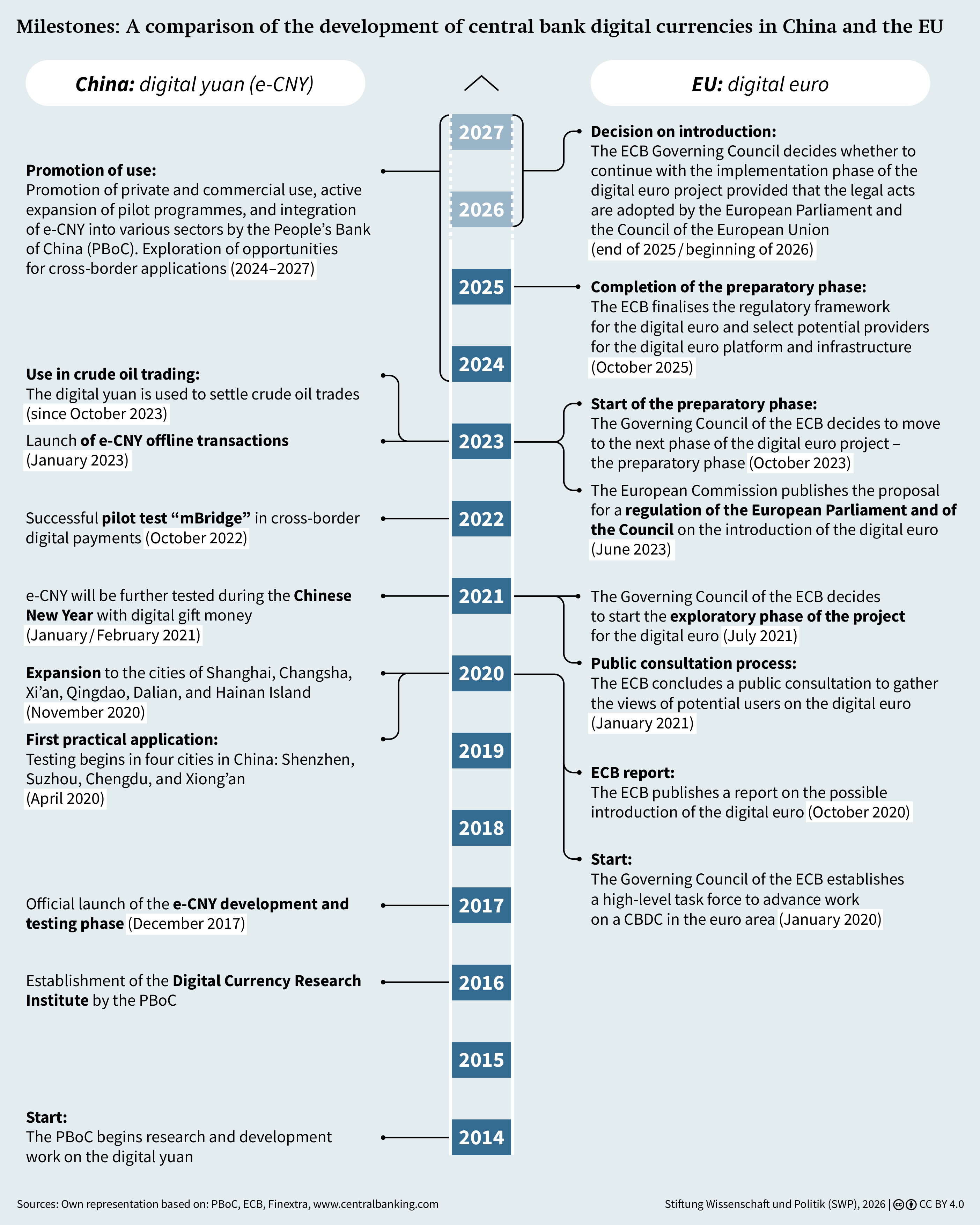
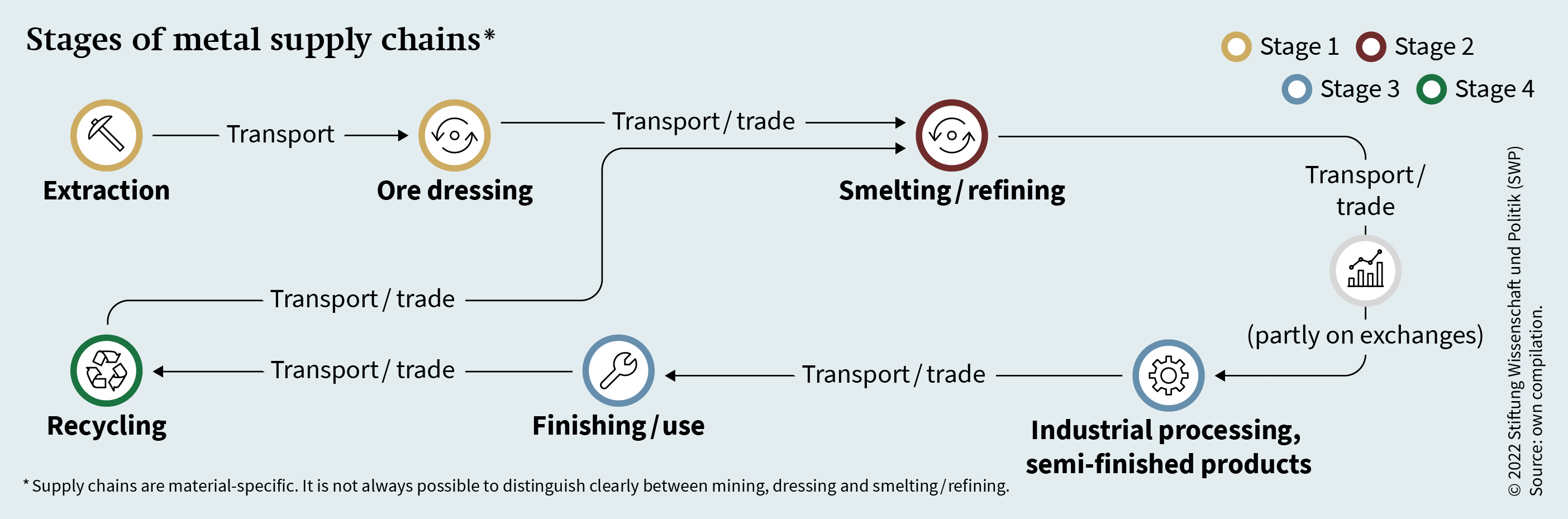
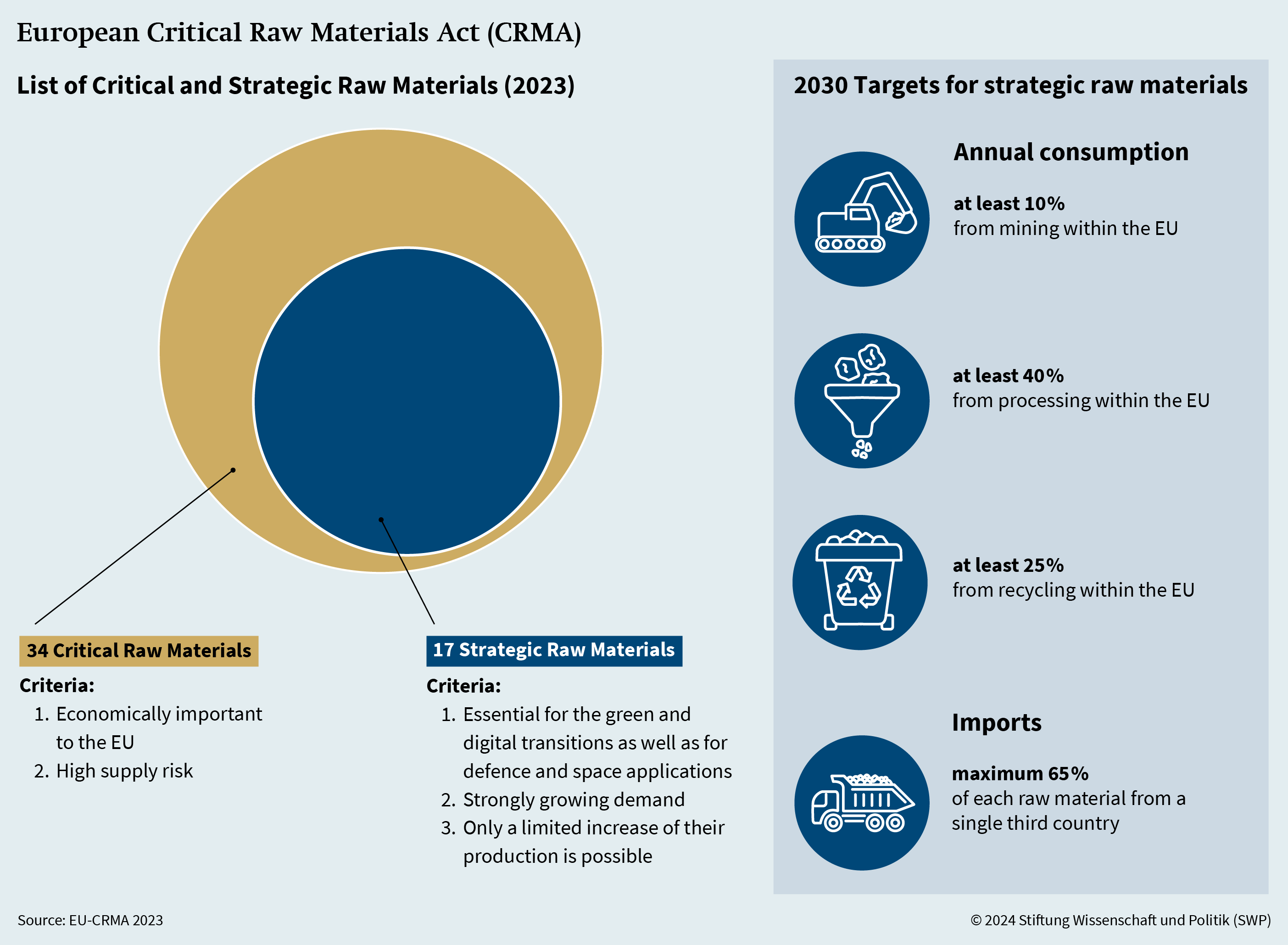
In this context, the EU should set the following priorities: protecting data, maintaining credibility as a regulatory authority, and preserving economic openness. In particular, the importance attached to the protection of personal data could give the EU a competitive advantage. In contrast, China is likely to use the digital yuan as a tool to control, monitor, and oppress its own population. Above all, however, China’s digital RMB is intended to expand its fiscal and monetary policy options; give the country a leading role in foreign and industrial policy in the development of digital cross-border payment systems; and create options for action against future Western financial sanctions.
Monetary policy-makers around the world encounter a twofold challenge: First, they must respond to the declining dominance of the dollar; second, they must safeguard their sovereignty in the face of the growing popularity of private payment platforms and the rise of privately issued currencies. This poses a particular challenge for the EU, whose economy is much more open than China’s. The EU single market benefits from financial innovations but is also exposed to their negative effects, which require regulatory measures. In this context, the EU should set the following priorities: protecting data, maintaining credibility as a regulatory authority, and preserving economic openness. In particular, the importance attached to the protection of personal data could give the EU a competitive advantage. In contrast, China is likely to use the digital yuan as a tool to control, monitor, and oppress its own population. Above all, however, China’s digital RMB is intended to expand its fiscal and monetary policy options; give the country a leading role in foreign and industrial policy in the development of digital cross-border payment systems; and create options for action against future Western financial sanctions.
It should also be noted that strengthening national currency sovereignty can succeed only if it is aligned with the expectations of global financial markets. These expectations extend not only to full convertibility of a currency, but also to whether efficient market institutions exist, whether there are liquid capital-market instruments, and whether risks can be assessed on the basis of adequate access to information. Monetary and exchange-rate policy measures that run counter to market logic can only have a limited effect on increasing the relevance of a currency in the global economy. Therefore, the limited convertibility of the RMB is likely to continue to limit the role of the RMB in the future. The fragmented capital market and the barriers of the internal market are likely to stand in the way of a growing international importance of the euro.
The rank of the euro and the RMB in the international currency hierarchy – and, consequently, the ability to exercise currency power politics with these two currencies – will ultimately depend on the extent to which Europe and China succeed in overcoming the structural obstacles outlined above. Europe’s advantage is that internationally active investors, in their efforts to diversify, are more likely to place their trust in the rule-of-law framework, institutions, and transparent systems of the Old Continent. China’s advantage lies in its centralised political system and the political leadership’s active, strategic, and purposeful efforts to reshape the international monetary order in line with its own preferences.
How Off-Balance-Sheet Fiscal Agencies Can Expand Fiscal Space to Finance Geoeconomic Challenges
The contributions in this research paper make it clear that the Federal Republic of Germany is increasingly confronted with new geoeconomic challenges, which entail greater financing requirements. So far, defence policy has become a driver of profound fiscal policy changes. A pioneering instrument was created in June 2022 with the Bundeswehr Special Fund. It marked the beginning of a new phase in which targeted exceptions to the debt brake enshrined in Germany’s Basic Law were made possible in order to address the geopolitical challenges posed by Russia’s war of aggression against Ukraine. After the 2025 federal election, the next step followed, namely the decision to exempt defence spending from the debt brake as a matter of principle. However, these measures address only some of the geoeconomic challenges facing Germany and Europe. The other contributions in the second part of this research paper show that there is a considerable need for action in many other areas, such as raw materials security, energy policy, and digital sovereignty.
The fiscal ecosystem offers scope for financing the response to geoeconomic challenges.
With regard to geoeconomic practice, fiscal policy serves as the material basis for other areas of government action in which “economic means are used to achieve political goals”.1 Only with the appropriate fiscal resources can security, foreign, and economic policy challenges be effectively addressed. Fiscal space is found not only in the core budgets, but also in “off-balance-sheet fiscal agencies”.2 Special funds such as those for the German Armed Forces are one example, but development banks such as the Kreditanstalt für Wiederaufbau (KfW) and municipal energy utilities also fall under this category. Together, the core budgets and off-balance-sheet fiscal agencies form a “fiscal ecosystem” that has evolved over time and now comprises tens of thousands of distinct entities.
In order to meet geoeconomic challenges, off-balance-sheet fiscal agencies can play an important role alongside core budgets – an issue that has so far received little attention in the debate. The following section therefore begins by providing an overview of the fiscal ecosystem in Germany, including the wide variety of off-balance-sheet fiscal agencies at the federal, state, and municipal levels. It then outlines and discusses two proposals for how fiscal space in foreign and security policy could be expanded through off-balance-sheet fiscal agencies. Finally, it considers possible trade-offs in terms of fiscal sustainability and systemic financial stability.
Off-balance-sheet fiscal agencies in Germany’s current fiscal ecosystem
Figure 1 provides a schematic overview of Germany’s current fiscal ecosystem, the types of off-balance-sheet fiscal agencies, and what characterises them. The figure lists 72 different entities that form part of the fiscal ecosystem that provides the fiscal space needed for financing the measures to address geoeconomic challenges.
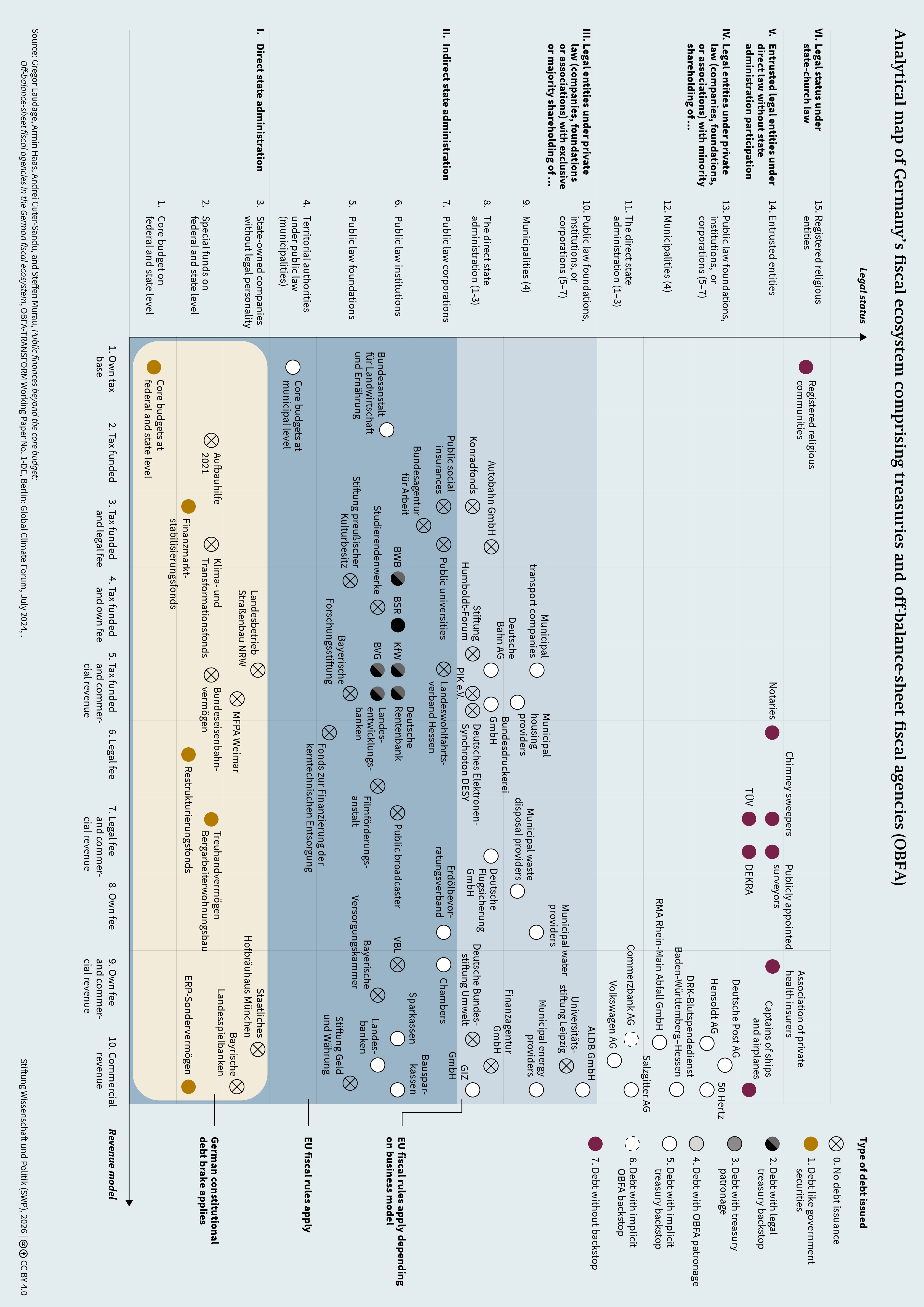
The categorisation framework has three dimensions: an institution’s legal status, its revenue model, and its ability to take on debt. The reference point is the core budgets of the federal and state governments, which have their own tax bases and can borrow on the capital market.
First: legal status. This dimension builds on an understanding of German administrative law. The individual levels are positioned on the vertical axis in such a way that their placement reflects their proximity to, or distance from, the core budgets of the federal and state governments. The lower a level is positioned, the closer it is to the core budgets. The lowest category (Category I) comprises the direct state administration, which includes the core budgets; the next one (Category II) comprises the indirect state administration. Category III includes legal entities that are wholly or majority owned by institutions in Categories I or II. Category IV includes minority holdings of institutions in Categories I or II. Category V includes legal entities under private law that are not publicly owned but perform public tasks. Finally, Category VI comprises religious communities under public law.
Second: the revenue model. This dimension also shows the proximity or distance from the core budgets on the horizontal axis. Category 1, on the far left, comprises institutions with their own tax bases. Categories 2 to 5 include institutions that are financed by funds from the core budgets. In Category 2, this is the sole source of revenue. In Categories 3 and 4, levies are added, which are specified by law in Category 3, but in Category 4 they are determined by the institutions in this category themselves; in Category 5, the budgetary funds are supplemented by the institutions’ own business income. Categories 6 to 9 include institutions that are financed through levies. In Categories 6 and 7, these levies are set by law. In Category 6, these levies are the sole source of revenue, whereas in Category 7, they are supplemented by business income. In Categories 8 and 9, the levies are determined by the institutions themselves. In Category 8, these are the sole source of income, whereas in Category 9, they are supplemented by business income. Finally, Category 10 includes institutions that are financed exclusively through business income.
Third: borrowing options. The extent to which entities can borrow is represented by different types of circles. Institutions in Category 0 cannot borrow, while institutions in Categories 1 to 7 can incur their own debt. In Category 1, the debt securities of the institutions are identical to those of the core budgets. In Category 2, these are secured by the core budgets through guarantor liability. In Category 3, they are backed by a letter of comfort issued by the core budgets; in Category 4 by a letter of comfort issued by other off-balance-sheet fiscal agencies. In Categories 5 and 6, the guarantee is only implicit – that is, without an explicit legal claim – through the core budgets (Category 5) or through other off-balance-sheet fiscal agencies (Category 6). Finally, Category 7 comprises institutions whose debt securities are not guaranteed. Whether an institution can take on its own debt does not necessarily indicate its proximity to, or distance from, the core budgets. Although special funds, for example, are closest to the core budgets, some of them can incur debt while others cannot.
These three dimensions illustrate the complexity of Germany’s fiscal ecosystem. In particular, they show that the distinction between state and market entities is by no means binary, but that the transition from power to market (and back) is gradual. The logic of action that governs an entity therefore does not depend solely on whether it is organised under public or private law. Instead, what also matters is the precise mandate defined for an entity. In this respect, off-balance-sheet fiscal agencies may well be suitable vehicles for financing geoeconomically defined objectives.
A further aspect that appears in Figure 1 also plays an important role here, namely the extent to which off-balance-sheet fiscal agencies are subject to the scope of legal debt brakes. First, this concerns the debt brake enshrined in Germany’s Basic Law. It follows a legal logic according to which the legal structure of an entity alone determines whether it falls under the debt brake. Specifically, all entities within the direct state administration are included, regardless of their revenue model. Second, this concerns the fiscal rules of the European Union (EU). These follow an economic logic under which limits are placed on the public deficit, regardless of an entity’s legal form. This is based on the statistical rules of the European System of Accounts. On that basis, EU fiscal rules apply to all entities within the direct and indirect state administration. In the case of legal entities that are wholly or majority owned by the direct or indirect state administration, whether EU fiscal rules apply to them depends on their revenue model. If they generate most of their revenue on the market, this is not the case.3 This applies, for example, to Deutsche Bahn AG, which is not subject to EU fiscal rules. Autobahn GmbH, on the other hand, is subject to them, even though both institutions belong to the same legal category (Category 8) as federally owned corporations.
The entities shown in Figure 1 are all illustrative examples and are by no means exhaustive – the total number runs into the tens of thousands. In addition to the 17 core budgets at the federal and state levels, there are 10,753 municipalities and 106 independent cities, as well as 294 counties. The number of special funds of the federal and state governments is just under 200, which is still quite manageable. However, the number of publicly owned companies is in the order of 20,000, of which 16,000 are owned by municipalities. The most important of these companies operate in the energy supply, water management, and public transport sectors.
Off-balance-sheet fiscal agencies as a means of pursuing geoeconomic objectives
The starting point for the following considerations is the need to rethink economic and fiscal policy in order to meet the geoeconomic challenges associated with the return of power in the global economy.4 The main question here is to what extent off-balance-sheet fiscal agencies can be used to manage financing tasks and expand fiscal space. These objectives can vary widely – ranging from state support for energy infrastructure, to the financial underwriting of risks in trade policy, or the long-term rearmament of the armed forces. The coordinate system in Figure 1 makes it possible to consider different institutional arrangements.
In principle, it is a recurring historical phenomenon that, when states are confronted with major financing tasks, they create new off-balance-sheet fiscal agencies to expand their fiscal space. To stay with the example of defence financing, several hundred off-balance-sheet fiscal agencies, such as the Darlehnskassen (loan funds), were already an essential part of the German war economy during the First World War.5 The best-known German off-balance-sheet fiscal agency associated with the Second World War was arguably the Metallurgical Research Company (MEFO), a shell company used to covertly finance German rearmament. This financing had to be concealed because it violated the Treaty of Versailles.6 On the other side of the Atlantic, too, it was an off-balance-sheet fiscal agency that helped the United States finance public investment in the early 1930s, and thus work its way out of the Great Depression. During the Second World War, this Reconstruction Finance Corporation contributed significantly to war financing, and it was not dissolved until the post-war period.
If off-balance-sheet fiscal agencies are now to be used to finance geoeconomic objectives, the question likewise arises as to what form of institutional arrangement within the fiscal ecosystem would be appropriate. These could involve either existing entities or ones that would need to be created.
A first option would be an entity within the indirect state administration, constituted as a public-law foundation, public-law institution, or public-law corporation, with the right to incur debt. Since this debt would not be subject to Germany’s debt brake, this entity would have greater fiscal space than the core budgets or special funds. However, its debt would be subject to European fiscal rules. The extent to which these rules would restrict the entity’s fiscal space would depend on the assessment of the public sector’s total debt. In some situations, the room for manoeuvre may be very narrow; in others in may be considerably greater. Assessing borrowing leeway requires a wide margin of discretion due to the complex underlying methodology.7
A second example could be an entity structured as a private-law entity, exploiting the hard-to-define grey area between the market and the state, which is difficult to grasp, in order to avoid being subject to European fiscal rules. To achieve this, it would either need to be majority-owned by the public sector and financed through the market, or else be held by the public sector only as a minority stake. Both alternatives would face considerable challenges. In the case of majority ownership, the question arises as to what the relevant market would look like and who its non-state customers might be. In the case of a minority stake, it would be necessary to clarify who the private majority shareholders of such a company could be, and how its business model and risk-return profile would have to be designed in order to be attractive to private investors. Such arrangements could also appear questionable in terms of political and constitutional propriety, and it would require broad public support and parliamentary majorities.
In addition to greater fiscal space, off-balance-sheet fiscal agencies would offer the opportunity to pool specialised technical expertise. Many geoeconomic issues require the close integration of expertise in foreign, economic, technological, and security policy. A topic-specific structure could strategically bring these competencies together across departmental boundaries. This could, for example, make a targeted contribution to geoeconomically relevant technological development.8 In the longer term, this could help establish an institutional framework that complements rather than replaces existing ministerial responsibilities. Such an institution could operate more flexibly and innovatively, enable more cooperative financing models, and strengthen cross-departmental capacity to act.
The question of fiscal sustainability: Funding in the financial system
The use of off-balance-sheet fiscal agencies to finance measures for addressing geoeconomic challenges should not come at the expense of the stability of public finances. This danger is not unfounded. In fact, the above-mentioned expansion of the monetary and credit system ended – in both world wars – with a severe destabilisation of Germany’s public finances. However, as the financial crisis of 2008 showed, a fundamental breakdown in the monetary and credit system does not necessarily have to be preceded by a lost war.
Institutional diversity should be harnessed for governance and financing purposes, while keeping the fiscal ecosystem stable.
So, what determines whether a given level of indebtedness – not only of the core budgets, but of the entire fiscal ecosystem – is fiscally sustainable? The approach taken by existing debt rules is to strictly limit new borrowing (as under the constitutional debt brake) or to set a debt ratio (such as the reference value of 60 per cent of gross domestic product according to the Maastricht criteria). These are stopgap measures designed to prevent excessive debt, but they are not sufficient to ensure fiscal sustainability. In practice, the crucial point is whether and how the debt securities issued by the entities within the fiscal ecosystem can be placed and refinanced in the financial system. This is the question of “funding”.9
Whether debt securities can be funded depends not only on the supply side, but also on demand within the financial system. Public debt securities also fulfil an important function as a public good for financial institutions. They serve as safe investment instruments on which private households, banks, and institutional investors are heavily dependent. In the euro area in particular, there has long been a shortage of such safe assets, which makes Germany’s role as an issuer particularly relevant.
Funding debt is a complex political and macro-financial management task that cannot be resolved solely through ex ante targets. It must take into account both supply- and demand-side factors. In Germany, there are specialised institutions such as the German Finance Agency for this purpose. It works with the Bund Issues Auction Group, which comprises those credit institutions that purchase newly issued federal securities on the primary market and then resell them on the secondary market. The Finance Agency offers federal securities with different maturities in order to meet varied investment preferences on the demand side. These long-established structures all serve the objective of ensuring the sustainable funding of public-sector debt. Whether market participants consider the debt of off-balance-sheet fiscal agencies to be equivalent to the debt of the core budgets will depend on the credibility and transparency of their institutional design.
Conclusion
A closer look at the fiscal ecosystem reveals the complexity of government financing structures, which are far removed from the highly abstract notion that public finances relate exclusively to the core budgets. The large number of off-balance-sheet fiscal agencies shows how different institutional arrangements can help to expand fiscal space in order to strategically pursue geoeconomically motivated objectives. Against this backdrop, in its future fiscal and economic policy the federal government should approach indebtedness within the fiscal ecosystem not exclusively as a deficit problem, but also as a powerful policy lever. The key here is a willingness to move away from simplified budgetary narratives, take institutional diversity seriously, and use the fiscal ecosystem constructively to address geoeconomic challenges.
Conclusion and Recommendations
Hanns Günther Hilpert and Sascha Lohmann
The starting point for this research paper was the conceptually vague use of the term “geoeconomics” in politics, economics, and applied research.1 Gone are the days when a German federal president felt compelled to resign after speaking in an interview in favour of protecting free trade routes with military force if necessary – a statement that drew heavy cross-party criticism.2 In contrast, the current discourse is sometimes couched in an overly martial rhetoric that portrays markets as battlefields in a global economic war, in which economic decoupling and the withholding of technology are being wielded as weapons. Behind this noise, however, a paradigm shift is taking place. It is characterised by the fact that considerations of power politics are increasingly permeating market-based exchange relationships, shifting the relationship between power and the market. David Ricardo’s theory of comparative advantage – as guiding rationale for maximum specialisation in the international division of labour – is coming under increasing fire.3 The rules-based international order is losing its appeal, and an interregnum is emerging between declining interdependence and ascending polarity. The economy is seen less as an engine of social prosperity and more as a material prerequisite for state power.4 This transformation is taking place across different regions and countries, where it is fuelled by their respective traditions.5 What is new about this geoeconomic Zeitenwende is the high degree of interconnection and interdependence that distinguishes today’s globalised world from earlier eras, posing entirely new challenges for German and European foreign and security policy.
The contributions to this research paper make it clear that the return of power politics to the market is much more complex than a supposed decline of the trading state and its replacement by a resurgent national security state. As an ideal-type, a trading state secures national prosperity and world peace through global trade. Its primary task is to create favourable conditions for investors and to enable the country’s comparative specialisation advantages to be realised to the greatest extent possible. However, this can no longer be the priority of a security state, for which national interests come first. Where necessary, international economic and financial relations must be disentangled, and interventions abroad may be required to protect (or even advance) national security interests. In any case, this ideal-typical separation between economy and security was never empirically quite so strict. Whereas the trading state, for example, guaranteed freedom of foreign trade and secured absolute profits within the framework of rules- and norm-based cooperation, security considerations have always played an important role as grounds for exceptions.6
For globally active companies, the operating conditions have shifted fundamentally. Globalisation and technological change do not exempt private-sector actors from state regulation, nor do they lead to a global market in which goods, capital, services, and labour are traded freely and seamlessly. Instead of the “twilight of sovereignty” – as proclaimed by former Citibank Corporation CEO Walter B. Wriston in the mid-1990s – globalised markets are increasingly being instrumentalised for foreign and security policy objectives. In turn, the free-market logic of global production and supply chains is being shackled by national security considerations, particularly by the United States and China, but also increasingly in the European Union (EU).7 In this process, the separation between public (government) and private-sector (market-oriented) interests is increasingly dissolving. Companies must take political requirements into account and, where necessary, implement them.8
The return of power politics to the market has an existential impact on the German economy, which is dependent on exports and free trade. The autonomous decisions and actions of German foreign trade actors, which are geared towards profit-making, are increasingly subject to the provision that they must not jeopardise Germany’s economic security or political sovereignty. Considerations of power politics are increasingly restricting the free play of market forces, and with each geopolitical escalation spiral, the number of trade barriers, such as tariffs and licensing requirements, continues to grow. However, the desired increase in political autonomy and economic security comes at the expense of the prosperity gains that can be achieved in foreign trade.
This geoeconomic Zeitenwende, as a potentially disruptive transformation, poses a considerable challenge for the EU and its member states. Responding to this transformation – not only by increasing resilience, but also by actively shaping it – requires first and foremost a willingness to change foreign trade policy priorities, if not the underlying paradigm of free trade itself. Although the toolbox available to state actors for market intervention was purposefully expanded in the wake of the COVID-19 pandemic and Russia’s war of aggression against Ukraine, the economy as a resource of power alongside military force and diplomacy was given only declaratory attention at best. Josep Borrell, High Representative of the Union for Foreign Affairs and Security Policy at the time, called for the EU to “learn the language of power”9 by deploying the economic potential of the single market, but this was followed by few concrete actions. Thus, the EU’s “geopolitical awakening”10 has so far largely amounted to a retreat from its claim to be a “normative power”.11 This shows that the ideational resources for geoeconomic action – an approach that does not treat power and markets as two separate spheres, but consistently combines them and acts accordingly – have for too long gone untapped, especially in Germany.12
Policy recommendations for Germany and Europe
This research paper provides practical guidance and actionable knowledge at a time when foreign and security policy decision-makers in Germany and Europe are being called upon with increasing urgency to assume greater international responsibility.13 The authors of the individual contributions trace the increasing frequency and intensity with which economic and technological instruments are deployed across various policy areas to pursue economic and security-policy objectives, and they draw a number of concrete conclusions for their respective fields of action. Building on these insights, three overarching recommendations for geoeconomic action by the German government are formulated below. These concern:
|
1) |
the establishment of inter-agency structures, |
|
2) |
communication and coordination with relevant stakeholders from business and academia, and |
|
3) |
cooperation with like-minded countries and international institutions. |
Establishment of inter–agency structures
Geoeconomic action is an inherently cross-cutting task. It requires inter-agency structures within the executive branches at the EU and member state levels so that the domains of economic policy and foreign and security policy – still largely separated along departmental lines – can be subjected to a joint assessment and situational review. New methods such as a national risk analysis should be introduced and applied at regular intervals in order to create a joint situational assessment across individual departments, which could serve as a basis for geoeconomic action.14 Complementing this, future developments of geoeconomic relevance should be systematically anticipated through strategic foresight and, in particularly critical cases, thought through in scenarios and (simulation) exercises such as “war gaming”.15 Economic and technological instruments that have been deployed should continually be evaluated as a matter of routine – both in terms of their intended and unintended effects as well as their effectiveness. In Germany, the transformation of the pre-existing Federal Security Council into a National Security Council in early May 2025 created an institutional structure that is, in principle, well suited. It now needs to be further developed in light of the growing infusion of power politics into international economic relations. Ideally, the National Security Council should be vested not only with the necessary coordination powers, but also with decision-making authority.
To facilitate more efficient and effective inter-agency coordination and networked geoeconomic thinking and action, the relevant legal and administrative frameworks should be amended and bureaucratic processes made more agile. Currently, for example, the German government has only limited powers and instruments at its disposal to directly influence private-sector companies through regulations, restrictions, or prohibitions. Their cross-border activities are protected by the constitutionally guaranteed freedom of foreign trade. This freedom is restricted only for the purpose of controlling military and civil-military goods and certain overseas investments. In this context, the existing security and precautionary legislation is of particular significance from a legal perspective. It empowers the government – after a respective emergency declaration by the German Bundestag (Verteidigungsfall, Spannungsfall, Bündnisfall, Zustimmungsfall) – to intervene extensively in the economy, food supply, water, postal and telecommunications services, and transport; this applies where “supply difficulties cannot be overcome by market-based means”.16 In the energy sector, extensive state intervention – through price controls such as “caps” or “price brakes”, as well as expropriations – are already permitted in the event of a crisis in order to ensure security of supply.
An amendment to the Foreign Service Act and the Foreign Trade Act should create positions tasked with geoeconomic activities in all career tracks and improve them continuously through institutionalised professional development, training, and further education. The Federal Foreign Office in particular would assume a platform function in such a networked approach. This means that staff, especially at senior level, should lead and steer diverse networks from business and civil society, rather than merely consulting (with) them.17 Beyond close exchanges with different interest groups, such “geoeconomic diplomacy”18 should also be able to draw on a large pool of personnel. These individuals could rotate across departments in various positions and perform a wide range of tasks, for example in the departments of defence, finance, economics, health, or digital affairs.
In addition to these structural measures, the National Security Strategy should be further developed conceptually and operationally.19 The use of economic instruments should be specified in more detail and linked more closely to the relevant strategies at the EU level. The implementation of the European Economic Security Strategy, as set out in the coalition agreement, should be guided by the objective of applying economic measures more coherently, both domestically and externally. Analogous to the use of military force, a doctrine should be formulated that specifies the conditions under which defensive and offensive economic instruments – such as export and investment controls or screening and restrictive measures within the framework of the Common Foreign and Security Policy (CFSP) – would be deployed.
Communication and coordination with relevant stakeholders
Geoeconomic action is a task for society as a whole, and the business and academic communities must also play their part in addressing it. Resilience and resistance can hardly be prescribed. To achieve them, various actors from politics and business must work together, competently supported by a academic community that is willing to search for theoretical insights and practical solutions in a multidisciplinary manner. This requires formats for close – and, where necessary, confidential – exchanges of ideas and experiences.20 Beyond the narrow focus on profit maximisation, what is needed first and foremost is a changed mindset in business, but also in politics and society. Similar to Finland, for example, economic resilience and defence preparedness must be given the same high priority as sustainability.
The EU and its member states’ policies in the geoeconomic domain require close cooperation with private-sector actors. Individual companies and their respective business associations must be involved in this process. In terms of legislation and public administration, these policies depend on sound and reliable information. To this end, established exchange formats should be further developed – for example, hearings conducted as part of parliamentary legislative processes or administrative procedures. For geoeconomic measures to be implemented effectively, policy-makers must secure support and acceptance within the private sector. For business, national security considerations can be an undue burden, as they jeopardise (in the short term) commercial profitability and competitiveness. It is therefore not enough to take market-based incentives into account when designing regulatory measures. Instead, profitability must be safeguarded, for example through suitable exchange formats that enable short-notice adjustments. Geoeconomically oriented policies stand the greatest chance of acceptance if they are aligned as closely as possible with the recognised principles of the social market economy.
In view of the geoeconomic constraints of the present, the following general recommendations apply:
-
Entrepreneurial freedom of decision-making and action in foreign trade should only be restricted to the extent that is absolutely necessary for security reasons. Measures to ensure security of supply and protect critical infrastructure and technology should only be taken if they are unavoidable, or urgently necessary, to protect the state and the population.
-
Defensive and offensive instruments of geoeconomic action should be geared solely towards the security objective. They should not be mixed with other objectives such as industrial policy, environmental and climate policy concerns, or economic stimulus measures. Separate instruments are needed to achieve these objectives.21
-
Government measures should, as far as possible, be framed in general terms, for example in the form of diversification quotas or concentration tariffs. Direct interventions in the business activities of firms engaged in foreign trade should only occur in exceptional cases. Protective measures aimed at ensuring security of supply should be limited to the small range of goods and sectors that, firstly, cannot be substituted in the short term; secondly, are directly relevant to consumption; and thirdly, would generate negative externalities in the event of a supply failure.22
-
Risks for profits and of loss in foreign trade lie with investors, not with the state, even where losses are geopolitically driven. Admittedly, the state can mitigate risks ex ante and help initiate business deals through investment guarantees, co-financing, and political intervention. However, the business risk and the associated geopolitical risk are borne solely by investors. Risk assessment and risk-taking are a business responsibility.23
These general considerations may be useful when it comes to establishing the legal authorities, institutional structures, and administrative processes necessary for closer cooperation between the state and business. But in individual cases, complex trade-offs must always be made. This also means carefully reassessing opportunities and risks as well as benefits and costs. Based on an integrative approach, risks, incentives, and resilience should be considered together. This makes it possible to examine different options for responding to production and supply-chain risks, such as stockpiling, maintaining reserve capacity, industrial-policy subsidies, or even relocation closer to home (nearshoring). These analyses should contribute to systematic learning, which must be promoted and utilised through sustainable knowledge management in the public administration.
However, learning is particularly necessary in the private sector, as geoeconomic thinking and action have not been regarded as part of the remit of companies operating globally to date. At best, owner-operated companies were interested in factoring geopolitical risks into their decision-making, since these can quickly become existential threats. As a rule, taking geopolitical interests into account reduces turnover and profits. The pursuit of returns and profits and competitive pressure ensure that national economic security is only partially priced into the calculations of companies, if at all. Economic security is a public good; from a business perspective, it therefore seems rational to expend as little effort as possible on preserving national security. This is especially true when competition forces cost reductions and companies start hoping to be rescued, through government support if necessary. To some extent, politicians can counteract this through appeals to companies active in foreign trade to fulfil their responsibility to the domestic economy and society. Geoeconomic free riders should be made aware that such conduct entails reputational risk.
Instead of relying solely on voluntary action by companies and their global division of labour, diversification requirements and limits, for example on imports, should be specified and calibrated in such a way that market-based incentives remain effective.24 This requires mechanisms that make it possible to arrive at reliable assessments. However, restrictions or enhanced due diligence and documentation requirements are hardly sufficient to meet the demands of government regulation in a geoeconomic Zeitenwende. Beyond that, the costs of geoeconomic decisions, such as higher prices for domestically produced goods, should be made transparent and thus more comprehensible.25
Such a rethinking is not only needed in the business sphere, but also in academia. The still dominant – and ultimately damaging – trend towards increasing specialisation within academic disciplines would need to be slowed and, in part, reversed. For the silo mentality that accompanies it reduces engagement between social science disciplines, especially between political science and economics. Transdisciplinary approaches are needed to explore geoeconomic thinking and action in an applied manner. That would support the aim of overcoming the conventional separation between political science, economics, and law.26 It would also be advisable to resurrect geoeconomic knowledge (from oblivion) that was developed in the first half of the 20th century in (non-)university research facilities in Germany and other European institutions. However, this would require that the contributions in question be historically scrutinised and contextualised to avoid association with discredited ideologies.
International cooperation
Defensive geoeconomic action aims to manage and contain risky foreign and security policy dependencies – and the resulting vulnerabilities – within foreign trade relations. Some interdependencies should be tactically limited or even dismantled. Others, on the other hand, should be strategically promoted in the interests of balanced risk diversification and structured according to politically relevant categories such as partners, rivals, and adversaries.27
China and the United States, in particular, are aggressively using geoeconomic instruments to pursue foreign policy and foreign trade objectives. The EU, by contrast, justifies its use of measures such as sanctions primarily on defensive grounds, for example to deprive Russia of important resources for its military aggression against Ukraine, or on normative grounds, to uphold sustainability, human rights, and non-proliferation standards. On the one hand, the EU would therefore have much to gain from cooperation with non-European market-based democracies. On the other hand, it would have little to fear from more intensive foreign economic and technological interdependence.
Even in the eyes of potential partner countries, the EU is a far more attractive partner than the United States or China, which often act arbitrarily in the pursuit of power politics. A carefully coordinated diversification strategy would bring greater economic security for all parties involved. For example, the EU, the United Kingdom, Canada, Australia, Japan, South Korea, and Taiwan could liberalise their trade, investment, and technology policies among themselves internally while harmonising them externally, increasing their resilience in the long term. At the same time, foreign trade cooperation with the ASEAN countries, Mercosur, Mexico, and South Africa poses hardly any geoeconomic risks for the EU and could, on the contrary, improve economic security. Examples would include coordinated stockpiling of critical goods, common standards for the development and implementation of protective measures, or even an alliance against geoeconomic challenges posed by third parties. At the bilateral level, existing exchange formats among like-minded G7 partners should be expanded. The most obvious avenues for this would arise primarily in relation to their respective economic security strategies, which are still largely defined at the national level.28
Germany, as an exporting nation, and the EU, as a trading power, must strike a balance between the freedom of foreign trade on the one hand, and foreign and security policy-driven regulation on the other. This includes a reconciliation of private-sector profit-seeking with societal requirements such as security of supply. To manage this balancing act, it could be helpful to define – together with partners outside the EU – certain principles of economic statecraft in a formulated doctrine, according to which the use of the respective instruments would be guided. Unlike the elaborate doctrines governing the use of military force, equivalents for the exercise of economic power still need to be developed.29
Not least in order to lend greater legitimacy to power politics in international economic relations, the use of economic and technological instruments should be placed on a firmer, more rules-based footing. The exceptions for national security interests commonly enshrined in international treaties and intergovernmental agreements open up a broad grey area in which the application of economic measures such as sanctions and export controls has so far largely been able to evade effective regulation. In this context, proven procedures (best practices) could be systematised, and voluntary commitments (soft law) could be used as models (such as the Helsinki Final Act of the Conference on Security and Co-operation in Europe) to justify invoking relevant exceptions for the protection of economic and national security.30 To avoid losing sight of the need to civilise international relations in this geoeconomic Zeitenwende, the still nascent discussion on how geoeconomic action could be more strongly aligned with “responsible”31 or “positive”32 objectives should be enriched by European and German contributions. Economic and technological transformations – including the return of power politics to the market, as examined in this research paper – are characterised by an inherent tension between interdependence and polarity, which, as “conflicting or even competing” lines of development, will likely continue to shape international politics in the future.33
Afterword
Hanns Günther Hilpert and Sascha Lohmann
This research paper presents the results of the SWP thematic working group Economic and Technological Transformations. In its 2024/2026 research orientation framework,1 the German Institute for International and Security Affairs (SWP) has defined four thematic areas in which regional and functional expertise is pooled over a three-year period with the aim of analysing politically urgent and fundamental issues of great complexity across research groups and deriving practical recommendations. The thematic working group Economic and Technological Transformations2 focuses on the comprehensive changes brought about by disruptive economic and technological change, which may provide both constraints and opportunities for German and European policy. Economic and technological change are well-known phenomena in themselves. What is new and noteworthy is the breadth, diversity, and interconnectedness of the associated transformational processes, which currently unfold alongside them. The changing nature of globalisation; a global economy that is becoming increasingly fragmented due to shifts in economic centres of gravity and the increasing instrumentalisation of foreign trade; rapid advances in cross-cutting digital technologies; and growing requirements such as the decarbonisation of an economy still dependent on fossil fuels – all of this poses new and complex challenges for German and European foreign and security policy. The overarching research objective is therefore to develop a better understanding of these transformative developments, identify cross-cutting links between individual processes, elaborate on their respective significance for operational policy, and outline practical solutions.
The main topics of the thematic working group include the securitisation of the economy, including security of supply and migration; the role of digital technologies and cyberspace in shaping security arrangements; and the actions of state actors deploying defensive and offensive instruments across areas as diverse as trade, capital flows and payment transactions, technology, energy, and health. A key trend within the economic and technological transformations addressed by the thematic working group is the return of power politics to the market. Here, mutual economic interdependence is increasingly permeated by considerations of power politics such as the pursuit of sovereignty, control, and national security, though it is not displaced entirely. The respective strategies and tactics of state-driven power politics, which operate exclusively or predominantly with economic and technological means, form part of a practice that has been exercised by political communities for centuries. What is new and historically unprecedented, however, are the conditions under which economic and technological means are now being deployed ever more frequently to achieve foreign and security policy objectives.
In the first eighteen months of the thematic working group, the changed framework conditions of a globalised economy in an age of intensified competition between great powers and rapid technological developments were analysed from multiple perspectives and across sectors. These developments are being discussed ever more broadly and intensely in politics, business, and academia under the heading of “geoeconomics”. To this end, fundamental assumptions underlying foreign and security policy, cross-border trade, overseas investment, and technology transfer were subjected to critical scrutiny. What can be observed is a paradigm shift in international relations that is difficult to grasp using conventional liberal theories in political science and economics. With the replacement of the previously influential liberal paradigm of the pacifying effects of mutual economic interdependence based on the efficient use of resources, risks resulting from asymmetrical dependencies are increasingly coming to the fore. In order to assess the associated opportunities and risks, as well as costs and benefits, on a sound basis and to better gauge the prospects of success of corresponding strategies and tactics, there is, first and foremost, an urgent need to conceptualise geoeconomic thinking and action.
The results presented in this research paper at the halfway point of the thematic working group Economic and Technological Transformations are succinctly captured in the title “The Return of Power Politics to the Market”. As a matter of fact, the power politics of international economic relations have long been a topic of SWP’s research agenda, as reflected in work on East-West trade, technology transfer, the relationship between economic strength and foreign-policy capacity, energy and raw-materials policy, and the use of sanctions. The authors of the individual contributions build on this relevant body of literature created by colleagues over past decades. In addition, external expertise from business and academia was brought in for three of the contributions. We would like to take this opportunity to express our sincere thanks to all authors responsible for their contributions.
Appendix
Abbreviations
|
AFET |
Committee on Foreign Affairs (Affaires étrangères) |
|
AI |
Artificial Intelligence |
|
ASEAN |
Association of Southeast Asian Nations |
|
BGR |
Federal Institute for Geosciences and Natural Resources (Bundesanstalt für Geowissenschaften und Rohstoffe) |
|
BMWK |
Federal Ministry for Economic Affairs and Climate Protection (Bundesministerium für Wirtschaft und Energie) |
|
BRI |
Belt and Road Initiative |
|
CAP |
Common Agricultural Policy |
|
CBAM |
Carbon Border Adjustment Mechanism |
|
CBDC |
Central Bank Digital Currency |
|
CCP |
Chinese Communist Party |
|
CEO |
Chief Executive Officer |
|
Cerfa |
Study Committee on Franco-German Relations |
|
CFSP |
Common Foreign and Security Policy |
|
COCOM |
Coordinating Committee on Multilateral Export Controls |
|
CRMA |
Critical Raw Materials Act (European Raw Materials Act) |
|
CSIS |
Center for Strategic and International Studies |
|
DARPA |
Defense Advanced Research Projects Agency |
|
DEVE |
Committee on Development |
|
DG CNECT |
Directorate-General for Communications Networks, Content and Technology within the European Commission |
|
DG COMP |
Directorate-General for Competition within the European Commission |
|
DG ECFIN |
Directorate-General for Economic and Financial Affairs within the European Commission |
|
DG GROW |
Directorate-General for Internal Market, Industry, Entrepreneurship, and SMEs within the European Commission |
|
DG INTPA |
Directorate-General for International Partnerships within the European Commission |
|
DG TRADE |
Directorate-General for Trade and Economic Security within the European Commission |
|
DIHK |
German Chamber of Industry and Commerce (Deutsche Industrie- und Handelskammer) |
|
DIW |
German Institute for Economic Research (Deutsches Institut für Wirtschaftsforschung) |
|
DMA |
Digital Markets Act |
|
DSR |
Digital Silk Road |
|
ECB |
European Central Bank |
|
e-CNY |
Digital Yuan |
|
ECOFIN |
Economic and Financial Affairs Council |
|
ECON |
Committee on Economic and Monetary Affairs |
|
EEAS |
European External Action Service |
|
EMPL |
Committee on Employment and Social Affairs |
|
ESG |
Environmental, Social, and Governance |
|
EU |
European Union |
|
FAC |
Foreign Affairs Council |
|
FAO |
Food and Agriculture Organization |
|
FOCAC |
Forum on China-Africa Cooperation |
|
G20 |
Group of Twenty |
|
G7 |
Group of Seven |
|
GATT |
General Agreement on Tariffs and Trade |
|
GIZ |
German Society for International Cooperation (Deutsche Gesellschaft für Internationale Zusammenarbeit) |
|
GPS |
Global Positioning System |
|
HR/VP |
High Representative of the Union for Foreign Affairs and Security Policy/Vice-President of the European Commission |
|
IMCO |
Committee on Internal Market and Consumer Protection |
|
INTA |
Committee on International Trade |
|
ITRE |
Committee on Industry, Research, and Energy |
|
JURI |
Committee on Legal Affairs |
|
KfW |
Kreditanstalt für Wiederaufbau |
|
LLM |
Large Language Model |
|
LNG |
Liquefied Natural Gas |
|
MDB |
Multilateral Development Bank |
|
Mercosur |
Mercado Común del Sur (Southern Common Market) |
|
MSP |
Minerals Security Partnership |
|
MSSG |
Executive Steering Group on Shortages and Safety of Medicinal Products |
|
NASA |
National Aeronautics and Space Administration |
|
OECD |
Organisation for Economic Co-operation and Development |
|
OSCE |
Organization for Security and Co-operation in Europe |
|
PBoC |
People’s Bank of China |
|
RMB |
Renminbi |
|
SIC |
Space Information Corridor |
|
SME |
Small and Medium-Sized Enterprises |
|
SPRIND |
Federal Agency for Breakthrough Innovations (Bundesagentur für Sprunginnovationen) |
|
TRAN |
Committee on Transport and Tourism |
|
TSMC |
Taiwan Semiconductor Manufacturing Company |
|
TTC |
Trade and Technology Council |
|
UN |
United Nations |
|
US |
United States |
|
USDA |
United States Department of Agriculture |
|
WHO |
World Health Organization |
|
WTO |
World Trade Organization |
|
ZTE |
Zhong Xing Telecommunication Equipment Company Limited |
The Authors
Dr Michael Bayerlein
Health Policy Scientist
Global Health Policy Lab (GHPL), Charité Center for Global Health, Charité Universitätsmedizin Berlin
Dr habil. Annegret Bendiek
Senior Fellow in the EU / Europe Research Division
Dorothée Falkenberg
Programme Manager, Brussels Office of SWP
Dr Nadine Godehardt
Senior Associate in the Asia Research Division, SWP Brussels Office
Rocco Görhardt
Master’s student in European Studies at the University of Gothenburg, Research Assistant in The Americas Research Division
Dr Armin Haas
Researcher in the Emmy Noether Research Group The Political Economy of Financing Large-Scale Transformations at the Global Climate Forum, Berlin (GCF)
Dr Hanns Günther Hilpert
Visiting Fellow in the Asia Research Division (co-head of the thematic working group Economic and Technological Transformations until June 2025)
Moritz Kapff
Member of the Emmy Noether Research Group The Political Economy of Financing Large-Scale Transformations at the Global Climate Forum, Berlin (GCF)
Dr Sascha Lohmann
Senior Associate in the Americas Research Division (co-head of the thematic working group Economic and Technological Transformations)
Prof. Dr Hanns W. Maull
Non-resident Senior Fellow at SWP
Dr Melanie Müller
Deputy Head of the Africa and Middle East Research Division (co-head of the thematic working group Cooperation in the Context of Systemic Rivalry)
Dr Steffen Murau
Head of the Emmy Noether Research Group The Political Economy of Financing Large-Scale Transformations at the Global Climate Forum, Berlin (GCF)
Dr Jacopo Maria Pepe
Associate in the Global Issues Research Division
Dr Christian Pfeiffer
Manager Government Affairs EMEA, Zimmer Biomet; Deputy Director, Zukunft-Fabrik.2050
Dr agr. Bettina Rudloff
Senior Associate in the EU / Europe Research Division (co-head of the thematic working group Economic and Technological Transformations since July 2025)
Dr Tobias Scholz
Associate in the Asia Research Division
Dr Angela Stanzel
Senior Associate in the Asia Research Division
Prof. Dr iur. Dr h. c. Peter-Tobias Stoll
Visiting Fellow in the Global Issues Research Division until July 2025 and Professor of Public Law and International Law (International Economic Law) at Georg August University of Göttingen
Juliana Süß
Associate in the International Security Research Division
Dr oec. Paweł Tokarski
Senior Associate in the EU / Europe Research Division
Dr Pedro Alejandro Villarreal Lizárraga
Visiting Fellow in the Global Issues Research Division
Dr Daniel Voelsen
Head of the Global Issues Research Division and Coordinating Head of the Cybersecurity and Digital Policy Research Cluster
Endnotes
- **
-
Unless otherwise indicated, all German quotations have been translated into English by the editors.
- *
-
The editors would like to thank Kim Jensen, student assistant in the Economic and Technological Transformations thematic working group, for her helpful support with research and formatting.
- 1
-
The justification refers to the “existierenden geoökonomischen und sicherheitspolitischen Spannungen in der internationalen Politik” [existing geoeconomic and security policy-related challenges in international politics], German Bundestag, 20th legislative period, Gesetzentwurf der Fraktionen der SPD und CDU/CSU. Entwurf eines Gesetzes zur Änderung des Grundgesetzes (Articles 109, 115, and 143h), 10 March 2025 (Bundestags-Drucksache 20/15096), 1.
- 2
-
Hanns Günther Hilpert, Sascha Lohmann, and Hanns W. Maull, “Deutschland und die geoökonomische Zeitenwende – kluge Machtpolitik gefragt”, in Neue Verhältnisse – schwierige Beziehungen. Europa – USA – “Globaler Süden”, ed. Barbara Lippert and Stefan Mair, SWP-Studie 24/2024 (Berlin: Stiftung Wissenschaft und Politik, December 2024), 43–46, doi: 10.18449/2024S24; Stefan Fröhlich, Markets, Power, and Change: Germany’s Geoeconomic Turning Point (Wiesbaden: Springer, 2025).
- 3
-
See the contribution by Christian Pfeiffer in this research paper, pp. 19ff. See also Felix Mallin and James D. Sidaway, “Critical Geoeconomics: A Genealogy of Writing Politics, Economy and Space”, Transactions of the Institute of British Geographers 49, no. 1 (2023); David T. Murphy, The Heroic Earth: Geopolitical Thought in Weimar Germany, 1918–1933 (Kent, OH: Kent State University, 1997).
- 4
-
Christian Pfeiffer, Geoeconomics in International Relations: Neorealist and Neoliberal Conceptualizations (Abingdon: Routledge, 2024), 154–62.
- 5
-
See Edward N. Luttwak, “From Geopolitics to Geo-Economics: Logic of Conflict, Grammar of Commerce”, The National Interest, no. 20 (1990): 17–23; Valerie M. Hudson, Robert E. Ford, David Pack, and Eric R. Giordano, “Why the Third World Matters, Why Europe Probably Won’t: The Geoeconomics of Circumscribed Engagement”, Journal of Strategic Studies 14, no. 3 (1991): 255–98.
- 6
-
See Sören Scholvin and Mikael Wigell, “Geo-Economic Power Politics: An Introduction”, in Geo-Economics and Power Politics in the 21st Century: The Revival of Economic Statecraft, ed. Mikael Wigell, Sören Scholvin, and Mika Aaltola (Abingdon: Routledge, 2019): 1–13 (4–8).
- 7
-
Robert Habeck, Federal Minister for Economic Affairs and Climate Protection, “Geo-Ökonomie bedeutet, die außen- und sicherheitspolitischen Überlegungen auch in die Wirtschaftspolitik mit einzubeziehen” [Geoeconomics means to include national security and foreign policy considerations also in economic policy], speech at the Business Day of the 21st Conference of Heads of German Missions Abroad, Berlin, 5 September 2023, https://www.youtube.com/watch? v=kHImhPvwR6Y (accessed 31 March 2026); Annalena Baerbock, Federal Foreign Minister, “Interdependenz birgt auch Risiken. Und auf Handel folgt nicht automatisch demokratischer Wandel” [Interdependence heralds also risks. And trade is not automatically followed by democratic change], speech given at the Business Day of the 20th Conference of Heads of German Missions Abroad (Berlin, 6 September 2022, https://www.auswaertiges-amt.de/de/newsroom/ wirtschaftstag-2550254 (accessed 31 March 2026).
- 8
-
Friedrich Merz, speech on foreign and European policy priorities for Germany at the Körber Global Leaders Dialogue, 23 January 2025, https://koerber-stiftung.de/mediathek/ friedrich-merz-zu-aussen-und-europapolitischen-prioritaeten-fuer-deutschland/ (accessed 31 March 2026).
- 9
-
This can be defined in contrast to competition as its “außerhalb der gesellschaftlichen Moral- und ökonomischen Effizienzvorstellungen stehende[r] Zwilling” [twin freed from societal norms of morality and efficiency], Ulrich Blum, Wirtschaftskrieg. Rivalität ökonomisch zu Ende denken (Wiesbaden: Springer, 2020), 9.
- 10
-
“Wirtschaftsmacht beruht auf der ausgeprägten Fähigkeit, zu lernen, sich selbst zu verändern” [Economic power rests on the distinct ability to learn, and change, accordingly]. Hanns W. Maull, “Wirtschaftsmacht: Überlegungen zu den Gestaltungsmöglichkeiten Japans und der Bundesrepublik in den internationalen Beziehungen”, in Weltordnung oder Chaos? Beiträge zur internationalen Politik, Festschrift zum 75. Geburtstag von Professor Klaus Ritter, ed. Albrecht Zunker, Internationale Politik und Sicherheit 35 (Baden-Baden: Nomos, 1993): 302–16 (308); Norbert Kloten, “Die Bundesrepublik als Weltwirtschaftsmacht”, in Deutschlands neue Außenpolitik, vol. 1: Grundlagen, ed. Karl Kaiser and Hanns W. Maull, 3rd ed. (Munich: R. Oldenbourg Verlag, 1997), 63–80 (Series: Internationale Politik und Wirtschaft 59).
- 11
-
Gilbert Ziebura, World Economy and World Politics, 1924–1931: From Reconstruction to Collapse (Oxford and New York, NY: Oxford University Press and Berg Publishers, 1990), 23–32.
- 12
-
Thomas Oatley, “Toward a Political Economy of Complex Interdependence”, European Journal of International Relations 25, no. 4 (2019): 957–78.
- 13
-
Intensive research on this matter was conducted in the first half of the 20th century. However, the results have largely been buried, not least because of the respective normative premises of the imperial era and the Third Reich.
- 14
-
Milan Babić, “[D]ie Geoökonomisierung globaler Interdependenzen ist ein vielschichtiger und nicht auf die Rückkehr der Geopolitik reduzierbarer Epochenwandel” [Geoeconomisation of global interdependencies is a multifaceted epochal change, which cannot be reduced to a return of geopolitics], Geoökonomie. Anatomie der neuen Weltordnung (Berlin: Suhrkamp, 2025), 16.
- 15
-
“Survival concerns almost always trump prosperity concerns when those goals are in conflict since you cannot prosper if you do not survive”, John J. Mearsheimer, “War and International Politics”, International Security 49, no. 4 (2025): 7–36 (17).
- 16
-
John H. Herz, “Idealist Internationalism and the Security Dilemma”, World Politics 2, no. 2 (1950): 157–80 (163).
- 17
-
“Wandel durch Annäherung”, Egon Bahr, speech at the Protestant Academy in Tutzing, 15 July 1963. For a more comprehensive account of the peace-promoting effects of mutual economic interdependence, see, for example, John Maynard Keynes, The Economic Consequences of the Peace (New York, NY: Harcourt, Brace and Howe, 1919), and Robert O. Keohane and Joseph S. Nye, Jr., Power and Interdependence, 4th ed. (Boston: Pearson / Longman, 2012).
- 18
-
“The re-politicisation of the economy signals the end of the context that maintained the economics hegemony witnessed during the neoliberal era or the postwar period of high Keynesianism”, see Rune Møller Stahl, “The End of Economics Hegemony? Studying Economic Ideas in a Post-neoliberal World”, Review of International Political Economy 32, no. 4 (2025): 1266–83 (1278).
- 19
-
For example, from the President of the Deutsche Bundesbank: Joachim Nagel, “Geoeconomic Fragmentation: Handling Inflation Pressures and Volatility, Increasing Resilience”, speech at Tokyo University, 18 November 2024, https://www.bundesbank.de/en/press/speeches/geoeconomic-fragmentation-handling-inflation-pressures-and-volatility-increasing-resilience-944408 (accessed 31 March 2026). See also Shekhar Aiyar et al., Geoeconomic Fragmentation and the Future of Multilateralism, Staff Discussion Notes no. 2023/001 (Washington, D.C.: International Monetary Fund, 15 January 2023), https://www.imf.org/-/media/Files/Publications/SDN/ 2023/English/SDNEA2023001.ashx (accessed 31 March 2026).
- 20
-
Elke Thiel, “Zum Verhältnis von Wirtschafts- und Sicherheitspolitik in den atlantischen Beziehungen”, in Polarität und Interdependenz. Beiträge zu Fragen internationaler Politik, ed. Stiftung Wissenschaft und Politik (Baden-Baden: Nomos, 1978), 85–96.
- 21
-
To put it bluntly: “EU policymakers and politicians now pray at the altar of geoeconomics”, Matthias Matthijs and Sophie Meunier, “Europe’s Geoeconomic Revolution: How the EU Learned to Wield Its Real Power”, Foreign Affairs 102, no. 5 (2023): 168–79 (168).
- 22
-
Federal Statistical Office, “Gaspreise für Haushalte im 2. Halbjahr 2024 um 3,5% gestiegen”, press release no. 123 (Wiesbaden, 31 March 2025), https://www.destatis.de/DE/ Presse/Pressemitteilungen/2025/03/PD25_123_61243.html.
- 23
-
Federal Statistical Office, “Globalisation Indicators”, as of 9 October 2024, https://www.destatis.de/EN/Themes/ Economy/Globalisation-Indicators/Tables/01_02_03_44_ VGR.html (accessed 31 March 2026).
- 24
-
This concerns the framework for the screening of foreign direct investments into the Union (3/2019), the Anti-Coercion Instrument (11/2023), the Council’s Recommendation to coordinate a response at Union level to disruptions of critical infrastructure with significant cross-border relevance (12/2022), and the European Economic Security Strategy (6/2023), see European Commission, Joint Communication to the European Parliament, the European Council and the Council on a European Strategy for Economic Security, JOIN(2023) 20 final (Brussels, 20 June 2023), https://eur-lex.europa.eu/legal-content/EN/TXT/HTML/?uri=CELEX:32019R0452 (accessed 31 March 2026), see also the revised EU maritime security strategy and action plan (10/2023) and the Commission Recommendation on secure and resilient submarine cable infrastructure (2/2024).
- 25
-
Hanns W. Maull, Strategische Rohstoffe. Risiken für die wirtschaftliche Sicherheit des Westens (Berlin and Boston: R. Oldenbourg Verlag, 1987), 8 (Series: Internationale Politik und Wirtschaft 53).
- 26
-
Peter Rudolf, Sanctions in International Relations: On the Current State of Research, SWP Research Paper 6/2007 (Berlin: Stiftung Wissenschaft und Politik, June 2007), https:// www.swp-berlin.org/publikation/sanctions-in-international-relations (accessed 31 March 2026); idem, Wirkungen und Wirksamkeit internationaler Sanktionen. Zum Stand der Forschung, SWP-Studie 13/2024 (Berlin: Stiftung Wissenschaft und Politik, April 2024), doi: 10.18449/2024S13.
- 27
-
Hans Kundnani, “Germany as a Geo-economic Power”, The Washington Quarterly 34, no. 3 (2011): 31–45; Stephen F. Szabo, Germany, Russia, and the Rise of Geo-Economics (London: Bloomsbury Academic, 2014); Jens van Scherpenberg, “Wirtschaftliche Reformpolitik – Grundlage außenpolitischer Handlungsfähigkeit”, in Ausblick: Deutsche Außenpolitik nach Christoph Bertram, SWP-Studie (Berlin: Stiftung Wissenschaft und Politik, September 2005), 13–17.
- 28
-
This builds on relevant preliminary work by SWP. See Uwe Nerlich, Großmachtkonkurrenz und Weltwirtschaftsordnung (Ebenhausen: Stiftung Wissenschaft und Politik, 1977).
- *
-
This article is based in large part on: Christian Pfeiffer, Geoeconomics in International Relations: Neorealist and Neoliberal Conceptualizations (London: Routledge, 2024).
- 1
-
See the parallels to the concept of “international order”, which, as Hanns W. Maull explains in his contribution to this research paper (p. 24ff.), also depends on ideologies that shape the principles, norms, and rules of political orders.
- 2
-
Veit Bachmann and Gerard Toal, “Geopolitics – Thick and Complex: A Conversation with Gerard Toal”, Erdkunde – Archive for Scientific Geography 73, no. 2 (2019): 143–55.
- 3
-
Arthur Dix, “Forderungen des globalen Zeitalters: Geopolitik und Geoökonomie”, Weltpolitik & Weltwirtschaft 1, no. 1 (1925): 34–39 (37).
- 4
-
Arthur Dix, “Wirtschaftsstruktur und Geopolitik”, Volkswirtschaftliche Blätter 26, no. 7/9 (1927): 465–484 (477).
- 5
-
See the contribution by Hanns W. Maull in this research paper, pp. 24ff.
- 6
-
Michael W. Doyle, “Kant, Liberal Legacies, and Foreign Affairs”, Philosophy & Public Affairs 12, no. 3 (1983): 205–35.
- 7
-
Robert D. Blackwill and Jennifer M. Harris, War by Other Means: Geoeconomics and Statecraft (Cambridge: Belknap/ Harvard, MA, 2016).
- 8
-
In his contribution, Hanns W. Maull points out the danger of domestic policy being dictated by real or imagined external threats (“security state”) and, in the section “Geoeconomic options for action by liberal democracies” (p. 28f.), he outlines alternative development paths.
- 9
-
Bruce Douglass, “The Common Good and the Public Interest”, Political Theory 8, no. 1 (1980): 103–17 (109).
- 10
-
Gearóid Ó Tuathail, “Japan as Threat: Geo-economic Discourses on the USA-Japan Relationship in US Civil Society, 1987–1991”, in The Political Geography of the New World Order, ed. Colin H. Williams (London and New York: Belhaven Press, 1993), 181–209 (193).
- 11
-
In his contribution to this research paper, Hanns W. Maull describes the cornerstones of a liberal domestic order in the section “Liberal orders” (p. 25ff.): the rule of law, political participation through elected parliaments, and a commitment to freedom and human rights.
- 12
-
Kim B. Olsen, The Geoeconomic Diplomacy of European Sanctions: Networked Practices and Sanctions Implementation (Leiden: Brill, 2022), 71.
- 13
-
Simon Bulmer and William E. Paterson, Germany and the European Union: Europe’s Reluctant Hegemon? (London: Red Globe Press, 2019), 228.
- 14
-
See Maull’s comments in his contribution to this research paper, section “Geoeconomic drafting of regulations” (p. 27f.), where he highlights power politics in the form of subversion, coercion, and violence as characteristics of short-term geoeconomic orders.
- 15
-
See also Hanns W. Maull’s contribution to this research paper, section “Liberal orders” (p. 25ff.).
- 16
-
This is the Chinese alternative to the Western liberal Washington Consensus, characterised by state-directed economic policy and autocratic pragmatism.
- 17
-
Edward Luttwak, “The Coming Global War for Economic Power: There Are No Nice Guys on the Battlefield of Geo-Economics”, The International Economy 7, no. 5 (1993): 18–67 (67).
- 1
-
Edward Luttwak, “From Geopolitics to Geo-Economics: Logic of Conflict, Grammar of Commerce”, The National Interest, no. 20 (1990): 17–23 (19). Luttwak fictitiously attributes this formulation to Clausewitz.
- 2
-
These activities are the domain of economic geography and spatial economics or new economic geography. On the significance of space in geopolitics, see the contributions by Nadine Godehardt, pp. 30ff., and Christian Pfeiffer, pp. 19ff., in this research paper.
- 3
-
See, however, Christian Pfeiffer, Geoeconomics in International Relations: Neorealist and Neoliberal Conceptualizations (London and New York: Routledge, 2024), who shows that there are also “liberal” models of geoeconomics alongside the “realist” ones; see also his contribution in this research paper, pp. 19ff.
- 4
-
See, e.g., “‘Es regiert der reine Tumult’” (interview with Herfried Münkler), Süddeutsche Zeitung, 7 March 2025, https://www.sueddeutsche.de/kultur/herfried-muenkler-interview-trump-ukraine-li.3185266?reduced=true (accessed 23 July 2025); Alexander Cooley and Daniel H. Nexon, “Das Ende der liberalen Weltordnung. America First und der Multilateralismus autoritärer Mächte”, Blätter für deutsche und internationale Politik, no. 2 (February 2025): 51–58.
- 5
-
Hanns W. Maull, “Die internationale Ordnung: Bestandsaufnahme und Ausblick”, SIRIUS 4, no. 1 (2020): 3–23, doi: 10.1515/sirius-2020-1002.
- 6
-
It is therefore misleading to speak of a “multipolar” world order: Multipolarity describes power relations between states but does not in itself define the substance of an international order. It is therefore possible to imagine very different multipolar world orders, and to find historical evidence for them. See Barry Buzan and Richard Little, International Systems in World History: Remaking the Study of International Relations (Oxford: Oxford University Press, 2000); Ulrich Menzel, Die Ordnung der Welt (Frankfurt: Suhrkamp, 2015).
- 7
-
Strictly speaking, this international order therefore concerns two societies – the global society of currently around eight billion people and the society of around two hundred states in the international community. The Charter of the United Nations and international law address both societies.
- 8
-
Hanns W. Maull, “Introduction: The International Order: A Framework for Analysis”, in The Rise and Decline of the Post-Cold War International Order, ed. idem (Oxford: Oxford University Press, 2018), 1–18.
- 9
-
Wally Adeyemo and Joshua Zoffer, “The Global Trading System Needs New Rules, Not Tariffs”, The Economist, 25 March 2025, https://www.economist.com/by-invitation/2025/ 03/25/the-global-trading-system-needs-new-rules-not-tariffs-say-wally-adeyemo-and-joshua-zoffer (accessed 23 July 2025).
- 10
-
However, the erratic foreign trade policy of the current US administration calls into question the dollar’s function as a reserve currency, and thus also the present monetary order. See the contribution by Hanns Günther Hilpert and Paweł Tokarski in this research paper, pp. 85ff.
- 11
-
Steven Levitzky and Lucan A. Way, “Der Staat als Waffe: Trumps kompetitiver Autoritarismus”, Blätter für deutsche und internationale Politik, no. 3 (March 2025): 47–58, https://www. blaetter.de/ausgabe/2025/maerz/der-staat-als-waffe-trumps-kompetitiver-autoritarismus (accessed 23 July 2025).
- 12
-
Similarly, Milan Babić, Geoökonomie. Anatomie der neuen Weltordnung (Berlin: Suhrkamp, 2025).
- 13
-
See G. John Ikenberry, Inderjeet Parmar, and Doug Stokes, “Introduction: Ordering the World? Liberal Internationalism in Theory and Practice”, International Affairs 94, no. 1 (2018): 1–5, https://academic.oup.com/ia/article/94/1/ 1/4762723 (accessed 5 September 2025).
- 14
-
Jeff D. Colgan and Robert O. Keohane, “The Liberal Order Is Rigged”, Foreign Affairs 96, no. 3 (2017): 36–45, https://www.foreignaffairs.com/articles/world/2017-04-17/ liberal-order-rigged (accessed 5 September 2025).
- 15
-
Daniel Deudney and G. John Ikenberry, “The Nature and Sources of Liberal International Order”, Review of International Studies 25, no. 2 (1999): 179–96, https://library.fes.de/libalt/ journals/swetsfulltext/8357287.pdf (accessed 5 September 2025); G. John Ikenberry, Liberal Leviathan: The Origins, Crisis, and Transformation of the American World Order (Princeton, NJ: Princeton University Press, 2012).
- 16
-
See Daniel Voelsen’s contribution to this research paper, pp. 36ff.
- 17
-
See the contributions in this research paper by Bettina Rudloff and Rocco Görhardt, pp. 62ff., and by Peter-Tobias Stoll and Dorothée Falkenberg, pp. 43ff.
- 18
-
Bismarck’s innovative social legislation in Wilhelmine Germany illustrates this. On the ideology of nationalism, see Anthony D. Smith, Nationalism. Theory, Ideology, History, 2nd ed. (Oxford: Polity Press, 2010).
- 19
-
On the international economic policy of the People’s Republic of China, see Rush Doshi, The Long Game: China’s Grand Strategy to Displace American Order (Oxford: Oxford University Press, 2021).
- 20
-
Kristine Lee and Alexander Sullivan, People’s Republic of the United Nations: China’s Emerging Revisionism in International Organizations (Washington, D.C.: Center for a New American Security, 2019), https://www.cnas.org/publications/reports/ peoples-republic-of-the-united-nations (accessed 5 September 2025).
- 21
-
Alexander Cooley, “Russia Stakes Global Ambitions on Regional Dominance”, in Competing Visions of International Order: Responses to US Power in a Fracturing World, ed. Leslie Vinjamuri (London: Chatham House, 2025), 22–32, https:// www.chathamhouse.org/2025/03/competing-visions-international-order (accessed 5 September 2025).
- 22
-
One exception was the oil crises of the 1970s, when the vulnerability of Western industrialised countries to supply disruptions led to political countermeasures, such as the establishment of the International Energy Agency. This can be characterised as the energy industry counterpart to NATO, the Western defence alliance.
- 23
-
Daniel W. Drezner, Henry Farrell, and Abraham L. Newman, eds., The Uses and Abuses of Weaponized Interdependence (Washington, D.C.: Brookings Institution Press, 2021).
- 24
-
See the contributions by Daniel Voelsen, pp. 36ff., Bettina Rudloff and Rocco Görhardt, pp. 62ff., and Peter-Tobias Stoll and Dorothée Falkenberg, pp. 43ff., in this research paper.
- 25
-
The prototype for this is the United States during the Cold War, but also during George W. Bush’s “global war on terror”. See Michael J. Glennon, National Security and Double Government (Oxford: Oxford University Press, 2015); Jane Mayer, The Dark Side: The Inside Story of How the War on Terror Turned into a War on American Ideals (New York: Doubleday, 2008); Charlie Savage, Takeover: The Return of the Imperial Presidency and the Subversion of American Democracy (New York: Little, Brown and Company, 2007).
- 26
-
Hanns W. Maull, Raw Materials, Energy and Western Security (London and Basingstoke: Macmillan, 1984), 7–49.
- 27
-
Markus K. Brunnermeier, Die resiliente Gesellschaft. Wie wir künftige Krisen besser meistern können (Berlin: Ullstein, 2021).
- 28
-
Karl Aiginger and Dani Rodrick, “Rebirth of Industrial Policy and an Agenda for the Twenty-First Century”, Journal of Industry, Competition, and Trade 20 (2020): 189–207, doi: 10.1007/s10842-019-00322-3; Mariana Mazzucato, The Entrepreneurial State: Debunking Public vs. Private Sector Myths, rev. ed. (New York: PublicAffairs, 2015).
- 1
-
Centrality refers to the position of power held by global actors such as states or companies in certain network structures or ecosystems. The degree of centrality of an actor is measured by the extent to which it controls the networks or ecosystems and, for example, makes them dependent on itself. The focus here often remains on the power component. The question of how the centrality gained can restructure the relationship between power and space ranks significantly lower. The focus on the centrality of actors basically already implies a spatial logic, since it is often less about control over classic territory and more about control of networks and systems that extend beyond defined areas. See Seth Schindler et al., “The Second Cold War: US-China Competition for Centrality in Infrastructure, Digital, Production, and Finance Networks”, Geopolitics 29, no. 4 (2024): 1083–1120, doi: 10.1080/14650045.2023.2253432.
- 2
-
This has led to descriptions of geoeconomics as “a field of study that examines the connections between geopolitics and economics”. See Cathrin Mohr and Christoph Trebesch, Geoeconomics, Working Paper no. 2279 (Kiel: Kiel Institute for the World Economy, January 2025), 1, https://www.ifw-kiel.de/fileadmin/Dateiverwaltung/IfW-Publications/fis-import/8fd80157-9e5c-4d8b-96c4-f0f8e2fca597-KWP_2279. pdf (accessed 6 April 2025).
- 3
-
See Susanne Buckley-Zistel, Raum in den Internationalen Beziehungen. Ein Überblick (Wiesbaden: Springer VS, 2021), especially p. 8, doi: 10.1007/978-3-658-32951-8, on a similar issue. Works from economic geography offer points of reference, analysing spatial factors that play a role in the economy and understanding space as a social product (e.g. in the context of New Economic Geography). However, the connection between space and power remains vague for the most part. See the detailed overview of various concepts of space in economic geography by Lech Suwala: “Concepts of Space, Refiguration of Spaces, and Comparative Research: Perspectives from Economic Geography and Regional Economics”, Forum: Qualitative Sozialforschung/Forum: Qualitative Social Research 22, no. 3 (2021), doi: 10.17169/fqs-22.3.3789.
- 4
-
Christopher Clayton, Matteo Maggiori, and Jesse Schreger, A Framework for Geoeconomics, Working Paper no. 24/1 (Stanford, CA: Institute for Economic Policy Research, January 2024), https://siepr.stanford.edu/publications/working-paper/ framework-geoeconomics (accessed 6 April 2025).
- 5
-
See earlier texts on political and critical geography that address this issue: John Agnew, “The Territorial Trap: The Geographical Assumptions of International Relations Theory”, Review of International Political Economy 1, no. 1 (1994): 53–80, doi: 10.1080/09692299408434268; Gearóid Ó Tuathail, “Borderless Worlds? Problematising Discourses of Deterritorialisation”, in Geopolitics at the End of the Twentieth Century: The Changing World Political Map, ed. Nurit Kliot and David Newman (London: Routledge, 2001), 139–54, doi: 10.4324/ 9781315039770; Karoline Postel-Vinay, “The Historicity of the International Region: Revisiting the ‘Europe and the Rest’ Divide”, Geopolitics 12, no. 4 (2007): 555–69, doi: 10.1080/14650040701546046.
- 6
-
Daniel Lambach, “Space, Scale, and Global Politics: Towards a Critical Approach to Space in International Relations”, Review of International Studies 48, no. 2 (2022): 282–300, doi: 10.1017/S026021052100036X.
- 7
-
See the introduction to this research paper, pp. 7ff.
- 8
-
See Stuart Elden, “Secure the Volume: Vertical Geopolitics and the Depth of Power”, Political Geography 34 (2013): 35–51, doi: 10.1016/j.polgeo.2012.12.009. For a critique of territory as a fixed space, see Agnew, “The Territorial Trap” (see note 5).
- 9
-
“Territory can be understood as […] both political and technology in a broad sense: techniques for measuring land and controlling terrain”, see Elden, “Secure the Volume” (see note 8), 36.
- 10
-
This also brings the materiality of space to the fore, for example in Li: “The move towards materiality has not only highlighted how the terrain is prefigured in the contestation and control of a state’s territory […] but also that de facto territorial sovereignty is often manifested as the control of ‘volume’ through technoscientific means and governance through ‘volumetrics’ […]”, Andy Hanlun Li, “Volumising Territorial Sovereignty: Atmospheric Sciences, Climate, and the Vertical Dimension in 20th Century China”, Political Geography 111, 103106 (2024): 1–11 (2), doi: 10.1016/j.polgeo. 2024.103106.
- 11
-
See Franck Billé, ed., Voluminous States: Sovereignty, Materiality, and the Territorial Imagination (Durham and London: Duke University Press, 2020), doi: 10.1215/9781478012061.
- 12
-
See the contribution by Angela Stanzel and Juliana Süß in this research paper, pp. 72ff.
- 13
-
The authors associate two assumptions with the term “terrestrial trap”: firstly, that politics only takes place on Earth, and secondly, that politics follows the rules and conditions of Earth’s life-friendly environment. In the age of volumetric change, these assumptions limit our understanding of political processes, which now extend beyond Earth. See Enrike van Wingerden and Darshan Vigneswaran, “The Terrestrial Trap: International Relations beyond Earth”, Review of International Studies 50, no. 3 (2024): 600–18, doi: 10.1017/S0260210524000184.
- 14
-
See ibid.; see also the contribution by Christian Pfeiffer in this research paper, pp. 19ff.
- 15
-
See Henry Farrell and Abraham Newman, Underground Empire: How America Weaponized the World Economy (Dublin: Henry Holt and Co., 2023). Underground empire refers to the economic and technological structures that constitute the character of the empire in a quasi “invisible” way – in contrast to classic conquering empires or colonial powers.
- 16
-
Dirk van Laak, Lifelines of Our Society: A Global History of Infrastructure (Cambridge, MA: MIT Press, 2023).
- 17
-
See Manfred Kühn, “Peripheralization: Theoretical Concepts Explaining Socio-Spatial Inequalities”, European Planning Studies 23, no. 2 (2015): 367–78, doi: 10.1080/09654313. 2013.862518.
- 18
-
This does not preclude the willingness or modernisation of the armed forces to prepare for armed conflict. What is important here is that there are a whole range of non-military means by which China is both strengthening its own autonomy and increasingly creating dependencies.
- 19
-
See Gunter Schubert, “Chinas Zukunft – Imperium, nicht Hegemonie”, Leviathan 49, no. 4 (2021): 545–59, doi: 10.5771/0340-0425-2021-4; Tobias ten Brink and Wiebke Rabe, “Imperiale Modernisierung. Der Wandel des chinesischen Entwicklungsmodells”, Politikum 11, no. 1 (2025): 4–13, https://www.wochenschau-verlag.de/Der-China-Faktor/60133 (accessed 1 August 2025).
- 20
-
See Jesse Rodenbiker, “Ecological Militarization: Engineering Territory in the South China Sea”, Political Geography 106, no. 102932 (2023), doi: 10.1016/j.polgeo.2023.102932.
- 21
-
See Xuewu Gu et al., China’s Engagement in Africa: Activities, Effects and Trends, CGS Global Focus (Bonn: Center for Global Studies [CGS], June 2022), https://www.cgs-bonn.de/ cms/wp-content/uploads/2022/07/CGS-China_Africa_Study-2022.pdf (accessed 1 August 2025).
- 1
-
For an introduction to the comprehensive, albeit somewhat fluctuating debate, which is often shaped by technological developments, see Daniel W. Drezner, “Technological Change and International Relations”, International Relations 33, no. 2 (2019): 286–303.
- 2
-
See James C. Scott, Seeing Like a State: How Certain Schemes to Improve the Human Condition Have Failed (New Haven, CT, and London: Yale University Press, 1998).
- 3
-
See, for example, European Commission, Joint White Paper for European Defense Readiness 2030, JOIN(2025) 120 final (Brussels, 19 March 2025), Section 2, https://eur-lex.europa.eu/ legal-content/EN/TXT/?qid=1747980902610&uri=CELEX%3A 52025JC0120.
- 4
-
For a conceptual definition of the terms “geoeconomics” and “geopolitics”, see the introduction to this research paper by Hanns Günther Hilpert and Sascha Lohmann, pp. 7ff., as well as the contribution by Christian Pfeiffer, pp. 19ff. See also Daniel Voelsen, “Die geopolitische Vereinnahmung des Digitalen”, Internationale Politik (online), 1 November 2020, IP Special 3/2020: 20–25, https://internationalepolitik.de/de/die-geopolitische-vereinnahmung-des-digitalen (accessed 12 October 2023).
- 5
-
On the spatial dimension of geoeconomic patterns of interpretation, see also the contribution by Nadine Godehardt in this research paper, pp. 30ff.
- 6
-
With regard to German federal governments, reference is made here, for example, to the Artificial Intelligence Strategy, first published in 2018, the Blockchain Strategy of 2019, and the Quantum Technologies Action Plan of 2023. See also the contribution by Annegret Bendiek and Tobias Scholz in this research paper, pp. 77ff. For an insight into selected AI strategies, see Laura Galindo, Karine Perset, and Francesca Sheeka, “An Overview of National AI Strategies and Policies”, OECD Going Digital Toolkit Notes (Paris: OECD, 2021), doi: 10.1787/c05140d9-en.
- 7
-
Defense Advanced Research Projects Agency (DARPA), “About DARPA”, https://www.darpa.mil/about (accessed 17 July 2025).
- 8
-
SPRIND GmbH, “A New Era of Entrepreneurship”, SPRIND Magazine (online), 4 December 2024, https://www.sprind.org/ en/words/magazine/a-new-era-of-entrepreneurship (accessed 16 January 2026).
- 9
-
Ingeborg Maus, Über Volkssouveränität: Elemente einer Demokratietheorie (Berlin: Suhrkamp, 2019).
- 10
-
See also the introduction to this research paper by Hanns Günther Hilpert and Sascha Lohmann, pp. 7ff.
- 11
-
Michael C. Horowitz, “What to Know about the New U.S. AI Diffusion Policy and Export Controls”, Council on Foreign Relations (blog), 13 January 2025, https://www.cfr.org/ blog/what-know-about-new-us-ai-diffusion-policy-and-export-controls (accessed 17 July 2025).
- 12
-
Chris Miller, Chip War: The Fight for the World’s Most Critical Technology (London, New York, Sydney, Toronto, and New Delhi: Scribner, 2022).
- 13
-
Matthias Schulze and Daniel Voelsen, “Digital Spheres of Influence”, in Strategic Rivalry between United States and China: Causes, Trajectories, and Implications for Europe, ed. Barbara Lippert and Volker Perthes, SWP Research Paper 4/2020 (Berlin: Stiftung Wissenschaft und Politik, April 2020), 30–34.
- 14
-
“Microsoft verspricht Europa Schutz vor politischen Risiken”, Handelsblatt (online), 30 April 2025, https://www. handelsblatt.com/technik/it-internet/handelskonflikt-microsoft-verspricht-europa-schutz-vor-politischen-risiken/ 100125166.html (accessed 17 July 2025).
- 15
-
Zeyi Yang, “Why the Chinese Government Is Sparing AI from Harsh Regulations – for Now”, MIT Technology Review (online), 9 April 2024, https://www.technologyreview.com/ 2024/04/09/1091004/china-tech-regulation-harsh-zhang/ (accessed 18 July 2025).
- 16
-
Cecilia Kang, “Biden Administration Sprints to Tie Up Tech Loose Ends”, New York Times (online), 10 December 2024, https://www.nytimes.com/2024/12/10/technology/biden-tech-regulation.html (accessed 18 July 2025).
- 17
-
For more details, see Daniel Voelsen, Technologiepolitik unter Trump II: Der einstige Partner wird zur Gefahr für Europas Wirtschaft und Demokratie, SWP-Aktuell 14/2025 (Berlin: Stiftung Wissenschaft und Politik, April 2025), doi: 10.18449/ 2025A14.
- 18
-
See also the contribution by Peter-Tobias Stoll and Dorothée Falkenberg in this research paper, pp. 43ff.
- 1
-
Robert D. Blackwill and Jennifer M. Harris, War by Other Means: Geoeconomics and Statecraft (Cambridge, MA: Belknap Press, 2016), 9, doi: 10.2307/j.ctt1c84cr7.
- 2
-
“Consolidated Version of the Treaty on the Functioning of the European Union, Article 207(1)”, Official Journal, no. 115 (9 May 2008): 140f., https://eur-lex.europa.eu/ LexUriServ/LexUriServ.do?uri=CELEX:12008E207:en:HTML.
- 3
-
Johan Adriaensen and Evgeny Postnikov, eds., A Geo‐economic Turn in Trade Policy? EU Trade Agreements in the Asia‐Pacific (Cham: Palgrave Macmillan, 2022), doi: 10.1007/978-3-030-81281-2; Anthea Roberts, Henrique Choer Moraes, and Victor Ferguson, “Toward a Geoeconomic Order in International Trade and Investment”, Journal of International Economic Law 22, no. 4 (2019): 655–76, https://papers.ssrn.com/sol3/papers. cfm?abstract_id=3389163.
- 4
-
In line with the Competitiveness Compass, which will guide the Commission’s work during the current legislative term (2024–2029). European Commission, “A Competitiveness Compass for the EU”, COM(2025) 30 final (Brussels, 29 January 2025), https://eur-lex.europa.eu/legal-content/EN/TXT/ HTML/?uri=CELEX:52025DC0030.
- 5
-
Peter-Tobias Stoll, “Secondary Economic Sanctions: What Role for the WTO?”, in The Cambridge Handbook of Secondary Sanctions and International Law, ed. Tom Ruys, Cedric Ryngaert, and Felipe Rodríguez Silvestre (Cambridge: Cambridge University Press, 2024), 241–64 (255 ff.), doi: 10.1017/9781009 365840.
- 6
-
Peter-Tobias Stoll, Die Freihandelsabkommen der EU. Neue Herausforderungen und Potentiale, SWP-Studie 9/2025 (Berlin: Stiftung Wissenschaft und Politik, June 2025), doi: 10.18449/ 2025S09.
- 7
-
Lars Brozus, Felix Heiduk, and Daniel Voelsen, Verlässliche Partnerschaften in der internationalen Politik. Deutschlands Partner, Partner Deutschland, SWP-Studie 8/2025 (Berlin: Stiftung Wissenschaft und Politik, May 2025), doi: 10.18449/2025S08.
- 1
-
See Hanns W. Maull, Oil and Influence: The Oil Weapon Examined (London: International Institute for Strategic Studies, 1975).
- 2
-
See also the contribution by Peter-Tobias Stoll and Dorothée Falkenberg in this research paper, pp. 43ff.
- 3
-
Jacopo Maria Pepe, Energie zwischen Markt und Geopolitik: Der Fall LNG. Herausforderungen für die EU und Deutschland seit Russlands Krieg in der Ukraine, SWP-Studie 4/2025 (Berlin: Stiftung Wissenschaft und Politik, March 2025), 8–9, doi: 10.18449/2025S04. For more on Russian-German energy relations from a geoeconomic perspective, see Stephen Szabo, Germany, Russia, and the Rise of Geo-Economics (London et al.: Bloomsbury, 2014).
- 4
-
International Energy Agency, Energy Supply Security: Emergency Response of IEA Countries (Paris: International Energy Association, June 2014), 13, https://iea.blob.core.windows.net/ assets/73908149-4d6e-4f10-b626-d55c60ab3bd7/ENERGY SUPPLYSECURITY2014.pdf (accessed 27 June 2025).
- 5
-
Mathieu Blondeel, Michael J. Bradshaw, Gavin Bridge, and Caroline Kuzemko, “The Geopolitics of Energy System Transformation: A Review”, Geography Compass 15, no. 7 (2021): 1–22.
- 6
-
Thijs van de Graaf and Benjamin K. Sovacool, Global Energy Politics (Cambridge: Polity, 2020), 54–64.
- 7
-
Jacopo Maria Pepe, Geopolitics and Energy Security in Europe: What Next? (Brussels: FES JustClimate, 2023), 9–13.
- 8
-
“The European Green Deal: Striving to Be the First Climate-neutral Continent” (Brussels: European Commission, 2019), https://commission.europa.eu/strategy-and-policy/ priorities-2019-2024/european-green-deal_en (accessed 16 January 2026); Maria Pastukhova, Jacopo Maria Pepe, and Kirsten Westphal, Beyond the Green Deal: Upgrading the EU’s Energy Diplomacy for a New Era, SWP Comment 31/2020 (Berlin: Stiftung Wissenschaft und Politik, June 2025), doi: 10.18449/ 2020C31.
- 9
-
Statista, Dependency on Natural Gas Imports in the European Union from 1990 to 2023, 18 July 2025, https://www.statista. com/statistics/1293942/natural-gas-import-dependency-in-the-european-union/; Federal Statistical Office of Germany (Destatis), Energieabhängigkeit der EU (Berlin, 21 January 2025), https://www.destatis.de/Europa/DE/Thema/Umwelt-Energie/ Energieabhaengigkeit.html?utm_source; German Environment Agency, Primärenergiegewinnung und -importe, (Berlin, 20 December 2024), https://www.umweltbundesamt.de/daten/ energie/primaerenergiegewinnung-importe (all accessed 5 September 2025).
- 10
-
European Commission, “Commission Supports European Photovoltaic Manufacturing Sector with New European Solar Charter” (Brussels, 15 April 2024), https://energy.ec. europa.eu/news/commission-supports-european-photo voltaic-manufacturing-sector-new-european-solar-charter-2024-04-15_en (accessed 15 April 2025); Dawud Ansari, Julian Grinschgl, and Jacopo Maria Pepe, Electrolysers for the Hydrogen Revolution, SWP Comment 57/2022 (Berlin: Stiftung Wissenschaft und Politik, September 2022), doi: 10.18449/ 2022C57.
- 11
-
Statista, Number of LNG Import Terminals in Europe by Type in 2023, 18 March 2025, https://www.statista.com/statistics/ 1101746/lng-import-terminals-by-type-europe/ (accessed 15 April 2025); Agency for the Cooperation of Energy Regulators (ACER), Market Monitoring Report 2024: Analysis of the European LNG Market Developments (Ljubljana, 19 April 2024), 22.
- 12
-
European Commission, REPowerEU: A Plan to Rapidly Reduce Dependence on Russian Fossil Fuels and Fast Forward the Green Transition (Brussels, 18 May 2022), https://ec.europa.eu/ commission/presscorner/api/files/document/print/en/ip_22_ 3131/IP_22_3131_EN.pdf (accessed 16 January 2026).
- 13
-
European Commission, “EU Invests over €1.2 Billion in Cross-border Infrastructure”, press release (Brussels, 30 January 2025), https://ec.europa.eu/commission/ presscorner/detail/en/ip_25_377 (accessed 15 April 2025).
- 14
-
European Commission, Critical Raw Materials Act, https:// single-market-economy.ec.europa.eu/sectors/raw-materials/ areas-specific-interest/critical-raw-materials/critical-raw-materials-act_en; idem., Clean Industrial Deal: A Plan for EU Competitiveness and Decarbonisation (Brussels, 26 February 2025), https://commission.europa.eu/topics/eu-competitive ness/clean-industrial-deal_de (accessed 15 April 2025).
- 15
-
Jacopo Maria Pepe, “Der Schutz kritischer maritimer Energieinfrastrukturen: Bedeutung, Risiken, Prioritäten”, in Maritime Kritische Infrastrukturen. Strategische Bedeutung und geeignete Schutzmaßnahmen, ed. Daniel Voelsen, SWP-Studie 3/2024 (Berlin: Stiftung Wissenschaft und Politik, February 2024), 27–37, doi: 10.18449/2024S03.
- 16
-
“Opening Statement of Commissioner Jørgensen in the European Parliament Plenary Debate on Accelerating the Phase-out of Russian Gas and Other Russian Energy Commodities in the EU”, European Commission, Strasbourg, 12 March 2025, https://ec.europa.eu/commission/presscorner/ detail/en/speech_25_764 (accessed 15 April 2025).
- 17
-
See also the contribution by Daniel Voelsen in this research paper, pp. 36ff.
- 18
-
European Commission, Critical Infrastructure and Cybersecurity, https://energy.ec.europa.eu/topics/energy-security/ critical-infrastructure-and-cybersecurity_en (accessed 15 April 2025); European Union, “Regulation (EU) 2019/452 of the European Parliament and of the Council of 19 March 2019 establishing a framework for the screening of foreign direct investments into the Union”, Official Journal of the European Union, no. L 79 I/1 (19 March 2019), https://eur-lex. europa.eu/legal-content/EN/TXT/HTML/?uri=CELEX:32019 R0452; and “Directive (EU) 2022/2557 of the European Parliament and of the Council of 14 December 2022 on the resilience of critical entities and repealing Council Directive 2008/114/EC”, Official Journal of the European Union, no. L 333 (27 December 2022): 164–96, https://eur-lex.europa.eu/legal-content/EN/TXT/HTML/?uri=CELEX:32022L2557 (accessed 16 January 2025).
- 19
-
“Commission Delegated Regulation (EU) 2023/1184 of 10 February 2023 supplementing Directive (EU) 2018/2001 of the European Parliament and of the Council by establishing a Union methodology setting out detailed rules for the production of renewable liquid and gaseous transport fuels of non-biological origin”, Official Journal of the European Union, no. L 157 (20 June 2023), https://eur-lex.europa.eu/legal-content/EN/TXT/HTML/?uri=CELEX:32023R1184; “Commission Delegated Regulation (EU) 2023/1185 of 10 February 2023 supplementing Directive (EU) 2018/2001 of the European Parliament and of the Council by establishing a minimum threshold for greenhouse gas emissions savings of recycled carbon fuels and by specifying a methodology for assessing greenhouse gas emissions savings from renewable liquid and gaseous transport fuels of non-biological origin and from recycled carbon fuels”, ibid., https://eur-lex.europa.eu/eli/ reg_del/2023/1185/oj/eng (all accessed 16 January 2026).
- 1
-
Inga Carry, Nadine Godehardt, and Melanie Müller, The Future of European-Chinese Raw Material Supply Chains: Three Scenarios for 2030 – and What They Mean, SWP Comment 27/2023 (Berlin: Stiftung Wissenschaft und Politik, May 2023), doi: 10.18449/2023C27.
- 2
-
German Mineral Resources Agency (DERA), “Raw Materials in China” (Berlin, 16 June 2025), https://www.bgr.bund.de/ DERA/DE/Laufende-Projekte/Rohstoffpotenzialbewertung/ Rohstoffe%20in%20China/lp-china_node.html (accessed 16 June 2025).
- 3
-
Cornelius Bähr et al., Kritisch für die Wertschöpfung – Rohstoffabhängigkeit der deutschen Wirtschaft, Study for the KfW Banking Group (Frankfurt, Cologne, Karlsruhe: KfW, 1 March 2024), 28, https://www.kfw.de/PDF/Download-Center/Konzern themen/Research/PDF-Dokumente-Studien-und-Materialien/ Studie-Rohstoffabhaengigkeit_IWC_ISI.pdf (accessed 27 June 2025).
- 4
-
Carry, Godehardt, and Müller, The Future of European-Chinese Raw Material Supply Chains (see note 1).
- 5
-
European Commission, “Critical Raw Materials”, 16 June 2025 (Internal Market, Industry, Entrepreneurship, and SMEs), https://single-market-economy.ec.europa.eu/sectors/ raw-materials/areas-specific-interest/critical-raw-materialsen#fifth-list-2023-of-critical-raw-materials-for-the-eu (accessed 16 June 2025).
- 6
-
Federal Ministry for Economic Affairs and Climate Action (BMWK), Eckpunktepapier: Wege zu einer nachhaltigen und resilienten Rohstoffversorgung, Berlin, 3 January 2023 (Raw Materials and Resources), https://www.bmwk.de/Redaktion/DE/ Downloads/E/eckpunktepapier-nachhaltige-und-resiliente-rohstoffversorgung.html (accessed 16 June 2025).
- 7
-
Melanie Müller, “Das große Graben”, Internationale Politik, no. 2 (2024): 18–24.
- 8
-
Meike Schulze, Security of Supply in Times of Geo-economic Fragmentation: Enhancing the External Dimension of the EU’s Raw Materials Policy, SWP Comment 15/2024 (Berlin: Stiftung Wissenschaft und Politik, April 2024), doi: 10.18449/2024C15.
- 9
-
European Commission, “Selected Strategic Projects under the CRMA”, Internal Market, Industry, Entrepreneurship and SMEs (Brussels 2025), https://single-market-economy.ec. europa.eu/sectors/raw-materials/areas-specific-interest/ critical-raw-materials/strategic-projects-under-crma/selected-projects_en (accessed 16 June 2025).
- 10
-
European Commission, Representation in Germany, “47 strategische Projekte ausgewählt: Zugang zu kritischen Rohstoffen sichern und diversifizieren”, press release (Brussels, 25 March 2025), https://germany.representation.ec. europa.eu/news/47-strategische-projekte-ausgewahlt-zugang-zu-kritischen-rohstoffen-sichern-und-diversifizieren-2025-03-25_de (accessed 16 June 2025).
- 11
-
Felix Dorn, “Unsere Energiewende, ihr Problem”, Spektrum (online), 21 December 2023, https://www.spektrum.de/ news/rohstoffe-lithiumbergbau-in-portugal-entzweit-die-gemueter/2202120 (accessed 16 June 2025); Oliver Noyan, “Local Resistance as an Obstacle to EU Plans for Critical Raw Materials”, Euractiv (online), 13 January 2023, https:// www.euractiv.de/section/energie-und-umwelt/news/lokaler-widerstand-als-hindernis-fuer-eu-plaene-fuer-kritische-rohstoffe/ (accessed 16 June 2025); Karl Urban, “Kritische Metalle: Die Energiewende bekommt ein Rohstoffproblem”, Spektrum (online), 3 April 2022, https://www.spektrum.de/ news/fuer-die-energiewende-werden-die-rohstoffe-knapp/ 2005387 (accessed 6 June 2025).
- 12
-
Emma Watkins, Emma Bergeling, and Eline Blot, Circularity and the European Critical Raw Materials Act: How Could the CRMA Better Promote Material Circularity?, Briefing (Brussels and London: Institute for European Environmental Policy [IEEP], October 2023), 11, https://ieep.eu/wp-content/uploads/2023/ 10/Circularity-and-the-European-Critical-Raw-Materials-Act-IEEP-2023.pdf (accessed 27 June 2025).
- 13
-
Simon M. Jowitt, Timothy T. Werner, Zhehan Weng, and Gavin M. Mudd, “Recycling of the Rare Earth Elements”, Current Opinion in Green and Sustainable Chemistry 13 (2018): 1–7.
- 14
-
Vasileios Rizos, Edoardo Righetti, and Amin Kassab, “Understanding the Barriers to Recycling Critical Raw Materials for the Energy Transition: The Case of Rare Earth Permanent Magnets”, Energy Reports 12 (2024): 1673–82.
- 15
-
Samuel Carrara, Patrícia Alves Dias, Beatrice Plazzotta, and Claudiu Pavel, Raw Materials Demand for Wind and Solar PV Technologies in the Transition towards a Decarbonized Energy System (Luxembourg: Publications Office of the European Union, 2020), doi: 10.2760/160859.
- 16
-
Frédéric Simon, “Kritische Rohstoffe: Recycling laut Industrie ‘kein Allheilmittel’”, Euractiv (online), 8 March 2023, https://www.euractiv.de/section/energie-und-umwelt/news/ kritische-rohstoffe-recycling-laut-industrie-kein-allheilmittel/ (accessed 16 June 2025); European Court of Auditors, ed., EU Action on Ecodesign and Energy Labelling: Important Contribution to Greater Energy Efficiency Reduced by Significant Delays and Non-compliance, Special Report, no. 01/2020 (Brussels: European Union, 2020), https://www.eca.europa.eu/Lists/ECADocu ments/SR20_01/SR_Ecodesign_and_energy_labels_EN.pdf (accessed 27 June 2025).
- 17
-
Lee Bailey, Laury Haytayan, and Thomas Scurfield, “As Saudi Arabia and the UAE Expand Foreign Mining Interests, How Can Producing Countries Prepare?”, 17 September 2024 (blog post), https://resourcegovernance.org/articles/saudi-arabia-and-uae-expand-foreign-mining-interests-how-can-producing-countries-prepare (accessed 16 June 2025); Meike Schulze and Mark Schrolle, Saudi Arabia Strives to Become Major Player in Mineral Supply Chains: A Questionable Pillar of Europe’s Diversification Strategy, SWP Comment 52/2024 (Berlin: Stiftung Wissenschaft und Politik, October 2024), doi: 10.18449/2024C52.
- 18
-
United States Department of State, “Minerals Security Partnership” (Washington, D.C., 8 January 2025), https:// 2021-2025.state.gov/minerals-security-partnership/ (accessed 16 June 2025).
- 19
-
Christopher Vandome, “Trump’s Critical Minerals Commitment Problem” (London: Chatham House, https://www. chathamhouse.org/2026/02/trumps-critical-minerals-commit ment-problem (accessed 30 March 2026).
- 20
-
Arthur Leichthammer, The EU’s Critical Raw Materials Predicament: ReSourceEU to the Rescue? (Berlin: Hertie School, Jacques Delors Centre, 19 December 2025), https://www. delorscentre.eu/en/publications/detail/publication/the-eus-critical-raw-materials-predicament (accessed 30 March 2026).
- 21
-
German Institute for Economic Research (DIW), “Diversifizierung der Lieferketten kann vorteilhaft für Unternehmenserfolg sein”, press release (Berlin, 15 November 2023), https://www.diw.de/de/diw_01.c.885249.de/diversifizierung_ der_lieferketten_kann_vorteilhaft_fuerunternehmenserfolg_sein.html (accessed 16 June 2025); Galina Kolev-Schaefer et al., Resilienz der deutschen Lieferketten nach der Zeitenwende, study by EPICO KlimaInnovation e. V. in collaboration with the German Economic Institute (IW) (Berlin and Cologne, 2025), https://www.iwkoeln.de/studien/galina-kolev-schaefer-juergen-matthes-thilo-schaefer-resilienz-der-deutschen-lieferketten-nach-der-zeitenwende.html (accessed 27 June 2025).
- 22
-
“Deutsche Unternehmen investieren noch stärker in China”, Tagesschau (online), 3 August 2024, https://www.tages schau.de/wirtschaft/weltwirtschaft/deutsche-direktinvestitio nen-china-100.html (accessed 16 June 2025).
- 23
-
Ernst & Young, ed., Staatliche Instrumente zur Erhöhung der Versorgungssicherheit von mineralischen Rostoffen (31 August 2022), https://www.bmwk.de/Redaktion/DE/Publikationen/ Industrie/studie-staatliche-instrumente-versorgungs sicherheit.pdf?__blob=publicationFile&v=4 (accessed 27 June 2025); Hanns Günther Hilpert and Stormy-Annika Mildner, “Problems and Recommendations”, in Fragmentation or Cooperation in Global Resource Governance? A Comparative Analysis of the Raw Materials Strategies of the G20, edited by, SWP Research Paper 1/2013 (Berlin: Stiftung Wissenschaft und Politik/Federal Institute for Geosciences and Natural Resources [BGR], 2 March 2013), 7–9 (9), https://www.swp-berlin.org/ publikation/raw-materials-strategies-of-the-g20 (accessed 20 January 2026); “Wenn schon der Staat Rohstofflager plant, ist die Idee vielleicht nicht so schlecht!”, Noble BC, 16 June 2023, https://noble-bc.de/insights/news/wenn-schon-der-staat-rohstofflager-plant-ist-die-idee-vielleicht-nicht-so-schlecht (accessed 17 June 2025).
- 24
-
See the contribution by Bettina Rudloff and Rocco Görhardt in this study, pp. 62ff.
- 25
-
Gabriel Felbermayr, “Gleichgewicht des Schreckens: Wann Zölle hilfreich sein können”, WirtschaftsWoche (online), 6 August 2024, https://www.wiwo.de/politik/ausland/handels streit-gleichgewicht-des-schreckens-wann-zoelle-hilfreich-sein-koennen/29923878.html (accessed 16 June 2025).
- 26
-
German Chamber of Commerce and Industry (DIHK), ed., Diversifizierung von Lieferketten, DIHK Ideenpapier (Berlin, April 2024), https://www.dihk.de/resource/blob/116726/ 003faf3406551196866dc1e7dbebc1ed/dihk-ideenpapier-diversifizierung-data.pdf (accessed 27 June 2025).
- 27
-
European Commission, “Joint Purchase of Gas: First Call for Tenders Launched”, press release (Brussels, 10 May 2023), https://germany.representation.ec.europa.eu/news/gemeinsamer-gaseinkauf-erste-ausschreibung-gestartet-2023-05-10_ de?prefLang=en&etrans=en (accessed 20 January 2026).
- 1
-
Johann Heinrich von Thünen, Der isolierte Staat in Beziehung auf Landwirthschaft und Nationalökonomie, vol. 1, 2nd ed. (Rostock: Leopold, 1842), 384.
- 2
-
Wilhelm Abel, Deutsche Agrargeschichte: Geschichte der deutschen Landwirtschaft vom frühen Mittelalter bis zum 19. Jahrhundert, vol. 2 (Stuttgart: Verlag Eugen Ulmer, 1962).
- 3
-
Robert E. Evenson and Douglas Gollin, “Assessing the Impact of the Green Revolution, 1960 to 2000”, Science 300, no. 5620 (2003): 758–62; Jennifer Clapp, Titans of Industrial Agriculture: How a Few Giant Corporations Came to Dominate the Farm Sector and Why It Matters (Cambridge, MA: The MIT Press, 2025), doi: 10.7551/mitpress/15661.001.0001.
- 4
-
Theodora Karanisa, Yasmine Achour, Ahmed Ouammi, and Sami Sayadi, “Smart Greenhouses as the Path toward Precision Agriculture in the Food-Energy and Water Nexus: Case Study of Qatar”, Environment Systems and Decisions 42 (2022): 521–46, doi: 10.1007/S10669-022-09862-2.
- 5
-
Thomas Hobbes, Leviathan or the Matter, Forme, & Power of a Commonwealth Ecclesiastical and Civil, chap. 24: “Of the Nutrition, and Procreation of a Commonwealth”, Project Gutenberg, E-Book, 2021 (first published in 1651); Carl von Clausewitz, Vom Kriege, ed. Oliver Corff (Berlin: Clausewitz-Gesellschaft, 2010), Book 6, p. 297 and p. 374, https://www.clause witz-gesellschaft.de/wp-content/uploads/2014/12/VomKriege-a4.pdf (accessed 22 April 2025).
- 6
-
Sarah Luisa Brand, Das Recht auf Nahrung in bewaffneten Konflikten, Information no. 50 (Berlin: German Institute for Human Rights, September 2024), 6, https://wwwinstitut-fuer-menschenrechte.de/fileadmin/Redaktion/Publikationen/ Information/Information_Das_Recht_auf_Nahrung_in_ bewaffneten_Konflikten.pdf (accessed 22 April 2025).
- 7
-
Jana Wiedemann, “Krisenresilienz der deutschen Ernährungsnotfallvorsorge im Kontext von Pandemie und Ukraine-Krieg”, in Politisches Krisenmanagement, vol. 4: Gleichzeitigkeit – Zusammenwirken – Kontrolle, ed. Anna Daun, Thomas Jäger, and Dirk Freudenberg (Wiesbaden: Springer VS, 2024), 223–45, doi: 10.1007/978-3-658-44002-2.
- 8
-
Lukas Kornher, Kristina Mensah, Luis Czilwa, and Bettina Rudloff, “Ernährungssicherung in globalisierten Märkten in Zeiten geopolitischer Unsicherheit – Konzepte, geostrategische Ansätze und Szenarien”, in Die Zukunft der Agrarwirtschaft. Ernährungssicherheit, Innovation und Transformation im globalen Kontext, Rentenbank Publication Series, vol. 41 (Frankfurt: Edmund Rehwinkel Foundation of the Agricultural Rentenbank, 2025), 7–60, https://www.rentenbank.de/ export/sites/rentenbank/dokumente/Rentenbank_Schriften reihe_Band41.pdf (accessed 20 June 2025); Jennifer Clapp, “Food Self-Sufficiency: Making Sense of It, and When It Makes Sense”, Food Policy 66 (January 2017): 88–96, doi: 10.1016/j.foodpol.2016.12.001.
- 9
-
Emily Zarevich, “The Flour War”, JSTOR Daily, 1 March 2024, https://daily.jstor.org/the-flour-war/ (accessed 30 April 2025); John Bohstedt, “Food Riots and the Politics of Provisions from Early Modern Europe and China to the Food Crisis of 2008”, The Journal of Peasant Studies 43, no. 5 (2016): 1035–67, doi: 10.1080/03066150.2016.1170009.
- 10
-
Bettina Rudloff, Kristina Mensah, Christine Wieck, Olayinka Kareem, Jose Ma Luis Montesclaros, David Orden, Neils Sonddergaard, and Wusheng Yu, Geostrategic Aspects of Policies on Food Security in the Light of Recent Global Tensions: Insights from Seven Countries (International Agricultural Trade Research Consortium, September 2024), doi: 10.22004/ag.econ.343001.
- 11
-
Zarevich, “The Flour War” (see note 9).
- 12
-
European Commission, EU Agricultural Outlook, 2024–2035 (Brussels: Directorate-General for Agriculture and Rural Development, 2024), https://agriculture.ec.europa.eu/document/ download/48b04248-de6c-4608-bbcf-f2c9e0ed9d2b_en? filename=agricultural-outlook-2024-report_en.pdf (accessed 20 June 2025).
- 13
-
European Commission, State of Food Security in the EU: A Qualitative Assessment of Food Supply and Food Security in the EU within the Framework of the EFSCM, Spring 2025 – no. 4 (Brussels, April 2025), 4, https://agriculture.ec.europa.eu/document/ download/908f9e34-1881-4f4d-99f8-7d34ebb9b94e_en? filename=efscm-assessment-spring-2025_en.pdf (accessed 19 August 2025).
- 14
-
For migration, see Ahmad Sadiddin, Andrea Cattaneo, Marinella Cirillo, and Meghan Miller, “Food Insecurity as a Determinant of International Migration: Evidence from Sub-Saharan Africa”, Food Security 11 (2019): 515–30; Bettina Rudloff, “Aufstand der Ausgehungerten. Preisexplosionen, Versorgungskrisen, Hungeraufstände: Was wir tun können”, Internationale Politik 9 (2009): 38–44, https://internationale politik.de/system/files/article_pdfs/11_Rudloff.pdf (accessed 18 August 2025); Naomi Hossain and Patta Scott-Villiers, “How ‘Food Riots’ Work, and Why They Matter for Development”, in Food Riots, Food Rights and the Politics of Provisions, ed. Naomi Hossain and Patta Scott-Villiers (London: Routledge, 2017), 177–94, doi: 10.4324/9781315175249-9.
- 15
-
Fabio Parasecoli and Mihai Varga, “War in the Ukrainian Fields: The Weaponization of International Wheat Trade”, Economic Sociology: Perspectives and Conversations 24, no. 2 (2023): 4–12.
- 16
-
Ronjini Ray and Jamshed Ahmad Siddiqui, “Unilateral Economic Sanctions and Food Security”, Journal of International Trade Law and Policy 22, no. 3 (2023): 229–46; Dapo Akande and Emanuela-Chiara Gillard, “Conflict-Induced Food Insecurity and the War Crime of Starvation of Civilians as a Method of Warfare: The Underlying Rules of International Humanitarian Law”, Journal of International Criminal Justice 17, no. 4 (2019): 753–79.
- 17
-
Bettina Rudloff, “Nahrungsversorgungsrisiken im Sanktionsumfeld strategisch begrenzen”, in Wirtschaftssanktionen gegen Russland – internationale Perspektiven und globale Auswirkungen, SWP 360 Grad, coord. Janis Kluge (Berlin: Stiftung Wissenschaft und Politik, July 2022), https://www.swp-berlin.org/publikation/wirtschaftssanktionen-gegen-russland-internationale-perspektiven-und-globale-auswirkungen (accessed 28 July 2025).
- 18
-
John Reidy, “Saudi Arabia to Import More Wheat”, World Grain, 22 October 2024, https://www.world-grain.com/ articles/20614-saudi-arabia-to-import-more-wheat (accessed 20 June 2025); United States Department of Agriculture (USDA), Foreign Agricultural Service, Grain and Feed Update – Algeria, 23 January 2025, https://apps.fas.usda.gov/newgainapi/ api/Report/DownloadReportByFileName?fileName=Grain%20 and%20Feed%20Update_Algiers_Algeria_AG2025-0001.pdf (accessed 28 July 2025); USDA, Foreign Agricultural Service, Grain and Feed Update – Nigeria, 2 October 2024, https://apps. fas.usda.gov/newgainapi/api/Report/DownloadReportBy FileName?fileName=Grain%20and%20Feed%20Update_ Lagos_Nigeria_NI2024-0012.pdf (accessed 28 July 2025); USDA, Foreign Agricultural Service, Grain and Feed Update – Morocco, 23 January 2025, https://apps.fas.usda.gov/newgain api/api/Report/DownloadReportByFileName?fileName=Grain %20and%20Feed%20Update_Rabat_Morocco_MO2025-0001.pdf (accessed 28 July 2025); Food and Agriculture Organization of the United Nations, FAOSTAT Statistical Database: Detailed Trade Matrix, Rome 2025, https://www.fao.org/faostat/ en/#data/TM (accessed 20 June 2025).
- 19
-
Federal Information Center for Agriculture (BZL), “Flächenstilllegung ausgesetzt: Die Folgen für Landwirtschaft und Umwelt”, 8 July 2025, https://www.landwirtschaft.de/ umwelt/natur/biodiversitaet/flaechenstilllegung-ausgesetzt-die-folgen-fuer-landwirtschaft-und-umwelt (accessed 20 August 2025).
- 20
-
Bettina Rudloff, Trade Rules and Food Security: Scope for Domestic Support and Food Stocks (Bonn and Eschborn: Deutsche Gesellschaft für Internationale Zusammenarbeit [GIZ], September 2015), https://d-nb.info/1097638340/34 (accessed 18 August 2025).
- 21
-
Zarevich, “The Flour War” (see note 9).
- 1
-
Moritz Rudolf, China’s Health Diplomacy during Covid‑19: The Belt and Road Initiative (BRI) in Action, SWP Comment 9/2021 (Berlin: Stiftung Wissenschaft und Politik, January 2021), doi: 10.18449/2021C09.
- 2
-
Hampus Holmer, “Global Health Politics: Multipolarity Is the New Reality”, Think Global Health (online), 30 September 2024, https://www.thinkglobalhealth.org/article/global-health-politics-multipolarity-new-reality (accessed 30 July 2025).
- 3
-
See also relevant documents from the German Federal Government, such as the coalition agreement: Verantwortung für Deutschland. Koalitionsvertrag zwischen CDU, CSU und SPD, 21st legislative period (Berlin, April 2025), https://www.koalitions vertrag2025.de/sites/www.koalitionsvertrag2025.de/files/ koav_2025.pdf (accessed 30 July 2025); the National Security Strategy: Robust. Resilient. Sustainable. Integrated Security for Germany. National Security Strategy (Berlin, June 2023), https:// www.nationalesicherheitsstrategie.de/National-Security-Strategy-EN.pdf (accessed 30 July 2025); and the Global Health Strategy of the German Federal Government: Strategie der Bundesregierung zur globalen Gesundheit (Berlin, October 2020), https://www.bundesgesundheitsministerium.de/ service/publikationen/details/global-health-strategy-of-the-german-federal-government.html (accessed 30 July 2025).
- 4
-
Michael Bayerlein, Branwen J. Hennig, and Beate Kampmann, “Germany’s Role in Global Health After the 2025 General Election: Are the Aspirations Matching the Needs?”, Global Health Hub Germany (online), 2 April 2025, https://www. globalhealthhub.de/en/news/detail/germanys-role-in-global-health-after-the-2025-general-election-are-the-aspirations-matching-the-needs (accessed 30 July 2025).
- 5
-
Daniel F. Runde, U.S. Foreign Assistance in the Age of Strategic Competition (Washington, D.C.: Center for Strategic and International Studies [CSIS], May 2020), https://csis-website-prod. s3.amazonaws.com/s3fs-public/publication/20514_Runde_ ForeignAssistance_v3_FINAL.pdf (accessed 30 July 2025).
- 6
-
Seow Ting Lee, “Vaccine Diplomacy: Nation Branding and China’s COVID-19 Soft Power Play”, Place Branding and Public Diplomacy 19, no. 1 (2023): 64–78, doi: 10.1057/s41254-021-00224-4.
- 7
-
Maria Cheng, “U.S. Is Pulling Funding from Gavi, Global Group That Has Paid for More Than a Billion Kids to Get Vaccinated”, PBS News (online), 26 June 2025, https://www.pbs. org/newshour/health/u-s-is-pulling-funding-from-gavi-global-group-that-has-paid-for-more-than-a-billion-kids-to-get-vaccinated (accessed 30 July 2025).
- 8
-
See the introduction to this research paper by Hanns Günther Hilpert and Sascha Lohmann, pp. 7ff.
- 9
-
Organisation for Economic Co-operation and Development (OECD), Securing Medical Supply Chains in a Post-Pandemic World, OECD Health Policy Studies (Paris, 2024), 19, doi: 10.1787/119c59d9-en (accessed 30 July 2025).
- 10
-
The White House, Delivering Most-Favored-Nation Prescription Drug Pricing to American Patients, Executive Order (Washington, D.C., 12 May 2025), https://www.whitehouse.gov/ presidential-actions/2025/05/delivering-most-favored-nation-prescription-drug-pricing-to-american-patients/ (accessed 30 July 2025).
- 11
-
Executive Steering Group on Shortages and Safety of Medicinal Products (MSSG), MSSG Recommendations to Strengthen Supply Chains of Critical Medicinal Products (Amsterdam: European Medicines Agency, 19 April 2024), https://www.ema. europa.eu/en/documents/other/mssg-recommendations-strengthen-supply-chains-critical-medicinal-products_en.pdf (accessed 30 July 2025).
- 12
-
See the contribution by Bettina Rudloff and Rocco Görhardt in this research paper, pp. 64ff.
- 13
-
MSSG, MSSG Recommendations (see note 11).
- 14
-
Expert Committee on Specifications for Pharmaceutical Preparations, “Annex 10: Good Reliance Practices in the Regulation of Medical Products: High Level Principles and Considerations”, in idem, Fifty-fifth Report, WHO Technical Report Series no. 1033 (Geneva: World Health Organization [WHO], October 2021), https://www.who.int/publications/m/ item/annex-10-trs-1033 (accessed 30 July 2025).
- 15
-
See the contribution by Peter-Tobias Stoll and Dorothée Falkenberg in this research paper, pp. 43ff.
- 16
-
See the contribution by Christian Pfeiffer in this research paper, pp. 19ff.
- 17
-
Inga Carry, Raw Materials Partner Chile: More than Just a Supplier, SWP Comment 26/2025 (Berlin: Stiftung Wissenschaft und Politik, May 2025), doi: 10.18449/2025C26 (accessed 30 July 2025).
- 18
-
Anna Lotte Böttcher and Katja Pohlmann, “Supporting Local Vaccine Production in Africa”, Development and Cooperation (online), 10 October 2024, https://www.dandc.eu/en/article/ order-reduce-africas-dependence-global-supply-chains-germany-working-partners-support-local (accessed 30 July 2025).
- 19
-
See Council of the European Communities, “Council Directive of 21 December 1988 relating to the transparency of measures regulating the pricing of medicinal products for human use and their inclusion in the scope of national health insurance systems”, Official Journal of the European Communities, no. L 40 (11 February 1989): 8–11, https://eur-lex.europa.eu/legal-content/EN/TXT/PDF/?uri=CELEX: 31989L0105.
- 1
-
The State Council Information Office of the People’s Republic of China, China’s Space Program: A 2021 Perspective (Beijing, 28 January 2022), https://english.news.cn/20220128/ 6b7a3f42392949778b334ae12a8c93c9/c.html; Xi has also already defined the stages on the path to realising the “Chinese dream”: “Achieving the centenary goals of the People’s Liberation Army by 2027, fundamentally realizing the modernization of national defense and the armed forces by 2035, and fully building the armed forces into world-class forces by the middle of the 21st century”, see “Xi Focus: PLA Striving to Build World-class Military under Xi’s Leadership”, Xinhua, 2 August 2022, https://english.news.cn/20220802/a1990d 2381244c06899751bab3ce739d/c.html (accessed 15 September 2025).
- 2
-
“The space dream is part of the dream to make China stronger” (Xi Jinping), quoted in Tian Shaohui, “Backgrounder: Xi Jinping’s Vision for China’s Space Development”, Xinhua, 24 April 2017, http://www.xinhuanet.com/english/2017-04/24/c_136232642.htm (accessed 15 September 2025).
- 3
-
Shi Yinhong, China’s Complicated Foreign Policy, European Council on Foreign Relations, 31 March 2015, https://ecfr.eu/ article/commentary_chinas_complicated_foreign_policy 311562/ (accessed 15 September 2025).
- 4
-
See the contribution by Nadine Godehardt, pp. 30ff.
- 5
-
Juliana Süß, “Guo Wang: China’s Answer to Starlink?” (London: Royal United Services Institute, 3 May 2023), https://www.rusi.org/explore-our-research/publications/ commentary/guo-wang-chinas-answer-starlink (accessed 10 September 2025).
- 6
-
See the contribution by Nadine Godehardt in this research paper, pp. 30ff.
- 7
-
Benjamin Silverstein, “China’s Space Dream Is a Legal Nightmare”, Foreign Policy, 21 April 2023, https://foreign policy.com/2023/04/21/china-space-law-treaty-djibouti-obock-launch-facility-ost/ (accessed 15 September 2025).
- 8
-
Victoria Samson and Laetitia Cesari, Global Counterspace Capabilities Report (Washington, D.C.: Secure World Foundation, April 2025), https://www.swfound.org/publications-and-reports/2025-global-counterspace-capabilities-report (accessed 15 September 2025).
- 9
-
Joey Roulette, Eduardo Baptista, Sarah El Safty, and Joe Brock, “China Builds Space Alliances in Africa as Trump Cuts Foreign Aid”, Reuters, 11 February 2025, https://www.reuters. com/investigations/china-builds-space-alliances-africa-trump-cuts-foreign-aid-2025-02-11/ (accessed 15 September 2025).
- 10
-
Ibid.
- 11
-
Makena Young and Akhil Thadani, Low Orbits, High Stakes: All-In on the LEO Broadband Competition (Washington, D.C.: CSIS, 14 December 2022), https://www.csis.org/ analysis/low-orbit-high-stakes (accessed 15 September 2025).
- 12
-
See the contribution by Nadine Godehardt in this research paper, pp. 30ff.
- 13
-
In May 2025, for example, the lowest rate for using a Starlink terminal in Juba, South Sudan, was a one-time fee of $389 for the hardware and a minimum monthly fee of $30, see Starlink, “Availability Map”, https://www.starlink. com/de/map (accessed 22 July 2025).
- 14
-
See the contribution by Daniel Voelsen in this research paper, pp. 36ff.
- 15
-
“China Space Activity Overview: 2024 Insights”, New Space Economy (online), 4 October 2024, https://newspace economy.ca/2024/10/04/china-space-activity-overview-2024-insights/?utm_source=chatgpt.com (accessed 15 September 2025).
- 16
-
US Department of Defense, Military and Security Developments Involving the People’s Republic of China 2024: Annual Report to Congress (Washington, D.C., December 2024), https:// media.defense.gov/2024/Dec/18/2003615520/-1/-1/0/MILITARY-AND-SECURITY-DEVELOPMENTS-INVOLVING-THE-PEOPLES-REPUBLIC-OF-CHINA-2024.PDF (accessed 15 September 2025).
- 17
-
National Development and Reform Commission, Guojia minyong kongjian jichu sheshi zhong chang qi fazhan guihua (2015–2025) [National Medium- and Long-Term Development Plan for Civil Space Infrastructure (2015–2025)], 2015, https:// www.ndrc.gov.cn/xxgk/zcfb/ghwb/201510/W020190905497791202653.pdf (accessed 15 September 2025).
- 18
-
See Yuexia Han et al., “A PIE Analysis of China’s Commercial Space Development”, Human and Social Sciences Communications, 28 October 2023, https://www.nature.com/ articles/s41599-023-02274-w (accessed 15 September 2025).
- 19
-
European Commission, The Draghi Report on EU Competitiveness. Part-B: In-Depth Analysis and Recommendations (9 September 2024), 173, https://commission.europa.eu/document/ download/ec1409c1-d4b4-4882-8bdd-3519f86bbb92_en (accessed 15 September 2025).
- 20
-
Ibid., 176.
- 21
-
European Commission, “Government Gateway. Information on the Roll-out of the Government Gateway Strategy, Partnerships, Projects and Funding Opportunities” (Brussels, n.d.), https://international-partnerships.ec.europa.eu/ policies/global-gateway_en (accessed 15 September 2025).
- 22
-
European Commission, “Africa-EU Space Partnership Programme” (Brussels, n.d.), https://international-partner ships.ec.europa.eu/policies/global-gateway/africa-eu-space-partnership-programme_en (accessed 15 September 2025).
- 23
-
Juliana Süß and Vanessa Vohs, “Kein rechtsfreier Weltraum”, Internationale Politik (online), 8 July 2025, https:// internationalepolitik.de/en/kein-rechtsfreier-weltraum (accessed 15 September 2025).
- 24
-
See Daniel Voelsen, Internet from Space: How New Satellite Connections Could Affect Global Internet Governance, SWP Research Paper 3/2021 (Berlin: Stiftung Wissenschaft und Politik, April 2021), doi: 10.18449/2021RP03.
- 1
-
See Annegret Bendiek and Isabella Stürzer, “Neofunktionalistische Mechanismen der digitalen Agenda: Von der Digitalmarktintegration zur externen Wirkung europäischer Cyberpolitiken”, in Stand der Integration, ed. Raphael Bossong and Nicolai von Ondarza, SWP-Studie 11/2024 (Berlin: Stiftung Wissenschaft und Politik, April 2024), 63–72, doi: 10.18449/2024S11; for India, see Soumya Awasthi and Abhishek Sharma, Rethinking India’s Cyber Readiness in the Age of Information Warfare (New Delhi: Observer Research Foundation, May 2025), https://www.orfonline.org/expert-speak/ rethinking-india-s-cyber-readiness-in-the-age-of-information-warfare (accessed 5 August 2025).
- 2
-
For an overview of all relevant digital policy legislation, see Kai Zenner, J. Scott Marcus, and Kamil Sekut, A Dataset of International Legal and Policy Instruments for the Digital World (Brussels: Centre for European Policy Studies, May 2025), https://www.ceps.eu/ceps-publications/a-dataset-of-inter national-legal-and-policy-instruments-for-the-digital-world/? mc_cid=a9b38fe64f&mc_eid=ce07fd0dad (accessed 5 August 2025).
- 3
-
See Eric Rosenbach, Lea Baltussen, Eleanor Crane, and Ethan Kessler, Critical and Emerging Technologies Index (Cambridge, MA: Harvard Kennedy School, Belfer Center for Science and International Affairs, June 2025), https://www. belfercenter.org/critical-emerging-tech-index (accessed 5 August 2025). On the relevance of digital partnerships, see Maria Niestadt, “The EU’s Digital Partnerships” (European Parliamentary Research Service, 6 June 2025), https:// epthinktank.eu/2025/06/06/the-eus-digital-partnerships/ (accessed 5 August 2025); for India, see Sauradeep Bag, From BharatNet to Starlink: Rewiring India’s Digital Future (New Delhi: Observer Research Foundation, May 2025), https://www. orfonline.org/expert-speak/from-bharatnet-to-starlink-rewiring-india-s-digital-future (accessed 5 August 2025).
- 4
-
Fundamental to this is Sheila Jasanoff, ed., States of Knowledge: The Co-production of Science and the Social Order (London: Routledge, 2004).
- 5
-
On the concept of digital sovereignty in relation to the EU, see Annegret Bendiek and Jürgen Neyer, “Europas digitale Souveränität. Bedingungen und Herausforderungen internationaler politischer Handlungsfähigkeit”, in Demokratietheorie im Zeitalter der Frühdigitalisierung, ed. Michael Oswald and Isabelle Borucki (Wiesbaden: Springer VS, 2020), 103–25, doi: 10.1007/978-3-658-30997-8_6.
- 6
-
For an overview of EU legislation, see J. Scott Marcus, Kamil Sekut, and Kai Zenner, A Dataset on EU Legislation for the Digital World (Brussels: Bruegel, 20 July 2023; updated 6 June 2024), https://www.bruegel.org/dataset/dataset-eu-legislation-digital-world (accessed 5 August 2025); Emily Benson, Max Bergmann, and Federico Steinberg, The Transatlantic Tech Clash: Will Europe “De-Risk” from the United States? (Washington, D.C.: CSIS, May 2025), https://www.csis.org/analysis/transatlantic-tech-clash-will-europe-de-risk-united-states (accessed 5 August 2025).
- 7
-
Annegret Bendiek, No New Cold War: Give Strategic Interdependence a Chance, SWP Point of View (Berlin: Stiftung Wissenschaft und Politik, November 2018), https://www. swp-berlin.org/publikation/no-new-cold-war-give-strategic-interdependence-a-chance-1 (accessed 5 August 2025).
- 8
-
See Annegret Bendiek and Isabella Stürzer, “The Brussels Effect, European Regulatory Power and Political Capital: Evidence for Mutually Reinforcing Internal and External Dimensions of the Brussels Effect from the European Digital Policy Debate”, Digital Society 2, no. 5 (2023), doi: 10.1007/ s44206-022-00031-1.
- 9
-
See Ludovica Favarotto, Data, Deals, and Partnership: The European Union’s Rise as a Digital Trade Leader (Milan: Italian Institute for International Political Studies, April 2025), https://www.ispionline.it/en/publication/data-deals-and-partnership-the-european-unions-rise-as-a-digital-trade-leader-205847 (accessed 5 August 2025).
- 10
-
Annegret Bendiek, Deutsche Cybersicherheit in Europa, SWP Working Paper 01/2023 (Berlin: Stiftung Wissenschaft und Politik, January 2023), https://www.swp-berlin.org/ publications/products/arbeitspapiere/Deutsche_Cybersicher heit_in_Europa_BT20012023_Bendiek_AP.pdf (accessed 5 August 2025); German Bundestag, “Sachverständige werben für Straffung der Verantwortlichkeiten bei Cybersicherheit”, Committee on Digital Affairs, Public Hearing (Berlin, 25 January 2023), https://www.bundestag.de/dokumente/textarchiv/ 2023/kw04-pa-digitales-928536 (accessed 5 August 2025).
- 11
-
See Meredith Broadbent, Reading Tea Leaves on Transatlantic Digital Trade with Europe (Milan: Italian Institute for International Political Studies, April 2025), https://www. ispionline.it/en/publication/reading-tea-leaves-on-trans atlantic-digital-trade-with-europe-205861 (accessed 5 August 2025); Nikolaus von Bernuth, “The Premise of Good Faith in Platform Regulation: On the Changing Conditions of the Digital Services Act’s Regulatory Approach”, Verfassungsblog, 14 April 2025, https://verfassungsblog.de/the-premise-of-good-faith-in-platform-regulation-dsa/ (accessed 5 August 2025).
- 12
-
Rajat Kathuria and Amaia Sánchez-Cacicedo, Tapping into the Momentum: The EU-India Trade and Technology Council (New Delhi: Heinrich-Böll-Stiftung, May 2025), https:// www.boell.de/sites/default/files/2025-06/tapping-into-the-momentum-the-eu-india-trade-and-technology-council.pdf (accessed 5 August 2025).
- 13
-
The world’s leading chip contract manufacturer, Taiwan Semiconductor Manufacturing Company (TSMC), announced in 2024 that it would build a large semiconductor factory in Dresden, made possible by €5 billion in funding from Germany and the EU under the European Chips Act. France and Italy are also investing in new chip factories (expansions at European semiconductor manufacturer STMicroelectronics), often co-financed by the EU programme. Together, Europe aims to achieve the scale necessary to catch up with the United States (with its CHIPS and Science Act) and China (with its Made in China 2025 strategy) in semiconductor production.
- 14
-
See Tim Nicholas Rühlig, The “Huawei Saga” in Europe Revisited: German Lessons for the Rollout of 6G, Notes du Cerfa, no. 187 (Paris: The French Institute of International Relations [Ifri], 2 June 2025), https://www.ifri.org/sites/default/files/ 2025-06/ifri_ruhlig_huawei_saga_europe_2025.pdf (accessed 5 August 2025).
- 15
-
See Harsh V Pant and Aarshi Tirkey, “The 5G Question and India’s Conundrum”, Orbis 64, no. 4 (2020): 571–88, doi: 10.1016/j.orbis.2020.08.006.
- 16
-
Arvind Gupta, The New National Security Directive Will Strengthen Telecom Security (New Delhi: Vivekananda International Foundation, 20 December 2020), https://www. vifindia.org/2020/december/20/the-new-national-security-directive-will-strengthen-telecom-security (accessed 5 August 2025).
- 17
-
Sujan Chinoy, “Boost for India’s Telecom Security: New Directive Cuts Reliance on Foreign Equipment, Including from Dubious Sources”, The Times of India (online), 28 December 2020, https://timesofindia.indiatimes.com/blogs/toi-edit-page/boost-for-indias-telecom-security-new-directive-cuts-reliance-on-foreign-equipment-including-from-dubious-sources/?utm_source=chatgpt.com (accessed 5 August 2025).
- 18
-
The Government of India, Ministry of Electronics and Information Technology, “India Semiconductor Mission”, https://ism.gov.in/ (accessed 5 August 2025).
- 19
-
U.S. Department of Commerce, “Secretary Raimondo Announces U.S.-India Semiconductor Supply Chain and Innovation Partnership MOU in New Delhi” (Washington, D.C., 15 March 2023), https://www.commerce.gov/news/blog/ 2023/03/secretary-raimondo-announces-us-india-semi conductor-supply-chain-and-innovation (accessed 5 August 2025).
- 20
-
Rudra Chaudhuri and Konark Bhandari, The U.S.–India Initiative on Critical and Emerging Technology (iCET) from 2022 to 2025: Assessment, Learnings, and the Way Forward (Washington, D.C.: Carnegie Endowment for International Peace, 23 October 2024), https://carnegieendowment.org/research/2024/10/ the-us-india-initiative-on-critical-and-emerging-technology-icet-from-2022-to-2025-assessment-learnings-and-the-way-forward?lang=en (accessed 5 August 2025).
- 21
-
Anushka Saxena, “Contemporary Dynamics of an India-Taiwan Partnership”, South Asian Voices, 2 April 2024, https:// southasianvoices.org/geo-f-in-n-india-taiwan-partnership-04-02-2024/ (accessed 5 August 2025).
- 22
-
Anna-Lisa Wirth, “A Real Ban on Dark Patterns – Why Co-regulation Is Not Enough” (Berlin: Hertie School Centre for Digital Governance, 11 April 2025), https://www.hertie-school.org/en/content/detail/content/a-real-ban-on-dark-patterns-why-co-regulation-is-not-enough (accessed 5 August 2025).
- 23
-
Polona Car, “Digital Markets Act Enforcement: State of Play” (European Parliamentary Research Service, April 2025), https://www.europarl.europa.eu/RegData/etudes/ATAG/2025/772826/EPRS_ATA(2025)772826_EN.pdf (accessed 5 August 2025); von Bernuth, “The Premise of Good Faith in Platform Regulation” (see note 11).
- 24
-
Daniel AJ Sokolov, “Indien sperrt bereits über 200 chinesische Apps”, heise online, 26 November 2020, https://www. heise.de/news/Indien-sperrt-bereits-ueber-200-chinesische-Apps-4971277.html (accessed 5 August 2025).
- 25
-
Ministry of Electronics and Information Technology, Government of India, “Government of India Blocks 43 Mobile Apps from Accessing by Users in India: MEITY Issues Order for Blocking Apps under Section 69A of the Information Technology Act”, press release (New Delhi, 24 November 2020), https://pib.gov.in/PressReleaseIframePage.aspx?PRID= 1675335 (accessed 5 August 2025).
- 26
-
See Benjamin Boudreaux, Gregory Smith, Edward Geist, and Leah Dion, Insights from Nuclear History for AI Governance (Santa Monica, CA: RAND Corporation, May 2025), https:// www.rand.org/pubs/perspectives/PEA3652-1.html; Felix Sieker, Alek Tarkowski, Lea Gimpel, and Cailean Osborne, Public AI White Paper – A Public Alternative to Private AI Dominance (Gütersloh: Bertelsmann Stiftung, May 2025), doi: 10.11586/2025040; Michael J. D. Vermeer, Could AI Really Kill Off Humans? (Santa Monica, CA: RAND Corporation, 9 May 2025), https://www. rand.org/pubs/commentary/2025/05/could-ai-really-kill-off-humans.html (accessed 5 August 2025); Cy McGeady and Rebecca Riess, Great Power Competition: Surveying Global Electricity Strategies for AI (Washington, D.C.: CSIS, 8 May 2025), https:// www.csis.org/analysis/great-power-competition-surveying-global-electricity-strategies-ai (accessed 5 August 2025).
- 27
-
See, for example, Julia Christina Hess, “Eine Gigafactory reicht vorerst: Besonnen statt groß denken!”, Interface, 5 May 2025, https://www.interface-eu.org/publications/eine-giga factory-reicht-vorerst-besonnen-statt-gross-denken (accessed 5 August 2025); Raluca Csernatoni, The EU’s AI Power Play: Between Deregulation and Innovation (Washington, D.C.: Carnegie Endowment for International Peace, May 2025), https://carnegieendowment.org/research/2025/05/the-eus-ai-power-play-between-deregulation-and-innovation?lang=en (accessed 5 August 2025).
- 28
-
European Commission, Directorate-General for Communications Networks, Content and Technology, “AI Act”, https://digital-strategy.ec.europa.eu/en/policies/regulatory-framework-ai#:~:text=The%20AI%20Act%20is%20the,play% 20a%20leading%20role%20globally (accessed 5 August 2025).
- 29
-
Nestor Maslej et al., Artificial Intelligence Index Report 2025 (Stanford, CA: Stanford University, AI Index Steering Committee, Institute for Human-Centered AI, April 2025), https:// hai-production.s3.amazonaws.com/files/hai_ai_index_ report_2025.pdf (accessed 5 August 2025).
- 30
-
Santosh Kumar, Ritu Kataria, and Saurabh Kalia, “India’s AI Revolution: A Roadmap to Viksit Bharat”, press release (New Delhi: Ministry of Electronics and Information Technology, Press Information Bureau, Government of India, 6 March 2025), https://pib.gov.in/PressReleasePage.aspx?PRID= 2108810&utm (accessed 5 August 2025).
- 31
-
Nikhil Inamdar, “India Seeks AI Breakthrough – But Is It Falling Behind?”, BBC, 18 February 2025, https://www. bbc.com/news/articles/cp8qglr9r74o (accessed 5 August 2025).
- 32
-
“Indian Finance Ministry Bans ChatGPT, DeepSeek for Employees amid Data Security Concerns”, Firstpost (online), 5 February 2025, https://www.firstpost.com/india/indian-finance-ministry-bans-chatgpt-deepseek-for-employees-amid-data-security-concerns-13859900.html (accessed 5 August 2025).
- 33
-
European Commission, Directorate-General for Communications Networks, Content and Technology, “Key Outcomes of the Second EU-India Trade and Technology Council” (Brussels: DIGIBYTE, 28 February 2025), https://digital-strategy.ec. europa.eu/en/news/key-outcomes-second-eu-india-trade-and-technology-council#:~:text=In%20line%20with%20their%20 shared,of%20both%20economies%20and%20societies (accessed 5 August 2025).
- 34
-
Ibid.
- 35
-
Hannes Ebert, “Prospects and Perils for EU-India Cybersecurity Cooperation” (German Marshall Fund, n.d.), https://www.gmfus.org/news/prospects-and-perils-eu-india-cybersecurity-cooperation#:~:text=First, the EU and India, health sector and further%20 (accessed 5 August 2025).
- 1
-
As a medium of exchange, store of value, unit of account, and measure of debt.
- 2
-
See also Stefan Eich, The Currency of Politics: The Political Theory of Money from Aristotle to Keynes (Princeton, NJ: Princeton University Press, 2022); Jonathan Kirshner, “Money Is Politics”, Review of International Political Economy 10, no. 4 (2003): 645–60.
- 3
-
See the contribution by Christian Pfeiffer in this research paper, pp. 19ff.
- 4
-
Benjamin J. Cohen, Currency Power: Understanding Monetary Rivalry (Princeton, NJ: Princeton University Press, 2015).
- 5
-
See Jonathan Kirshner, Currency and Coercion: The Political Economy of International Monetary Power (Princeton, NJ: Princeton University Press, 2015); Ulrich Blum, Wirtschaftskrieg. Rivalität ökonomisch zu Ende denken (Berlin: Springer Gabler, 2020), 745–47, 769–73.
- 6
-
On dollar dominance, see, e.g., Carol Bertaut, Bastian von Beschwitz, and Stephanie Curcuru, The International Role of the U.S. Dollar – 2025 Edition, FEDS Notes (Washington, D.C.: Board of Governors of the Federal Reserve System, 18 July 2025), doi: 10.17016/2380-7172.3856.
- 7
-
See, e.g., Benn Steil and Robert E. Litan, Financial Statecraft: The Role of Financial Markets in American Foreign Policy (New Haven, CT, and London: Yale University Press, 2006); Sascha Lohmann, “Währungspolitik”, in Die Außenpolitik der USA. Eine Einführung, ed. Thomas Jäger (Wiesbaden: Springer VS, 2017), 203–21, doi: 10.1007/978-3-531-93392-4.
- 8
-
See the contribution by Daniel Voelsen in this research paper, pp. 36ff.
- 9
-
International Monetary Fund, “Currency Composition of Official Foreign Exchange Reserves (COFER)”, IMF Data, https://data.imf.org/en/Data-Explorer?datasetUrn=IMF.STA: COFER(7.0.1) (accessed 05 March 2026).
- 10
-
Atlantic Council, Dollar Dominance Monitor, https://www. atlanticcouncil.org/programs/geoeconomics-center/dollar-dominance-monitor/ (accessed 24 September 2025).
- 11
-
Paweł Tokarski, “Der Euro im internationalen Finanzsystem: Realitätscheck in einer Dollar-Welt”, Integration 46, no. 4 (2023): 333–50.
- 12
-
Paweł Tokarski, Divergence and Diversity in the Euro Area: The Case of Germany, France and Italy, SWP Research Paper 6/2019 (Berlin: Stiftung Wissenschaft und Politik, May 2019), doi: 10.18449/2019RP06.
- 13
-
Paweł Tokarski, The Euro in a World of Dollar Dominance: Between Strategic Autonomy and Structural Weakness, SWP Research Paper 2/2024 (Berlin: Stiftung Wissenschaft und Politik, February 2024), doi: 10.18449/2024RP02.
- 14
-
Sebastian Dullien, “The German Barrier to a Global Euro”, European Council on Foreign Relations (online), 30 August 2018, https://ecfr.eu/article/commentary_german_barrier_ global_euro_maas/ (accessed 24 September 2025).
- 15
-
Marek Dabrowski, Increasing the International Role of the Euro: A Long Way to Go, CASE Reports 502 (Warsaw: Center for Social and Economic Research [CASE], 2020), https://hdl. handle.net/10419/261105 (accessed 24 September 2025).
- 16
-
Hanns Günther Hilpert, China’s Currency Campaign: The Challenge of Internationalisation and Digitalisation of the Renminbi, SWP Research Paper 7/2024 (Berlin: Stiftung Wissenschaft und Politik, June 2024), doi: 10.18449/2024RP07.
- 17
-
Knut Benjamin Pißler, “History and Legal Framework of the People’s Bank of China”, in Central Banking and Financial Stability in East Asia, ed. Frank Rövekamp, Moritz Bälz, and Hanns Günther Hilpert (Cham et al.: Springer, 2015), 11–24.
- 18
-
See, e.g., Enrico Letta, Much More Than a Market: Speed, Security, Solidarity – Empowering the Single Market to Deliver a Sustainable Future and Prosperity for All EU Citizens (Brussels: European Commission, 2024), https://www.consilium.europa.eu/ media/ny3j24sm/much-more-than-a-market-report-by-enrico-letta.pdf (accessed 24 September 2025); Association for Financial Markets in Europe (AFME), Capital Markets Union: Key Performance Indicators – Seventh Edition – Unlocking Capital Markets for a Competitive Europe, November 2024, https://www. afme.eu/Portals/0/DispatchFeaturedImages/AFME_CMU_ KPIs2024_06-1.pdf (accessed 24 September 2025).
- 19
-
Maria Demertzis and Josh Lipsky, “The Geopolitics of Central Bank Digital Currencies”, Intereconomics 58, no. 4 (2023): 173–77; Lucia Quaglia and Amy Verdun, “The Geoeconomics of Central Bank Digital Currencies (CBDCs): The Case of the European Central Bank (ECB)”, New Political Economy 30, no. 5 (2025): 1–13.
- 20
-
Nikou Asgari, “EU Speeds Up Plans for Digital Euro after US Stablecoin Law”, Financial Times, 22 August 2025.
- 21
-
The Executive Order of 23 January 2025 prohibits work on CBDCs in the United States and describes this form of money issued by the central bank as a threat to the stability of the financial system and the sovereignty of the United States, see “Strengthening American Leadership in Digital Financial Technology” (Washington, D.C.: The White House, 23 January 2025), https://www.whitehouse.gov/presidential-actions/2025/01/strengthening-american-leadership-in-digital-financial-technology/ (accessed 24 September 2025).
- 22
-
United States Congress, Guiding and Establishing National Innovation for U.S. Stablecoins Act of 2025 (GENIUS Act of 2025), Public Law No. 119–27, 18 July 2025, 1582, https://www. congress.gov/bill/119th-congress/senate-bill/1582/text (accessed 24 September 2025).
- 23
-
Paweł Tokarski, US Stablecoin Regulation Increases Pressure on Europe, SWP Point of View (Berlin: Stiftung Wissenschaft und Politik, July 2025), https://www.swp-berlin.org/ publikation/us-stablecoin-regulation-increases-pressure-on-europe (accessed 24 September 2025).
- 1
-
Quote from Christian Pfeiffer’s contribution to this research paper, p. 21.
- 2
-
See Gregor Laudage, Armin Haas, Andrei Guter-Sandu, and Steffen Murau, State Finance Beyond the Core Budget: Off-Balance-Sheet Fiscal Agencies in Germany’s Fiscal Ecosystem, OBFA-TRANSFORM Working Paper No. 1 EN (Berlin: Global Climate Forum, August 2024).
- 3
-
For a detailed explanation of the classification of institutions according to EU fiscal rules, see Laudage, Haas, Guter-Sandu, and Murau, State Finance Beyond the Core Budget (see note 2), 21ff.
- 4
-
See the editors’ introduction to this research paper, pp. 7ff.
- 5
-
See Armin Haas, Andrei Guter-Sandu, Olan McEvoy, and Steffen Murau, All Quiet on the Fiscal Front? Off-Balance-Sheet Fiscal Agencies in the German War Economy, 1914–1918, OBFA-TRANSFORM Discussion Paper no. 7 (Berlin: Global Climate Forum, July 2025).
- 6
-
See Armin Haas, Friederike Reimer, Andrei Guter-Sandu, and Steffen Murau, The Mefo Operation: A Macro-Financial Analysis of Camouflaged Sovereign Borrowing through Off-Balance-Sheet Fiscal Agencies, 1933–1945, OBFA-TRANSFORM Working Paper no. 2 (Berlin: Global Climate Forum, August 2024).
- 7
-
See Vanessa Endrejat, “Off-Balance-Sheet Policies to the Rescue: The Role of Statistical Expertise for European Public-Private Partnerships”, Competition & Change 28, no. 3–4 (2024): 515–35, doi: 10.1177/10245294241245512.
- 8
-
See Daniel Voelsen’s contribution to this research paper, pp. 36ff.
- 9
-
Andrei Guter-Sandu, Armin Haas, and Steffen Murau, “Green Macro-Financial Governance in the European Monetary Architecture: Assessing the Capacity to Finance the Net-Zero Transition”, Competition & Change (online), 17 October 2024, doi: 10.1177/10245294241275103.
- 1
-
This finding also applies to other key terms in foreign and security policy that are equally poorly conceptualised and used predominantly in a declaratory manner. See the reference to the “almost inflationary use of terms such as ‘geostrategic’ and ‘geopolitical’ by the European Council, which by no means makes the EU a truly strategic actor” (translated from German by the authors), Mathias Jopp, “Der Europäische Rat und die Außen- und Sicherheitspolitik der Europäischen Union: Spagat zwischen Einstimmigkeit und Effizienz”, Integration 48, no. 2 (2025): 171–83 (183), doi: 10.5771/0720-5120-2025-2-171.
- 2
-
“My assessment, however, is that overall we are on the way to understanding, across society as a whole, that a country of our size, with this orientation towards foreign trade and thus also this dependence on foreign trade, must also be aware that, in case of doubt, in an emergency, military deployment may be necessary in order to safeguard our interest, for example, free trade routes, or to prevent regional instability, which might certainly have a negative effect on our trade, jobs, and income” (translated from German by the authors), “Köhler: Mehr Respekt für deutsche Soldaten in Afghanistan” (interview), Deutschlandfunk Kultur, 22 May 2010, https://www.deutschlandfunkkultur.de/koehler-mehr-respekt-fuer-deutsche-soldaten-in-afghanistan-100.html (accessed 31 March 2026).
- 3
-
Harvard Kennedy School, “Ricardo Is Dead: Long Live Fair, Balanced, and Reciprocal Trade – A Presentation on U.S. Trade Policy by Dr. Peter Navarro, Director of the White House Office of Trade and Manufacturing Policy”, Institute of Politics, 25 April 2019, https://iop.harvard.edu/events/ricardo-dead-long-live-fair-balanced-and-reciprocal-trade (accessed 31 March 2026).
- 4
-
“In the realm of military competition, the instruments of power are missiles, planes, warships, bombs, tanks, and divisions. In the realm of economic competition, the instruments of power are productive efficiency, market control, trade surplus, strong currency, foreign exchange reserves, ownership of foreign companies, factories, and technology”, Samuel P. Huntington, “Why International Primacy Matters”, International Security 17, no. 4 (1993): 68–83 (73), doi: 10.2307/2539022.
- 5
-
Eric Helleiner, The Neomercantilists: A Global Intellectual History (Ithaca, NY: Cornell University Press, 2021).
- 6
-
And they are also granted in principle to the contracting states of the WTO under Article XX of the GATT Agreement.
- 7
-
European Commission, Joint Communication to the European Parliament, the European Council and the Council on “European Economic Security Strategy”, JOIN(2023) 20 final (Brussels, 20 June 2023), https://eur-lex.europa.eu/legal-content/EN/TXT/?uri= celex:52023JC0020 (accessed 31 March 2026).
- 8
-
Čedomir Nestorović, Geopolitics and Business: Relevance and Resonance (Cham: Springer Nature Switzerland, 2023), 307–09, doi: 10.1007/978-3-031-45325-0.
- 9
-
Josep Borrell, “The Difficult Process of Learning to ‘Speak the Language of Power’”, European External Action Service, Blog of the High Representative/Vice-President (online), November 29, 2024, https://www.eeas.europa.eu/eeas/difficult-process-learning-speak-language-power_en (accessed 31 March 2026).
- 10
-
Sofia Vandenbosch, Kerttuli Lingenfelter, and Carolyn Moser, “Law and Governance Variations of Europe’s Geopolitical Awakening”, Verfassungsblog (online), 28 October 2024, doi: 10.59704/b1a5127f403ec766.
- 11
-
Ian Manners, “Normative Power Europe: A Contradiction in Terms?”, Journal of Common Market Studies 40, no. 2 (2002): 235–58, doi: 10.1111/1468-5965.00353.
- 12
-
“The use of economic policy instruments for geopolitical ends initially contradicts traditional German regulatory thinking, whose founders transferred the principle of a regulatory framework for open markets from the nation-state to a rules-based global economy” (translated from German by the authors), Gerald Braunberger, “Krieg mit anderen Mitteln”, Frankfurter Allgemeine Zeitung, 29 July 2025, https://www.faz. net/aktuell/wirtschaft/donald-trump-und-die-zoelle-krieg-mit-anderen-mitteln-110610494.html (accessed 31 March 2026).
- 13
-
See Stiftung Wissenschaft und Politik, German Marshall Fund of the United States, eds., New Power, New Responsibility: Elements of a German Foreign and Security Policy for a Changing World (Berlin and Washington, D.C., 2013), 2, https://www. swp-berlin.org/publications/products/projekt_papiere/German ForeignSecurityPolicy_SWP_GMF_2013.pdf (accessed 31 March 2026).
- 14
-
Daniela Schwarzer, Thomas Kleine-Brockhoff, and Stefan Mair, “Sicherheitspolitik mit Strategie”, Tagesspiegel, 25 June 2025, https://www.tagesspiegel.de/politik/sicherheitspolitik-mit-strategie-deutschland-braucht-eine-nationale-risiko analyse-13913455.html (accessed 1 August 2025).
- 15
-
Emily Kilcrease, No Winners in This Game: Assessing the U.S. Playbook for Sanctioning China (Washington, D.C.: Center for a New American Security, December 2023), https://www.cnas. org/publications/reports/no-winners-in-this-game (accessed 31 July 2025).
- 16
-
German Bundestag, 4th session, Begründung zum Entwurf eines Gesetzes über die Sicherstellung von Leistungen auf dem Gebiet der gewerblichen Wirtschaft sowie des Geld- und Kapitalverkehrs, Bundestag printed matter IV/892 (Bonn, 14 January 1963), 8, https://dserver.bundestag.de/btd/04/008/0400892.pdf (accessed 31 March 2026).
- 17
-
Thomas Bagger, “Network Policy: In einer veränderten Welt wachsen dem Auswärtigen Dienst neue Rollen zu”, Internationale Politik 68, no. 1 (2013): 44–50 (49f.), https:// internationalepolitik.de/system/files/article_pdfs/IP_01-2013_Bagger.pdf (accessed 31 March 2026).
- 18
-
Kim. B. Olsen, The Geoeconomic Diplomacy of European Sanctions: Networked Practices and Sanctions Implementation, Diplomatic Studies vol. 19 (Leiden and Boston: Brill Academic Publishers, 2022), 160, https://brill.com/view/title/62972 (accessed 31 March 2026).
- 19
-
See Holger Janusch, “Außenhandel als Achillesferse der deutschen Sicherheit: Wirtschaftliche Resilienz und Abschreckung in der Nationalen Sicherheitsstrategie”, in Integrierte Sicherheit für Deutschland? Die Nationale Sicherheitsstrategie der Bundesrepublik Deutschland, ed. Holger Janusch and Thomas Dörfler, ZfP. Zeitschrift für Politik, Special Edition 13 (Baden-Baden: Nomos, 2025), 163–80 (177–79).
- 20
-
Jaša Veselinovič, “A Knowledge Regime Fit for Geoeconomics? The Changing Production, Consumption and Practices of Policy Knowledge in the EU”, European Foreign Affairs Review 29, no. 2 (2024): 177–204, doi: 10.54648/ eerr2024008.
- 21
-
See Jan Tinbergen, On the Theory of Economic Policy (Amsterdam: North-Holland Publishing Company, 1952) on the so-called Tinbergen rule.
- 22
-
See Gabriel Felbermayr and Martin Braml, Der Freihandel hat fertig. Wie die neue Welt(un)ordnung unseren Wohlstand gefährdet (Vienna: Amalthea Verlag, 2024), 153–58.
- 23
-
Similarly, see Friedrich Merz, “Außenpolitische Grundsatzrede”, Körber Global Leaders Dialogue, 23 January 2025, https://www.cdu.de/aktuelles/aussen-und-sicherheitspolitik/ politikwechsel-fuer-eine-bessere-aussenpolitik/ (accessed 31 March 2026).
- 24
-
The maximum permissible limit for natural gas imports from any one country, agreed upon by Chancellor Helmut Schmidt in the Federal Security Council, was 30 per cent for a long time. See Reinhard Bingener and Markus Wehner, Die Moskau-Connection. Das Schröder-Netzwerk und Deutschlands Weg in die Abhängigkeit, 5th ed. (Munich: C. H. Beck, 2023), 78.
- 25
-
Bradley Martin, Supply Chain Uncertainty: Building Resilience in the Face of Impending Threats (Santa Monica, CA: RAND Corporation, December 2024), 13, http://www.rand.org/t/RRA2558-1 (accessed 31 March 2026).
- 26
-
The call to overcome artificially drawn boundaries between social science disciplines is by no means new. As early as the mid-1970s, there were complaints about a “hyperspecialisation” of political science and economics and the “mutual isolation of disciplines”, Gilbert Ziebura, Weltwirtschaft und Weltpolitik 1922/24–1931: Between Reconstruction and Collapse (Frankfurt: Suhrkamp, 1984), 24; see Susan Strange, “International Economics and International Relations: A Case of Mutual Neglect”, International Affairs 46, no. 2 (1970): 304–15.
- 27
-
Karl Kaiser, “Deutsche Außenpolitik in der Verflechtungsfalle”, Zeitschrift für Außen- und Sicherheitspolitik 8, no. 1 (2015): 35–43, doi: 10.1007/s12399-014-0445-5.
- 28
-
See Japanese Ministry of Economy, Trade and Industry (METI), White Paper on International Economy and Trade 2023 (Tokyo, 2023), 205ff., https://www.meti.go.jp/english/report/ data/wp2023/wp2023.html (accessed 31 March 2026).
- 29
-
See, as an exception, the approach taken by the Obama administration at the time: U.S. Department of State, “Delivering on the Promise of Economic Statecraft – Remarks by Secretary Clinton: November 2012”, Singapore, 17 November 2012, https://2009-2017.state.gov/secretary/20092013clinton/ rm/2012/11/200664.htm (accessed 31 March 2026).
- 30
-
Harlan Grant Cohen, “Toward Best Practices for Trade-Security Measures”, Journal of International Economic Law 27, no. 1 (2024): 93–113, doi: 10.1093/jiel/jgad046; Better Order Project, Towards a Better Security Order (Washington, D.C.: Quincy Institute for Responsible Statecraft, November 2024), 41–43, https://betterorderproject.org/ (accessed 31 March 2026); Nora Kürzdorfer, Eduardo Valencia, and Ariel Macaspac Hernandez, eds., Global Perspectives on Responsible Economic Statecraft (Hamburg: German Institute for Global and Area Studies, January 2025), doi: 10.13140/RG.2.2.32649.04963.
- 31
-
See Global Perspectives on Responsible Economic Statecraft, ed. Kürzdorfer, Valencia, and Macaspac Hernandez (see note 30).
- 32
-
Daleep Singh, “Forging a Positive Vision of Economic Statecraft”, New Atlanticist (online), 22 February 2024, https:// www.atlanticcouncil.org/blogs/new-atlanticist/forging-a-positive-vision-of-economic-statecraft (accessed 31 March 2026).
- 33
-
Klaus Ritter, “Vorwort des Herausgebers”, in Polarität und Interdependenz. Beiträge zu Fragen der Internationalen Politik, ed. Stiftung Wissenschaft und Politik, Internationale Politik und Sicherheit, vol. 1 (Baden-Baden: Nomos, 1978), 9.
- 1
-
Orientierungsrahmen für die Forschung 2024/2026 (Berlin: Stiftung Wissenschaft und Politik, December 2023), https:// www.swp-berlin.org/die-swp/forschung/qualitaetssicherung/ orientierungsrahmen.
- 2
-
SWP, thematic working group Economic and Technological Transformations, https://www.swp-berlin.org/en/ topics/horizontal-topics-working-groups/economic-and-technological-transformations.
This work is licensed under CC BY 4.0
SWP Research Papers are peer reviewed by senior researchers and the executive board of the Institute. They are also subject to copy-editing. For further information on our quality control procedures, please visit the SWP website: https://www.swp-berlin.org/ en/about-swp/quality-management-for-swp-publications/.
SWP Research Papers reflect the views of the author(s).
SWP
Stiftung Wissenschaft und Politik
German Institute for International and Security Affairs
Ludwigkirchplatz 3–4
10719 Berlin
Germany
Phone +49 30 880 07-0
Fax +49 30 880 07-200
www.swp-berlin.org
swp@swp-berlin.org
ISSN (Print) 2747-5123
ISSN (Online) 1863-1053
DOI: 10.18449/2026RP07
(Revised English version of SWP‑Studie 16/2025)