The Destabilising Role of the United Arab Emirates in African Conflicts
SWP Comment 2026/C 19, 13.05.2026, 8 Seiten
doi:10.18449/2026C19
ForschungsgebieteThe United Arab Emirates (UAE) has become one of the most aggressive external actors in African conflicts, from Ethiopia, Libya and Somalia to Sudan. The leadership in Abu Dhabi obstinately denies its support for belligerents, yet it has maintained it even during the US-Israeli war against Iran – despite the serious repercussions for the UAE. Its role impedes efforts at conflict resolution and exacerbates humanitarian crises and regional instability. It undermines Europe’s interest in reliable trade routes, the prevention of forced displacement and regional integration. Germany and its European partners should accord much greater weight to the UAE’s destabilising actions in their bilateral relations, criticise them more explicitly and consider sanctions. The context of the war with Iran, as well as tensions between the UAE and Saudi Arabia, offers an opening for a change in policy in Abu Dhabi.
The Iran war has eclipsed a development that had attracted increasing attention among the European public in late 2025: the role of the UAE in African conflicts, particularly in light of the devastating humanitarian consequences of the ongoing war in Sudan. This war reached a new peak in October 2025, when the Rapid Support Forces (RSF) captured the city of El-Fasher in North Darfur and subsequently committed massacres leading to an estimated tens of thousands of deaths. The UAE is regarded as the RSF’s most important military, logistical and financial backer. Even after the start of the war with Iran, numerous suspicious cargo flights departed from the Emirates to Ethiopia, apparently to transport supplies across the border to the RSF. The UAE’s involvement in African conflicts, however, extends far beyond Sudan. As early as 2014, it supported Khalifa Haftar’s Libyan Arab Armed Forces (LAAF) in the Libyan civil war, including during their offensive against the internationally recognised government in Tripoli in 2019–20. In Ethiopia, the government of Abiy Ahmed relied on drones from the UAE to repel an offensive by Tigrayan rebels in autumn 2021. A hallmark of Emirati interventions is the reluctance to deploy its own military forces. Instead, it exerts its influence mainly through local partners, many of them quasi-state or non-state armed groups.
|
Map 1
|
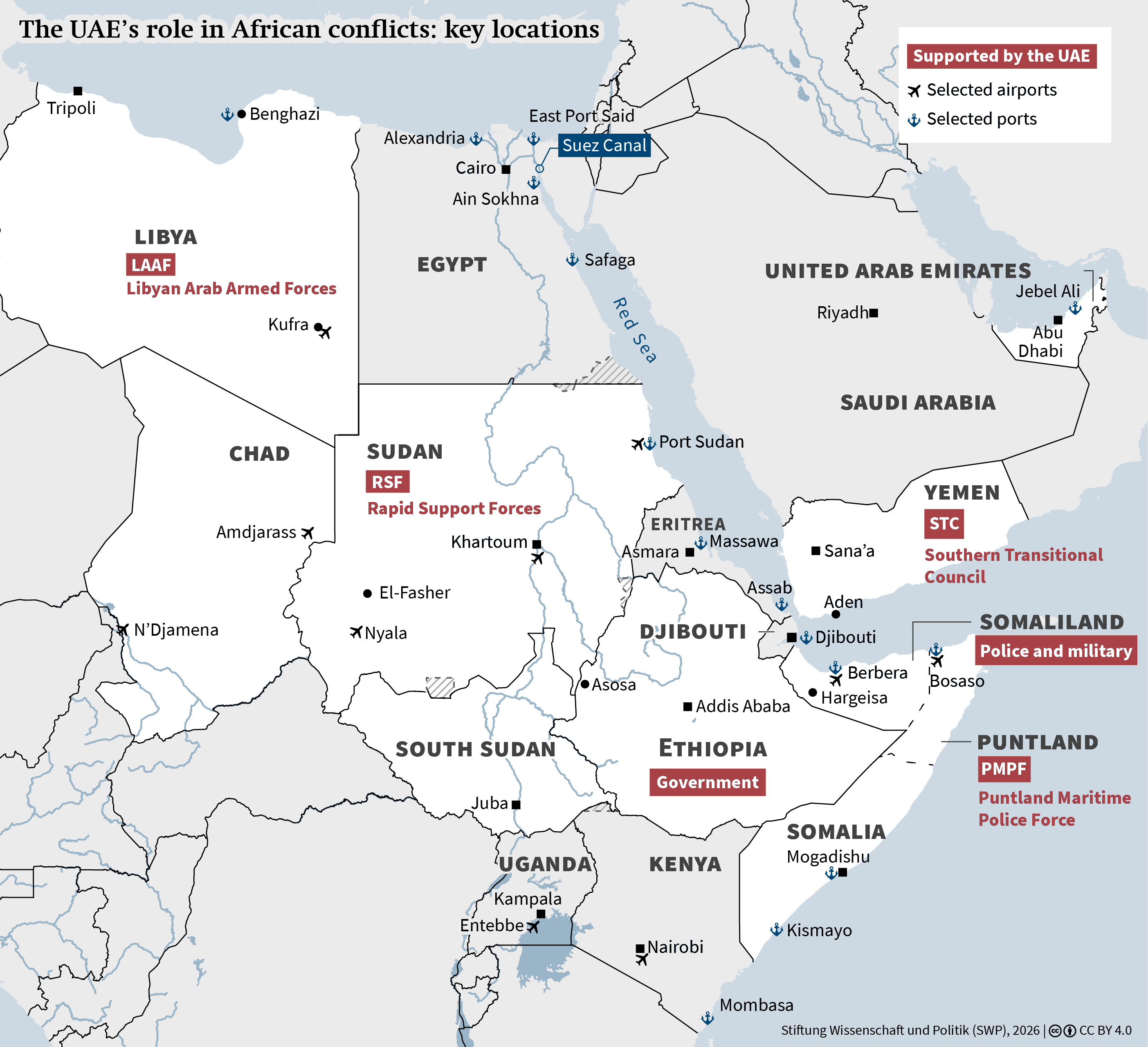
Support for disruptive actors
The UAE’s allies include Haftar’s LAAF in Libya, the RSF under Mohamed Hamdan Dagalo (Hemedti) in Sudan, the Puntland Maritime Police Force (PMPF) as well as the police and military forces of Somaliland in northern Somalia. According to numerous reports, the UAE supplies these groups, as well as the Ethiopian government, with weapons systems that are often decisive to the course of wars, such as advanced long-range drones. The UAE has also carried out its own air strikes against the government in Tripoli and in the Somali region of Puntland, where it attacked a cell of the so-called Islamic State.
Three of the UAE’s local partners – the LAAF, the RSF and the PMPF – have tense or even hostile relations with their respective central governments. They originate from para-state militias and control their own territory. Support for the Ethiopian government, particularly during the war in the country’s north in 2020–22, departs from this pattern, as in that case the Emirates strengthened the internationally recognised government against the Tigray Defense Forces (TDF). Nevertheless, all of these actors – and the UAE itself – are pursuing a disruptive agenda with regard to their political systems and aiming to shift the local balance of power.
The UAE’s toolkit also includes recruiting foreign fighters and mercenaries, transporting them to battlefields or deploying them for logistical support. As early as 2010, the UAE deployed a South African-run private military company to establish the PMPF in Somalia, allegedly for combating piracy. It later paid Sudanese mercenaries who fought on Haftar’s side in Tripoli. And in Sudan, the Emirati security firm Global Security Services Group organised the recruitment, transport and payment of several hundred Colombian mercenaries, including via a military base in the Emirates. When the US government imposed sanctions on the actors involved in 2025 (with the exception of the aforementioned Emirati security firm in question), it stated that these men had reinforced the RSF with “tactical and technical expertise, served as infantry and artillery personnel, as drone pilots, vehicle operators and instructors, some of whom even trained children for combat”.
Emirati activities in these conflict zones do not occur in isolation, but form part of a transnational network established by the UAE. Supplies to the RSF were routed, among other places, via LAAF-controlled areas of Libya (above all Kufra in the south), via N’Djamena and Amdjarass in Chad, and in some cases via stopovers in Kenya, Uganda and Rwanda. Bosaso in Puntland served as a base for supporting the PMPF, but also for transporting weapons from Yemen and Colombian mercenaries for the RSF. The UAE continually adapts these routes to respond to changes in the military situation or the positions of local rulers. To gain influence in the countries that form part of this logistical network, it deploys large sums of money. For instance, during a visit in June 2023, the UAE promised Chadian President Idriss Déby a loan of US$1.5 billion. Emirati loans also helped the governments in Ethiopia and Kenya to overcome short-term financial difficulties. At the same time, the UAE profits from the export and smuggling of gold from conflict zones such as Sudan.
The Emirates denies most of these activities, particularly direct military support for parties to the conflict such as the RSF. After a 2024 report by the United Nations (UN) panel of experts referred to “credible” evidence of Emirati support for the RSF, there was no mention of this in the subsequent report, though it did appear in the leaked draft of that same report. The UAE points to the published, apparently amended version as proof of its alleged non-interference and even calls for a UN arms embargo for the whole of Sudan, whereas at present it applies only to Darfur.
The UAE has gone to considerable lengths to avoid international criticism. For instance, Emirati Minister of State Lana Nusseibeh spent four days in Brussels in November 2025 to meet with Members of the European Parliament. In the Parliament’s resolution on Sudan, adopted at the same time, the UAE’s support for the RSF is not mentioned, following opposition from the European People’s Party to amendments tabled by left-wing parliamentary groups.
Economy, geopolitics and self-enrichment
The specific interests underlying the UAE’s actions in individual conflicts often remain unclear. Decisions are made within a small circle, with Mohammed bin Zayed Al Nahyan, the Emir of Abu Dhabi and Emirati President, at its centre. Moreover, the threshold for intervention is low, as the UAE until recently bore hardly any political costs for these activities. These interventions do not necessarily follow a coherent overarching strategy. Nevertheless, certain underlying motives can be identified. For instance, the UAE’s security policies are frequently explained by external economic interests. Indeed, in recent years the Emirates has emerged as one of the most important economic partners of numerous African states. The state-owned logistics groups DP World and AD Ports Group, based in Dubai and Abu Dhabi, operate or are developing ports and associated infrastructure in, among other places, Somalia, Senegal, Tanzania, Mozambique, Angola and Egypt. These port projects form part of strategically significant economic corridors designed to transport raw materials such as minerals, agricultural and energy commodities to international markets.
For the UAE, these corridors are essential also because they secure long-term access to strategic resources and trade routes. Such investments reflect an Emirati strategy to diversify the economy away from oil. Military interventions can therefore be understood as a means of safeguarding these economic interests.
However, given the impact of the UAE’s regional policies, this is at best a partial explanation. The UAE’s involvement often contributes to the destabilisation of economic spaces, suggesting additional motives that are not primarily economic. Foremost among these is the Emirates’ ambition to gain greater influence in the region and, with it, greater international significance. The primary aim is to hold its own against significantly stronger regional powers, such as Iran, but above all against its larger neighbour on the Arabian Peninsula, Saudi Arabia. Tensions between the two “brother states”, such as those that escalated in Yemen at the end of 2025, are by no means new. Whereas border disputes and wrangling over competences within the Gulf Cooperation Council used to dominate, the rivalry is now manifested predominantly in competing economic development and regional strategies. Both states are pursuing ambitious plans to establish themselves as central hubs for trade, logistics and investment between Africa, Asia and Europe. Since Riyadh forced Abu Dhabi to withdraw from southern Yemen, it has become clear just how serious these tensions are – with acute regional repercussions. Saudi Arabia, like Egypt and Somalia, temporarily closed its airspace to UAE supply missions bound for the RSF. Consequently, Ethiopia gained in importance as a logistical hub for such deliveries. Even the war with Iran, which has severely affected both the UAE and Saudi Arabia, did little to ease bilateral tensions. These tensions were also the reason why the Third International Sudan Conference in Berlin on 15 April 2026 initially failed to produce a joint final declaration. At the end of April 2026, the UAE also announced its withdrawal from the OPEC+ oil cartel, a move likely to further strain its relationship with Saudi Arabia.
The ideological opposition of the ruling Al-Nahyan family in Abu Dhabi to the Muslim Brotherhood also significantly shapes its regional policies. The family seeks to preserve its authoritarian model of rule and opposes Islamist movements that pursue social mobilisation and demand political participation. Abu Dhabi therefore pursues a policy of actively containing such actors, which is reflected in both domestic repression and an interventionist foreign policy. This became particularly evident during the blockade of neighbouring Qatar between 2017 and 2021, which was largely driven by Abu Dhabi. Qatar’s leadership was accused of supporting the Muslim Brotherhood in the region.
In African conflicts, too, the UAE often supports local actors such as the RSF, which explicitly opposes the Muslim Brotherhood or groups aligned with it. Yet, at times, the Emirates demarcation from other Islamist actors remains blurred. Security alliances are pragmatic in nature and do not necessarily align with the officially stated goals of counter-terrorism.
Finally, personal networks of members of the ruling families in Abu Dhabi and Dubai also play a role. Mansour bin Zayed, for instance, a brother of the President and chairman of the sovereign wealth fund Mubadala, has, according to media and research reports, close ties to local power actors in African conflicts, including Haftar in Libya and Dagalo in Sudan. Trade in and smuggling of gold and other resources provide lucrative sources of revenue for both the RSF and the regular Sudanese military (Sudanese Armed Forces, SAF), as well as for their business partners in the UAE.
Escalation and spread of conflicts
The conflicts in Sudan, Ethiopia, Libya and Somalia each have their own causes and are not merely proxy wars. Nevertheless, external military and financial support – in this case from the UAE – encourages the conflicting parties to pursue their goals by force. This has consequences: The war in Sudan has created the world’s largest humanitarian crisis, measured by the number of people who, according to the UN, are dependent on humanitarian aid (33.7 million), have been displaced (at times more than 15 million) or are suffering from extreme hunger. The RSF, a partner of the UAE, is responsible for targeted violence against the Sudanese civilian population. This includes sexual violence, hostage-taking, looting, displacement, attacks on medical facilities and mass killings. Much of this violence is directed against members of non-Arab minorities such as the Masalit in West Darfur and the Zaghawa in North Darfur. The city of El-Fasher, which the SAF and its allies controlled until October 2025 as the last provincial capital in Darfur, was besieged by the RSF for a year and a half. During its capture of the city, the RSF proceeded in such an organised manner against the non-Arab civilian population that a UN fact-finding mission described it as having the hallmarks of genocide.
The UAE’s logistical network, established primarily to support the RSF, is helping to link conflicts in various countries more closely. Since autumn 2025, the UAE has set up a training camp for the RSF in Benishangul-Gumuz in western Ethiopia. Military equipment intended for the RSF, some of it apparently arriving via the city of Berbera in Somaliland, also appears to be rerouted via a base of the Ethiopian armed forces. At the same time, the RSF has launched an offensive in the south of Sudan’s Blue Nile state, in which it is apparently also deploying units from South Sudan.
The UAE’s logistical support to the RSF via Chad threatens the fragile balance there. Several ethnic groups in Darfur – and therefore the local parties to the conflict – have close ties to Chad, from where some of the fighters also originate. President Déby at least temporarily allowed the UAE to use the country as a logistical hub to support the RSF. This fuels tensions within the Chadian military elite, since the RSF recruits predominantly from Arab groups and fights against units drawn from the Zaghawa – Déby’s own group. Repeated clashes between the RSF and the Chadian army in the border area suggest that the conflict could escalate.
Libya illustrates the potential long-term consequences for Europe of Emirati interventionism. There, the UAE’s early intervention in support of Haftar was a key reason why his attack on Tripoli in April 2019 turned into a protracted civil war. It lasted for more than a year and resulted in a permanent Turkish and Russian military presence in the country. Whether the UAE financed the involvement of the Russian Wagner Group in this conflict, as the US Defense Intelligence Agency claimed in 2020, remains unclear. What is certain, however, is the UAE’s close cooperation with Wagner during the war: Wagner’s logistics relied in part on transport flights from the UAE, the UAE deployed Pantsir air defence systems that were operated by Wagner personnel, and the latter provided target coordinates for Emirati drones. The Emirates therefore shares some of the responsibility for the now entrenched Russian military presence in Libya, and thus for the country’s ongoing division.
The humanitarian consequences of the conflicts in which the UAE intervenes are far-reaching – although the UAE itself remains largely insulated from them. The massive refugee crisis caused by the war in Sudan weighs particularly heavily on neighbouring states. However, it has also led to a growing number of Sudanese refugees arriving in Europe via the Mediterranean. Among arrivals in Italy, both the number and the proportion of Sudanese nationals doubled between 2024 and 2025, from 3 to 6 per cent. In Greece, Sudanese refugees already constituted the second-largest group in 2025, accounting for more than a fifth of the total.
Undermining international conflict resolution
A consistent pattern emerges not only in the UAE’s interventions, but also in its approach to international conflict resolution. The Emirates participates in diplomatic processes aimed at ending conflicts, but it uses the international stage primarily to present itself as an ostensibly constructive actor.
The most prominent example of such diplomatic manoeuvring is the Quad format (Egypt, Saudi Arabia, the UAE and the United States), which in September 2025 presented joint commitments for a ceasefire in Sudan. These included an end to external support, which, according to US intelligence reporting, the UAE in fact further intensified in 2025. These diplomatic initiatives served more to allow the RSF once again to present itself as a willing partner for a ceasefire while carrying out a massacre.
The UAE also positions itself as a humanitarian donor for Sudan. At a conference organised jointly with the African Union, the regional economic community IGAD and Ethiopia in February 2025, it pledged US$200 million, followed by a further US$500 million at a US conference in 2026. However, it is unclear where these funds are going, as the UAE contributed only around US$33 million to the UN-coordinated plan in 2025. Germany had already witnessed during the Berlin Libya Process (2019–20) how the UAE undermined diplomatic efforts: Despite pledges (together with Russia and Turkey) to cease support for the Libyan parties to the conflict, that support was in fact intensified. Even on the day of the Berlin Libya Conference in January 2020, transport aircraft flew from the Emirates to eastern Libya. Consequently, the war did not end as a result of diplomatic efforts, but because of the military balance of power created by these interventions. Both Libya and, currently, Sudan demonstrate that, without pressure, including the UAE in conflict resolution processes does not produce results.
The UAE’s actions also undermine a key instrument of multilateral conflict resolution: arms embargoes. The UAE’s open disregard for the UN embargo on Libya from 2014 onwards, and particularly during the Tripoli war in 2019–20, likely encouraged states such as Turkey to adopt a similar approach. The same has applied to Sudan since 2023. A report from a UN panel of experts lists 458 flights involving heavy transport aircraft from military airports in the UAE or from the Emirati transhipment hub of Bosaso to eastern Libya between October 2024 and the end of 2025. These included 239 flights to Kufra, a hub for support to the RSF. These shipments likely violated both the UN arms embargo on Libya and that on Darfur. At the same time, it is clear that support for the SAF from Egypt, Saudi Arabia, Russia, Turkey, Iran and other countries is also fuelling the war.
In both conflicts, Western governments have been conspicuously reluctant to criticise the UAE, which also prevents them from pressing other intervening states more forcefully to comply with the embargoes. To date, no member of the UN Security Council has explicitly addressed the UAE’s support for the RSF in meetings. This leniency towards Emirati interventionism has contributed significantly to the loss of credibility of the sanctions regimes.
Not a constructive partner
This analysis of Emirati interventions in Africa shows that the UAE has not, to date, been a reliable partner for European efforts at conflict prevention and resolution on the continent. Rather, the country acts as a spoiler whose interventions exacerbate local conflict dynamics, entrench war economies and drive state fragmentation. The consequences are not only disastrous for the societies affected, but also impact European interests – ranging from regional stability and migration to safeguarding multilateral order.
This assessment is by no means new. Even so, the UAE has so far not had to reckon with any tangible political consequences from Germany and its European partners for its actions. In the overall balance, other aspects of the bilateral relationship predominate: economic and trade interests; security cooperation, which has taken on even greater significance amid the Iran war; the UAE’s close cooperation with Israel; the strategic goal of preventing the Emirates from drifting further towards China or Russia; and, more recently, cooperation in the field of artificial intelligence.
There is an urgent need for a sober and comprehensive review of relations with the UAE, especially since other aspects have so far been neglected. These include, for instance, the Emirates’ ambivalent to obstructive role in international climate negotiations, its pragmatic to friendly dealings with Russia, as well as its efforts to exert political influence in Europe – including relations with right-wing populist to far-right parties and support for networks spreading disinformation. Emirati foreign policy in Africa is therefore not an isolated shortcoming of an otherwise constructive partner. Rather, it should be understood as the expression of a consistent approach aiming to project power: The UAE promotes disruptive actors and systematically links military support with commercial and ideological interests.
This approach could be intensified further in the future. Following the UAE’s withdrawal of its remaining troops from Yemen at the turn of 2025/26 due to differences with Saudi Arabia, African theatres have become even more strategically important: as hubs along the trade and energy routes through the Red Sea, as locations for port and logistics projects as part of an expansionary foreign trade policy, as gateways to raw materials and as zones of military influence. The fact that logistical support for the RSF in Sudan continued even amid Iranian attacks on the UAE demonstrates the importance the Emirates attaches to this policy. The Emirates’ recently initiated cooperation with Israel in establishing a military presence in Somaliland likewise reflects such ambitions.
At the same time, Abu Dhabi is likely to be far more interested now than before in not jeopardising its good relations with European states. Growing criticism of Emirati policy in Middle Eastern states, tensions with Saudi Arabia, and the economic and security vulnerabilities exposed by the Iran war present an opportunity to exert more effective pressure on the UAE. Specifically, Germany and its European partners have five courses of action available to them in order to encourage a more constructive Emirati regional policy.
First, the reputational dimension should be utilised more effectively towards Abu Dhabi. The UAE attaches great importance to its image as a modern, stable and responsible actor. Addressing its destabilising activities more openly in international forums can generate political pressure. Instead of merely speaking in general terms about external support for conflict actors in Africa, Germany should explicitly mention both the UAE and other states involved, without allowing itself to be drawn into Gulf rivalries. Reputational damage can also have economic consequences, as in the case of the alleged involvement of the former head of DP World in the Epstein network – he resigned following the intervention of a Canadian pension fund.
Second, the EU should expand its financial sanctions and apply them more consistently, particularly where Emirati actors have been documented as violating UN embargoes or supporting belligerents.
Third, Germany’s arms export policy towards the UAE should be fundamentally reviewed. For despite the Emirates’ increased need to protect itself against Iranian attacks, the risk of German arms being transferred or used in third-country conflicts remains real. For instance, the UAE equipped Haftar’s offensive on Tripoli in Libya with Pantsir air defence systems mounted on MAN/Rheinmetall chassis. The French Galix defence system was deployed on UAE armoured vehicles in Sudan.
Fourth, stricter criteria could be applied in the enforcement of anti-money-laundering and transparency rules. European regulation should focus more on the role of Emirati financial centres as hubs for conflict economies, informal capital flows and sanctions evasion. Although the UAE was removed from the Financial Action Task Force’s “grey list” in 2024 following the introduction of anti-money-laundering reforms, civil society organisations and transparency initiatives criticised this decision as premature. They pointed to persistent structural deficits in enforcement, as well as the continued attractiveness of Emirati financial centres for problematic capital flows.
Fifth, diplomatic engagement also needs to be reassessed. The “strategic partnership” that Germany has maintained with the UAE since 2004 suggests a broad alignment of interests. Failing to at least suspend this partnership in light of the UAE’s interventions in conflicts undermines Germany’s stated commitment to reliable, rules-based behaviour. Such a partnership makes sense only if the Emirates demonstrably reorients its policy in Africa towards de-escalation, thereby allowing Abu Dhabi’s considerable financial weight and political networks to be harnessed for constructive conflict resolution.
Dr Gerrit Kurtz is an Associate, Dr Wolfram Lacher a Senior Associate, and Dr Stephan Roll a Senior Fellow in the Africa and Middle East Research Division at SWP.
This work is licensed under CC BY 4.0
This Comment reflects the authors’ views.
SWP Comments are subject to internal peer review, fact-checking and copy-editing. For further information on our quality control procedures, please visit the SWP website: https://www.swp-berlin.org/en/about-swp/ quality-management-for-swp-publications/
SWP
Stiftung Wissenschaft und Politik
German Institute for International and Security Affairs
Ludwigkirchplatz 3–4
10719 Berlin
Telephone +49 30 880 07-0
Fax +49 30 880 07-100
www.swp-berlin.org
swp@swp-berlin.org
ISSN (Print) 1861-1761
ISSN (Online) 2747-5107
DOI: 10.18449/2026C19
(English version of SWP‑Aktuell 22/2026)