Connectivity and Redundancy: Major Geoeconomic Projects in the Persian Gulf and the Middle East
SWP Comment 2026/C 43, 27.10.2026, 8 Seiten
doi:10.18449/2026C43
ForschungsgebieteThe geopolitical dynamics in the Middle East will remain fluid, regardless of the outcome of the war in the Persian Gulf. Virtually all regional actors are working to hedge their bets – in terms of security policy, but also through economic adjustments. The focus is on new, secure transport routes to and from the Arab Gulf states. This is not merely about oil or gas, but the overall security of supply chains through multimodal links and connectivity corridors: for energy supplies, other raw materials, goods, data and people. Not every plan will be implemented, but those that are will reshape the geoeconomic landscape and change the region’s geopolitical map. The process could boost regional integration and will impact Europe’s cooperation with the countries in the region.
Global interest in the Strait of Hormuz centres on its role as a chokepoint for export of hydrocarbons and other raw materials. Until the outbreak of the Iran War in February 2026, more than one quarter of the world’s traded oil, around 20 per cent of liquefied natural gas exports and up to a third of all fertiliser exports passed through the Strait of Hormuz. At the same time, the Persian Gulf is the main route for imports entering the Gulf states. The Arab Gulf states, in particular, are heavily dependent on imports of industrial and consumer goods, and the only seaborne access to Iraq, Kuwait, Qatar and Bahrain is via the Hormuz chokepoint. The Iranian Revolutionary Guards announced the Strait’s closure in early March 2026, a few days after the first attacks by the United States and Israel; in April, the US Navy began a blockade of Iranian ports. Although traffic through the Strait did not come to a complete standstill, it fell at times to between 5 and 10 per cent of the pre-war average.
Iran, Saudi Arabia and the United Arab Emirates (UAE) each have alternative ports on the Gulf of Oman, the Arabian Sea and/ or the Red Sea. However, the most important Iranian ports and two of the largest Saudi ports are on the Persian Gulf and only accessible via the Strait of Hormuz. The same applies to the port and free zone of Jebel Ali in the UAE, which is the largest container transhipment hub in the Middle East. Owing to its location, freight traffic via Jebel Ali dropped by up to 90 per cent following the closure of the Strait of Hormuz.
New functions, new connections
Over the past two or three decades, the UAE, followed by the other Gulf monarchies, have begun to prepare for the “post-oil” era. They are striving to position themselves as regional and global centres – hubs – for logistics, finance, tourism and other services – as well as offering safe locations for individuals and businesses, and, more recently, for energy-intensive data centres. Indirectly, this also meant repositioning the region – the Gulf and the Arabian Peninsula – on the global political and economic map: no longer tied to a crisis-ridden Middle East, but a new centre linking Europe to the Indian Ocean.
One manifestation of this ambition is the India-Middle East-Europe Economic Corridor (IMEC), agreed by India, the United States, Saudi Arabia, the UAE, the European Union, France, Germany and Italy in 2023. The project has the potential to shorten transport times between India, the Arab Gulf states and Europe, and is also intended to facilitate the supply of green hydrogen to Europe. At the same time it is a geopolitical project, with Washington and New Delhi hoping to counter China’s Belt and Road Initiative in the wider Indian Ocean region. Washington also viewed IMEC as an infrastructural underpinning for the so-called Abraham Accords and a further normalisation of relations between Israel and individual Arab states. This was certainly the case until the start of the Gaza war.
The war between Israel and Hamas, triggered by the attacks of 7 October 2023, has at least temporarily halted IMEC’s implementation. For Saudi Arabia, in particular, a corridor project with Israel’s port of Haifa as the intended terminus of the overland route between the Persian Gulf and the Mediterranean became politically unpalatable as long as Israel was destroying livelihoods in the Gaza Strip and re-occupying parts of it. As a consequence, Riyadh has repeatedly stated that any “normalisation” of economic and political relations with Israel is contingent upon a resolution of the Israeli-Palestinian conflict and the prospect of a Palestinian state. In 2026, the war with Iran and the associated closure of the Strait of Hormuz exacerbated doubts about the security and availability of the Persian Gulf ports – while at the same time underlining the urgency of alternative routes to the Arab Gulf states.
The primary concern here is to safeguard supply routes to the Arab Gulf states and protect their oil and gas revenues. Neither the Arab Gulf monarchies nor Iraq have any interest in any form of Iranian control over shipping through the Strait of Hormuz, though they may have to accept some form thereof, and they will be unable to prevent Tehran from threatening disruption. They can relativise the strategic importance of the Strait of Hormuz, however, by reducing their own dependency on it, thus limiting Iran’s ability to weaponise the Strait. In this context alternative, redundant transport routes become the geoeconomic equivalent of missile defence.
The Arab Gulf states have no intention of abandoning the Strait of Hormuz and the Persian Gulf as a key transport corridor, though. As long as the Strait remains open and safe for navigation, it will remain the most economic route for exporting oil and gas, and transporting other goods to and from the Gulf states. US Treasury Secretary Scott Bessent’s prediction that the Strait of Hormuz will be “a worthless piece of water” in two years’ time is not a realistic scenario, nor does it reflect the interests of the Arab Gulf states, for whom investing in alternatives means above all creating redundancies to increase the resilience of their supply chains. For example, the operators of the port and free zone at Jebel Ali are planning to build two new cargo ports at Fujairah on the Gulf of Oman, linked to Jebel Ali by a land corridor.
Connectivity as a response to geopolitical challenges
While plans for new transport routes or corridors in Middle East were afoot long before the Iran War, they have obviously gained momentum now. Some projects are more concrete than others, and the cost estimates tend to be vague. There is talk of “hundreds of billions” of US dollars in planned investment, with a key focus on pipeline links.
|
Map
|
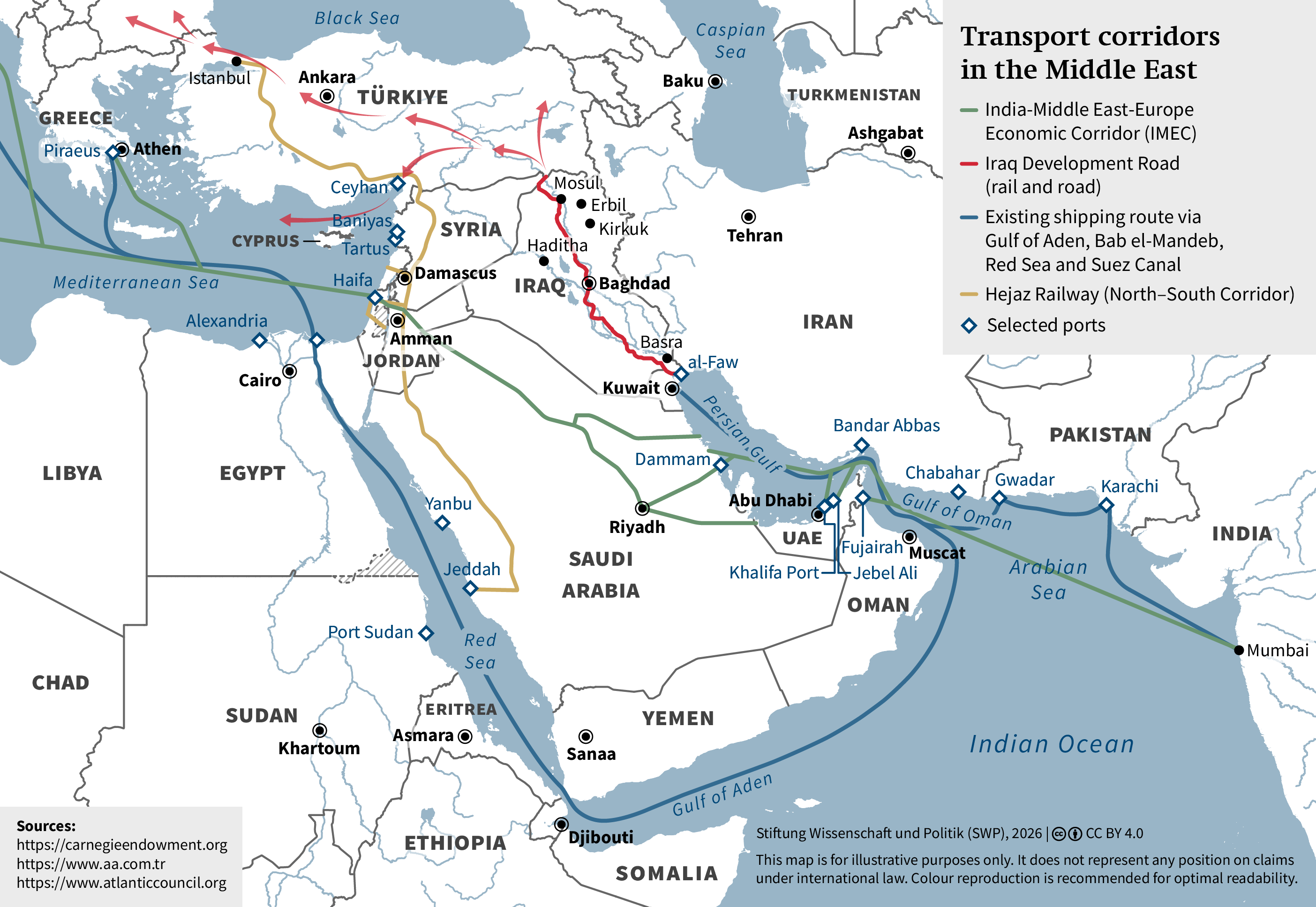
Expanding the capacity of existing oil pipelines is likely to be the easiest option. These include the Saudi East-West Pipeline, built in the 1980s during the Iran-Iraq War, which connects the oilfields in the east of the country with the port of Yanbu on the Red Sea. While some of this oil is refined and consumed domestically in the west of the country, the pipeline has enabled Saudi Arabia to export around 4 million barrels of crude per day (b/d) even following the closure of the Strait of Hormuz – just under two-thirds of the pre-war average of 6 to 7 million b/d. The planned capacity expansion would make it possible to transport a further 2 million b/d to the Red Sea coast. In order to export this oil, the capacity of the Yanbu terminals would also need to be expanded.
The east-west pipeline provides redundancy by allowing Saudi Arabia to export its oil from either the east or the west coast. However, the pipeline itself is vulnerable, and all shipping out of the Red Sea must pass through one of two chokepoints: the Suez Canal or the Bab al-Mandab between Yemen and Djibouti. The latter route is the more important for the Saudi oil industry, as most Saudi crude oil exports go to Asia, with just 15 per cent heading for the Mediterranean and Europe. Although oil can be exported to Asia via the Suez Canal, that requires smaller tankers – to pass through the canal – and takes roughly twice as long due to the circuitous route around Africa.
In September 2026, Saudi Arabia was forced to temporarily shut the pipeline following a drone attack by pro-Iranian Iraqi militias. Almost simultaneously, Yemen’s Houthi militia – who are also supported by Iran – made territorial gains along the Red Sea coast in their fight against the Saudi-backed Yemeni government. This enabled them to enforce a previously announced blockade of the Bab al-Mandab for Saudi vessels. These two developments forced the Saudi government to announce a temporary suspension of oil exports via the Red Sea.
The UAE also operates a pipeline bypassing the Strait of Hormuz, connecting oil production facilities in Abu Dhabi with the loading terminal in Fujairah since 2012. If a second pipeline along the same route comes into operation as planned in 2027, more than half of the UAE’s planned crude oil exports could be shipped from a port outside the Persian Gulf. However, redundancy does not mean invulnerability. Like other ports on the Gulf of Oman, Fujairah has also been attacked by Iranian drones.
Meanwhile, work is under way in Iraq to restore the pipeline linking the northern oil fields near Kirkuk to the Syrian Mediterranean port of Baniyas, which has been out of operation since the 2003 Iraq War. The project, which includes the US oil giant Chevron and Qatari investors, has Washington’s support and is due to be completed within four years. Iraq and the Syrian government agreed in 2025 to restore the pipeline, and formalised the arrangement in 2026. At the same time, Baghdad is planning a pipeline from Basra, in Iraq’s main southern oilfields, to the hub at Haditha. From there, the oil could be channelled into the rebuilt pipeline to Baniyas and – again for redundancy – via another new link north into the existing pipeline from Kirkuk to the Turkish Mediterranean port of Ceyhan. However, operation of the Kirkuk–Ceyhan pipeline has been plagued for years by political and legal disputes between Baghdad, Ankara and the Kurdish Regional Government in Erbil. In the absence of a pipeline – and with the Strait of Hormuz closed – Iraqi oil from the southern oilfields is currently transported to Baniyas using thousands of road tankers.
Kuwait and Qatar currently have no real alternatives for exporting their oil and gas, other than the Strait of Hormuz. New pipeline routes via Saudi Arabia or connecting to a proposed Saudi pipeline to Oman are under discussion, but without concrete plans. Bahrain, which is a smaller oil exporter, is already connected by pipeline to the Saudi oil export infrastructure.
However, pipelines represent only one element of the proposals for enhancing the resilience of the Arab Gulf states and their supply chains. As well as pipeline infrastructure, oil exports also require port and loading facilities. Oil pipelines are vulnerable, as drone attacks on the Saudi east-west link have demonstrated. The history of cross-border pipelines in the Middle East – Kirkuk–Baniyas, Kirkuk–Ceyhan, the so-called Trans-Arabian Pipeline (Tapline) and others – is also a history of destruction and blockades associated with military, political and legal conflicts. Any pipeline from Saudi Arabia to the Mediterranean would have to cross at least two international borders, and any from the UAE or Qatar at least three, thus requiring considerable trust between states. And in any case, Asia remains by far the largest market for Gulf oil and gas exports. For all these reasons, planning currently seeks to expand the options rather than replacing the route through the Strait of Hormuz – in other words, creating greater redundancy.
More than just pipelines: IMEC and other multimodal corridors
For connectivity with Europe, plans for multimodal corridors combining road, rail and sea transport, data networks and energy transmission lines are more important than new oil and gas pipelines. The planned IMEC corridor from India via the Middle East to Europe remains a major geoeconomic project bringing together the economic and political interests of India, the Gulf Arab states, the European Union and its member states, and the United States.
However, the conflicts in the Persian Gulf and between Israel and its neighbours place a cloud over the project; potential investors are holding back and necessary infrastructure elements are lacking entirely or, at best, in planning. This applies, for example, to rail links between the UAE and Saudi Arabia, and from Saudi Arabia via Jordan to Israel, as well as port expansion in Haifa and transport infrastructure for green hydrogen. Given that Saudi Arabia is excluding Israel from regional integration initiatives pending resolution of the Israeli-Palestinian conflict, alternative routes that bypass Israel are under discussion along with projects to bypass the Strait of Hormuz. These include linking Omani ports to the route crossing the Arabian Peninsula, another route connecting Saudi Arabia to Egypt via the Red Sea or the Sinai, and, last not least, new links via Jordan to Syria’s Mediterranean ports.
None of these would make IMEC obsolete, but the discussion does suggest to all involved that they should avoid focussing on a single new corridor for all forms of connectivity. It seems more realistic that a network of infrastructure links between the Indian Ocean and the Mediterranean will emerge – including new railway lines, data cables and (potentially) hydrogen pipelines. The EU has been particularly committed to expanding secure data connections between India, Africa, the Middle East and Europe. A new cable link from Europe via Israel and Jordan to the Gulf of Aqaba (Blue Raman) has been partially completed. Its extension through the Red Sea has been delayed by the instability at the Bab al-Mandab. Cable-laying is not impossible, but conflict around the chokepoint has increased insurance and other costs to a point where the venture becomes uneconomic.
The Iraq Development Road
While some observers have discussed the Iraq Development Road (IDR; also Iraq-Turkey-Europe Development Road) as a geopolitical rival to IMEC, it is ultimately likely to fit into a network of multiple – and therefore more resilient – connections. Concrete planning for the IDR began in 2024 – before the Iran War – with a quadrilateral memorandum of understanding between Iraq, Turkey, Qatar and the UAE. The plan envisages a road, rail, energy and data corridor running from the Iraqi container port of al-Faw to Turkey and on to Europe. The first phase of the Al-Faw Grand Port development has been completed; according to Iraqi plans, the port will exceed the capacity of Jebel Ali. Even if that target is not met, the corridor would help Iraq and other Gulf states to reduce their dependency on the Strait of Hormuz.
The key players here are Iraq and Turkey. The project’s realisation will depend crucially on Iraqi-Turkish relations – but also on the course of the peace process between the Turkish government and the PKK, without which the security situation in the border region will remain precarious. Within Iraq there is ongoing disagreement over the corridor’s route in the north, with Kurdish Regional Government demanding that the route serve Dohuk in Iraqi Kurdistan, while Baghdad plans to bypass the Kurdish autonomous region entirely.
The UAE’s interest in the project includes a joint venture between Abu Dhabi Ports and the Iraqi state-owned port operator to expand the port of al-Faw. Emirati and Qatari investors are also involved in plans for a digital corridor with data cables along the route and undersea cables linking their countries to al-Faw.
Iranian attacks on the Gulf states have brought home the enormous vulnerability of the latter’s investments in artificial intelligence and data centres more generally. Diversifying their data connections would increase resilience in this area. At present, the most important data cables between Kuwait, Qatar, Bahrain, the UAE, Iran and Europe run through both the Strait of Hormuz and the Bab al-Mandab.
The North-South Corridor and Syria’s reintegration
Plans for a corridor linking Europe and Turkey to the Arabian Peninsula via Syria and Jordan are recent in origin but making relatively concrete progress. The main impetus came from the fall of the Assad regime in Syria in December 2024 and the end of the Syrian civil war, which opened up the prospect of Syria’s political and economic reintegration with the region. The blockade of the Gulf states’ maritime supply routes in 2026 heightened their interest in realising the project swiftly and accelerated the conclusion of relevant agreements between Saudi Arabia, Jordan, Syria and Turkey. While some stakeholders and observers speak of a North-South Corridor, others refer to it as a “new Hejaz Railway”.
However, this is not about restoring the Ottoman-era narrow-gauge railway between Istanbul and Medina, which has been out of service for more than a century. Rather, it is a case of reinventing a historic route. One central element is a modern rail link connecting to the Saudi rail network, thereby creating direct links to all of Saudi Arabia’s economic and population centres and, in principle, to the other Arab Gulf states too. But here, again, a multimodal corridor is planned, for road and rail, transport, data and potentially energy. The “Hejaz Railway” label taps into a narrative emphasising the historical ties between Anatolia, the Levant and the Arabian Peninsula, including the holy sites of Islam on the western coast of present-day Saudi Arabia (the Hejaz). This narrative revives a political and economic axis that had lost its relevance due to Syria’s civil war and the Assad regime’s geopolitical orientation towards Iran. Syria functioned as a land corridor for the Iranian-dominated “Axis of Resistance” (against Israel), extending from Iran through Iraq and Syria to Lebanon and the Israeli border. Syria’s new government has largely severed ties with Iran, seeks to resolve conflicts with Israel peacefully, and is aligning itself politically with Ankara and Riyadh.
Despite these geopolitical aspects, the corridor’s economic significance remains the primary focus. In any case, Syria is leveraging its geographical location to attract investment from the Gulf states and Europe and position itself as a transit route for energy supplies and other goods. Damascus also expects the North-South Corridor to boost growth in its manufacturing sector. Turkey, Syria, Lebanon, Jordan and Saudi Arabia would likely expand their reciprocal trade and Saudi Arabia would gain greater security in its supply chains for consumer and industrial goods from Europe.
The semi-state-owned Saudi Telecom Company is also planning a 4,500-kilometre fibre-optic link from Saudi Arabia to Syria and on to Turkey (SilkLink), with a submarine cable spur from Syria via Cyprus to Greece. Here again, economic logic intersects with geopolitics: Saudi Arabia sees the connection as a replacement for an earlier Saudi-Greek data cable project routed via Israel that predated the Gaza war, in an era when the prospect of normalisation between Saudi Arabia and Israel was on the table.
Regional integration: impacts and challenges
All participating states expect the planned corridors to bring economic growth, and their hope is not unfounded. Unlike a cross-border pipeline, a multimodal corridor does more than simply connect two end points in different countries. It creates an infrastructure network with potential to boost growth and development along its routes and promote regional integration. However, realisation of these corridor projects will depend on regional cooperation. For instance, transit, border and customs procedures will have to be simplified. Open borders and security along transport routes must be guaranteed.
As long as the distribution of competencies between different levels of governance within a state remain unclear and conflicts between central governments and local or regional authorities – such as the Kurdish Regional Government in Iraq – remain unresolved, investors are unlikely to be convinced that these projects are secure.
The new Syrian government clearly wishes to avoid political or geopolitical conflicts overshadowing the country’s economic opportunities. The same applies to Lebanon, Jordan and Iraq. However, none of these states is immune to geopolitical disruption and adverse developments outside their control. These include the repercussions of the Iran war as well as ongoing conflicts between Israel and its immediate neighbours. Nevertheless, Damascus, Beirut, Amman and Baghdad are treating the Arab Gulf states’ quest for greater resilience as an opportunity to become part of the solution.
The expectation that the corridors – and at least many of their individual elements – will actually be realised rests on their combination of security and economic rationales. They create redundancies, provide alternative supply chains where necessary, and thereby increase the economic – and ultimately, the political and social – resilience of the Arab Gulf states. Even after the end of the Iran war, the Arab states will remain mistrustful of Iran. Nor will they want to rely solely on Washington to provide naval escorts for oil and gas exports in the event of crisis. Here redundancy counts for more than pure efficiency. At the same time, Gulf investors expect the planned projects to pay for themselves in the medium term. And given that connectivity brings influence, it is interesting to see who is included in the planned routes and who is left out.
The Arab Gulf states have no current plans to involve Iran in their connectivity projects. Tehran is focusing on expanding its own road and rail links to the Caspian Sea, Turkmenistan, Afghanistan and Pakistan, and on to Central Asia, Russia and China. The IMEC project bypasses Turkey, whilst the Hejaz Corridor and the IDR strengthen Turkey’s role as a bridge between Europe and the Middle East, and a development partner for the participating states. Neither the Hejaz route nor the IDR involve connections to Israel. A connection would certainly be technically possible, for example through the Jordan Valley, but that would presuppose a peaceful resolution of the Israeli-Palestinian conflict – and could then also involve a Palestinian state or entity. Egypt was not included in the original IMEC plans and lies outside the scope of the IDR and the Hejaz Corridor. However, after Israel’s involvement in regional infrastructure projects was taken off the table for the foreseeable future, Cairo put itself forward for an alternative IMEC connection to the Mediterranean. This is also in line with Saudi Arabia’s current policy, whilst the UAE continues to prioritise close cooperation with Israel.
Europe’s interests
Although these major infrastructure proposals promote regional cooperation, their primary aim is to forge closer links with Europe. Europe’s interests overlap in many respects with those of the Gulf states and the Levant, but are not identical. For instance, Europe’s demand for fossil fuels is likely to decline. Expanding pipeline links is therefore not the most obvious option for deepening economic relations. Multimodal corridors, on the other hand, are attractive to Europe from an economic, political and development-policy perspective.
European actors should be involved in the relevant planning, as is already the case with IMEC. This applies to individual states such as Germany, France, Italy and Greece, to the European Union as a whole, to the European Investment Bank (via the Global Gateway strategy), and to national development banks. And it also applies to private capital, not least to logistics companies, digital service providers and industrial equipment suppliers. Geopolitically, the planned connectivity corridors serve both Europe’s interest in stabilising Syria and Iraq and its desire for closer and more resilient links with the Gulf region and the Indian Ocean.
Prof. Dr Volker Perthes is a Senior Distinguished Fellow at the SWP.
This work is licensed under CC BY 4.0
This Comment reflects the author’s views.
SWP Comments are subject to internal peer review, fact-checking and copy-editing. For further information on our quality control procedures, please visit the SWP website: https://www.swp-berlin.org/en/about-swp/ quality-management-for-swp-publications/
SWP
Stiftung Wissenschaft und Politik
German Institute for International and Security Affairs
Ludwigkirchplatz 3–4
10719 Berlin
Telephone +49 30 880 07-0
Fax +49 30 880 07-100
www.swp-berlin.org
swp@swp-berlin.org
ISSN (Print) 1861-1761
ISSN (Online) 2747-5107
DOI: 10.18449/2026C43
(English version of SWP‑Aktuell 49/2026)