EU Aviation between Crisis and Climate Policy

Policy Options between the Kerosene Shock and the Revision of the Emissions Trading System
SWP Comment 2026/C 28, 20.07.2026, 8 Seitendoi:10.18449/2026C28
ForschungsgebieteThe war in Iran has led to kerosene prices roughly doubling and forced airlines to cancel thousands of flights. Some voices from the industry have used the crisis to call for climate policies to be relaxed. However, this misreads what the crisis actually demonstrates: Costs are being driven not by too much climate policy, but by dependence on fossil energy itself. In 2026/27 the European Union (EU) will decide whether to end the “stop the clock” exemption that has shielded international flights from the Emissions Trading System (ETS) since 2013 and extend the ETS to all departures from the European Economic Area, or whether such flights will continue to be covered by international offsetting mechanisms. The decision will have implications well beyond aviation: for the EU’s 2040 climate target, the demand for durable CO2 removal, and the credibility of European climate policy more broadly.
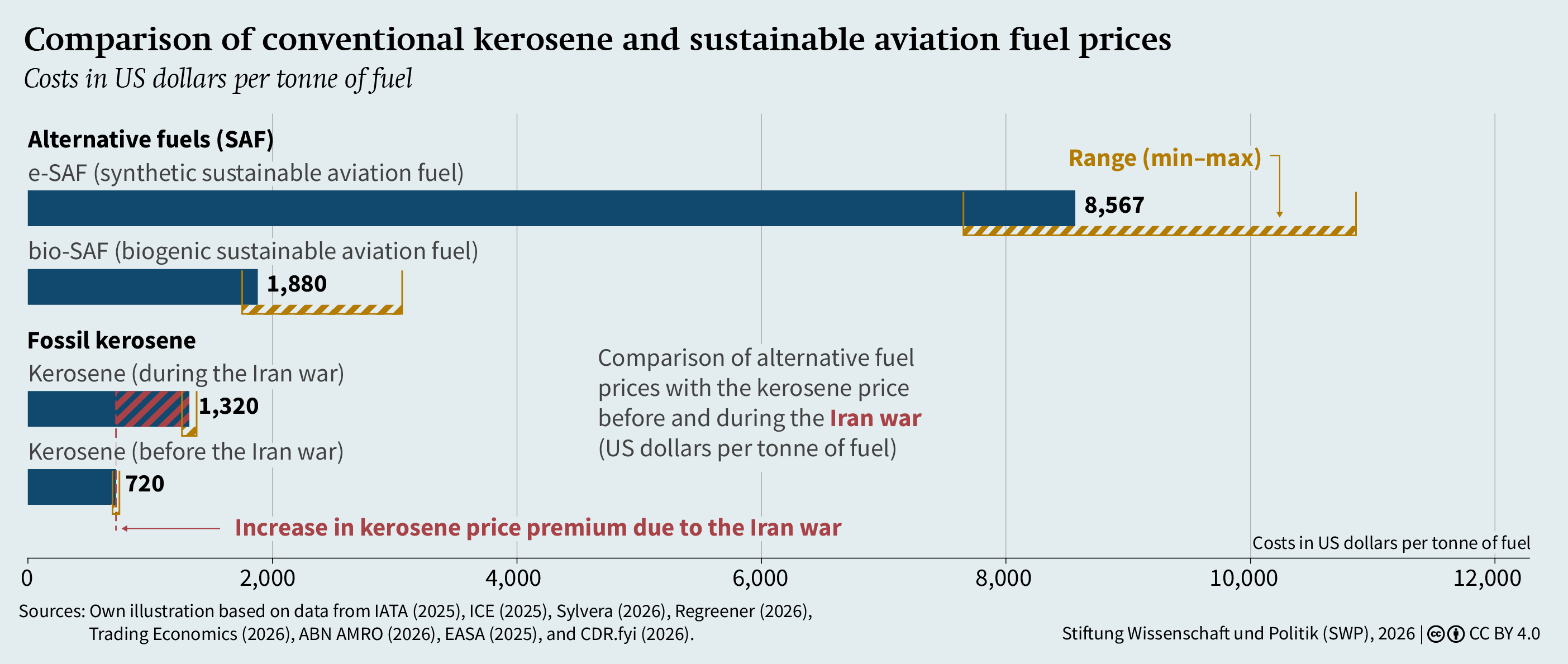
The war in the Middle East has resulted in a stress test for the European aviation industry. Kerosene prices have roughly doubled compared with pre-crisis levels, and Lufthansa has removed around 20,000 flights from its schedule through to October. Both the International Energy Agency and the airport association ACI Europe are warning of fuel shortages, since around a third of the kerosene used in Europe is imported.
Environmental groups and producers of alternative fuels have responded with a “we told you so”, arguing that a more determined scale-up of sustainable aviation fuels (SAFs) would have left Europe less exposed today. The aviation industry and some member states are pushing back firmly against this narrative, pointing out that SAF prices have also risen in recent weeks. SAFs are in fact typically priced at a premium to the fossil wholesale benchmark (gasoil and jet futures) and so cannot escape fossil-fuel price volatility. These arguments are accompanied by further demands: While ACI Europe is pushing for a temporary suspension of aviation taxes, several airlines are calling for existing climate-policy instruments in aviation to be weakened. At the heart of these calls are the EU ETS and the ReFuelEU Regulation, which since 2025 has required a gradually increasing SAF blending quota rising to 70 per cent by 2050.
Under the ETS, only intra-European flights are covered until 2027, whereas flights to third countries remain exempt. There are now calls to reinstate the free allocation of emissions allowances, which was fully phased out in 2026, and to keep aviation’s geographic scope limited in the pending ETS revision. EasyJet and Ryanair, which had supported extending the ETS’s scope in earlier consultation rounds, have reversed their position. Ryanair now even argues for removing intra-European flights from the ETS altogether. When advancing these demands, airlines point to competitive disadvantages for European hubs relative to non-European ones, such as London and Istanbul, where passengers could transfer to avoid SAF and ETS costs (“hub switching”), as well as the high regulatory costs of these instruments. At the same time, the industry has changed its stance on CORSIA, the ICAO’s offsetting scheme for international flights and thus the international counterpart to the ETS. Where CORSIA was until recently regarded within the industry as inadequate, the International Air Transport Association (IATA) and Airlines for Europe are now jointly calling for a “global solution” and for a “strengthening” of CORSIA, with the evident aim of preventing the ETS from being extended to international flights.
|
How the ETS and CORSIA work |
||
|
The EU Emissions Trading System an absolute, declining limit on emissions from the industries it covers (“cap”). Operators, including airlines on intra-European routes, must buy an allowance for every tonne of CO2 emitted (“cap and trade”). The market price forces reductions within the industry, while the revenue remains in the EU and is available for climate investment. By contrast, the Carbon Offsetting and Reduction Scheme for International Aviation (CORSIA), run by the United Nations’ International Civil Aviation Organization (ICAO), is a global offsetting scheme for international flights. Airlines do not reduce their emissions under CORSIA but purchase credits from climate- |
mitigation projects in third countries to offset them. Only emissions exceeding a baseline (set at 85 per cent of 2019 emissions) need to be offset. Until early 2027, the EU exempts international departures from ETS compliance under the “stop the clock” compromise and accepts CORSIA instead. The forthcoming revision will determine whether this exemption comes to an end and the EU ETS is extended to all flights departing the European Economic Area. On the 17th of July 2026, the Commission proposed to extend the ETS only to outgoing flights within 5,000 km of the EU’s geographical centre from 2029 onwards. |
|
As such, the oil crisis risks leading not to better climate policy but to its rollback. A recent precedent shows how far this could go. After nearly two years of political pressure from the automotive industry – backed by Germany, Italy, and several Central and Eastern European member states with large automotive production sites – the EU watered down the 2035 phase-out of combustion engines in the name of competitiveness. Parts of the European aviation industry now appear to be following the same pattern: an alliance of industry and like-minded states using an economic downturn to weaken binding climate targets.
Yet this narrative overlooks a key economic reality. In the current shock, the sales price of SAFs has risen as well, but production costs have remained largely unchanged. This increases producers’ margins and the profitability of new plants. At the same time, the premium over fossil kerosene has narrowed, so that the price gap between SAFs and conventional fuel is shrinking, making the switch more attractive. While the aviation industry cites the crisis as an argument against ReFuelEU, in reality the economics of scaling up SAF production in Europe are improving.
The scale of these costs illustrates the same contradiction. An analysis by Transport & Environment, the umbrella organisation of European NGOs for sustainable transport, puts the additional cost from the Iran crisis at around €90 per passenger on long-haul routes and €29 within Europe. ETS obligations, by comparison, currently add about €7 to an average intra-European flight, while ReFuelEU adds less than €1. The doubling of kerosene prices is thus having a far greater impact on ticket prices than the ETS and ReFuelEU combined. The fear that climate-policy costs would depress demand is also being disproved. Airlines are cancelling flights because of kerosene shortages, not because demand has fallen. Since air fares have fallen substantially over the past three decades, even as consumer prices have generally risen sharply, higher climate-policy costs would likely result in ticket prices that are roughly where they were a few years ago. This removes the rationale for rolling back precisely those instruments that could serve security of supply and long-term climate goals.
ETS and CORSIA at a crossroads
The inclusion of aviation in EU climate law has a long history of delay. When the EU included aviation in the ETS in 2008, it was originally meant to cover all arrivals and departures within the European Economic Area. Under pressure chiefly from China and the United States, which objected to unilateral pricing of their airlines, the EU narrowed the scope to intra-European flights and “stopped the clock” for international routes in 2013, conditional on ICAO developing a global solution in the meantime. In 2016, ICAO agreed on CORSIA, which aimed to offset emissions exceeding 2020 levels. Because emissions fell sharply in 2020 due to the COVID-19 pandemic, the baseline was later adjusted to 85 per cent of 2019 emissions. The “stop the clock” compromise remains in place for international flights until early 2027.
On the 17th of July 2026, the European Commission tabled a legislative proposal to extend the scope of aviation emissions within the ETS, based on an assessment of whether CORSIA meets the requirements of the Paris Agreement and whether participation by third countries is sufficient. This extension concerns only outgoing flights within 5,000 km of the EU’s geographical centre from 2029 onwards. This perimeter cautiously stops short of long-haul routes to the United States and China, where the geopolitical costs of a full extension would be highest. Arriving flights would remain exempt in order to avoid conflicts with third countries. CORSIA implementation under EU law is extended in parallel until 2035. Sufficient ambition, global participation, and environmental integrity of CORSIA were set out as the Commission’s benchmarks for the ETS extension to international flights under Article 28b(2) of the ETS Directive. To date, none of these criteria has been met in substantive terms.
First, the system’s baseline, set at 85 per cent of 2019 emissions, is not very ambitious and is incompatible with the 1.5°C target. Second, CORSIA remains voluntary until 2027 and currently excludes flights involving non-participating states such as Russia, India, Brazil, and China. As a result, CORSIA currently covers only around 60 per cent of international aviation emissions. Third, the scheme’s environmental integrity is questionable. Because CORSIA relies on emissions-reduction credits from other industries, it neither directly reduces aviation emissions nor physically offsets their climate impact. Moreover, the pricing of emissions in itself creates little incentive for transformation: CORSIA credits currently trade at around $10–22 per tonne, since they often originate from low-cost emission reduction projects in developing countries. As such, offsetting via CORSIA credits is always cheaper for an airline than paying the SAF premium over fossil kerosene. The EU ETS, by contrast, forces real emissions cuts through its decreasing absolute cap, reflected in an allowance price of €66–93 per tonne. Finally, the approval of recognised carbon-crediting programmes is slow and inconsistent, and the environmental quality of many credits remains disputed.
Article 6.4 as an “upgrade” and its risks
Given CORSIA’s low level of ambition, a third option to tackle those flights that remain excluded from the ETS is to add a quality filter to CORSIA by using Article 6.4 of the Paris Agreement as the benchmark for eligible credits. This “CORSIA Plus” approach rests on the expectation that Article 6.4 credits, as the successor to the widely criticised Clean Development Mechanism, would be subject to stricter requirements on additionality, transparency, and the avoidance of double counting, and would therefore be of higher quality. The idea fits into a broader EU trend towards integrating Article 6 into its climate-policy architecture, for example into the 2040 climate target and, potentially, into instruments such as the Carbon Border Adjustment Mechanism (CBAM).
While Article 6.4 could establish stricter quality standards than older mechanisms, the CORSIA Plus approach carries three risks.
First, the supply of high-quality Article 6.4 credits that genuinely go beyond host countries’ nationally determined contributions (NDCs), rule out double counting, and meet strict safeguards is likely to remain scarce for the foreseeable future, since demand already outstrips supply today. Under a CORSIA Plus scenario, the EU alone would need credits amounting to around 80 million tonnes, while only about 32 million tonnes of CORSIA-eligible units are currently available across all voluntarily participating states, not just for the EU. From 2027, when CORSIA becomes mandatory for most states involved in international aviation, demand pressure is likely to rise further. At the same time, the EU’s 2040 target architecture and complementary instruments such as CBAM will, within a few years, be competing for large volumes of high-quality Article 6.4 credits. Credits tied up in aviation would be unavailable elsewhere.
Second, implementing such a quality filter within the CORSIA architecture is structurally difficult. Article 6.4 credits are not automatically recognised under CORSIA, but must be approved by ICAO and authorised via a letter of authorisation from the host country. Once accepted, they become available to all airlines in the recognised registries, not just European ones. This spillover of European regulatory standards into the global market (elsewhere known as the “Brussels effect”) would in this case work against the EU. Since demand for CORSIA credits is already clearly outstripping supply, the introduction of a quality filter at the EU level might draw more Article 6.4 credits into the CORSIA market. In turn, this would also intensify global competition for those units, pulling credits away from the EU’s own 2040 target architecture, where they are needed. A rule that applied exclusively to EU airlines would be hard to enforce within CORSIA’s architecture, which is meant to be global and originates from a level-playing-field logic.
Third, this approach carries the risk of political lock-in. Once established, a CORSIA Plus architecture would be politically very difficult to reverse, cementing offsetting as Europe’s paradigm for international aviation. That would reinforce the notion that the industry’s residual emissions can be compensated through mitigation credits from other industries, rather than through durable carbon dioxide removal (CDR), which is the only option that delivers a genuine physical offset. Because today’s CORSIA compromise is considered close to the ceiling of what can be achieved multilaterally within ICAO, a later increase in ambition aligned with the 1.5°C target remains unlikely. This highlights the risks of relying on this instrument for achieving ambitious emissions reductions in the EU’s aviation industry.
Full integration of international aviation in the ETS
Bringing all flights departing from the European Economic Area into the EU ETS from 2027 would have several structural advantages over the CORSIA Plus path. Currently, around 60 per cent of CO2 emissions from departures at European airports to third countries remain outside ETS carbon pricing altogether. Full integration into the ETS would substantially increase the share of aviation emissions subject to an absolute cap and carbon pricing. Unlike CORSIA, the ETS generates revenue for the EU through the sale of emissions allowances. If the ETS were extended to all outbound flights, roughly 80 million additional tonnes of CO2 would fall under the cap each year, compared with around 64 million tonnes currently covered from intra-European flights. The Commission’s recent proposal moves cautiously in this direction, although it would generate less than half the revenues that a full-scope extension would raise. These additional ETS revenues from international departures could open up substantial fiscal room. They could be earmarked for decarbonising the industry, for example through investment in SAF production, distribution, and refuelling infrastructure to accelerate the shift away from crude-oil-based kerosene; measures addressing non-CO2 effects, particularly large-scale testing of contrail avoidance; and the early-stage scale-up of durable CDR technologies.
Using the revenues in this way would also strengthen coherence with ReFuelEU. ReFuelEU mandates minimum SAF blending quotas and gives producers market certainty, while ETS carbon pricing raises the cost of fossil kerosene, narrows the price gap with SAFs, and allows earmarked revenues to possibly mobilise further investments. The Commission’s proposal moves in this direction by recycling a portion of the new aviation allowances to SAF uptake, electrification, and cost-effective contrail-mitigation measures.
Finally, ETS integration is supported by a long-term argument that the CORSIA path lacks. Even if ReFuelEU cuts a substantial share of today’s aviation emissions through physical substitution of fuels by 2050, residual emissions will remain that neither efficiency gains nor SAFs alone can eliminate. Under CORSIA, these would be offset by mitigation credits from other industries without physically reducing aviation emissions. Under the ETS, by contrast, aviation emissions would fall under the cap and would need to be brought down to (net) zero over the long term.
Politically, full ETS integration is demanding, especially vis-à-vis third countries that criticise it as a unilateral extension of European climate law. However, with CBAM the EU already has a recognised precedent for climate measures with extraterritorial effect, and bilateral agreements offer scope for mitigating adverse impacts. Forgoing an ETS extension, on the other hand, would mean permanently ceding the level of ambition of European aviation policy to a system whose design lies outside European control.
CO2 removal is unavoidable
Full implementation of ReFuelEU, the main instrument of European aviation climate policy, would cut net CO2 emissions from European aviation by at least 47 per cent by 2050. Electric and hydrogen-powered aircraft could contribute a further 5 per cent. Even under these assumptions, more than 40 per cent of today’s emissions would remain as structural residual emissions. Raising the SAF quota to 100 per cent is unrealistic even with a strengthened ReFuelEU, since sustainable feedstocks for bio-based SAFs are available only in limited quantities, while synthetic e-SAFs are expensive and energy-intensive. According to IATA, at least 20 per cent of the industry’s emissions cannot be avoided with the technology portfolio currently foreseeable.
To physically offset these residual emissions, an equivalent amount of CO2 must be permanently removed from the atmosphere. CDR therefore plays an indispensable role for aviation. This role may be even greater than a maximum SAF build-out would suggest, since CDR can deliver the same mitigation effect as SAFs at a fraction of the cost. Even the most expensive durable CDR options, such as direct air capture with carbon storage (DACCS), are cheaper than synthetic e-SAFs from non-biogenic feedstocks, once full system costs are considered. However, no mechanism currently gives CDR a substantial role in aviation policy. In principle, durable CDR projects could be authorised under CORSIA, but no such project has been accredited so far. Even if durable CDR credits were available under CORSIA, airlines are unlikely to purchase them as long as much cheaper emission reduction credits can also be deployed to meet CORSIA’s obligations.
The recent revision of the European Climate Law, together with the Commission’s proposal on the ETS revision, is expected to create a way to reconcile the ETS’s path to net zero with the reality of residual industry emissions by integrating durable CDR into the ETS. Full inclusion of European departures in the ETS, combined with this CDR integration, which is explicit in the Commission’s proposal, would add the CDR component that has been missing from aviation climate policy. Modelling results suggest aviation could become the largest source of demand for DACCS and durable biogenic CDR within the ETS. Extending aviation’s coverage under the ETS would thus create the kind of investment incentive that the EU is otherwise trying to generate elsewhere through support instruments as part of its carbon management strategy.
|
Figure 1
|
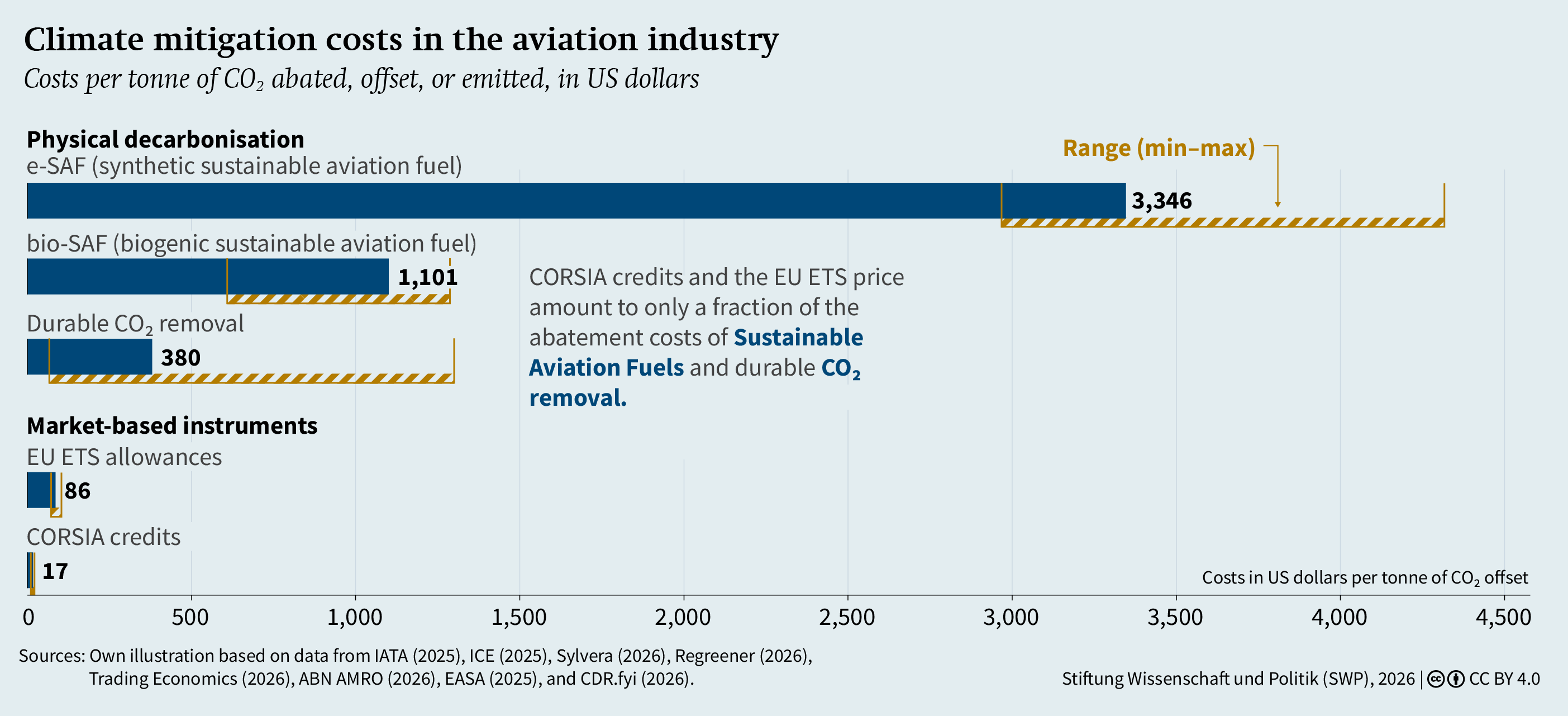
Full ETS integration is not the only way to pursue both emissions reductions in aviation and CDR scale-up simultaneously. Another option would be to introduce durable CDR into ReFuelEU as a limited flexibility or compliance mechanism. For example, a capped share of the SAF quota could be met with equivalent volumes of high-integrity CDR instead, or CDR could serve as part of a penalty mechanism for non-compliance. Under strict durability and integrity criteria, this would preserve the ambition level, since emissions would need to be offset one-to-one in terms of their atmospheric impact. The UK’s SAF mandate already includes a comparable regulatory opening for CDR. This route, however, has two drawbacks compared with ETS integration. First, it would not raise the level of ambition for emissions reductions in aviation beyond what ReFuelEU already requires. Second, CDR would substitute for SAFs rather than compensate for residual emissions, slowing urgently needed investment in SAFs, which in turn could entrench dependence on fossil kerosene and increase geopolitical supply risks.
Conclusion
Amid the kerosene shock triggered by the Iran war, four implications emerge for EU aviation policy.
First, the EU should not use the crisis as a pretext to extend the “stop the clock” exemption or weaken ReFuelEU. Available data show that the main driver of current cost increases in aviation is fossil-fuel price volatility, not climate policy. Diluting ETS or SAF quotas now would only deepen the dependency whose costs are currently becoming apparent.
|
Figure 2
|
Second, the EU should resist the temptation to make CORSIA a long-term cornerstone of its aviation policy, including by enhancing the scheme via an Article 6.4 quality filter. Such a CORSIA Plus architecture would tie up scarce high-integrity credits in an offsetting scheme that is incompatible with the EU’s climate-neutrality goals and would place them in competition with other uses. If CORSIA continues to be used, it should do so only in a subsidiary role, for example for incoming flights from third countries exempted by the ETS – and provided it raises its ambition floor, such as via an explicit CDR component.
Third, from 2027, all flights departing from the European Economic Area should be brought under the ETS, with no new “stop the clock” exemption. The additional ETS revenue from international aviation should be earmarked. Combined with integrating CDR into the ETS, this would create an incentive to scale up durable removals. At the same time, the EU should not bow to pressure to water down ReFuelEU. As a concession to the aviation industry, durable CDR could be introduced into ReFuelEU as a limited flexibility or penalty mechanism at most, tied to strict durability and integrity criteria, with clear limits on its use so that SAF scale-up is not undermined.
The Commission’s proposal moves in the right direction, but it misses an opportunity due to the limited scope of the ETS extension. Although this constraint seeks to address objections raised by individual member states and the industry, for instance concerning the competitiveness of European hubs, it disregards evidence suggesting that route diversion to avoid ETS pricing would remain limited. The EU has already developed industry-specific safeguards against competitive distortion in other areas. A similarly tailored approach for particularly exposed long-haul routes could be considered as part of the revision package.
In sum, the EU should not further entrench aviation’s reliance on traditional offset credits. Instead, it should leverage the current crisis to anchor the industry around three interconnected pillars: ETS integration, SAF scale-up, and a transparent, high-integrity CDR strategy.
Dr Nicoletta Brazzola is a Research Associate in the research division EU/Europe of SWP and works in the project “CDR policies for the next decade of EU climate governance (CDRnext)”.
This work is licensed under CC BY 4.0
This Comment reflects the author’s views.
SWP Comments are subject to internal peer review, fact-checking and copy-editing. For further information on our quality control procedures, please visit the SWP website: https://www.swp-berlin.org/en/about-swp/ quality-management-for-swp-publications/
SWP
Stiftung Wissenschaft und Politik
German Institute for International and Security Affairs
Ludwigkirchplatz 3–4
10719 Berlin
Telephone +49 30 880 07-0
Fax +49 30 880 07-100
www.swp-berlin.org
swp@swp-berlin.org
ISSN (Print) 1861-1761
ISSN (Online) 2747-5107
DOI: 10.18449/2026C28
(Updated English version of SWP‑Aktuell 29/2026)