Ankara’s Critical View of the EU–India Free Trade Agreement

Turkey Is Emphatically Calling for the Modernisation of the Customs Union with the EU
SWP Comment 2026/C 12, 13.03.2026, 8 Seitendoi:10.18449/2026C12
ForschungsgebieteThirty years after establishing a customs union with the European Union (EU), Ankara sees growing economic risks in the EU’s free trade agreements with third countries, most recently India. While negotiations on the EU–India Free Trade Agreement were concluded at the end of January, and security cooperation between the EU and India is now also to be expanded, Ankara remains on the sidelines. From Turkey’s perspective, the agreement could also weaken its significance in the EU’s strategic calculus. Ankara is therefore making a strong case for the modernisation of the customs union. It cannot be ruled out that the structural asymmetries of the customs union will become even more entrenched to Turkey’s detriment: Market integration without political participation may place Turkey at a lasting disadvantage and strain its relations with the EU. Once the free trade agreement enters into force, Indian products will gain easier access to the Turkish market, whereas Turkish products will not gain corresponding access to India. Due to geopolitical differences with India, Turkey also sees risks to its own regional interests. Brussels and Berlin could use this constellation to put cooperation with Ankara on a viable institutional footing.
European Commission President Ursula von der Leyen regards the free trade agreement with India as a milestone in bilateral economic relations between the world’s “largest democracies”, while India’s Prime Minister Narendra Modi has even described it as the “mother of all agreements”. European Council President António Costa sees the agreement as potentially opening a new phase in relations that would extend beyond trade to include security cooperation.
At the World Economic Forum in Davos in January this year, German Chancellor Friedrich Merz described the free trade agreement as an opportunity to take joint action against growing protectionist tendencies and political isolationism. He emphasised that countries committed to “rules-based order” – such as Germany, the EU member states and India – benefit from open markets and should therefore stand together.
Whereas the free trade agreement is seen as both an economic and a geopolitical gain in Germany and other EU countries, scepticism predominates in Turkey. From a Turkish perspective, the agreement is a warning sign: Europe’s economic and political geography is being reshaped, while Turkey – as a member of the customs union with the EU – risks having to comply with rules over which it has had no say.
The free trade agreement and its relevance for the EU–Turkey Customs Union
The free trade agreement between the EU and India provides for the reduction of 90 per cent of customs duties. This will give both sides extensive market access in the trade of goods and services as well as investments. Annual EU goods exports to India are expected to increase by 107.6 per cent by 2032. Key industrial sectors such as mechanical engineering, chemicals, pharmaceuticals and automotive components, as well as selected services sectors including IT, financial and professional services, are expected to benefit in particular.
The market opening is accompanied by provisions on investment protection, regulatory cooperation and intellectual property protection, as well as by mechanisms designed to simplify customs and trade procedures. At the same time, the agreement embeds commitments on labour, environmental and sustainability standards. Transition periods and exemptions ensure that parts of the agricultural sector remain protected. Overall, the agreement aims at a long-term, rules-based deepening of economic relations, and at strengthening India’s strategic integration into the European market.
The EU–India Free Trade Agreement must be seen in the context of global geopolitical and economic shifts as well as increasing neo-mercantilist protectionism, as exemplified by disputes over tariffs. With this agreement, the EU aims to intensify economic cooperation with India, open up new export markets, expand its economic presence in the Indo-Pacific and reduce its dependence on China. India, for its part, will use cooperation with the EU to accelerate its economic and technological modernisation. This is considered a key prerequisite for the country’s desired stronger role on the international stage.
For Turkey, the relevance of the EU–India Free Trade Agreement is derived primarily from the EU–Turkey Customs Union and is chiefly economic in nature. Established in 1996, the customs union covers almost all industrial goods; excluded are basic agricultural products and coal and steel products, for which separate preferential agreements are in place. These agreements grant tariff preferences only to so-called originating goods, that is, products wholly obtained in one of the contracting parties or sufficiently processed there using non-originating materials. The specific rules of origin are set out in the relevant origin protocol.
This situation creates economic risks for Turkey: Products from a country with which the EU has concluded a free trade agreement can circulate duty-free on the EU market and, due to the customs union, also in Turkey. Therefore, Turkish business stakeholders and experts believe that the EU–India Free Trade Agreement poses economic policy challenges. The debate on the agreement therefore focuses on the customs union rather than on India, especially in relation to three issues.
First, the debate led by political decision-makers and business stakeholders – and followed closely in the media – points to the institutional asymmetry between Brussels and Ankara. As part of the customs union with the EU, Turkey is bound by the trade regulations and tariff rates resulting from new free trade agreements concluded by the EU with third countries; however, it is not involved in shaping them, which leads to structural disadvantages. Against this backdrop, Turkey’s concerns focus on the impact of such EU free trade agreements on its trade relations with the EU: As a member of the customs union, Turkey must adopt the tariffs agreed by the EU with third countries.
Among experts and decision-makers in Turkey, the EU–India Free Trade Agreement is widely perceived as a clear distortion of competition. The reason is that Indian industrial goods will in future be able to enter the EU internal market, and thus also the Turkish market, duty-free or at low tariff rates, while Turkish exporters will not have comparable access to the Indian market. Accordingly, calls for the customs union to be modernised are growing louder, especially as a growing number of EU free trade agreements – including those with Mercosur, Vietnam and the United Kingdom – now open the Turkish market to third countries.
A modernisation of the EU–Turkey Customs Union would likely include the following: expansion to new sectors such as services, agriculture and public procurement; the elimination of structural asymmetries through better integration of Turkey into EU free trade agreements with third countries; and the introduction of a binding dispute-settlement mechanism. In 2016, the European Commission recommended revising the customs union along these lines in a report.
Leading Turkish business representatives recently emphasised in a letter to senior EU figures that modernising the customs union is crucial to Europe’s stability and competitiveness. Nail Olpak, President of the Foreign Economic Relations Board of Turkey (Dış Ekonomik İlişkiler Kurulu, DEİK), and the chairpersons of the bilateral Turkey–Europe Economic Councils (Türkiye-Avrupa İş Konseyleri) are calling for a “paradigm shift” in EU–Turkey relations. In their view, the Copenhagen criteria of 1993 – compliance with which is a precondition for EU accession – must be redefined as they consider them “inefficient”. In the letter, they present the modernisation of the customs union as a means of strengthening European competitiveness. Given the close institutional links between the Economic Councils, DEİK and the government, the statement appears to have been coordinated with President Recep Tayyip Erdoğan.
On 4 December 2025, President Erdoğan appealed to EU decision-makers, urging them to take Turkey into account should public authorities in future give preference to “Made in Europe” cars in procurement – in an attempt to limit Turkey’s economic disadvantage and loss of influence in the European market. However, the customs union does not entitle Turkey to have its goods automatically included in the EU’s preference policy. The “Made in Europe” initiative, part of the broader “European preference” agenda, is intended in future to favour products manufactured predominantly in the EU in order to strengthen industry, value creation and employment; the relevant regulations have not yet entered into force.
Second, from an economic perspective, the EU–India Free Trade Agreement is seen as a potential challenge for Turkish exports to the EU, for Turkey’s integration into EU supply chains and for foreign direct investment. Another relevant factor is the expected increase in Indian exports to Turkey, which could further increase its trade deficit with India. (See the following two sections.)
Industry representatives have expressed similar concerns. Mustafa Paşahan, Vice-President of the Istanbul Apparel Exporters’ Association (İstanbul Hazır Giyim ve Konfeksiyon İhracatçıları Birliği, İHKİB), points out that tariff-free imports from India could place further pressure on the Turkish textile industry, distort competition and lead to further job losses. The sector is already facing considerable challenges: The value of exports in the apparel sector, which has traditionally played a central role in the Turkish economy, fell from US$21.2 billion in 2022 to US$16.8 billion in 2025. At the same time, employment in this sector declined over the past three years, from 1.2 million to around 860,000.
Erdal Bahçıvan, President of the Istanbul Chamber of Industry (İstanbul Sanayi Odası, İSO), emphasises that the customs union has increasingly become a brake on industrial growth and urgently needs to be modernised. If this does not happen, Turkey risks losing important market share in its largest export market, the EU.
In contrast, Turkish Trade Minister Ömer Bolat downplayed the potential impact of the free trade agreement between the EU and India, reassuringly pointing out that Turkey was not expected to suffer any significant losses on the EU market.
Third, there is concern that Turkey may weaken its significance in Europe’s geostrategic and security calculus. The state news agency Anadolu Ajansı reported on the conclusion of the free trade agreement under the headline: “EU and India sign security and defence cooperation agreement”. In doing so, it deliberately focused on the agreement’s security and defence policy dimension.
Implications for EU-Turkey trade, supply chain interdependence and investments
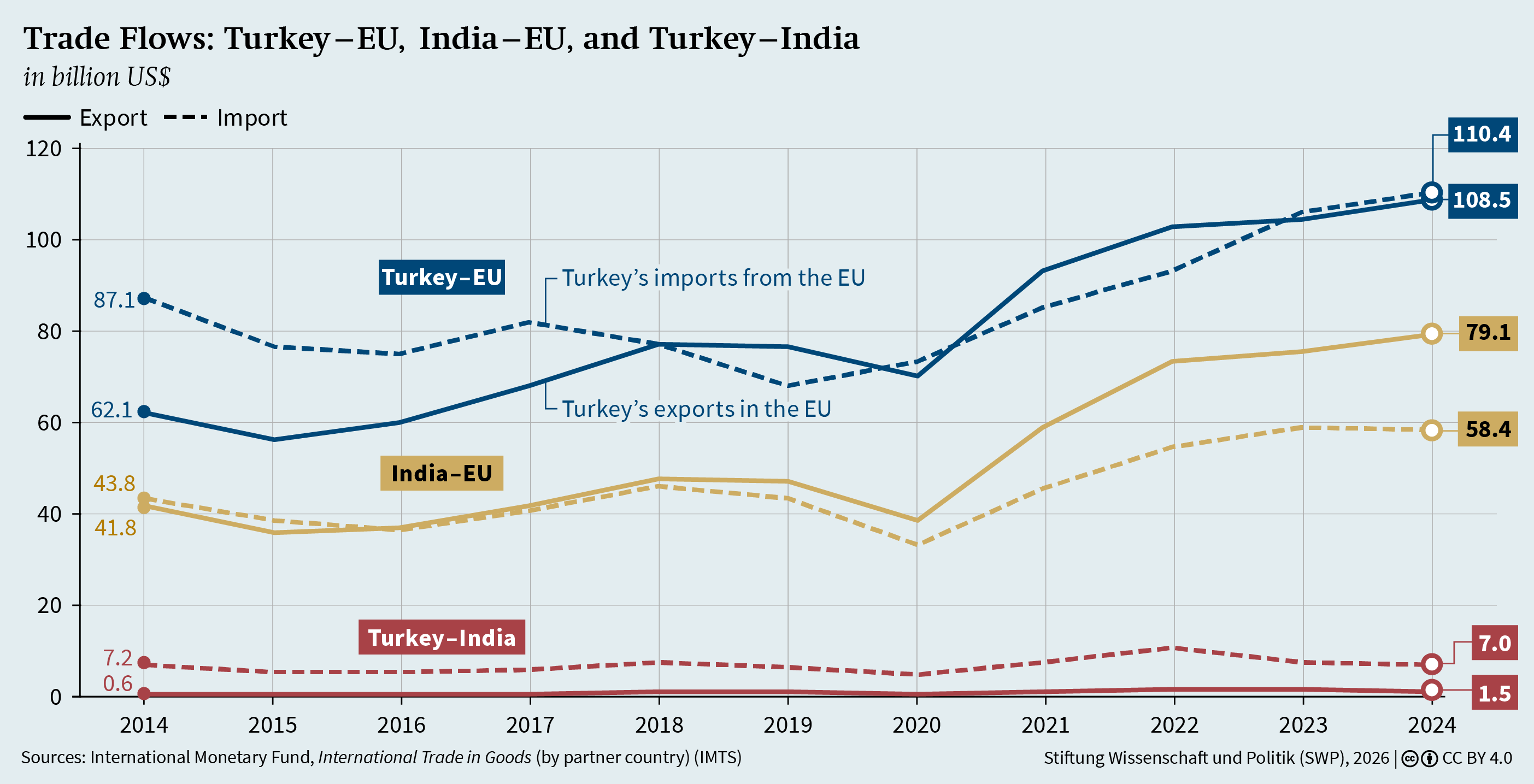
The EU–Turkey Customs Union, established in 1995, has intensified bilateral economic relations and made the EU Turkey’s most important trading partner and principal export market. In 2024, bilateral trade reached a record value of US$218.9 billion (see figure), with around 41 per cent of Turkish exports going to the EU and 32 per cent of Turkish imports originating there. A comparison of Turkish and Indian exports to the EU reveals the following picture: Turkey’s exports to the EU amounted to US$108.5 billion in 2024, while India’s totalled US$79.1 billion. Turkish business figures are expressing concern that the EU–India Free Trade Agreement could weaken the competitive position of Turkish exports in the EU vis-à-vis Indian supplies in the long term.
Turkey’s exports to the EU consist primarily of vehicles and automotive parts, machinery, mechanical products, textiles, and iron and steel, whereas India supplies machinery, technical equipment, chemicals, textiles and mineral products. The overlap in export profiles could intensify competition on the EU market. With the entry into force of the EU–India Free Trade Agreement, India’s growing export volume is likely to increase pressure on Turkish manufacturers in these key sectors and to test their price competitiveness and innovative capacity in Turkey’s most important export market.
The EU–India Free Trade Agreement could pose an additional challenge to Turkey’s trade ties and supply chain links with the EU. Turkey is pursuing an industrial and supply chain strategy aimed at aligning with the European Green Deal, advancing decarbonisation and strengthening Turkish exporters in European value chains. Duty-free access for Indian industrial goods to the EU market could undermine these efforts, intensify competition and lead to reduced cooperation with Turkish firms and the establishment of new partnerships with Indian ones. Consequently, a cooling of bilateral trade cannot be ruled out, as the barriers created by the outdated EU–Turkey Customs Union could be reinforced by the EU–India agreement. These barriers include the limited scope of the customs union, structural asymmetries, technical regulatory differences, visa problems affecting business travellers, transport quotas and other administrative hurdles.
In terms of investment, the provisions on investment protection and the facilitation of trade and regulation accompanying the EU–India agreement could enhance India’s locational advantages over Turkey for European investors. As a result, it is conceivable that some investment decisions from which Turkey might previously have benefited will now tilt in India’s favour. This could weaken the momentum of EU investment flows into Turkey.
Implications for bilateral trade between Turkey and India
Beyond its potential impact on EU–Turkey trade, the free trade agreement between the EU and India also carries the risk of directly affecting Turkey’s foreign trade. This could occur if the existing trade imbalance with India were to widen further.
With the liberalisation of the Turkish economy in the 1980s and the opening up of the Indian economy in the 1990s, bilateral trade began to grow but remained below US$1 billion until the early 2000s.
The 2010s saw a significant acceleration in the growth of bilateral trade between Turkey and India. Between 2014 and 2022, trade volume grew from US$7.8 billion to a historic high of US$12.3 billion (see figure). Throughout this period, Turkish exports to India lagged behind imports from India, with the trade balance largely favouring India. In 2023, Turkey’s exports to India were valued at US$1.6 billion, while imports from India stood at US$7.9 billion.
In 2024, bilateral trade fell to US$8.5 billion. Early indicators for 2026 point to a continuation of this trend. The causes include geopolitical tensions, temporary trade disruptions and declining demand in individual sectors. Nevertheless, India remains an important supplier country for Turkey, while Turkey continues to play only a subordinate role in the Indian market.
The EU–India Free Trade Agreement is likely to boost Indian exports to Turkey, thereby further exacerbating the trade imbalance.
Geopolitical and geoeconomic rivalry between Ankara and New Delhi
Although the EU–India Free Trade Agreement is not directly linked to Turkey’s geopolitical interests, it does have indirect geopolitical relevance. Failure to modernise the EU–Turkey Customs Union, resulting in declining trade and loss of growth, would weaken Turkey’s security and geopolitical interests.
The conclusion of the EU–India Free Trade Agreement was facilitated by a geopolitical constellation in which Europe is under pressure: on the one hand, in terms of security policy from Russia, and on the other from the rivalry between the major powers of the United States and China. The growing strategic conflict in the Indo-Pacific and the trade disputes between Beijing and Washington are placing a considerable strain on global trade and international security. China is building an increasingly dense network of regional dependencies, while the United States is forging new alliances and revitalising existing ones. In this context, Taiwan is considered a geostrategic “domino” whose destabilisation would have far-reaching implications for the regional and global security architecture.
Against this backdrop, India is gaining strategic importance as a regional counterweight to China, with which it has been embroiled in a long-standing conflict. The experience of the 1962 war and the border clashes of 2020 continue to shape India’s security doctrine. Although India is intensifying its cooperation with the United States, it is maintaining its traditional policy of neutrality and has no formal military ties with the West.
Whether India will enter into closer security cooperation with the EU remains to be seen. For the EU, however, the free trade agreement with India forms part of a broader strategic calculus, which is to position India as an economically and politically strengthening counterweight to China and to distance it from Russia. Germany and the EU therefore have a strong interest in a prosperous India that helps to constrain China’s power. From Turkey’s perspective, however, India is less important as a global counterweight to China than as a regional rival to Pakistan and an indirect but relevant competitor in the Middle East balance of power. Turkey maintains security relations with Pakistan and Bangladesh.
Turkish experts view the EU–India agreement as a factor that strengthens India economically and enables it to expand its position of power in the region at Turkey’s expense. India could thus support countries with which Turkey has tense relations, such as Israel, the United Arab Emirates (UAE), Greece and Cyprus. India cooperates with these countries in the areas of defence, security technology, drones, missile systems and cybersecurity.
Turkey views the Indian Navy’s participation in joint manoeuvres with Greek and Greek Cypriot naval forces in the eastern Mediterranean as a challenge. India also maintains close ties with the Republic of Cyprus, reflecting its growing interest in gas reserves and energy projects in the region. Conversely, India is closely monitoring Turkey’s growing maritime influence in the eastern Mediterranean, the Red Sea and the Indo-Pacific, particularly the Turkish Navy’s cooperation with Pakistan.
Another geoeconomic point of divergence between Turkey and India is the India–Middle East–Europe Economic Corridor (IMEC) project, unveiled at the G20 summit in New Delhi in September 2023. Its aim is to connect Indian markets to Europe via the Middle East. The project is supported by India, the United States and the EU, as well as Gulf and Mediterranean states. IMEC envisages two main corridors: an eastern one from India via the UAE, Saudi Arabia and Jordan to Israel, and a northern one from Israel to Europe. Smart infrastructure, green energy and digital connectivity are intended to make the corridor a sustainable, multilateral and private-sector-oriented alternative to China’s Belt and Road Initiative. Turkey, on the other hand, is not part of IMEC. President Erdoğan has openly criticised the project and is instead promoting the Iraq Development Road Project, a competing corridor via Iraq and Turkey. This illustrates that the differences between the two projects are not only logistical in nature but also reflect deeper geopolitical divergences.
Given their geopolitical differences, relations between Turkey and India remain largely confined to trade and multilateral diplomacy. Although economic contacts and diplomatic exchanges have increased since the 2000s, political trust has hardly deepened. The security policy positions from the Cold War era continue to have an impact today: Turkey is firmly integrated into NATO, while India, as a non-aligned state, was closer to the Soviet Union.
Formal diplomacy, multilateral contacts and occasional ministerial meetings characterise the relationship. A lack of strategic dialogue, irregular summit meetings and diverging regional visions prevent any easing, let alone an intensification, of bilateral relations. This is particularly evident in the Kashmir conflict: Turkey’s support for Pakistan and references to United Nations resolutions are perceived as political interference in India, and President Erdoğan’s statements on Kashmir have heightened tensions in New Delhi.
Turkish experts and decision-makers often tend to think in terms of a zero-sum game. As a result, potential overlaps with India in terms of broader global objectives are overlooked, including joint support for the reform of international institutions and recognition of the shift away from a unipolar world order. Possible points of departure for security cooperation therefore remain unexploited.
Implications for the EU and possible course of action
In the context of geopolitical and geoeconomic dynamics, the rivalry between the major powers of the United States, China and Russia, and growing neo-mercantilist isolationist tendencies, the EU–India Free Trade Agreement is a success. The agreement is expected to strengthen economic relations between Europe and India, help reduce both parties’ dependence on China and, at the same time, send a signal against protectionist tendencies.
The EU–India Free Trade Agreement is likely to have made it clear to Ankara that Turkey is not economically indispensable to the EU. Nevertheless, the Turkish market is likely to remain economically and strategically relevant to the EU in the short to medium term, even if market shares of European companies and the already declining investments could increasingly go to India. The agreement has not yet been ratified, many details still need to be clarified, and any tangible effects on trade and the wider economy are unlikely to be felt until 2030. Nevertheless, Ankara is already in a state of alarm – a moment that the EU could use to realign its relations with Turkey.
It is advisable for Brussels to strategically stabilise these relations and ensure reliable cooperation in the economic and security spheres so that any shifts in global economic and security policy do not come at Turkey’s expense. As part of the customs union and a key NATO partner, the country remains important to Europe’s economic and security architecture.
In view of domestic developments in Turkey, resuming EU accession negotiations does not appear realistic or politically advisable at present. The reasons for this are the continuing erosion of democracy, structural deficits in the rule of law and the persistent curtailment of civil liberties. Against this backdrop, modernising the EU–Turkey Customs Union is the most appropriate instrument currently available. Modernisation could sustain Turkey’s economic integration with the EU while at the same time consolidating its security and foreign policy orientation towards the Union.
Looking at the geopolitical and security challenges facing the EU, it is in Brussels’ strategic interest to prevent an economic decoupling from Turkey. An economically stable Turkey oriented towards Europe is important from both a trade and security perspective. Continued economic interdependence constitutes a key instrument through which the EU can anchor Turkey more firmly to itself.
If economic interdependence were to weaken, this would increase the risk of Turkey becoming politically and economically destabilised, drifting away from Europe geopolitically and becoming a security risk on the EU’s external borders. Against this backdrop, the approach pursued by Chancellor Merz appears consistent: He has opened up a European prospect for Turkey, while clearly linking it to conditions, above all compliance with the Copenhagen criteria. In doing so, he combines the consolidation of European–Turkish relations with the safeguarding of European interests.
The EU should make targeted use of politically resolvable issues to deepen Turkey’s economic and strategic integration. Such an approach would create incentives both to remove practical trade barriers and to facilitate Turkey’s participation in European programmes and initiatives. Particularly relevant in this context would be the following:
-
Concrete progress on visa liberalisation, which is of great symbolic and practical importance for the Turkish economy and civil society.
-
Integration into the emerging European security infrastructure to deepen cooperation on crisis management, energy security and supply chain security.
-
Turkey’s participation in the EU’s Security Action for Europe (SAFE) financial instrument, which is designed to strengthen the European defence industry. The aim of SAFE is to expand the industrial and technological base of European defence, increase production capacity and close capability gaps through the joint procurement of priority capabilities. Turkey’s participation would help align the country’s defence industry with European security and compliance standards.
-
An intensification of cooperation under Horizon Europe in order to link Turkish research and innovation more closely with European networks.
These measures would not only contribute to Turkey’s economic stabilisation but also strengthen political ties and create a solid foundation for modernising the EU–Turkey Customs Union. On this basis, the EU would retain its strategic room for manoeuvre vis-à-vis Ankara and could use it over the medium to long term to promote cooperative formats and support Turkey’s gradual alignment with European standards.
Dr Yaşar Aydın is Researcher at the Centre for Applied Turkey Studies (CATS) at the SWP.
The Centre for Applied Turkey Studies (CATS) is funded by Stiftung Mercator and the German Federal Foreign Office.
This work is licensed under CC BY 4.0
This Comment reflects the author’s views.
SWP Comments are subject to internal peer review, fact-checking and copy-editing. For further information on our quality control procedures, please visit the SWP website: https://www.swp-berlin.org/en/about-swp/ quality-management-for-swp-publications/
SWP
Stiftung Wissenschaft und Politik
German Institute for International and Security Affairs
Ludwigkirchplatz 3–4
10719 Berlin
Telephone +49 30 880 07-0
Fax +49 30 880 07-100
www.swp-berlin.org
swp@swp-berlin.org
ISSN (Print) 1861-1761
ISSN (Online) 2747-5107
DOI: 10.18449/2026C12
(English version of SWP‑Aktuell 8/2026)