India’s Space Policy

Interests, International Cooperation and Conflicting Goals
SWP Research Paper 2026/RP 09, 04.06.2026, 34 Seitendoi:10.18449/2026RP09
ForschungsgebieteDr Tobias Scholz is Associate in SWP’s Asia Research Division.
He would like to thank the Fritz Thyssen Foundation for the travel grants that enabled a research visit to four Indian cities in July 2025. He would also like to thank Simona Beckemeier for her support with the literature review and Arthur Buliz for creating the figures.
-
The Indian government is seeking to expand the country’s space programme in order to strengthen national security, promote economic growth and bolster India’s global standing. Its aim is to achieve strategic autonomy in the field of civilian space activities and technological sovereignty in the military sphere.
-
In the area of security policy, India’s quest for sovereign capabilities is a race against time owing to its rivalry with China. But despite improved investment and regulatory conditions, there has not yet been any significant progress towards the development of a robust and competitive space economy.
-
India’s most important strategic partner in the space sector is the US, with which it closely cooperates on trade, security and intelligence matters.
-
In the field of civilian space activities, however, there is a growing interest in cooperation with European actors. India wants to attract more investment into the country, close technology gaps and diversify its partnerships.
Table of contents
2 A “Developing Country” Becomes a Space Power
2.1 Enabling factors and interests
2.2 Background on India’s space cooperation
2.3 Political institutions and power
3 Growing Significance of the Space Economy
3.1 The liberalisation of the space economy
3.2 Make in India: Space trade and investment policy
3.3 Technology cooperation opens doors
4.1 Rivalries serve as starting point for reforms
4.3 Reconnaissance and navigation
5 Strengthening India’s Role in the Region
5.2 Bilateral technical cooperation
6.1 The quest for status and recognition
6.2 Conceptions of the global order
Issues and Conclusions
On 23 August 2023, India became the fourth country to land an unmanned probe on the moon. The Chandrayaan-3 mission of the Indian Space Research Organisation (ISRO) is exemplary of India’s ambition to position itself as a key player in international space policy. Four years earlier, in 2019, India successfully tested an anti-satellite weapon (ASAT). The test underscores that under Prime Minister Narendra Modi, India’s space policy has also gained significance as a pillar of its security policy. More recently, India has initiated institutional reforms to better integrate its more than 60-year-old space programme into military command structures and attract foreign private investment.
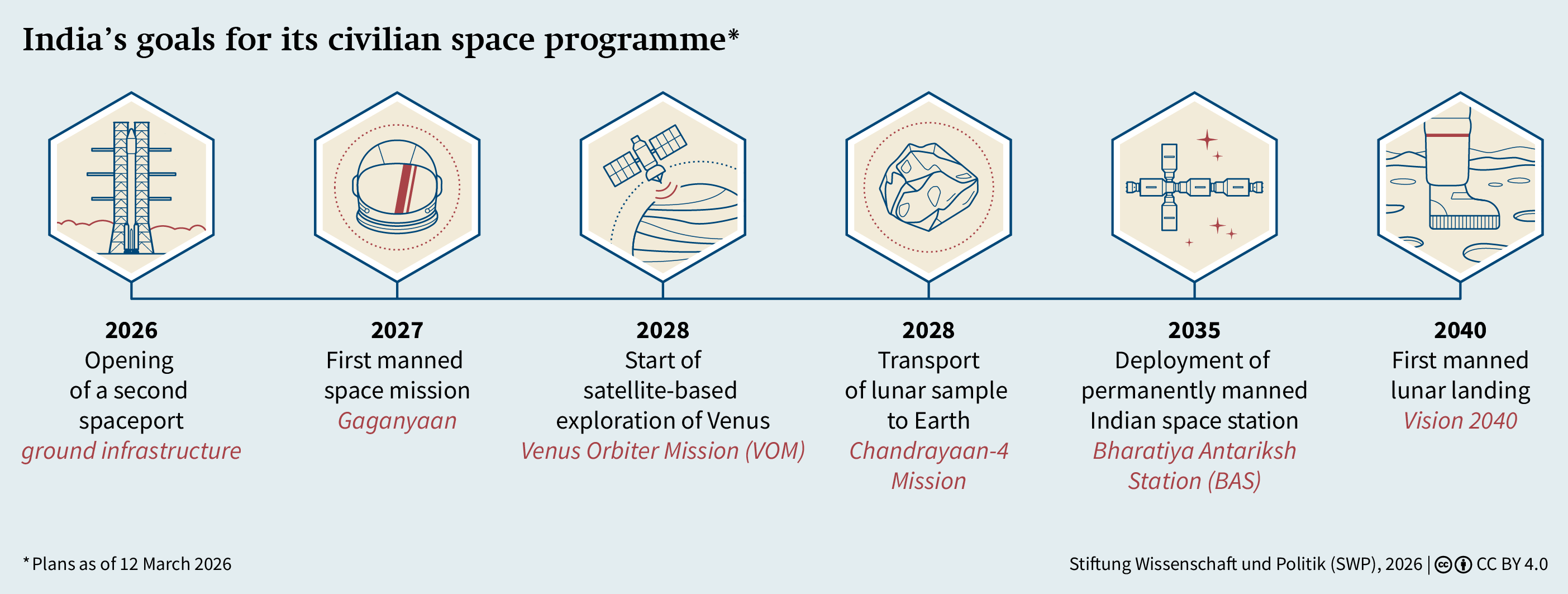
Thus far, the Indian space programme has been particularly successful with the provision of launch services for the transport of light payloads. Between 2015 and 2024, a total of 393 satellites belonging to other countries were deployed into orbit by India’s rocket systems. It is against this backdrop that the Indian government views the Chandrayaan-3 mission as the beginning of a new chapter in Indian space exploration. Under ISRO’s current plans, India will send humans into space for the first time in 2027 and carry out its first crewed lunar mission in 2040. Through ambitious missions, institutional reforms and a growing interest in new cooperation partnerships, the country is emerging as an increasingly important actor in international space policy.
At the same time, changes in the landscape of international space policy are boosting India’s relevance as a potential partner. For example, the end of the International Space Station (ISS), announced for 2030, will mark a turning point in the international space cooperation of Germany and Europe, as they are likely to start seeking new partnerships. Furthermore, given the resurgence of zero-sum thinking in the foreign policies of the US and Russia, it is probable that in the coming years, Earth’s orbit will increasingly become the arena of great power rivalries. Like the European Union (EU), the middle power India views the current revival of zero-sum politics in outer space as problematic.
In light of the domestic political developments in India outlined above and the ongoing shifts in the international order, this research paper examines the foreign-policy interests underpinning India’s space policy, which is understood here to mean policymaking processes concerning the use, regulation and strategic orientation of a nation’s civilian and military space activities. The analysis of India’s quest for power and recognition through its policy space provides insights not only into India’s domestic political interests and foreign policy priorities but also into the resulting conflicting goals. The study begins by outlining the development of India’s space programme and goes on to analyse four thematic areas relevant for India’s space policy.
First, it examines the economic interests of India in space. Since 2020, the Indian government has sought to strengthen the country’s private space sector on the internationally competitive growth market – a commitment that is evident not least from the country’s 2023 space policy. The fact that India currently accounts for only around 2 per cent of the global space market highlights the extent to which it has to make up ground on the two space powers China and the US. New Delhi regards ongoing investment in research and development as a prerequisite for being among the leaders in a new space race.
Second, the analysis highlights India’s security interests in space. The country’s priorities are to build up its capabilities vis-à-vis its regional rival, China, and reduce its technological dependence on other states. When India became the fourth nation to successfully test an anti-satellite weapon in 2019, the aim was to enhance its deterrence capability against Beijing. Another key objective of Indian security policy is to close capability gaps in military reconnaissance and satellite communications.
Third, the Indian quest for regional influence in South Asia is analysed. Under the (first) Modi government, India reaffirmed its ambition to become the benevolent regional hegemon by developing the South Asia Satellite. However, it is clear from its relations with most of its neighbours that India is currently unable to realise its ambition to assume a leadership position in the region.
Fourth, the research paper examines India’s visions and objectives regarding its status and position in the global (space) order. The first manned space mission Gaganyaan, the manned lunar mission Vision 2040 and the planned permanent space station Bharatiya Antariksh Station (BAS) stand paradigmatically for India’s quest for great power status in space. Multilateral space policy, on the other hand, ranks lower in New Delhi’s list of priorities. For this reason, political inconsistencies are more evident here than in the other policy areas examined.
Both Germany and the EU have a strategic partnership with India, and the political relevance of those relations has recently increased significantly. In the context of international space policy, Germany and India view one another as diversification partners in their respective pursuit for greater strategic autonomy. Accordingly, during his visit to India in September 2025, German Foreign Minister Johann Wadephul identified space cooperation as an important focus of collaboration going forward. India’s multilateral activities and its prioritisation of national security, as demonstrated by the 2019 ASAT test, have been disturbing the development of trust in German-Indian space relations. They underscore that the relationship is less about shared values and more about overlapping interests – for example, in cooperation on major civilian projects, such as the planned Indian space station, as well as in trade and investment.
A “Developing Country” Becomes a Space Power
Enabling factors and interests
The history of the Indian space programme is to be understood against the backdrop of national security needs, the activities of leading personalities and development policy discourses.
As a post-colonial state with unresolved border disputes, India attached great importance to autonomy in foreign and security policy from the outset. Prime Minister Jawaharlal Nehru (in office from 1947 to 1964), who co-initiated the 1955 Bandung Conference and was a leading figure in the Non-Aligned Movement, emphasised that his country was seeking a neutral status in what at the time was the emerging Cold War. With the successful launch of the Sputnik 1 satellite by the Soviet Union in 1957, it became clear that the power struggle between the major powers had reached outer space.
China’s military attack on India in October 1962 and India’s subsequent defeat served as a wake-up call for New Delhi.1 In 1957, its northern neighbour had already laid the foundations for a national space programme with the establishment of a national research centre; and one year earlier, China had gained access to modern ballistic missiles (R-1/SS-1 type) through a major technology transfer from the Soviet Union.2 The emerging rivalry with China and the ongoing hostilities with Pakistan prompted New Delhi to recognise the urgency of the security situation: it was forced to acknowledge the need to develop its own technological capabilities in order to keep pace with its rivals in the military sphere.
Thanks to its rapidly growing domestic research landscape, which was actively promoted by the government, India had the scientific capacity to develop its own space programme. As early as 1950, the first independent national government established Indian Institutes of Technology (IITs), which played an essential role in training an elite corps of home-grown space engineers.
However, the decisive reason for India developing its own civilian space capabilities was Nehru’s conviction that a space programme could help the country achieve its economic development goals.3 Unlike its counterparts launched during the Cold War, the Indian space programme was geared primarily not towards military objectives but towards development policy goals. A central belief of the founding generation of independent India was that technological and scientific progress would lead to the country’s socio-economic advancement. In this vein, the influential founding director of the Indian Space Research Organisation (ISRO), Vikram Sarabhai, argued that the primary political objective of Indian space policy must be to address the “real problems of man and society”.4
While the US and the Soviet Union viewed space as a new arena for their geopolitical rivalry, Sarabhai offered a narrative that chimed with Prime Minister Nehru’s vision of India as a non-aligned state. The latter’s vision was that of the development of a “Third World” – one that was distinct from the West and the Eastern bloc and comprised a group of nations defined by openness and solidarity rather than rivalry. Nevertheless, in the early years, India entered into partnerships in the space sector mainly with “First World” and “Second World” states.
Background on India’s space cooperation
Because of its internationally independent position during the early stage of the Cold War, India was courted by both the Soviet Union and the United States. Alongside France, the two main Cold War rivals supported India in establishing a launch site for high-altitude research rockets in Thumba in southern India.5 The contract was awarded to the Thumba Equatorial Rocket Launching Station (TERLS), which enjoyed the advantage of proximity to the magnetic equator and to the oceans, which are convenient for rocket launches.6 Previously, at the level of the United Nations (UN), the Scientific and Technical Subcommittee of the Committee on the Peaceful Uses of Outer Space (COPUOS) had adopted a resolution proposing such cooperation. India was one of the founding members of COPUOS in 1959.
It was also during this period that the Indian space programme was launched at the institutional level. In 1962, the Indian National Committee for Space Research (INCOSPAR) was established and tasked with the construction of the TERLS facility and the implementation of the first projects. The launch of a Nike-Apache high-altitude research rocket by the US National Aeronautics and Space Administration (NASA) at the TERLS site on 21 November 1963 is regarded as the actual start of the Indian space programme.7 In the years that followed, rockets of Soviet and French origin were launched from TERLS. During this early phase, India benefited from technological cooperation with both rival blocs.
In 1969, in order to pave the way for the development of a largely autonomous space programme, the Indian government established the national space agency ISRO. To this day, ISRO continues to play a coordinating role as the country’s lead space agency. To ensure that civilian and military programmes remained separate, ISRO was provided institutional independence from the Defence Research and Development Organisation (DRDO) of the Indian Ministry of Defence at the very outset. For its part, DRDO has been responsible for the development of military rocket technology since 1983.
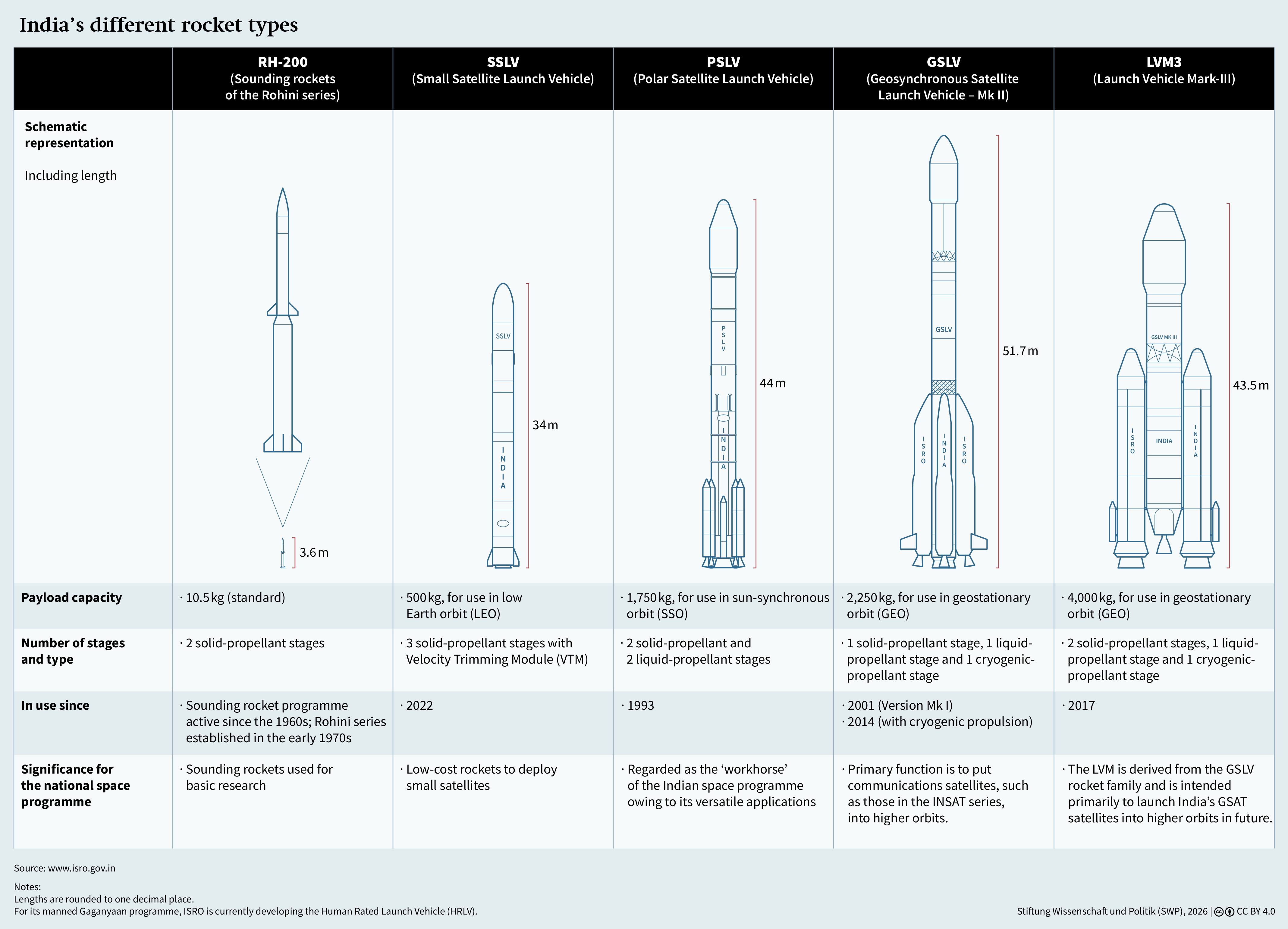
As the development of its own space technologies was progressing slowly, India sought to secure technology transfers from other states through political engagement. Above all, its relationship with France was strengthened in this area. From 1964 onwards, various agreements were concluded whereby the French space agency Centre national d’études spatiales (CNES) helped India manufacture its own solid-fuel rocket engine, which was essential for the development of the country’s first home-grown high-altitude research rocket, Rohini (see Figure 1, page 9).8 Just one decade later, CNES and ISRO signed another technology transfer agreement, the subject of which was the Viking liquid-fuelled rocket engine. The transfer enabled India to develop its own engine, the Vikas, which is still used in Indian rockets today. The attraction for Paris was that, in return, CNES was granted 100 years of labour by ISRO engineers, which has benefited French space research.9 Moreover, such close cooperation allowed France to develop a large degree of trust in India, which endures to this day. Owing to its willingness to transfer technology,
France continues to be perceived as one of the few Western states that treats India as an equal.
However, developments in Western export control policy proved a major structural constraint on India’s international space cooperation during the Cold War. The US, in particular, viewed India’s first nuclear weapons test, in 1974, as seriously threatening the Treaty on the Non-Proliferation of Nuclear Weapons (the so-called Nuclear Non-Proliferation Treaty), which had been ratified just four years earlier. In the US and Canada, the shock caused by Operation Smiling Buddha prompted calls for stricter export control regulations, which led to a broader interpretation of dual-use technologies.
Subsequent related developments were not confined to the establishment of the multilateral Nuclear Suppliers Group (NSG). In order to prevent the export of its own nuclear goods and technologies to newly proliferating countries, the US Congress passed the Nuclear Non-Proliferation Act in 1978. Thus, India’s first nuclear weapons test became the starting point for a highly restrictive US export policy – one that limited opportunities for scientific and technological cooperation between India and the United States for decades. The Indo-US trade in dual-use goods was not normalised until 2005, when the two countries signed the civil nuclear agreement. Since regulatory frameworks like those of the NSG and the Missile Technology Control Regime (MTCR) have such a significant impact on foreign policy options regarding key technologies, there are many within the Indian elite who today speak not of “technology control regimes” but of “technology denial regimes”.10
Moscow saw Western export control policy as an opportunity to draw India more closely into its political orbit. India’s first satellite, Aryabhata, was launched into space in 1975 from the Soviet spaceport at Kapustin Yar by a Kosmos carrier rocket.11 The Bhaskara satellites, through which India first developed remote-sensing capabilities by collecting data on Earth’s surface, were launched in cooperation with the Soviet Union, too. And in 1984, Moscow enabled Rakesh Sharma’s mission to the Salyut 7 space station, which marked the first time an Indian had travelled into space. This event, which earned the Soviet Union significant recognition in India, was regarded as a national sensation. After the end of the Cold War, the Russian Federation granted India the long-sought access to cryogenic propulsion technology.12 Thus, it was the Soviet Union and later Russia that, alongside France, were India’s most strategically significant partners.
At no point did India allow any foreign-policy constraints to limit its choice of partners. On the contrary, it remained open to all opportunities that arose, as evidenced by the INSAT multipurpose geostationary satellite system, which from 1983 onwards provided India with new capabilities, including independent telecommunications, television broadcasting and weather monitoring (see Table, page 22). In developing the INSAT missions, India worked closely with the United States and the European Community. Thus, from a historical perspective, its international space cooperation can be described as pragmatic.
The overall record of India’s foreign-policy efforts in the 20th century is mixed. On the one hand, it managed to establish a complex space programme; on the other hand, remained dependent on technology transfers from abroad and was unable to pursue a completely independent development of its own technology at the same pace as the major space powers. Nehru’s vision of a programme that would, among other things, significantly advance the country’s socio-economic development through tele-education projects could not be realised. India’s own limited capabilities and its critical stance towards most Western states were also reflected in its multilateral actions. From India’s perspective, the Western states, led by the US, were a problematic group of actors because their rocket and satellite programmes established faits accomplis in Earth’s orbit to which slower-developing space powers – including India itself – were compelled to adapt. It was for this reason that, within the framework of COPUOS, India advocated fundamental tenets of international law and universally valid principles through which not least the major spacefaring nations were to be bound by mandatory rules. The thrust of Indian policy was clear: robust multilateral regulations are necessary to ensure that states with fewer space capabilities have time to develop and contain tendencies of great power politics.13
For India, the conditions necessary for international cooperation in the space sector have changed in the 21st century – in three important respects. First, Washington and New Delhi have moved closer to each other. In 2008, India received de facto recognition of its nuclear status through an exemption from the NSG’s export control regulations. At the same time, trade barriers between Western nations and India have been lowered. Second, the focus of India’s international cooperation has shifted because its space capabilities have steadily increased. With the successful deployment of a domestically developed cryogenic engine in 2014, for example, India has achieved the capabilities required for full sovereignty in launch vehicle technology (see Figure 1, page 9). As regards cooperation within the civilian sector, satellite capabilities and large-scale projects have become more important for India. Third, a trend has been established in which space plays an increasingly central role in highly diverse aspects of the foreign-policy ambitions of states. As far as India is concerned, this growing importance has been reflected most recently in its regional and global ambitions as well as in its security- and economic-policy agendas.
Political institutions and power
Today, India’s space policy is shaped by a host of relevant stakeholders. The Prime Minister’s Office (PMO) plays a key role in steering policy in this area. A crucial factor here is the institutional subordination of the Department of Space (DOS) to the PMO, which allows the incumbent prime minister to contribute more actively to shaping space policy. The DOS, in turn, oversees key organisational bodies such as the space agency ISRO and the Indian National Space Promotion and Authorization Centre (IN-SPACe), which serves a dual purpose as both an industrial policy coordination platform and a regulatory body. It also oversees all state-run research and development facilities. And, as the commercial arm of ISRO, the state-owned Antrix Corporation Limited markets the services and technologies of the Indian space programme worldwide.
The DOS is tasked with realising India’s space ambitions. The prime minister’s influence ensures that it enjoys a privileged starting position in the annual budget negotiations. Although space policy has become more important under Prime Minister Narendra Modi – as evidenced by the significant increase in the DOS budget for 2024 (to around US$1.89 billion) compared with that of 10 years earlier – the Indian space programme is still lagging far behind its US counterpart (at US$79.68 billion) and even behind its German one (US$2.78 billion).14 Because it harbours grand ambitions under financially restrictive conditions, the Indian space programme is often characterised at the international level as “frugalist”. However, the relatively low level of public investment in the civil programme must be viewed in the context of India belonging to the group of lower-middle-income countries, which have a comparatively small national budget.
The PMO is also able to exert considerable influence over foreign and security policy. This is due to the fact that National Security Council, which has played a crucial role within the institutional framework over the past two decades, is another body that reports directly to the PMO. When it comes to foreign-policy decisions, Ajit Doval, who has served as national security adviser since 2014, is regarded as just as important as the incumbent External Affairs Minister. Among other things, he heads the government delegation within the framework of the India-US Initiative on Critical and Emerging Technology (iCET; now TRUST), which sets the direction of space cooperation with the United States.15
The government also has a Space Commission at its disposal. This is an informal body in which senior officials from the various ministries and agencies involved in the space programme come together in the presence of the prime minister to discuss space-policy priorities. The Space Commission is chaired by the head of the space agency ISRO. That is one reason why the importance of ISRO should not be underestimated. Another reason is that the space agency has been entrusted with the lead role in two prestigious projects: Gaganyaan, India’s first manned space mission planned for 2027, and the permanently manned Bharatiya Antariksh space station, planned for 2035 (see Figure 2). Thus, ISRO plays a very important role in the shaping of the national and international perception of the success or failure of India’s space efforts. As scientific pioneers, ISRO chairpersons enjoy an exceptionally high social standing in India. And, in the case of Abdul Kalam, an ISRO chairperson has even gone on to serve as president of India.
Other key players in foreign and security policymaking processes are the Ministry of External Affairs and the Ministry of Defence. The former represents India on space-related matters in multilateral organisations such as COPUOS. Because it has no space division of its own, it tends to coordinate rather than shape bilateral and plurilateral space cooperation. Together with the Indian Armed Forces, which fall under its authority, the Ministry of Defence is becoming increasingly important owing to the country’s improving national space capabilities. By 2025, the military had a total of 12 satellites. The Indian defence establishment has a strong interest in ensuring that national critical infrastructure for defence continues to expand in future.16 The Defence Space Agency (DSA), established in 2019, acts as a tri-service entity responsible for space warfare.
Growing Significance of the Space Economy
The significance of the space economy has increased as a result of both the growing commercial use of satellites and launch vehicles and the privatisation of rocket launches, which started in the US. Space is becoming ever more important for global communication and data transfer, for research and development capabilities as well as for tourism. Ambitious to become an emerging international economic power, India is competing economically with the major space powers – foremost among them the US and China. The Indian government aims to increase its global market share of the space industry from 2 per cent currently to 8 per cent by 2033.17 To compete successfully and boost its domestic capabilities, India has eased trade restrictions and is courting foreign investment. The fact that for several decades, the space sector was centrally controlled by the state and largely decoupled from the West by international technology control regimes has both advantages and disadvantages for India today. One advantage is that, as a result of those two developments, India has a space programme with highly sovereign supply chains. A disadvantage is that the sector is heavily dominated by a network of state-owned and close to the state enterprises, which, historically, has presented market-access challenges for small and medium-sized enterprises.
The liberalisation of the space economy
Adopted in 2023, the government’s Indian Space Policy has ushered in a new phase of domestic space regulation as it marked India’s first comprehensive, standard-setting national policy document on space. The policy forms part of wider reform efforts linked to domestic and foreign-policy interests since 2020. At the domestic level, the government’s aim with the Indian Space Policy was to drive forward the privatisation and commercialisation of the space sector.18 Whereas previously the financing, development and implementation of all space activities had been state-directed, the space policy established a framework for private-sector involvement. And although the state itself had shown an interest in a more diversified sector, decades of pursuing an economic model leaning towards a planned economy tended to favour large state-owned enterprises.19
India’s recent commitment to adhering to international rules through the Indian Space Policy is intended to build new trust for the cooperation with international partners.20 For economic liberals in India, who are increasingly engaging in the political discourse, this development is long overdue. They regard the liberalisation of the early 1990s as incomplete and see the Indian software boom over the past few decades as proof that the removal of trade and investment barriers is the right thing to do in the long term. And the space economy is one of the key sectors where the push for liberalisation is strongest.
As part of those liberalisation efforts, ISRO is now to focus more on its core task – the implementation of the civilian space programme. This is a crucial institutional change. In previous decades, the space agency saw its remit expand relentlessly; and many feared it was becoming increasingly unable to meet the growing demands. Going forward, it is to devote itself entirely to flagship government projects such as the Gaganyaan manned space programme and the establishment of its own space station, BAS (see Figure 2, page 12). The main foreign-policy objective is for India to become internationally competitive and be able to keep pace with global developments. All Indian stakeholders, including ISRO, agree that a wholly state-funded space programme cannot keep up with the global competition in research and development, nor can it provide for the scalability of satellite infrastructure. For this reason, the reform is fundamentally based on a broad consensus between the government, the private sector and the military.
The dual function of IN-SPACe as regulatory authority and marketing agency has prompted a debate.
IN-SPACe, established in 2020 and headquartered in Ahmedabad in the state of Gujarat, plays a prominent role in the new institutional framework of Indian space policy. It has two key responsibilities. First, it serves as the central regulatory authority with authorisation and oversight functions. For example, it is responsible for the release of technologies developed and protected by the civil space agency ISRO for use by the private sector.21 As of July 2025, no request for any such technology transfer had been refused.22 Second, IN-SPACe explicitly performs the role of an industry promotion body.23
The dual function of IN-SPACe as regulator and as national and international marketer demonstrates that the Indian government regards the agency as the key driver of the liberalisation of the space sector. While experts have welcomed the establishment of such an institution, some observers see its twofold function as a weakness. Moreover, IN-SPACe’s strong institutional ties to the Ministry of Space are cited as a potential vulnerability to its being able to perform its role as independent regulator.24 Any such potential shortcomings notwithstanding, IN-SPACe has a strong mandate that combines regulatory and market interests.
In its dual role, IN-SPACe is now setting the pace of collaboration between private sector players and international partners.25 The basis for such cooperation is the policy document on norms, guidelines and procedures published by IN-SPACe in 2024.26 This is the first document to establish the framework for cooperation between the Indian private sector and foreign entities. Even if there are now increased opportunities for Indian private space companies to engage in international cooperation, all space activities must be reviewed during the authorisation process to take into account “geopolitical considerations and relations with foreign countries”. The state thereby reserves the right to reject international cooperation so that it does not come at the expense of national security interests. This right of veto in the event of security concerns is reminiscent of what happened in the Indian telecommunications sector. In 2021, when the Department of Telecommunications was reviewing applicants for its 5G trials, only the Chinese providers Huawei and ZTE were excluded from taking part.27 Although their Chinese provenance was not officially cited as the reason in the IN-SPACe guidance document, it can nevertheless be assumed that India is intent on preventing excessive dependence on Beijing in the space sector as far as critical infrastructure is concerned.
NewSpace India Limited (NSIL) is another key player within the institutional framework that is relevant for economic interests. It performs some functions similar to those of IN-SPACe. Established in 2019, NSIL is a spin-off from ISRO, with which it shares its headquarters in Bengaluru (formerly Bangalore) in the state of Karnataka. As part of the liberalisation process, it is responsible for implementing key industrial projects. These include launch vehicles such as the Polar Satellite Launch Vehicle (PSLV) and the Small Satellite Launch Vehicle (SSLV) (see Figure 1, page 9) – and launch services. Unlike ISRO, NSIL can now engage in cooperation with the private sector and, like IN-SPACe, is intended to promote technology transfer. Thus, both NSIL and IN-SPACe are responsible for the commercialisation of state technologies, although the state retains overall control. Furthermore, NSIL’s mandate also overlaps with that of Antrix, which poses a risk of institutional redundancy in the future, while the mandate of the state-owned enterprise NSIL explicitly covers national and international promotion, meaning that Indian rocket technology can now be marketed more effectively abroad.28
Make in India: Space trade and investment policy
From an economic perspective, the Indian government sees liberalisation as an opportunity to increase the country’s appeal as a destination for direct investment, job creation and technological development. To this end, it has been adopting reforms less for geo-economic than for domestic-market reasons: the overriding aim is to boost India’s economic performance. Developments to date suggest that a fully autonomous space programme – one established and expanded independently – is possible only under simplified investment and trade conditions. Consequently, the Modi government’s economic formula for an independent India (Atmanirbhar Bharat) is not intended to be isolationist with regard to space, even though the focus here is, again, on the promotion of innovation and production within the country.
In February 2024, the Indian government lifted the remaining restrictions on foreign direct investment. Many Indian space projects can now be funded up to 100 per cent by foreign investors.29 This is another reason why there is optimism in India about the outlook: for example, in 2025, the consulting firm EY and the Indian trade organisation FICCI published a joint report in which they considered it realistic that the global market share of the Indian space sector could be increased from 2 per cent to 8 per cent by 2033, as targeted by the government.30 However, the Indian startup magazine Inc42 paints a different picture: it reported that total investment in the Indian space sector fell 35 per cent in 2024 to US$81 million.31
A key challenge to growth is the evident technological constraints of the Indian space industry. With startups such as Skyroot Aerospace and Bellatrix Aerospace, the industry’s current focus is very much on sectors and services related to rocket launches.32 But it is in this particular field that the international competition – especially from the US – is already very well established, which means companies need to consider just how sensible it is to specialise in precisely these technologies. Although the Indian space sector continues to grow, it cannot yet boast a single startup with the coveted “unicorn” status – that is, with a valuation of more than US$1 billion.
Until now, it has been largely Western firms and investment funds that have invested in India’s space startups. The Bengaluru- and California-based company Pixxel, for example, has benefited enormously from such investment: Google, Accenture Ventures and Lightspeed Venture Partners all number among the US investors in the company.33 Pixxel, which specialises in hyperspectral satellite photography, is one of the few firms in India that is highly successful in the field of satellite-based technologies. The fact that Google – whose Google Maps is India’s most important mapping and navigation application for private users – has chosen to support a company that is similarly aiming to develop Earth observation technologies underscores the importance that American companies attach to the Indian market. At the same time, it raises the question of whether the further liberalisation of the Indian space industry might not conflict with the desire to have fully sovereign capabilities.
The growing significance of the United States for India is also reflected in its diverse economic ties which are shaped not least by the large Indian diaspora. For example, the most important private-sector space project to date – the Vikram-S rocket, developed by the space startup Skyroot Aerospace – is largely backed by successful Indian-American tech figures.34 The (initial) steps towards liberalising market access that have been undertaken since 2024 demonstrate that the US holds a special position for the Indian private sector – for several reasons. First, the intended “indigenisation” of the Indian space programme is progressing more slowly than politically desired. Second, since India is falling further behind the programmes of other nations – namely, the US and China – the question arises as to whether India can establish its appeal as a cost-effective development and production hub in more complex areas such as manned missions.35 Third, the current development of the Indian space sector is not free from dependencies and is developing a growing interdependence with the American space ecosystem. Traditional partners of India, such as France and Russia, have not yet played a significant role in this area of cooperation, as they cannot make as lucrative offers to India in this field as the US can.
Technology cooperation opens doors
In the past, India’s space programme benefited greatly from technology transfers. Even today, access to new technologies remains one of the main reasons why India is seeking cooperation with other countries. While India claims to maintain space relations with no fewer than 61 countries, in reality there are only a small number of strategically relevant agreements with a handful of partners.36 Of primary importance are the collaborations with technologically advanced Western nations.
India is especially interested in partnerships that involve technology transfer. These align with its pursuit of technological progress, economic growth and job creation. For the respective partner country, the benefit is usually market access and the more cost-effective development and production opportunities available in India. However, as technology transfer invariably entails risks, the two partners need to have a high degree of trust in each other. India’s partners harbour reservations about this form of cooperation, particularly if they are concerned about losing control over their intellectual property. Historically, most technology transfers to India have been from France and Russia.
In recent years, it has been the United States, in particular, that has sought to capitalise on India’s interest in technological cooperation. The joint initiative “Transforming the Relationship Utilising Strategic Technology” (TRUST), which emerged from iCET in February 2025, aims to facilitate technological cooperation in strategically relevant sectors.37 From India’s perspective, however, there is one remaining challenge: American companies view India primarily as a new market for their products. Furthermore, it is doubtful whether closer economic cooperation between the two strategic partners can be achieved. US President Donald Trump has, for example, spoken out unequivocally in favour of increased reshoring but not “friend-shoring”; and it is the latter from which India, as a partner of the US, could have benefited. Because a shift towards greater technological cooperation with the US appears unlikely, India will continue to look for partners more willing to compromise. And it will do so not least because even what has been the smallest common denominator until now – the easing of export control regulations – is being called into question by President Trump’s tariff measures against India.
However, it is not only at the national governmental level that India is seeking space partnerships with other countries. For its part, ISRO maintains a network of partnerships with other space agencies. The space research organisation aims to advance the national projects of the civil space programme through collaborations with trusted international counterparts. It has close partnerships with France’s Centre national d’études spatiales (CNES), Japan’s Aerospace Exploration Agency (JAXA), NASA and the European Space Agency (ESA). Indeed, it is thanks to rockets produced by the European launch provider Arianespace that for many years now, ISRO has been able to put satellites into geostationary orbit (GEO).38 Currently, CNES and ISRO are working with Germany’s Airbus Defence and Space on the joint infrared satellite TRISHNA. The idea is to jointly provide space infrastructure that is then managed by the private sector. Both India and France regard the development of shared infrastructure as key to promoting private investment and innovation.
Besides collaborating with strategic partners, India is interested in working with the United Nations – something that it had already wanted to do back in the 1960s. For the most part, these technical collaborations are driven by scientific and development-policy considerations.
Research cooperation
There are currently 23 Institutes of Technology (IITs) dotted across India. They regularly distinguish themselves through technological excellence in the engineering fields and three are ranked among the world’s top 200 universities by QS.39 Since 2007, the state of Kerala has been home to a technical university dedicated to space research. The Indian space research landscape has always been closely interlinked with international space programmes. Besides institutional cooperation, an important factor is that many Indian scientists work abroad, which, ultimately, helps promote transnational exchange. Conversely, there are fewer foreign scientists who visit research sites in India. For India, research cooperation offers opportunities to drive forward innovation with international partners that can be utilised at home.
India’s keen interest in scientific exchange and the pooling of resources is evident in its recent satellite collaborations, among other things. Together with NASA, ISRO has been operating the Earth observation satellite NISAR since November 2025. The satellite enables centimetre-precise analysis of changes to Earth’s surface.40 Another satellite collaboration is TRISHNA.
A somewhat lower-threshold approach involves cooperation in the exchange of datasets without shared physical infrastructure. In 2018, the Indian government and the European Commission concluded an agreement on the exchange of Earth observation data collected by the Copernicus programme and Indian satellites.41 In addition, ISRO has entered into agreements on mutual data exchange with NASA and JAXA.
For the realisation of the BAS space station, India needs a technology partner such as Europe.
Alongside NASA, one of India’s key partners in the implementation of the Gaganyaan civilian manned spaceflight initiative is ESA. In this context, another recent significant development was the United States’ attempt to involve India in the Axiom 4 mission to the ISS by establishing a research partnership. Through this partnership, Shubhanshu Shukla became the first Indian astronaut to visit the ISS. For Europe, cooperation on space stations is one field where India becomes a potentially more important partner. ESA boasts a wealth of experience owing to its involvement in the ISS, yet a follow-up project is not yet in sight. In May 2025, ESA and ISRO agreed to strive for interoperability in rendezvous and docking systems.42 This is particularly important for India because it needs a technology partner such as Europe to realise its own space station, BAS. The timing for such cooperation is favourable as both parties want to further diversify beyond their collaboration with NASA. Structural cuts to science funding in the US are reinforcing this trend.
Finally, Japan is a partner that India cannot do without. ISRO has worked closely with JAXA on the three Chandrayaan missions to date. This has enabled joint scientific exploration of the lunar surface to research, among other things, the history of water resources on the Moon. Japan is further supporting the planned Mission 5 with its own lunar rover. Here, too, India can enhance the efficiency of its own programme through the division of labour with a reliable partner. ESA and NASA are contributing technical instruments in order to benefit from their joint scientific use.43
India thus appears open and willing to cooperate in space research. It is striking, however, that it is more enthusiastic to cooperate when it comes to implementing projects under its own national space programme rather than joining other countries’ initiatives.
Security
For several years now, space has been playing an increasingly important role in international security policy. Not least, it has served as another arena for existing conflicts (alongside land, water, air and cyberspace).44 In India, like elsewhere, the perception that the threat in space is growing has led to the national space programme being much more closely aligned with security policy interests than in previous decades.45 The risks and security threats are so diverse that New Delhi is seeking to expand not only its “power in space” but also its “power through space”.46 This includes both satellite-based communication and Earth observation capabilities that can be used for military purposes. Furthermore, it is evident that the existing strategic partnership with the United States has assumed special importance for India. Both countries are committed to deepening their security cooperation.47
Rivalries serve as starting point for reforms
For a country like India, which has its own space programme, satellite systems used for both military and civilian purposes are critical infrastructure that must be protected. Within its own neighbourhood, India has two rivals in space which, moreover, are allies – namely, Pakistan and the People’s Republic of China. There are unresolved border disputes with both nuclear powers. India’s border dispute with China last escalated in 2020, resulting in deaths and injuries on either side; and while Pakistan was perceived as the greatest threat in India around the turn of the millennium (not least because of the 1999 Kargil conflict between Pakistan and India), New Delhi’s focus has clearly shifted to China in the 2010s. The People’s Republic now has a complex space programme with growing military capabilities, which are increasingly serving Pakistani interests as well. For example, China supports the Pakistani space programme both through research and development and through the deployment of the latter’s satellites. The fact that China is set to welcome a Pakistani astronaut as the first foreign guest on its Tiangong space station illustrates the strategic dimension of their bilateral relations.48
When China tested an anti-satellite weapon in 2007, New Delhi was gravely concerned. The event raised India’s awareness of the security implications of space. In response to the Chinese anti-satellite test, India established the Integrated Space Cell within its armed forces. It is from this unit that the Defence Space Agency (DSA) emerged in 2019. Since then, the agency has been responsible for India’s space warfare capabilities.
The establishment of the DSA signalled a cautious approach to reform. In fact, the final government report released following the Kargil conflict, advocated the merger of military space capabilities under the air force, which would all but have resulted in a joint Indian air and space force. However, the DSA’s mandate covers all three branches of the armed forces (army, navy and air force) and the agency reports to the Integrated Defence Staff. This arrangement suggests a bureaucratic compromise that, for the first time, provides an institutional anchor for space warfare, albeit without fundamentally altering the command structures. The fact that the DSA, like ISRO, has its headquarters in Bengaluru underscores the growing importance of cooperation not only between the two agencies but also with the private sector, a large part of which is based in this city.
While some view the DSA merely as a first step in what will be a broader institutional transformation, how the national security architecture will continue to develop is unclear. It is known, however, that further development of an institutional and doctrinal nature is also being considered at the military leadership level .49 As far as deliberations on the continued development of military space capabilities are concerned, the DSA remains – at least for the time being – the central actor, which implements defence projects in collaboration with the Defence Research and Development Organisation (DRDO) of the Indian Ministry of Defence and, increasingly, with the private sector as well. In the capital’s decision-making process, the National Security Council is the linchpin for projects in space that are relevant for security and defence policy. Like the DOS, the council reports directly to the PMO; and over the past two decades, it has developed into a power centre for determining the government’s security policy, as it consolidates various competences and interests related to space. Both these institutions and the reform efforts associated with them demonstrate just how seriously India takes international security risks in space.
Deterrence
China’s testing of an anti-satellite missile in 2007 was seen in India as posing a major risk to the country’s satellite programme.50 Back then, New Delhi was already planning to expand the national satellite fleet but did not have its own operational counter-space capabilities. The fact that its most powerful rival now had the capability to shoot down Indian infrastructure in space was perceived as a real threat.
In 2010, Vijay Kumar Saraswat, who at the time was head of the DRDO, announced that India, too, would have to develop and test the technologies needed to take out enemy satellites.51 Some nine years later, on 27 March 2019, India became the fourth nation in the world to successfully test an anti-satellite weapon. In a speech delivered on the same day, Prime Minister Modi appealed to national pride by claiming that with Mission Shakti (literally Mission Power), India had attained the “status as a space power”.52 From a security-policy perspective, the test was intended primarily to send a signal to India’s rival China, which no longer had a technological advantage. Both Modi and other government officials cited national security as the legitimising factor for the test and emphasised that India’s main concern was deterrence. Anticipating international criticism, various Indian officials stressed that Mission Shakti had been planned with the utmost care to minimise potential risks, particularly those posed by space debris.53 However, the fact that the test was conducted in the middle of the Indian parliamentary election campaign suggests there was also a domestic political motive.
India’s confident, albeit defensively argued communications could not prevent the country’s international reputation from suffering in the short term. After all, while ASAT tests are not strictly prohibited under international law, they are shunned owing to their military nature and the large amount of dangerous space debris they generate. There are two reasons why India put up with the international criticism and the sudden detrimental impact on its image.
First, at the domestic level, the ASAT test underscored the growing importance of the security dimension of India’s space programme. The defensive logic underlying the use of anti-satellite weapons reflects India’s approach to the use of nuclear weapons.
India primarily saw its 2019 ASAT test as offering long‑term political benefits.
Second, from a foreign-policy perspective, it should not be underestimated to what extent the domestic debate continues to be shaped by international technology control regimes such as the MTCR and the NSG. The historical experience of sanctions led many in New Delhi to fear that the international community might adopt a multilateral test-ban treaty for anti-satellite weapons. The prospect of other states – not least China – being able to expand their military ASAT capabilities while India itself was deprived of such an advantage had to be averted in the eyes of the Indian government.54 Following this logic, India’s ASAT test implied that New Delhi would have to be included in any negotiations on such a test ban treaty. And that would constitute a de facto recognition of India as a major space power. Ultimately, the risks of damage to its international reputation were less important for India than the long-term political benefits.
Beyond the anti-satellite test, 2019 proved a decisive year for the development of India’s military space capabilities. Four months after the test, the three branches of the Indian armed forces conducted their first joint military exercise (IndSpaceEx), which took place under the leadership of the Integrated Defence Staff as part of a simulation exercise. The manoeuvres can be seen as having launched efforts to strategically coordinate India’s military interests in space. They are now held regularly and help prepare India for eventual conflicts in space or conflicts in which space is one of several military domains. By publicly announcing the first IndSpaceEx exercise, India sends a signal to rivals China and Pakistan that it is ready to defend itself and that it has the requisite domain expertise. Last year, India participated for the first time in a multinational space exercise – the Global Sentinel Exercise, led by US Space Command – to collaborate on space situational awareness (SSA) issues, promote interagency cooperation and discuss risks to space infrastructure.
Also in 2019, Satheesh Reddy, the acting DRDO director at the time, had already announced that India intended to significantly expand its counter-space capabilities in energy weapons, electromagnetic pulses and co-orbital weapon systems, especially those that accompany satellites.55 Despite the government’s assurances that India had peaceful objectives, the public interpreted its advocacy of increased military capabilities as the pursuit of a deterrence policy vis-à-vis China. However, the government has provided very little information either about the progress being made or about its political priorities, which, ultimately, fosters strategic ambiguity.
Reconnaissance and navigation
The 2020 border conflict between China and India – the first such clash since 1975 in which lives were claimed – marked a turning point in New Delhi’s security policy debate.56 The country’s political and military leadership appeared to be unprepared for the movements of the People’s Liberation Army (PLA) and the construction of new Chinese infrastructure along the disputed border in the Galwan Valley (located in the eastern part of Ladakh, where Chinese and Indian troops have been facing off since the 1962 border war). While India lays claim to the entire historical region of Kashmir, China has set its sights on the subregion Aksai Chin. Following the escalation of the border conflict, there was criticism in India about how the PLA had been able to operate without any outside interference. It quickly became clear that improved military Earth observation capabilities could have helped the Indian Army detect the PLA’s movements earlier. And that early intervention might even have prevented the deadly escalation.
Thus, in 2020, India found itself once again having to confront problems with the satellite surveillance of its borders that it had known about since the Kargil conflict of 1999. Although India’s military had improved Earth observation capabilities, they were not sufficient to identify the threat posed by China in a timely manner. That same summer, US companies such as Planet Labs, HawkEye 360 and Maxar Technologies used high-resolution satellite imagery to demonstrate to the world that China was quietly pushing ahead with infrastructure development in the disputed area. Furthermore, the images showed that the PLA possessed the necessary equipment to alter water flows in the Galwan Valley.57
To counter China’s military advantage on the border, the Indian government focused on expanding its own capabilities. But in the short term, it also prioritised a closer partnership with the US. In October 2020, India and the US concluded the Basic Exchange and Cooperation Agreement (BECA), which granted India access to real-time US geospatial satellite data and thereby took cooperation between the two defence ministries to a new level. Under the agreement, New Delhi was able to fill a yawning capability gap for the time being: through increased cooperation with the United States, it is now better informed about China’s troop movements and potential infrastructure projects.
Previously, the fate of the BECA agreement had been hanging in the balance for more than a decade; and the fact that it was finally concluded in 2020 demonstrates the extent to which the clashes in the Galwan Valley have reshaped the Indian security debate. BECA was signed as part of the 2+2 dialogue, in which the foreign and defence ministers of the two countries meet – a format that India maintains only with the US. As part of the Indian government’s strategic calculations, BECA can be seen as an attempt to provide a hedge against China. In other words, India is seeking to offset its own inferiority vis-à-vis China by expanding its security partnership with a militarily stronger state (in this case, the US).
The latest escalation of tensions between India and Pakistan last year following a terrorist attack in the Indian-administered part of Kashmir has reignited the Indian debate on independent Earth observation capabilities. Before committing their assault on 22 April 2025, Islamist extremists were allegedly able to enter the country from Pakistan across the Line of Control without being detected by the Indian military or border authorities. The discussion about what political conclusions should be drawn from this event took place at a time when US President Trump was increasingly undermining confidence in the strategic partnership with India. When Trump not only announced that the ceasefire in Kashmir had been achieved thanks to him but also secured a rapprochement with Pakistan and its chief of staff, Asim Munir, New Delhi’s position reinforced that India needed sovereign technologies. Consequently, in May 2025, the Indian government established a fast-track procurement procedure for defence equipment worth US$5 billion. Under this new procedure, the planned deployment of another 52 defence and surveillance satellites for its own Space-Based Surveillance (SBS) programme is to be accelerated. The SBS already has access to Indian satellite networks such as Cartosat and RISAT (see Table, page 22). The expansion of the SBS will now take place by 2029, with the support of the Indian private sector.58
Despite all the efforts of the Indian government, military Earth observation is a field in which India remains reliant on partner nations. For example, Drishti – India’s first multi-sensor Earth observation satellite, which combines optical and radar reconnaissance on a single platform – is due to be launched into orbit in 2026. However, the Indian developer did not commission ISRO to launch the satellite; rather, the contract went to the US company SpaceX. This demonstrates that even for the transport of medium-sized payloads into space – Drishti weighs around 150 kg – it is the dynamic US private sector that is currently able to offer Indian companies the most attractive deals. Thus, despite its focus on satellite launches, India cannot act autonomously, contrary to its own claims.
In the field of satellite navigation, the 1999 Kargil War influenced India’s strategic thinking just as significantly as the Galwan Valley clashes did 20 years later with regard to reconnaissance. In the Kargil War, India used modern precision systems for the first time, which is why more accurate target acquisition capabilities were required. For those using the US Global Positioning System (GPS), special authorisation is required from Washington to gain access to higher accuracy – namely, the Precise Positioning Service (PPS). However, the US makes this service available only to close partners.59 In India, the debate continues about what exactly happened back in 1999: it centres on the argument that the United States limited India’s access to GPS technology or even denied such access altogether. While this argument aligns with the Indian narrative of “technology denial”, it cannot be substantiated by publicly known and accessible sources. But, given its resolute response, it is more likely that New Delhi was denied access to PPS capabilities. That the US would opt not to grant India access to a capability as essential as military-grade GPS at a time of crisis continues to shape the domestic political debate in India to this day. And it was based on these experiences during the Kargil conflict that India made the decision to develop its own fully autonomous navigation satellite system, NavIC.60
It should also be noted here that by the late 1990s, the GLONASS navigation system developed by Russia – which, historically, is a close partner of India – was in a state of decline. This meant that a closer partnership with Moscow could not have offered India any viable prospects for its future endeavours in space. Thus, it was on several occasions a lack of trust in potential partners that led India to decide to develop its own technologies and strive for technological sovereignty.
Today, the strong commitment to the development of NavIC stands in stark contrast with the lack of investment in the expansion and maintenance of the system. As of August 2025, only four of India’s seven navigation satellites were operational; and one of the satellites in use was already past its scheduled end-of-service date. More recently, the attempt to put another NavIC satellite into geostationary orbit (GEO) failed for the second time.61 And so, 12 years after its official launch, India’s regional navigation satellite system remains a work in progress. Thus, while NavIC serves as an important example of just how convinced India is about the need to achieve complete autonomy, it is clear that New Delhi has to contend with the practical limitations that even its prestige military and civilian projects are still encountering today.
Satellite communications
Today, India is more self-sufficient in information and communication technologies than it is in any other part of its space programme. It can therefore be said that this is where India comes closest to achieving its self-declared goal of Atmanirbhar Bharat or an independent India. The domestic development and production processes along the value chain is a key factor here. However, failed launches of communications satellites remain a problem for India, which means it is likely to remain dependent on partners. Moreover, there are also dependencies for certain high-tech components.
Cooperation with Europe on satellite launches has strengthened mutual diplomatic trust.
For GEO launches of communications satellites used by the armed forces, India can now rely on its own launch pad at Sriharikota and its own Geosynchronous Satellite Launch Vehicle (GSLV – see Figure 1, page 9). As part of its quest for national sovereignty in space, India has been working for some time on a successor to the INSAT multi-purpose satellite system, which has been in operation since 1983. The communications satellites of the GSAT series are being developed by NSIL for various civil and military applications, with some satellites reserved exclusively for military use (see Table, page 22). Over the previous decade – since the launch of GSAT 7 in 2013 – GSAT satellites have been meeting more and more of the requirements of military communications. To this day, GSAT 7 remains the Indian Navy’s communications satellite, making the navy the first branch of the armed forces to have a sovereign communications infrastructure. In 2018, the other branches of the armed forces gained access to the system through the introduction of GSAT 7A.
In the past, however, the GSAT series could be realised only through international cooperation. Repeated complications during the initial attempts to launch GSAT satellites using GSLV rockets forced ISRO to rely on partners. As implied in the section on the technology cooperation, ISRO opted for a partnership with the European provider Arianespace, which has decades of experience in putting heavy satellites into GEO (previously, the company played a key role in the INSAT programme by helping India achieve its strategic objectives in space). GSAT 7 has now been put into GEO by an Ariane launch vehicle. The next satellite in the GSAT series, which is currently being developed for the Indian Army, is intended, among other things, to facilitate communications in the contested border regions. It is set to become the first communications satellite to be launched into space by India’s own GSLV rocket. As far as launches are concerned, India now enjoys greater autonomy and increasingly has its own capabilities for the transport of heavy payloads, including not only the GSLV rocket but also the Launch Vehicle Mark-III (LVM3). At the same time, cooperation with Europe has helped strengthen mutual diplomatic trust.
According to ISRO’s own figures, India itself manufactures 90 per cent of the components for its launch vehicles.62 But in the area of information and communication technologies, it remains dependent on foreign suppliers for high-tech components such as semiconductor chips and transponders. Whether this dependence can be reduced hinges, among other things, on whether domestic semiconductor projects – such as that being carried out by ISRO and IIT Madras – prove successful.63
Thus, it is clear that in its efforts to develop further military capabilities in space, India is having to navigate between pursuing the goal of “indigenisation” and enjoying the advantages of collaborating with partners that already possess sought-after technologies.
Strengthening India’s Role in the Region
In its quest for greater influence within the international system, India is also seeking to expand its power base within its own region. A contradiction underlies that endeavour. On the one hand, India is by far the geographically largest as well as economically and militarily strongest country in South Asia. On the other hand, the regional role it currently plays falls short of its own aspirations, not least owing to rivalries with China and Pakistan. Like in other policy areas, India’s ambition to become a shaping power in South Asia is reflected in its space policy. Furthermore, it is, above all, states in its wider neighbourhood – that is, beyond South Asia – that New Delhi considers of major importance. However, India’s grand ambitions are in stark contrast with its limited resource allocations.
The South Asia Satellite
Compared with other regions of the world – such as Southeast Asia and Africa – there are few well-established regional cooperation structures in South Asia. While a joint satellite of the member countries of the South Asian Association for Regional Cooperation (SAARC)64 was proposed as early as 1992,65 it took many years for cooperation on that project to get under way. A strong advocate of closer regional cooperation, India has been officially pursuing a “Neighbourhood First” policy since 2008 and sees itself in the role of agenda-setter. Its priorities are issues related to its own satellite programme and the early detection of disasters.
The fact that the first flagship project of India’s space diplomacy took place within the framework of the SAARC group underscores Prime Minister Narendra Modi’s interest in shifting the focus towards the region. In 2014, during his first year as prime minister, Modi attended the SAARC summit in Kathmandu, where he announced his intention to make a present of a satellite to the community of nations.66 Essentially, the proposal for a SAARC satellite was about India sharing its technological capabilities and resources with its South Asian partners.67 Pakistan rejected the idea, however. As a result, the satellite initiative failed to bring about a pan-regional rapprochement, highlighting a fundamental problem within SAARC: the group is unable to overcome the persistent rivalries that shape the region and to build trust among its members.
Nevertheless, as the other SAARC states welcomed the Indian initiative, New Delhi continued to promote the project. In 2017, the GSAT 9 communications satellite was placed in GEO and has since been available to all participating states. Because of Pakistan’s decision not to sign up to the Indian-led initiative, the name of the satellite was changed from the SAARC satellite to the South Asia Satellite. On 5 May 2017, the heads of government of the participating states were connected via video for the launch into space, which was carried out by an Indian GSLV rocket from the Indian spaceport at Sriharikota.68 Prime Minister Modi assumed the role of ceremonial host for the event. The SAARC satellite project reflects India’s aspiration to be perceived as a benevolent hegemon in the region – one that offers assistance to its neighbours without officially demanding anything in return.69
India sees the South Asia Satellite as a gift to its neighbouring countries.
As far as public relations are concerned, the South Asia Satellite is intended to promote the image of India as a generous provider of public goods. In response to an enquiry from Pakistan, the Indian government ruled out allowing other states to participate in the maintenance and repair of the satellite, thereby reaffirming that this was a service that it alone was providing to the SAARC states.70 Joint development and maintenance would have been at odds with the intended symbolism of India offering a gift to its neighbours. Furthermore, this diplomatic decision chimes with India’s overall South Asian policy, which focuses more on individual bilateral relations than on regional decision-making processes.
The South Asia Satellite should also be viewed in the context of the geo-economic rivalry with China. For Modi, the satellite, announced just a year or so after the unveiling of China’s Belt and Road Initiative (BRI), was an invitation to neighbouring states to cooperate more closely with India. Meanwhile, China, too, has been attempting to use its space capabilities to expand partnerships with states in South Asia – foremost among them Pakistan. Within the framework of the BRI, it is promoting the BeiDou satellite navigation system, which is now available worldwide, and exporting satellites to its BRI partners. Thus, the South Asia Satellite is, above all, an expression of India’s aspiration to become a technologically advanced power and an alternative to China. In terms of actual material capabilities, however, there remains a large gap in China’s favour.
To this day, progress towards the implementation of the satellite project has been weak. Of the five planned ground stations in Afghanistan, Bangladesh, Bhutan, Nepal and Sri Lanka, the only one that has been completed over the past 10 years is the Bhutan station (2019). This prioritisation suggests there are also security reasons why India is driving forward the construction of infrastructure for the South Asia Satellite:71 it can expand its dual-use capabilities through the station on the territory of its ally Bhutan. In 2017, a confrontation took place on the Bhutan-China border between Indian and Chinese forces after China had built road infrastructure in the region (India helps Bhutan defend its national borders). With what is, in effect, its own ground station in Bhutan, India is also providing a response to China’s ground station in Ngari, Tibet – just 125 kilometres from the border with India – which began operating in 2018.
Moreover, in the case of Afghanistan, it has become clear just how complicated it is for India to play a stronger role in the region amid political crises and upheavals. In 2017, New Delhi and Kabul reached an agreement whereby the former would help the latter develop remote sensing capabilities for agricultural use.72 But the return of the Taliban signalled the end of both diplomatic relations and hopes for deeper Indo-Afghan cooperation. For pragmatic reasons, the Indian government is now once again keen to normalise relations in a bid to keep Chinese and Pakistani influence in Afghanistan to a minimum.
The assessment to date of the flagship South Asia Satellite project has been mixed. On the one hand, India has succeeded in launching a satellite project with the participation of all South Asian states except Pakistan. It is thereby able to put forward a symbolic alternative to China, which, for its part, is offering its satellite services to the countries of the region in an increasingly proactive manner and has already found a taker in Sri Lanka. On the other hand, there is a stark contrast between India’s effective portrayal of itself as a benevolent hegemon and the modest operational successes of GSAT 9 (so far, the satellite has played only a minor role in early disaster detection and telemedicine, which were touted as key applications). Furthermore, it is clear neither Bangladesh nor Sri Lanka has any interest in becoming dependent on “India’s gift”; rather, they are diversifying their partnerships in space and regard GSAT 9 as just one of several options for satellite communication. Among other things, Bangladesh’s first satellite launch and the rapid rise of commercial and low-cost satellites such as those made by StarLink demonstrate that the South Asia Satellite serves, above all, a symbolic function and that India is far from achieving regional dominance in space.
Bilateral technical cooperation
India is also seeking to present itself as a benevolent regional hegemon in the provision of services – specifically in the areas of telemedicine, tele-education and disaster early warning. In doing so, it aims to promote the relevant technology among its neighbourhood partners as de facto public goods. Telemedicine and tele-education are highly regarded in India because, just like the Indian space programme, they combine a positive belief in technology with the vision of the country’s national advancement. However, the project is driven primarily by economic and research interests. So far, its implementation in cooperation with partner states, has been at a rather low level.
India’s policy on public goods in space is most pronounced in its dealings with African states. The most important project to date was the Pan African e‑Network Project (PAENP): through an official Memorandum of Understanding (MoU) with the African Union (AU), India supported distance learning and telemedicine on the African continent via its own satellites between 2009 and 2017 and lobbied for the expansion of the relevant infrastructure. By the end of the programme, 22,000 African participants had graduated from Indian universities. However, given that only 770 telemedicine consultations took place across the continent each year, it seems the programme has had only limited success.73 Key components of the project were implemented by Indian state-owned enterprises such as Telecommunications Consultants India Limited (TCIL) – an example of how economic interests are paramount for India in space cooperation with countries in its wider neighbourhood. India’s own space infrastructure has so far played a somewhat subordinate role in such cooperation as the focus has been on satellite services.
India works closely with the UN and partners in South Asia to address regional climate and environmental risks. It shares findings from its own satellite-based Earth observation in two ways. First, India actively participates in UNESCO’s Tsunami Early Warning System: in its capacity as government agency, the Indian Tsunami Early Warning Centre (ITEWC) also serves as official data source for UNESCO’s Indian Ocean Tsunami Warning and Mitigation System (IOTWMS).74 Second, as an institution designated by the World Meteorological Organization (WMO), the Regional Specialized Meteorological Centre (RSMC) in New Delhi collects, processes and shares information on tropical cyclones.75 India’s meteorological satellites are also used for this purpose. In addition, there is low-level cooperation with regional organisations on climate issues. The Bay of Bengal Initiative for Multi-Sectoral Technical and Economic Cooperation (BIMSTEC) has established the BIMSTEC Centre for Weather and Climate (BCWC) in India.76 Its aim is to strengthen the international exchange of datasets and models collected or developed at the national level. There are also MoUs between the Association of Southeast Asian Nations (ASEAN) and India.
From India’s regional engagement within the formats under discussion, it can be seen that New Delhi prefers to make unilateral offers and conclude intergovernmental agreements. Indian governments are generally opposed to the institutionalisation of regional initiatives as they tend to view this as ceding national sovereignty.
Global Ambitions
The successes of the Soviet satellite Sputnik 1 in 1957 and the US Moon landing in 1969 are emblematic of how states with space ambitions constantly strive for international recognition. India’s equally significant date is 23 August 2023, which is the day on which the Chandrayaan-3 mission succeeded and India became the first country ever to land near the Moon’s South Pole. The unmanned mission, carried out by the space agency ISRO, brought the Indian space programme greater international recognition77 and dispelled the image of India as a long-underestimated player in international space. For India, a growing presence in global space policy is important for two reasons. First, New Delhi wants to promote a positive narrative to both the international and domestic public about its standing in the world. Second, as an emerging space actor, it is able to exercise more influence on the international norms and institutions that shape the global space order.
The quest for status and recognition
India sees itself as an emerging power in a multipolar world order and wants to be recognised internationally as a major player.78 National pride and narratives of advancement play a significant role in the policies of Prime Minister Modi, who has been in power since 2014, and his Bharatiya Janata Party (BJP). Along with membership of the group of nuclear-weapon states, India sees belonging to the club of major space powers as an important criterion for national success.
The space programme is a central element of the government’s political vision. For example, it features in the Amrit Kaal (Golden Age) programme, which sets out the ambition of making the Republic of India a fully developed nation by 2047 (Viksit Bharat 2047), when it will celebrate the 100th anniversary of its founding. For the government, achieving Amrit Kaal involves the establishment of the Indian space station Bharatiya Antariksh by 2035 and the undertaking of the Vision 2040 manned lunar mission. This underscores the normative significance of the space programme.79
The prestige as global power that India aims to achieve through its space programme is expressed primarily through three narratives. First, the country’s cost-effectiveness is underscored. This is evident, for example, in Modi’s remark that the 2013 Mars orbiter mission Mangalyaan cost less than the production of the Hollywood film Gravity.80 Second, by successfully carrying out lunar, Martian and solar missions, India wants to demonstrate to the world that it has matured into a successful nation of science and innovation. Against the background of its colonial past, India’s emerging self-image as a globally relevant technological player is a key point of reference.81 Third, pride in the country’s space programme manifests itself in a culture of reverence for certain individuals. For example, Shubhanshu Shukla, who in 2025 became the first Indian to visit the ISS as a member of the Axiom-4 mission, is revered in his homeland like a pop star and serves as an important role model for patriotic Indians. It remains to be seen to what extent India’s pride in its space programme hinders trustworthy cooperation with partners in future. For example, India’s partners criticised its information policy as inadequate in the wake of the failed Chandrayaan-1 mission in 2007, which ended with the spacecraft crashing onto the lunar surface.82
Overall, India’s positioning as a global space actor is a balancing act, as the country sees itself not only as a peace-loving nation but also as a traditional great power. Thus, the 2019 anti-satellite test is in keeping with India seeing itself as a power that tests military technologies that other great powers have already tested for themselves. In a political environment informed by both pronounced nationalism and an acute sense of security threat, India wants to be perceived as sovereign, proud and capable of defending itself.83
The fact that public awareness of the national space programme has increased significantly is largely to be attributed to the prime minister’s personal interest. On the country’s 72th Independence Day in 2018, Modi announced the ambitious goal of India sending its first manned mission into space as early as 2022.84 Shortly after that announcement, the timetable was pushed back by many years, suggesting that the goal was unrealistic from the outset. This illustrates just how large the gap can be between India’s publicly declared political aspirations and what is actually feasible.
Conceptions of the global order
Unlike in other areas of multilateral cooperation, such as trade and climate policy, India has a strong interest in improved international regulation on space policy. It supports key multilateral instruments such as the 1967 Outer Space Treaty, the 1972 Space Liability Convention and the 1975 Space Registration Convention. To date, India has only signed, not ratified, the 1979 Moon Treaty, although it should be noted that no other space power has ratified the treaty either. In multilateral discussions on space, India wants binding rules to be implemented so that a level playing field can be established in an environment in which, until now, a handful of space powers have had an enormous advantage over all the others.
In pursuit of this goal of equal opportunities, India sees itself as representing the Global South on the international stage. It believes it is under-represented in the global order and acts as a reform-minded player. The country is highly engaged both in multilateral organisations and in COPUOS and adheres to the rules.85 This is because of its long-standing commitment to the peaceful use of space and its current security and economic interests.86
In its dealings with the United States, India has to perform a diplomatic balancing act. On the one hand, it wants to maintain constructive relations with this strategic partner; on the other hand, it faces serious conflicting goals. A major problem for India is that through companies such as SpaceX and OneWeb, the US is creating realities in low Earth orbit (LEO) that could prove disadvantageous for India in the medium term, as it is leaving less room for satellites from other states like India.87 As a result, there have been calls for fairer licensing rules – for example, via the International Telecommunication Union (ITU) – which is an important issue for India.
Furthermore, India feels that the US and its European partners often do not treat it as an equal partner. When it is not involved in the drafting of new international rules and standards, New Delhi tends to react negatively, as it wants to play a role in shaping multilateral standards.88 This was the case with the International Code of Conduct for Outer Space Activities, which was drawn up by the EU. The policy document was intended to serve as a multilateral normative framework. India refused to support the code – not because it rejected the standards enshrined in the document but because, despite the European claim that the code was universally valid, India had not been involved in the drafting process.89 Similarly, in cooperation at the United Nations level, India has made clear that the extent of its involvement in negotiations is decisive for how it votes.90
In multilateral contexts, India and Europe often have different priorities.
India’s wrangling over “Western” positions and negotiating practices has led it to increasingly make demands in multilateral contexts that are similar those of China and Russia.91 Like India, these two states advocate a stronger, legally binding regulation of outer space; but unlike India, they do so from a decidedly anti-Western stance. Through their joint commitment to the Prevention of an Arms Race in Outer Space (PAROS) treaty, India, China and Russia, (among others,) have expressed their demand for a legally binding framework.92 By making this demand, India’s stance broadly conflicts with the positions of European states in the UN Open-ended Working Group (OEWG). However, the PAROS treaty is essentially a non-starter and, accordingly, India has become more open to non-binding norms.
To float the idea of alternative global coalitions, India uses the BRICS group as a platform. This applies to policy in general, not just space policy. In 2022, the five original (and at the time only) members of the BRICS – Brazil, Russia, India, China and South Africa – agreed to establish a joint committee on space affairs. In doing so, they paved the way for the improved coordination of their capabilities in Earth observation and disaster early warning.93 While strategic cooperation among the BRICS states is unlikely owing to the Sino-Indian rivalry, India’s willingness to engage in low-threshold cooperation with China within the BRICS framework reflects the pragmatism that characterises Indian foreign policy.94 Unlike in its national and regional space policy, India views Russia and China as important multilateral partners in asserting its interests against a global order that it perceives as unjust.
In June 2023, India made the notable decision to join the Artemis Accords – a foreign-policy instrument initiated by the United States through which it reaches bilateral agreements with partner states on non-binding principles for the peaceful use of space. As more than 60 states have now signed the Artemis Accords, they are increasingly viewed as multilateral guidelines. India’s signing of the Artemis Accords was a departure from its usual approach to space diplomacy, as the country tends not to sign international agreements unless it has been involved in drafting the text.95 Thus, its accession can be explained only by strategic calculation: it was less a matter of accepting American influence in shaping an international space regime than the desire to signal recognition and trust and thereby help promote the deepening of bilateral relations.96
India’s decision to go ahead with the 2019 testing of an anti-satellite weapon, that was already discussed in the chapter on deterrence, provides another example of how the country sets priorities in its international space policy. Not only did the test run counter to the principle of the peaceful use of space; it was also at odds with India’s own efforts to establish a multilateral regime in which the peaceful use of space would be more firmly anchored in international law. Essentially, India’s decision showed that the country prioritises the security interests and status-related ambitions associated with the ASAT test over the multilateral level.
Conclusions and Recommendations
India is already one of the few countries to have a comprehensive space programme that is advanced in many areas. The programme, which was once driven primarily by development policy considerations, is increasingly being shaped by the dynamics of India’s rivalries with China and Pakistan. In the space economy, India is courting foreign investment and hopes that strategic partnerships will grant it better access to technology. At the regional level, India’s space cooperation reflects its natural status as the largest country in South Asia: while its relationship with Pakistan was the main obstacle to pan-regional cooperation on the SAARC satellite, India’s limited resource allocations stand in stark contrast with its claim to assume a regional leading role in in space (among other areas).
An analysis of the conflicting goals – autonomy vs cooperation – that shape India’s entire foreign policy provides practical insights. India is committed to full technological sovereignty in both military and critical civilian space capabilities; but in order to remain operationally capable at all times, it has to make compromises with regard to supply chains. In the medium term, however, India regards the “indigenisation” of key space technologies as politically necessary. By contrast, in investment and trade policy, the Modi government has dismantled protectionist barriers, even if the Atmanirbhar Bharat (“self-reliant India”) agenda also partly reinforces import substitution. Moreover, the recently concluded free trade agreement between the EU and India could lead to closer integration of economic areas within the space industry.
As regards the logic underlying India’s partnerships, the research paper has shown that India takes an interest-driven and opportunistic approach when selecting its partners. In the context of space policy, this implies that, at least since the end of the Cold War, India has collaborated mainly with Western nations. It cooperates with the United States because the latter supports its efforts to contain Chinese influence. Successful US-India cooperation on the exchange of satellite data demonstrates how the sharing of Earth observation data collected from the India-China border region has helped build mutual trust (keyword: BECA Agreement). Furthermore, in recent years the US has been India’s main technology partner owing to its strong investment and innovation capabilities. Although, historically, India has felt a certain affinity towards Russia, space cooperation with Moscow is now largely symbolic in nature. Japan, on the other hand, is regarded by India as an important high-tech partner.
For India, its European partners are key players with which it wants to step up cooperation in future, albeit on a transactional basis. Germany and France, in particular, are highly regarded within India’s scientific community owing to the long-standing tradition of partnership. Germany is in an especially strong position largely thanks to its robust cooperation in the fields of higher education and science policy. Should the ISS be decommissioned in 2030, as announced, the planned Indian space station would offer an opportunity for future European engagement in space – for example, within the framework of joint research projects. India’s long-term mission planning would help its European partners identify potential areas of cooperation. The fact that the Indian government recognises man-made climate change and feels threatened by a revisionist neighbouring state is both a unifying factor and an important basis for further cooperation. This applies not only to cooperation between national European space agencies and between the ESA and ISRO but also to European companies, which, owing to the new free trade agreement, are likely to focus more closely on India in future. In recent years, India has increasingly been seen as a potential manufacturing location. Investment and research cooperation in satellite-based services could help support India’s application-oriented and sector-specific approach, at the same time allowing European companies to benefit from innovations themselves.
While, until now, the ongoing rapprochement between Europe and India on security and defence policy has tended to take place at the national level, the European level is set to gain weight in space security going forward. The Security and Defence Partnership signed by India and the EU at the end of January 2026 has launched a new dialogue in which space security is regarded as a main issue. Thus, besides the Ministry of External Affairs and ISRO, other interlocutors like the National Security Council, the Ministry of Defence and the DRDO will become more relevant for Europe.
Today, India’s extensive space programme is technologically far advanced. The German Space Agency at the German Aerospace Centre (DLR) would benefit from a research and innovation partnership with ISRO that was based on an equal footing and thereby took their relations to a new level. The exchange of scientists could be an important milestone towards achieving this. Not only should Indian scientists travel to Germany, but incentives should be created for German researchers to visit India. Furthermore, Germany could follow France’s example by sending a diplomat to New Delhi or Bengaluru to oversee strategic space cooperation. In this way, a long-term perspective for the partnership would be promoted institutionally. In the area of security cooperation, closer collaboration with ISRO and the DSA – particularly on issues such as space situational awareness and the cybersecurity of space infrastructure – would benefit Germany.
In future, the challenges presented by the unilateral and imperialist policies of major powers could be used by Germany and the EU to coordinate more closely with India in multilateral contexts. Although conflicting interpretations of international technology control regimes significantly hampered cooperation in the past, the current global situation offers a window of opportunity to continue conducting a dialogue with partners such as India on the peaceful use of outer space.
Abbreviations
|
ASAT |
Anti-satellite weapon |
|
ASEAN |
Association of Southeast Asian Nations |
|
AU |
African Union |
|
BAS |
Bharatiya Antariksh Station (planned permanent Indian space station) |
|
BCWC |
BIMSTEC Centre for Weather and Climate |
|
BECA |
Basic Exchange and Cooperation Agreement |
|
BIMSTEC |
Bay of Bengal Initiative for Multi-Sectoral Technical and Economic Cooperation |
|
BJP |
Bharatiya Janata Party (Indian People’s Party) |
|
BRI |
Belt and Road Initiative |
|
BRICS |
The plurilateral platform whose current members are Brazil, China, Egypt, Ethiopia, India, Indonesia, Iran, Russia, South Africa, United Arab Emirates |
|
CNES |
Centre national d’études spatiales |
|
COPUOS |
Committee on the Peaceful Uses of Outer Space |
|
DLR |
German Aerospace Centre |
|
DOS |
Department of Space |
|
DRDO |
Defence Research and Development Organisation (development agency of the Indian Ministry of Defence) |
|
DSA |
Defence Space Agency |
|
EMISAT |
Electromagnetic Intelligence-gathering Satellite |
|
ESA |
European Space Agency |
|
EU |
European Union |
|
FICCI |
Federation of Indian Chambers of Commerce and Industry |
|
GEO |
Geostationary Earth Orbit |
|
GLONASS |
Global Navigation Satellite System |
|
GPS |
Global Positioning System |
|
GSAT |
Geosynchronous Satellite |
|
GSLV |
Geosynchronous Satellite Launch Vehicle |
|
iCET |
Initiative on Critical and Emerging Technology |
|
IIT |
Indian Institute of Technology |
|
INCOSPAR |
Indian National Committee for Space Research |
|
INSAT |
Indian National Satellite [system] |
|
IN-SPACe |
Indian National Space Promotion and Authorisation Centre |
|
IOTWMS |
Indian Ocean Tsunami Warning and Mitigation System |
|
ISRO |
Indian Space Research Organisation |
|
ISS |
International Space Station |
|
ITEWC |
Indian Tsunami Early Warning Centre |
|
ITU |
International Telecommunication Union |
|
JAXA |
Japan Aerospace Exploration Agency |
|
MoU |
Memorandum of Understanding |
|
MTCR |
Missile Technology Control Regime |
|
NASA |
National Aeronautics and Space Administration |
|
NavIC |
Navigation with Indian Constellation |
|
NISAR |
NASA-ISRO Synthetic Aperture Radar |
|
NSG |
Nuclear Suppliers Group |
|
NSIL |
NewSpace India Limited |
|
OEWG |
Open-ended Working Group |
|
PAENP |
Pan African e-Network Project |
|
PAROS |
Prevention of an Arms Race in Outer Space [treaty] |
|
PLA |
People’s Liberation Army |
|
PMO |
Prime Minister’s Office |
|
PPS |
Precise Positioning Service |
|
PSLV |
Polar Satellite Launch Vehicle |
|
RSMC |
Regional Specialised Meteorological Centre |
|
SAARC |
South Asian Association for Regional Cooperation |
|
SAR |
Synthetic-aperture radar |
|
SBS |
Space-Based Surveillance |
|
SSA |
Space Situational Awareness |
|
SSLV |
Small Satellite Launch Vehicle |
|
TCIL |
Telecommunications Consultants India Limited |
|
TERLS |
Thumba Equatorial Rocket Launching Station |
|
TRISHNA |
Thermal Infrared Imaging Satellite for High-resolution Natural Resource Assessment |
|
TRUST |
Transforming the Relationship Utilising Strategic Technology |
|
UN |
United Nations |
|
UNESCO |
United Nations Educational, Scientific and Cultural Organization |
|
WMO |
World Meteorological Organization |
Endnotes
- 1
-
To this day, the Chinese government continues to lay claim to the eastern part of Kashmir, known as the Aksai Chin region, as well as to the entire northeastern Indian state of Arunachal Pradesh.
- 2
-
Markus Schiller, “Chinas ballistisches Raketenprogramm”, Europäische Sicherheit & Technik, 8 August 2024, https://esut.de/ 2024/08/allgemein/51911/chinas-ballistisches-raketen programm/ (accessed 17 March 2025).
- 3
-
Hanamantray Baluragi and Byrana N. Suresh, “Indian Space Programme: Evolution, Dimensions, and Initiatives”, in Handbook of Space Security. Policies, Applications and Programmes, ed. Kai-Uwe Schrogl, Springer eBook Collection (Cham: Springer, 2020), 1–19, doi: 10.1007/978-3-030-22786-9_38-2.
- 4
-
Vikram Sarabhai Space Centre, Indian Space Research Organisation (ISRO), Department of Space, “Dr Vikram A Sarabhai”, https://www.vssc.gov.in/sarabhai.html (accessed 2 September 2025). Sarabhai is quoted as saying that: “There are some who question the relevance of space activities in a developing nation. To us, there is no ambiguity of purpose. We do not harbour the fantasy of competing with the economically advanced nations in the exploration of the moon or the planets or manned spaceflight. But we are convinced that if we are to play a meaningful role nationally, and in the community of nations, we must be second to none in the application of advanced technologies to the real problems of man and society.”
- 5
-
Marco Aliberti, India in Space: Between Utility and Geopolitics, Studies in Space Policy, vol. 14 (Cham: Springer International Publishing, 2018), doi: 10.1007/978-3-319-71652-7, and author’s interview (16) with a former space engineer working on India’s civilian programme conducted on 17 July 2025.
- 6
-
B. R. Guruprasad, “Understanding India’s International Space Cooperation Endeavour: Evolution, Challenges and Accomplishments”, India Quarterly: A Journal of International Affairs 74, no. 4 (2018), 455–81.
- 7
-
Rajeswari P. Rajagopalan and Dimitrios Stroikos, “The Transformation of India’s Space Policy: From Space for Development to the Pursuit of Security and Prestige”, Space Policy 69 (2024).
- 8
-
Ibid.
- 9
-
Rajaram Nagappa, “Development of Space Launch Vehicles in India”, Astropolitics 14, no. 2–3 (2016), 158–76.
- 10
-
Author’s interview (20) with an Indian space scientist and political analyst conducted on 18 July 2025.
- 11
-
Rajeswari P. Rajagopalan, “India’s Space Programme: A Chronology”, India Review 10, no. 4 (2011): 345–50.
- 12
-
Guruprasad, “Understanding India’s International Space Cooperation Endeavour” (see note 6).
- 13
-
S. Dhawan, Space and Foreign Policy, K.P.S. Menon Memorial Lecture, 1988 (New Delhi, 1998).
- 14
-
Statista, “Government Expenditure on Space Programmes in 2022 and 2024, by Major Country”, https://www. statista.com/statistics/745717/global-governmental-spending-on-space-programs-leading-countries/ (accessed 9 December 2025).
- 15
-
The White House, “Joint Fact Sheet: The United States and India Continue to Chart an Ambitious Course for the Initiative on Critical and Emerging Technology”, Washington, D.C., 17 June 2024, https://bidenwhitehouse.archives. gov/briefing-room/statements-releases/2024/06/17/joint-fact-sheet-the-united-states-and-india-continue-to-chart-an-ambitious-course-for-the-initiative-on-critical-and-emerging-technology/ (accessed 1 September 2025).
- 16
-
Vaibhav Agrawal, “India beyond Earth: India’s Status in Space Military Race”, Financial Express (online), 31 July 2022, https://www.financialexpress.com/business/defence-india-beyond-earth-indias-status-in-space-military-race-2582187/ (accessed 1 September 2025).
- 17
-
Press Information Bureau, “Empowering India’s Space Economy: Rs. 1,000 Crore Venture Capital Fund Initiative for Innovation and Growth”, press release, New Delhi, 25 October 2024, https://pib.gov.in/PressReleasePage.aspx? PRID=2068155 (accessed 8 September 2025).
- 18
-
Dimitrios Stroikos, India’s Space Policy: Between Strategic Autonomy and Alignment with the United States (Council on Foreign Relations, June 2025), https://cdn.cfr.org/sites/ default/files/pdf/Stroikos%20-%20India%27s%20Space %20Policy.pdf (accessed 1 July 2025).
- 19
-
Aliberti, India in Space (see note 5), 63.
- 20
-
Cabinet Committee on Security, Indian Space Policy – 2023 (New Delhi, 2023), https://www.isro.gov.in/media_isro/ pdf/IndianSpacePolicy2023.pdf (accessed 8 September 2025).
- 21
-
Indian National Space Promotion and Authorisation Centre (IN-SPACe), “Decadal Vision & Strategy”, 10 October 2023, https://www.inspace.gov.in/inspace?id=inspace_deca dal_vision_strategy (accessed 25 July 2025).
- 22
-
Author’s interview (28) with a representative of an Indian space agency conducted on 25 July 2025.
- 23
-
See the IN-SPACe website: https://www.inspace.gov.in/inspace?id=inspace_index (accessed 30 April 2026).
- 24
-
Ashwin Prasad, Space Reforms in India. A Job Half Done, Takshashila Discussion Document 2024–11 (Bengaluru: The Takshashila Institution, July 2024), https://takshashila.org.in/content/publications/20240710-Space-Reforms-in-India.html (accessed 11 March 2026).
- 25
-
IN-SPACe, “Decadal Vision & Strategy” (see note 21).
- 26
-
IN-SPACe, “Norms, Guidelines and Procedures for Implementation of Indian Space Policy – 2023. Authorisation of Space Activities (NGP)”, May 2024, https://www.inspace.gov.in/inspace?id=inspace_ngp_update_page (accessed 25 July 2025).
- 27
-
“Huawei and ZTE Left Out of India’s 5G Trials”, BBC (online), 5 May 2021, https://www.bbc.com/news/business-56990236 (accessed 9 September 2025).
- 28
-
NewSpace India Limited, NewSpace India Limited (NSIL). A Central Public Sector Enterprise (CPSE) under the Department of Space (Bengaluru), https://www.nsilindia.co.in/sites/default/files/u1/NSIL%20Brochure%20Single%20pages.pdf (accessed 25 July 2025).
- 29
-
Press Information Bureau, “Cabinet Approves Amendment in the Foreign Direct Investment (FDI) Policy on Space Sector”, press release, New Delhi, 21 February 2024, https://www.pib.gov.in/PressReleasePage.aspx?PRID=2007865 (accessed 2 September 2025). For some sectors of particular relevance for national security, the more restrictive percentages of 49 per cent or 74 per cent apply.
- 30
-
Federation of Indian Chambers of Commerce and Industry (FICCI), “Indian Space Economy Aiming to Reach $44 bn by 2033 from $8.4 bn in 2022: FICCI-EY Report on Space Economy”, press release, New Delhi, 12 March 2025, https://ficci.in/press_release_details/5033 (accessed 2 September 2025).
- 31
-
Team Inc42, “To Infinity & Beyond: Meet 26 Spacetech Startups Winning the Space Race for India”, Inc 42 (online), 21 March 2025, https://inc42.com/startups/to-infinity-beyond-indian-spacetech-startups-winning-space-race/ (accessed 25 July 2025).
- 32
-
Author’s interview (14) with an Indian think-tank researcher conducted on 16 July 2025.
- 33
-
Pixxel, “Pixxel Raises $24M in Additional Funding, Taking Its Total Series B Raise to $60M”, 9 December 2024, https://www.pixxel.space/news/pixxel-raises-24m-in-additional-funding-taking-its-total-series-b-raise-to-60m (accessed 9 September 2025).
- 34
-
PTI, “Skyroot Raises $4.5m in Funding Led by Google’s Ram Shriram”, The Hindu – businessline (online), 27 January 2022, https://www.thehindubusinessline.com/companies/skyroot-raises-45-mn-in-funding-led-by-googles-founding-board-member-ram-shriram/article64941328.ece (accessed 2 September 2025).
- 35
-
Srijan Pal Singh, “Why Isro’s Low-budget Hangover Is Not Sustainable for India’s Future Plans”, India Today (online), 6 November 2024, https://www.indiatoday.in/science/story/ why-isros-low-budget-hangover-is-not-sustainable-for-indias-future-plans-2628271-2024-11-06 (accessed 2 September 2025).
- 36
-
Press Information Bureau, “Union Minister Dr Jitendra Singh Says, Currently, Space Cooperative Documents Have Been Signed with 61 Countries and Five Multilateral Bodies”, press release, New Delhi, 8 February 2024, https://www.pib.gov.in/PressReleasePage.aspx?PRID=2003901 (accessed 10 September 2025).
- 37
-
The White House, “United States – India Joint Leaders’ Statement”, Washington, D.C., 13 February 2025, https://www.whitehouse.gov/briefings-statements/2025/02/united-states-india-joint-leaders-statement/ (accessed 6 November 2025).
- 38
-
Aliberti, India in Space (see note 5), 290.
GEO refers to orbits at a distance of at least 36,000 kilometres from Earth. - 39
-
QS, “QS World University Rankings 2026: Top Global Universities”, https://www.topuniversities.com/world-university-rankings?countries=in (accessed 27 July 2025).
- 40
-
National Aeronautics and Space Administration (NASA), “NISAR”, https://science.nasa.gov/mission/nisar/ (accessed 11 November 2025).
- 41
-
European External Action Service, “European Commission and Department of Space of India Sign Historic Cooperation Agreement to Share Satellite Earth Observation Data”, press release, 19 March 2018, https://www.eeas.europa.eu/ node/41583_en (accessed 11 November 2025).
- 42
-
European Space Agency, “No. 23–2025: European Space Agency Announces New Cooperation with Indian Space Research Organisation”, press release, 7 May 2025, https://www.esa.int/Newsroom/Press_Releases/European_ Space_Agency_announces_new_cooperation_with_Indian_ Space_Research_Organisation (accessed 10 November 2025).
- 43
-
ISRO, Department of Space, “ISRO and JAXA Gear Up for Joint Chandrayaan-5/LUPEX Mission in the Technical Interface Meet”, press release, 15 May 2025, https://www.isro.gov.in/ISRO_JAXA_CH5_Technical_Interface_Meet.html (accessed 10 November 2025).
- 44
-
See, for example, Jonas Schneider and Juliana Süß, Russian Nuclear Weapons in Space? Potential Destructive Consequences in Space, Escalation on Earth, and Damage to Arms Control, SWP Comment 21/2025 (Berlin: Stiftung Wissenschaft und Politik, April 2025), doi: 10.18449/2025C21.
- 45
-
Rajeswari P. Rajagopalan, India’s Space Strategy: Geopolitics Is the Driver (Milan: Istituto per gli Studi di Politica Internazionale [ISPI], 7 December 2020), https://www.ispionline.it/en/publication/indias-space-strategy-geopolitics-driver-28607 (accessed 27 June 2025).
- 46
-
Kai-Uwe Schrogl, “Die strategische Bedeutung des Weltraums für die Großmächte”, Zeitschrift für Politikwissenschaft 29, no. 4 (2019), 517–24.
- 47
-
The White House, “United States – India Joint Leaders’ Statement” (see note 37).
- 48
-
Sarah Zaman, “Growing Space Cooperation Between Pakistan, China Presents Risks and Opportunities, Experts Say”, Voice of America (online), 3 March 2025, https://www.voanews.com/a/growing-space-cooperation-between-pakistan-china-presents-risks-and-opportunities-experts-say-/7995718.html (accessed 27 July 2025).
- 49
-
PTI, “India Working on ‘Military Space Doctrine’, Expected to Be Out in Three Months, Says CDS [Chief of Defence Staff]”, The Hindu (online), 7 April 2025, https://www.thehindu.com/news/national/india-working-on-military-space-doctrine-expected-to-be-out-in-three-months-says-cds/article69424189.ece (accessed 17 July 2025).
- 50
-
Ashley J. Tellis, “India’s ASAT Test: An Incomplete Success” (Washington, D.C.: Carnegie Endowment for International Peace, 15 April 2019), https://carnegieendowment.org/research/2019/04/indias-asat-test-an-incomplete-success?lang=en (accessed 2 September 2025).
- 51
-
Ajey Lele, Asian Space Race: Rhetoric or Reality? (New Delhi: Springer India, 2013), doi: 10.1007/978-81-322-0733-7.
- 52
-
Ministry of External Affairs, Government of India, “Speech by Prime Minister on ‘Mission Shakti’, India’s Anti-Satellite Missile Test Conducted on 27 March 2019”, New Delhi, 27 March 2019, https://www.mea.gov.in/Speeches-Statements.htm?dtl/31180/Speech+by+Prime (accessed 28 July 2025).
- 53
-
India’s use of an anti-satellite weapon in low Earth orbit (LEO) at an altitude of 282 kilometres is thought to have generated around 400 particles; that is far fewer debris fragments than the Chinese test in 2007, which is believed to have released around 2,000 fragments at an altitude of 865 kilometres. See also Tellis, “India’s ASAT Test” (see note 50) and Ankit Panda, “Exclusive: India Conducted a Failed Anti-Satellite Test in February 2019”, The Diplomat (online), 30 March 2019, https://thediplomat.com/2019/04/exclusive-india-conducted-a-failed-anti-satellite-test-in-february-2019/ (accessed 2 September 2025).
- 54
-
Author’s interview (9) with an Indian political scientist conducted on 11 July 2025 and author’s interview (21) with an Indian space scientist conducted on 18 July 2025.
- 55
-
Anushka Saxena, “India’s Space Policy and Counter-Space Capabilities”, Strategic Analysis 47, no. 2 (2023): 146–58; Aishwarya Rakesh, “India To Kick-start Its First Simulated Space Warfare Drill”, Defense Mirror (online), 24 July 2019, https://www.defensemirror.com/news/25184/India_To_Kick_ start_Its_First_Simulated_Space_Warfare_Drill (accessed 12 September 2025).
- 56
-
Christian Wagner, The Indian-Chinese Confrontation in the Himalayas. A Stress Test for India’s Strategic Autonomy, SWP Comment 39/2020 (Berlin: Stiftung Wissenschaft und Politik, July 2020), doi: 10.18449/2020C39.
- 57
-
Anupriya Thakur, “Bridges, Roads, Water Channelising Machinery: Satellite Data Shows China’s Long-Term Plans in Galwan Valley”, India Today (online), 19 June 2020, https://www.indiatoday.in/india/story/bridges-roads-water-channelizing-machinery-satellite-data-shows-china-s-long-haul-plans-in-galwan-valley-1690430-2020-06-18 (accessed 28 March 2025).
- 58
-
FP Explainers, “Eyes in the Skies: Why India Is Looking to Accelerate Launch of Military Satellites”, Firstpost (online), 30 June 2025, https://www.firstpost.com/explainers/india-defence-satellites-space-based-surveillance-phase-3-china-pakistan-operation-sindoor-ws-e-13901750.html (accessed 8 December 2025).
- 59
-
United States Naval Observatory, “GPS Info”, https://www.cnmoc.usff.navy.mil/Our-Commands/United-States-Naval-Observatory/Precise-Time-Department/Global-Positioning-System/Global-Positioning-System-Overview/ (accessed 18 September 2025).
- 60
-
NavIC stands for Navigation with Indian Constellation.
- 61
-
Ruta S. Kulkarni, “India’s Proud GPS System NavIC, Born from Kargil War, Now Threatened by Space Failures”, Spacetech Times, 7 August 2025, https://spacetechtimes.com/indias-navic-still-struggles-to-become-fully/ (accessed 18 September 2025).
- 62
-
Pragati Chougule, “ISRO Chairman Calls for Reducing Electronics Imports to Boost Space Missions”, The Bridge Chronicle (online), 28 March 2025, https://www.thebridgechronicle.com/tech/isro-electronics-import-reduction (accessed 15 September 2025).
- 63
-
India Today Science Desk, “ISRO and IIT Madras Develop Indigenous Semiconductor Chip”, India Today (online), 11 February 2025, https://www.indiatoday.in/science/story/isro-and-iit-madras-develop-indigenous-semiconductor-chip-2678119-2025-02-11 (accessed 28 November 2025).
- 64
-
Since its founding in 1985, the SAARC member states have included Bangladesh, Bhutan, India, the Maldives, Nepal, Pakistan and Sri Lanka. Afghanistan joined in 2007.
- 65
-
Biswanath Gupta and Raju KD, “Space Exploration by India and Socio-economic Cooperation with SAARC Countries”, India Quarterly: A Journal of International Affairs 72, no. 3 (2016), 278–89.
- 66
-
South Asian Association for Regional Cooperation (SAARC), “18th SAARC Summit Declaration”, press release, Kathmandu, 28 November 2014, https://nepal.saarc-sec.org/index.php/press-release/106-18th-saarc-summit-declaration (accessed 30 June 2025).
- 67
-
Press Information Bureau, Government of India, “Speech by the Prime Minister at the SAARC Summit”, 26 November 2014, https://www.pib.gov.in/newsite/PrintRelease.aspx?relid=111876®=3&lang=2 (accessed 4 May 2026).
- 68
-
Ajey Lele, “India Launches a South Asia Satellite”, The Space Review, 8 May 2017, https://thespacereview.com/article/3233/1 (accessed 2 September 2025).
- 69
-
Dimitrios Stroikos, “Space Diplomacy? India’s New Regional Policy under Modi and the ‘South Asia Satellite’”, India Review 23, no. 1 (2024), 46–70.
- 70
-
Shounak Set, India’s Regional Diplomacy Reaches Outer Space (Carnegie India, July 2017), https://carnegieendowment. org/research/2017/07/indias-regional-diplomacy-reaches-outer-space?lang=en (accessed 2 September 2025); Press Information Bureau, Government of India, “South Asian Satellite to Boost Regional Communication”, press release, 7 May 2017, https://www.pib.gov.in/newsite/printrelease. aspx?relid=161611 (accessed 2 September 2025).
- 71
-
Surendra Singh, “PM Modi Inaugurates ISRO-funded Satellite Ground Station in Thimphu”, The Times of India (online), 17 August 2019, https://timesofindia.indiatimes.com/india/pm-inaugurates-isro-funded-sat-ground-station-in-thimphu/articleshow/70718336.cms?utm (accessed 15 July 2025).
- 72
-
Ministry of External Affairs, Government of India, “Joint Statement on the 2nd Strategic Partnership Council Meeting between India and Afghanistan”, press release, New Delhi, 11 September 2017, https://www.mea.gov.in/bilateral-documents.htm?dtl/28936/Joint_Statement_on_the_2nd_Strategic_Partnership_Council_Meeting_between_India_and_Afghanistan_New_Delhi_September_11_2017 (accessed 28 October 2025).
- 73
-
Meeting of the Permanent Representatives Committee, African Union, First Progress Report of the Chairperson of the Commission on the Pan-African e-Network on Tele-Education and Tele-Medicine (Addis Ababa, 29 March 2018), https://au.int/sites/ default/files/documents/34076-doc-auc.report.panafrican.e- network.prc_.29.03.pdf (accessed 28 October 2025).
- 74
-
Indian Tsunami Early Warning System, Ministry of Earth Sciences – Government of India, “About TSP [Tsunami Service Providers]”, https://tsunami.incois.gov.in/TEWS/AboutTSP.jsp (accessed 30 October 2025).
- 75
-
World Meteorological Organization, “Latest Advisories – RSMCs [Regional Specialized Meteorological Centres] and TCWCs [Tropical Cyclone Warning Centres]”, https://community.wmo.int/site/knowledge-hub/programmes-and-initiatives/tropical-cyclone-programme-tcp/latest-advisories-rsmcs-and-tcwcs (accessed 4 May 2026).
- 76
-
Member countries of BIMSTEC, Memorandum of Association between the Bay of Bengal Initiative for Multi-Sectoral Technical and Economic Cooperation (BIMSTEC) Member Countries regarding the establishment of a BIMSTEC Centre for Weather & Climate, 7 March 2014, https://bimstec.org/images/content_page_pdf/1696679251_Signed%20MOA%20on%20BCWC%20.pdf (accessed 30 April 2026).
- 77
-
Rajagopalan, “India’s Space Programme: A Chronology” (see note 11).
- 78
-
Author’s interview (18) with a representative of the private sector conducted on 17 July 2025.
- 79
-
Government of India, Press Information Bureau, “Expanding Horizons in Space Sector: From Lunar Exploration to a National Space Station”, Background Details, 24 September 2024, https://www.pib.gov.in/PressNoteDetails.aspx?NoteId=153184&ModuleId=3 (accessed 30 October 2025).
- 80
-
Jonathan Amos, “Why India’s Mars Mission Is So Cheap – and Thrilling”, BBC (online), 24 September 2014, https://www.bbc.com/news/science-environment-29341850 (accessed 31 October 2025).
- 81
-
Dimitrios Stroikos, “China, India, and the Social Construction of Technology in International Society: The English School Meets Science and Technology Studies”, Review of International Studies 46, no. 5 (2020): 713–31.
- 82
-
James Clay Moltz, Asia’s Space Race. National Motivations, Regional Rivalries, and International Risks (New York: Columbia University Press, 2011), 131.
- 83
-
Author’s interview (9) with an Indian political scientist (see note 54).
- 84
-
Prime Minister of India, Government of India, “PM’s Independence Day Speech – Highlights”, 15 August 2018, https://www.pmindia.gov.in/en/news_updates/pms-independence-day-speech-2018-highlights/?tag_term=independence-day&comment=disable (accessed 30 October 2025).
- 85
-
Stroikos, India’s Space Policy (see note 18).
- 86
-
Aliberti, India in Space (see note 5).
- 87
-
Author’s interview (11) with an Indian think-tank researcher conducted on 11 July 2025.
Low Earth Orbit (LEO) refers to orbits up to a distance of 2,000 kilometres from Earth, i.e., they are near-Earth orbits. - 88
-
Author’s interview (21) with an Indian space scientist (see note 54).
- 89
-
Aliberti, India in Space (see note 5).
- 90
-
Moltz, Asia’s Space Race (see note 82).
- 91
-
Stroikos, India’s Space Policy (see note 18).
- 92
-
Abhijeet Kumar, “Explained: What Is PAROS, Which Has Got Support from BRICS Leaders?”, Business Standard (online), 11 June 2024, https://www.business-standard.com/external-affairs-defence-security/news/explained-what-is-paros-which-has-got-support-from-brics-leaders-124061100659_1.html (accessed 4 November 2025).
- 93
-
K. J. M. Varma, “BRICS Countries Launch Joint Committee to Further Space Cooperation”, Economic Times (online), 27 May 2022, https://telecom.economictimes.indiatimes.com/news/brics-countries-launch-joint-committee-to-further-space-cooperation/91824229 (accessed 27 May 2025).
- 94
-
Rajagopalan and Stroikos, “The Transformation of India’s Space Policy” (see note 7).
- 95
-
Ajey Lele, “India and the Artemis Accords: Need to Tread Cautiously”, National Security 6, no. 4 (2023), 235–51.
- 96
-
Author’s interview with a former space engineer (16; see note 5) and author’s interview with an Indian space scientist (21; see note 54).
This work is licensed under CC BY 4.0
SWP Research Papers are peer reviewed by senior researchers and the executive board of the Institute. They are also subject to copy-editing. For further information on our quality control procedures, please visit the SWP website: https://www.swp-berlin.org/ en/about-swp/quality-management-for-swp-publications/.
SWP Research Papers reflect the views of the author(s).
SWP
Stiftung Wissenschaft und Politik
German Institute for International and Security Affairs
Ludwigkirchplatz 3–4
10719 Berlin
Germany
Phone +49 30 880 07-0
Fax +49 30 880 07-200
www.swp-berlin.org
swp@swp-berlin.org
ISSN (Print) 2747-5123
ISSN (Online) 1863-1053
DOI: 10.18449/2026RP09
(English version of SWP‑Studie 11/2026)