EU Climate Policy to 2040: Initial Steps towards More Flexibility and Effort Sharing
SWP Comment 2026/C 42, 16.10.2026, 7 Pages
doi:10.18449/2026C42
Research AreasBy setting a 90 per cent emissions reduction target for 2040, the European Union (EU) has taken a key step forward. This decision marks the start of a substantial realignment of its core climate policy instruments. The Commission’s implementation package is expected to comprise more than a dozen legislative proposals, the final form of which is to be negotiated by the Council and the European Parliament. The proposals include, among other items, the crediting of emission reductions from international mitigation projects within the EU Emissions Trading System (ETS), the further development of rules governing land use, land-use change and forestry (LULUCF) and the integration of carbon dioxide removal (CDR) into EU climate policy. Moreover, a political decision is needed on the future role of national targets within the EU’s climate policy architecture. Although the EU can still be regarded as a frontrunner at the global level, given its 90 per cent emissions reduction target, the inclusion of flexibilities in achieving this target creates uncertainties that significantly undermine the credibility and effectiveness of EU climate policy. It is therefore crucial that the Commission promptly presents its detailed proposals on international carbon credits and on updating the overall regulatory framework.
Since the 2024 European election campaign, the challenging economic and geopolitical developments have increasingly led to calls at EU level and in many member states for a scaling back of climate policy ambitions. Against this backdrop, the agreement on an ambitious 2040 target should be regarded as a demonstration of the EU’s capacity to take action on climate policy, despite the inclusion of new flexibility mechanisms.
With the decision to pledge a 66.25 to 72.5 per cent emissions reduction by 2035 (compared to 1990), the EU and its member states were able to update their Nationally Determined Contribution (NDC) just in time for the 30th Conference of the Parties (COP30) to the United Nations Framework Convention on Climate Change (UNFCCC) in Belém. However, fundamental differences among EU member states meant that, for the first time, a range of emissions reductions was agreed rather than a single target figure. This decision then paved the way for the adoption of a 2040 target, which was formally incorporated into the European Climate Law, as amended by Regulation (EU) 2026/667 at the beginning of 2026 following negotiations with the European Parliament.
The target of reducing emissions by 90 per cent by 2040 is based on both the European Commission’s impact assessment and the recommendations of the European Scientific Advisory Board on Climate Change. However, to facilitate a political agreement, various options for more flexibility have been incorporated into the target framework to alleviate the pressure on member states and businesses. For instance, the 2040 target no longer requires net emissions reductions to be achieved exclusively within the EU. From 2036, mitigation contributions from projects in third countries through mechanisms under Article 6 of the Paris Agreement may also count towards the EU’s climate target, up to a limit of five per cent of the EU’s net emissions in 1990. Furthermore, the eligibility of domestic CDR to count towards the 2040 target will no longer be subject to an upper limit. This differs from the EU’s 2030 target, for which the European Climate Law caps net removals from the LULUCF sector at 225 million tonnes per year.
|
Figure
|
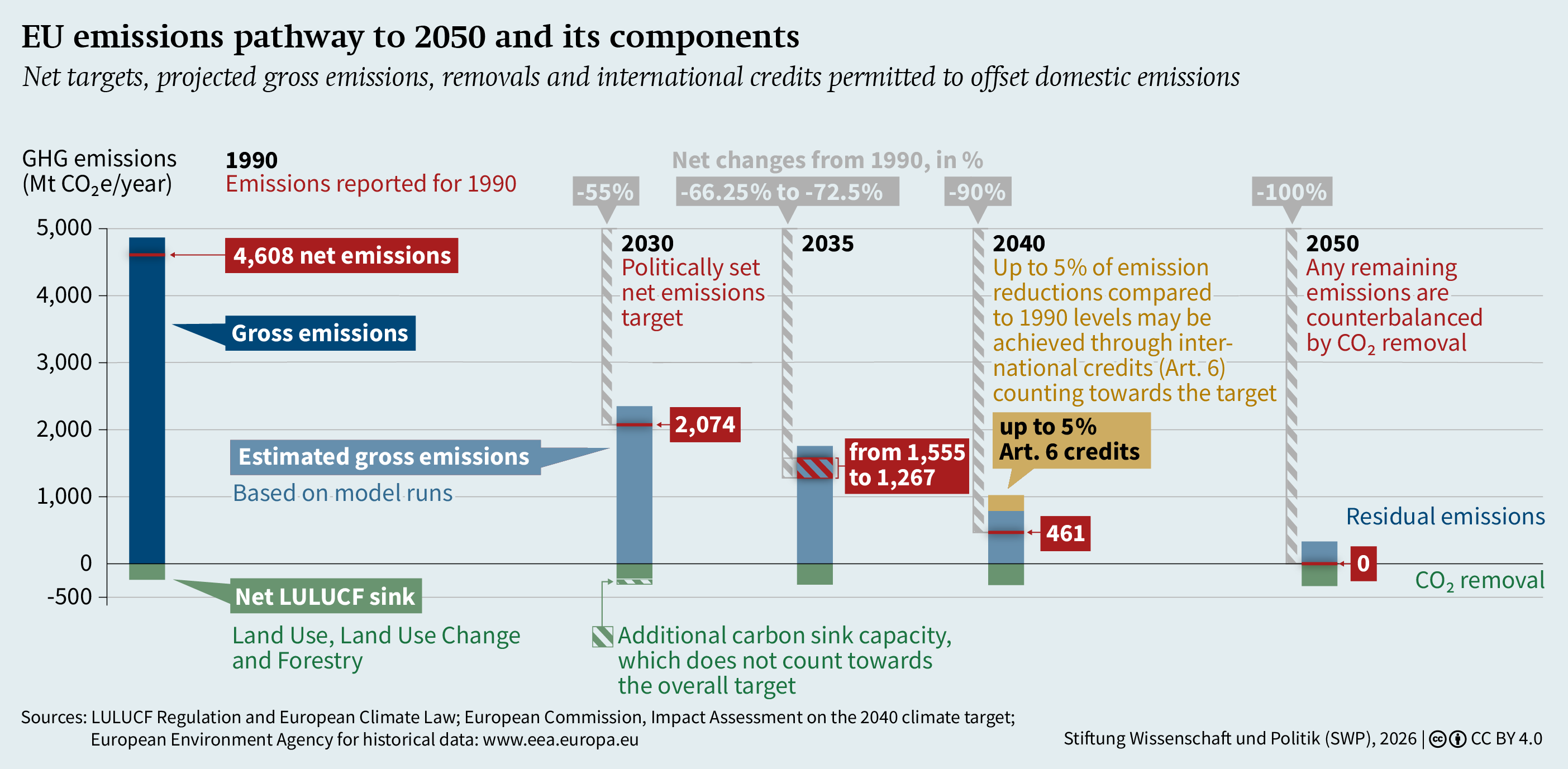
Despite the agreement reached in principle among member states and the European Parliament, important details remain unresolved. Many of these can be addressed in the forthcoming legislative procedures, including those on emissions trading, the inclusion of international credits and the contribution of the LULUCF sector. On a more fundamental level, the main issue for the overall regulatory framework to be clarified is the future of differentiated national targets, such as those currently in place for the LULUCF sector and, under the Effort Sharing Regulation, for the buildings, transport and agriculture sectors.
Emissions trading
In July 2026, the European Commission presented an initial reform proposal for the EU ETS, with the aim of concluding negotiations between the Council and the Parliament as early as 2027. The ETS has been the centrepiece of the EU’s climate policy architecture since 2005. By setting a cap on greenhouse gas (GHG) emissions from electricity generation, industry, aviation and maritime transport, it ensures that reduction targets are met for around 40 per cent of EU-wide GHG emissions under the so-called ETS 1. A separate emissions trading system (ETS 2) is also being introduced for the transport and buildings sectors, with its first trading period starting in January 2028. Carbon pricing and trading in emission allowances have a decisive impact on companies’ production costs, incentivising investments in abatement technologies. Given the tense economic situation in the EU, the ETS has become the focal point for various demands regarding the future of EU climate policy.
Primarily, the system is expected to further advance climate protection by steadily and significantly reducing the annual allocation of allowances. To this end, the Scandinavian member states, among others, are calling for the resulting high carbon price to be maintained. However, to avoid further undermining European competitiveness amid the difficult economic conditions, representatives of energy-intensive industries advocate easing the ETS targets. This demand is supported primarily by Eastern European governments. Germany takes a more nuanced stance. Although the German government wishes to maintain a strong ETS overall, it also backs the Commission’s reform proposals aimed at allowing greater flexibility regarding the volume of allowances brought to the market. The Commission’s plans include lowering the linear reduction factor, which determines the annual reduction in the overall cap; adjusting the Market Stability Reserve, which allows the Commission to control the volume of allowances to a certain extent; prolonging free allowance allocation to sectors facing particularly intense international competition beyond 2036; and introducing credits from mitigation projects outside Europe, limited to 5 per cent of the EU’s 1990 net GHG emissions. From 2036, CDR methods involving geological storage are to be integrated into the ETS, namely bioenergy with carbon capture and storage (BECCS) and direct air carbon capture and storage (DACCS). These two innovations mark a paradigm shift that extends far beyond emissions trading.
However, in implementing the 2040 climate target, the Commission no longer views the ETS in isolation, but rather as an instrument of European industrial and transition policy. Its proposal aims to balance a slower pace of implementation with incentives to invest in green technologies. This is evident in the detailed proposals. Energy-intensive companies receiving free allowances for longer than previously planned would, in return, be required to demonstrate that they are investing in decarbonisation measures (“transition contract”), while member states would be required to allocate at least 50 per cent of their ETS revenues to the decarbonisation of ETS-1 sectors. The Commission also proposes establishing an Industrial Decarbonisation Bank to provide investment incentives beyond those generated by the carbon price.
International credits
By allowing project credits from third countries from 2036, as already provided for in the amended European Climate Law, the EU is moving away from its “domestic only” paradigm, which required all mitigation measures to be implemented exclusively within the EU. By explicitly referring to Article 6 of the Paris Agreement, the EU expresses its will of achieving higher standards for international credits than those applied during the two commitment periods under the Kyoto Protocol (2008–2020), when low-cost credits of dubious quality undermined the credibility of EU climate policy. To avoid repeating this negative experience, the European Climate Law provides for safeguards regarding the origin of credits, their quality standards and the conditions under which they may be purchased. This also reflects the EU’s ambition to play a leading international role in regulating mitigation projects under Article 6.
Despite these guardrails, the European Climate Law remains largely programmatic. It defers key decisions on implementation to a later date. The actual scale of the system remains unclear for the time being: Between 2036 and 2040, credits equivalent to up to 5 per cent of 1990 emissions will be permitted. Between 2031 and 2035, a pilot phase is also envisaged to help establish a market for high-quality credits in the first place. How the 5 per cent cap is to be distributed across the years 2036 to 2040, whether it will be fully utilised and how the phasing-in might be structured will only be clarified in a detailed legislative proposal, which the Commission has announced for the fourth quarter of 2026 and which will be based on a separate impact assessment.
The potential use cases for Article 6 credits have not yet been fully determined either. With the proposal for the revision of the ETS, there is now an initial indication of how they might be allocated across sectors, albeit indirectly. Rather than explicitly integrating the credits into emissions trading for electricity producers and industrial companies, the proposal focuses on the linear reduction factor. From 2036, this adjustment would allow up to 260 million tonnes of additional CO2 emissions, to be covered by international credits. These credits would be financed by auctioning 260 million ETS allowances. In addition, the Commission is proposing a safeguard clause. If high-quality international credits were not available in sufficient quantities, the linear reduction factor would be increased accordingly from 2036. However, the minimum quality criteria for these credits will not be defined until the legislative proposal on international credits, announced for the end of 2026.
Every international project credit earmarked for use in the ETS reduces the scope for sectors outside the ETS to use such credits. This is particularly relevant to agriculture, a sector that is currently governed by national targets under the Effort Sharing Regulation and accounts for the highest proportion of residual emissions in net-zero pathways, primarily in the form of methane from livestock farming and nitrous oxide from the use of fertilisers. Although the use of international credits in the agricultural sector could help limit the political costs of the transition, the scope for offsetting emissions is limited by the high consumer sensitivity to food prices. This is particularly true given that methane and nitrous oxide have a far higher global warming potential than CO2 (a factor of 27 for methane and a factor of 273 for nitrous oxide, calculated over a 100-year time horizon in each case), which would multiply the offsetting costs per tonne accordingly.
CO2 removal and LULUCF
There is now broad consensus among European climate policymakers that CDR must be significantly scaled up over the coming decade to counterbalance residual emissions, and expanded to include methods beyond forestry. Including CDR in the planned purchases of international carbon credits would allow European demand for CDR to be met in part by capacity in third countries. This would be particularly relevant given the limited capacities within the EU for CDR methods such as BECCS, DACCS, biochar and enhanced rock weathering.
However, should the specific arrangements for integrating Article 6 credits into the EU’s 2040 climate policy architecture not include a clear requirement for CDR (e.g. in the form of a minimum quota), the use of international credits could actually diminish the previously anticipated increase in the importance of CDR in EU climate policy. Since removal credits not generated by reforestation or afforestation projects are, on average, traded at significantly higher prices on voluntary carbon markets than credits from emission reduction projects, the EU is unlikely to use them. An explicit sub-quota for credits from international CDR projects, on the other hand, would enable the EU to contribute specifically to building capacity in partner countries.
The interplay between the emerging European CDR policy and international carbon markets has not yet become a focus of the debate. Against this backdrop, the Commission’s proposal to reform the EU carbon market was eagerly awaited. This is because, as early as the last revision of the ETS Directive in 2023, the Council and the Parliament had obliged the Commission to present options for integrating CDR by summer 2026.
The Commission proposes not to pursue direct integration at this stage, whereby operators of BECCS and DACCS projects generating removals would be allocated an equivalent quantity of emission allowances that they could then trade themselves. Instead, the Commission is to act as the central purchaser. This role is to be taken on by the European Climate, Infrastructure and Environment Executive Agency (CINEA), which already manages the Innovation Fund, financed through the sale of ETS allowances. The mechanism proposed by the Commission would increase the volume of emission allowances auctioned during the period 2031–2040 by an amount corresponding to 250 million tonnes of emissions. The additional revenues would be used to purchase an equivalent volume of CO2 removals from BECCS and DACCS facilities in Europe. There are already signs that the approval of further CDR methods (e.g. biochar) and the overall CDR volume will be key issues in the negotiations.
On the path to net-zero emissions by 2050, EU climate policy relies not only on novel CDR methods such as BECCS, DACCS and biochar, but also on a significant contribution from the LULUCF sector. Here, the CO2 removals from forestry significantly exceed emissions from land use, such as those from drained peatlands. However, the balance is subject to increasingly pronounced fluctuations and is regularly revised. Currently, the LULUCF Regulation, as amended by Regulation (EU) 2023/839, sets national net removal targets totalling 310 million tonnes of CO2 equivalent for 2030, to be achieved through differentiated member state targets. However, only 225 million tonnes may be counted towards the EU’s overall emissions reduction target of 55 per cent. Given the increasingly tangible impacts of accelerating climate change, such as more frequent extreme weather events and pest infestations, achieving the overall LULUCF target for 2030 is considered unlikely. The Commission will not propose a level of ambition for the LULUCF sector for 2040 until the end of 2026. At the same time, according to the amended European Climate Law, the previous option to offset possible shortfalls in the LULUCF sector by exceeding targets in other sectors is to be abolished. Instead, the European Climate Law now even stipulates that any shortfalls in LULUCF targets must not impose additional burdens on other sectors. In the worst case, this could create a perverse incentive to initially adopt a highly ambitious net LULUCF target in order to give sectors such as agriculture, buildings or transport greater leeway – leeway that would not be restricted even if the initial LULUCF target for 2040 proved unattainable.
Differentiated national targets
One source of uncertainty that has received little attention to date is the anticipated restructuring of the EU’s climate policy architecture after 2030. The pressure for change does not stem directly from the adoption of the 2040 climate target, but rather from the planned introduction of ETS 2 in 2028 and the associated dual regulation of emissions from the transport and buildings sectors. These emission sources have been part of the “Effort Sharing” system since 2009, which is based on emissions reduction targets that differ between member states and cover not only transport and buildings, but also smaller industrial installations, the waste sector and agriculture. As the targets under the Effort Sharing Regulation are not to be adjusted before 2030, emissions from transport and buildings will be subject to two parallel regulatory systems until the end of the current regulatory period: EU-wide harmonised ETS 2 and a system of national responsibilities. It is generally undisputed that a new type of regulation will be required in this area from 2031.
However, various options for a future framework are currently under discussion. These range from retaining the existing system, through merging the two pillars with legally binding member state targets, to abolishing those targets altogether. In the first model, EU-wide harmonised emissions trading would remain in place alongside national targets for LULUCF and the remaining Non-ETS sectors. In the second model, LULUCF and the remaining effort-sharing sectors would be grouped under one combined target for each member state and continued alongside ETS 1 and ETS 2. In the third model, binding national emissions targets would be completely abolished and only indicative national targets would be set, similar to the renewable energy targets for 2030.
Retaining the existing system appears unlikely, primarily because effort-sharing in the 2030s is expected to be increasingly dominated by emissions from the – politically well-organised – agricultural sector, which would make it difficult to agree on ambitious national effort-sharing targets. A politically more viable option – and one that would be particularly attractive to countries where agriculture accounts for a high share of emissions – would be to integrate effort-sharing and LULUCF, as CO2 removals from forestry could be used flexibly to offset hard-to-abate methane and nitrous oxide emissions. Under the most far-reaching option discussed so far, the system of non-binding national sub-targets for renewable energy expansion would be extended to other sectors and incorporated into a reporting and monitoring system, as currently practised through National Energy and Climate Plans within the framework of the Governance Regulation (2018/1999).
The pending policy decision on how to balance EU-wide harmonised regulatory systems, such as emissions trading, with systems of differentiated member state targets will be crucial to the allocation of climate policy responsibilities from 2031 onwards. If binding member state and sectoral targets – such as those in place until 2030 under the Effort Sharing Regulation and the LULUCF Regulation – were abolished, this would make the overall climate policy architecture more flexible but would also diffuse responsibility. Here too, a comprehensive proposal from the Commission is expected towards the end of 2026.
Conclusions
The compromise on the 2040 target reflects a level of ambition unmatched by any other industrialised country, even though the EU’s rapid pace of climate action in recent years has come under increasing criticism in light of difficult macroeconomic developments and geopolitical tensions. Since the EU institutions were unwilling to deviate from the 90 per cent ambition long established in the European debate, their only option was to incorporate new flexibility options. These include not only the possibility, introduced by the amended European Climate Law, to count international carbon credits towards the target and rely more heavily on CDR methods. The Commission’s proposed changes to the emissions reduction pathway under ETS 1 and the emerging changes to the binding nature of national targets in sectors beyond the ETS point in the same direction.
A phase of uncertainty about future developments is now emerging in EU climate policy. Negotiations on the specific design of the new flexibility options will take a great deal of time, and climate policymakers, stakeholders and the businesses affected by the EU’s climate policy architecture will find it difficult to anticipate all possible interactions between existing regulatory mechanisms and those yet to be introduced.
To narrow the range of possible options, it is therefore important that the Commission promptly present its detailed proposals on the design of eligible international carbon credits and the further development of the regulatory architecture beyond emissions trading, particularly the role of binding national targets from 2031. Otherwise, there is a risk that far-reaching flexibility options will be introduced during the ongoing legislative process to reform the ETS without their implications for the overall regulatory system being adequately taken into account at an early stage.
Dr Oliver Geden is Senior Fellow in the EU/Europe Research Division and Co-Head of the Climate and Energy Policy Research Cluster at SWP. Dr Nicoletta Brazzola and Leona Tenkhoff are Associates in the EU/Europe Division, working in the “CDRnext” and “State of Carbon Dioxide Removal” research projects, respectively. Dr Susanne Dröge is Senior Fellow in the Global Issues Division and Co-Head of the Climate and Energy Policy Research Cluster.
This work is licensed under CC BY 4.0
This Comment reflects the authors’ views.
SWP Comments are subject to internal peer review, fact-checking and copy-editing. For further information on our quality control procedures, please visit the SWP website: https://www.swp-berlin.org/en/about-swp/ quality-management-for-swp-publications/
SWP
Stiftung Wissenschaft und Politik
German Institute for International and Security Affairs
Ludwigkirchplatz 3–4
10719 Berlin
Telephone +49 30 880 07-0
Fax +49 30 880 07-100
www.swp-berlin.org
swp@swp-berlin.org
ISSN (Print) 1861-1761
ISSN (Online) 2747-5107
DOI: 10.18449/2026C42
(English version of SWP‑Aktuell 46/2026)