The End of the Diplomatic Thaw between Japan and China

How Geopolitical Rivalry Shapes Bilateral Relations
SWP Comment 2025/C 52, 18.12.2025, 8 Pagesdoi:10.18449/2025C52
Research AreasThe relationship between Japan and China is of far-reaching importance for peace and stability in the Indo-Pacific, as the two countries are the world’s fourth- and second-largest economies, respectively. Over the past 15 years, bilateral tensions have deepened markedly, even as the two countries have maintained close economic ties. During the one-year tenure of Japanese Prime Minister Ishiba Shigeru (October 2024–October 2025), however, there were signs of a modest thaw in relations. In November 2024, Chinese President Xi Jinping described the relationship as being “in a critical phase of improvement and development”. His statement was followed by a series of diplomatic exchanges and Beijing even agreed to lift import restrictions on Japanese fishery products and beef. Yet, the thaw remained limited. Beijing has reverted to a confrontational posture following remarks on Taiwan by Japan’s new Prime Minister Takaichi Sanae in early November. The relationship remains fragile.
A review of state visits between Japan and China underscores just how limited high-level political engagement has been in recent years. The last such visit to Japan by a Chinese president took place 17 years ago, when Hu Jintao – Xi Jinping’s predecessor – travelled to Tokyo in 2008. On the Japanese side, Abe Shinzo’s 2018 trip to China remains the most recent official visit by a prime minister. Since then, interactions between heads of state or between ministers have taken place mainly on the sidelines of multilateral forums, including the United Nations General Assembly and the Asia-Pacific Economic Cooperation summit.
However, under Prime Minister Ishiba Shigeru, who stepped down in October 2025, political and diplomatic engagement appeared to regain traction. In late 2024, the National Security Advisor, Akiba Takeo, and Foreign Minister Iwaya Takeshi at the time visited China. This was followed in March 2025 by the first high-level economic dialogue in Tokyo since 2019, co-chaired by the two foreign ministers. At a trilateral meeting with South Korea that same month, the trade ministers agreed to reinvigorate negotiations that have been ongoing since 2012 on a joint free trade agreement.
Political party and parliamentary exchanges also intensified. In January 2025, Beijing hosted the first dialogue between the governing parties in six years, and in April, a cross-party Japanese delegation from the bilateral parliamentary friendship group visited China. Even military-to-military exchanges resumed after a five-year pause, with reciprocal commander-level visits in November 2024 and January 2025.
The engagement did not end with meetings – both governments also took initial, tangible steps to improve relations. In late 2024, Tokyo and Beijing announced a reciprocal easing of visa requirements and committed to expanding people-to-people exchanges. In early November 2025, Japan resumed seafood exports to China for the first time since 2023, after Beijing partially lifted its import ban. China had introduced the ban in 2023, when Japan began releasing treated cooling water from the damaged Fukushima nuclear plant into the Pacific Ocean. In July, Beijing went further, indicating that it intended to lift the long-standing import ban on Japanese beef that has been in place since 2001.
Yet these gestures did not translate into a substantive improvement in the bilateral relationship. Uncertainty over the United States’ (US) foreign-policy trajectory under President Donald Trump – combined with his administration’s hardline tariffs – may have encouraged Japan and China to keep communication channels open. However, such diplomatic efforts were overshadowed by escalating security and geopolitical rivalry, reinforced by deep mutual distrust. The intensity of this bilateral competition became immediately evident after Japan’s new Prime Minister Takaichi Sanae – who has repeatedly labelled China a threat and advocated closer ties with Taiwan – took office. Beijing responded aggressively to remarks she made in parliament.
Growing Fragility in Relations
The Sino-Japanese relationship has been marked by recurring tensions since the end of World War II. Initially, these revolved around Japan’s wartime legacy: Since the 1990s, the territorial dispute over the uninhabited Senkaku Islands (Diaoyu Islands in Chinese), administered by Japan, became an additional point of contention.
At the same time, stabilizing factors existed across the economic, political, and security spheres. Following the establishment of diplomatic relations, Japan became China’s largest development aid donor from 1979 onward, contributing to deepening economic ties that have benefitted both countries. Accordingly, bilateral relations in Japan were often described as “politically cold, economically hot” (seirei keinetsu). Another stabilizing factor was the network of personal ties between senior politicians in both countries – facilitated by the near-continuous governance of Japan’s Liberal Democratic Party and its coalition partner Komeito. These contacts served as informal channels to exchange information, discuss sensitive issues discreetly, and mitigate tensions. In the security domain, the military superiority of Japan’s ally, the US, over China established clear power dynamics, which also contributed to stability.
Over the past two decades, however, the relationship has undergone a fundamental transformation: China’s rise as a major power, coupled with an increasingly assertive posture, has sharpened geopolitical rivalry. At the same time, the stabilizing factors in the economic, political, and security spheres have weakened, while bilateral tensions have become increasingly visible. As a result, despite the intensified diplomatic exchanges during Ishiba’s tenure, the relationship has remained fragile and strained.
Geopolitical Rivalry and the Triangle with the US
Geopolitical rivalry now defines the Sino-Japanese relationship. Japan views China as an uncompromising, revisionist power intent on displacing the US as the region’s dominant hegemon. From Beijing’s perspective, Japan – America’s key ally in Asia – anchors US military presence in the region and, positioned along the first island chain, constrains China’s access to the Pacific. Through its “Free and Open Indo-Pacific” strategy, Japan has asserted its regional ambitions and positioned itself clearly against China’s assertive actions, including in the South China Sea.
The escalating US-China confrontation has deepened mistrust between Tokyo and Beijing. China interprets closer Japan-US coordination as evidence of a coordinated containment strategy. Tensions over Taiwan are particularly acute: While China has intensified threats toward the island, the US and Japan have repeatedly reaffirmed their shared commitment to maintaining peace and stability in the Taiwan Strait, such as at the February 2025 summit between President Trump and Prime Minister Ishiba. US Secretary of Defence Pete Hegseth described Japan as an “indispensable partner” in deterring Chinese aggression. According to media reports, the US and Japan intensified work on joint operational plans for a potential Taiwan crisis during Ishiba’s tenure. In parallel, Tokyo has gradually expanded its informal ties with Taipei.
It therefore seems paradoxical that China increased its diplomatic engagement with Japan under Ishiba. Two factors likely drove this tactical shift. First, it appears to have been opportunistic rather than principled. Beijing sought to exploit Japan’s uncertainty over Trump’s foreign policy – his dismissive attitude toward allies and apparent disregard for the rules-based order – and to amplify perceived rifts within the US-Japan alliance. For example, at the end of March 2025, Chinese state media reported that the trade ministers of China, Japan, and South Korea had agreed on a joint approach to US tariff policy – a claim Japan quickly denied.
Second, China was likely encouraged by Ishiba’s apparent willingness to engage in dialogue. While he prioritized strengthening Japan’s defence capabilities, he simultaneously emphasized his intention to seize every opportunity for exchange with Beijing in order to stabilize the relationship and prevent miscalculations. Against the backdrop of Trump’s disruptive policies and uncertainty regarding the resilience of Sino-American communication channels, Ishiba’s engagement with Beijing represented an effort to manage risk and preserve dialogue.
Confrontation in the East China Sea
Despite diplomatic exchanges over the past year, tensions in the security domain between China and Japan showed no signs of easing. Japan has long viewed China’s massive military buildup with concern. Reflecting these anxieties, the 2025 Japanese Defence White Paper once again labelled China an “unprecedented and greatest strategic challenge”, a formulation first used in the 2022 National Security Strategy. Concern is heightened by China’s growing security cooperation with North Korea and Russia, showcased during Beijing’s September 2025 military parade, which featured all three heads of state.
The territorial dispute over the Senkaku Islands in the East China Sea has become a daily flashpoint (see Figure, p. 4). Since the 2010 collision between a Chinese fishing vessel and a Japanese Coast Guard ship, China has maintained an almost continuous presence in surrounding waters. By sending its coast guard vessels into territorial waters (12 nautical miles) and the surrounding contiguous zone (12 to 24 nautical miles) off the Senkaku Islands, China challenges Japan’s territorial claims and control on a daily basis.
Two trends stand out. First, China has expanded its presence both quantitatively and qualitatively. In 2024, Chinese Coast Guard and Navy vessels passed through the islands’ contiguous zone on 355 out of 365 days – the highest number ever. By the end of October 2025, Chinese ships had been absent on only four days. Furthermore, in 2024 they entered territorial waters on 42 days, the second-highest figure since 2013. Chinese vessels are increasingly large and heavily armed, including the world’s largest coast guard ship equipped with two helicopters.
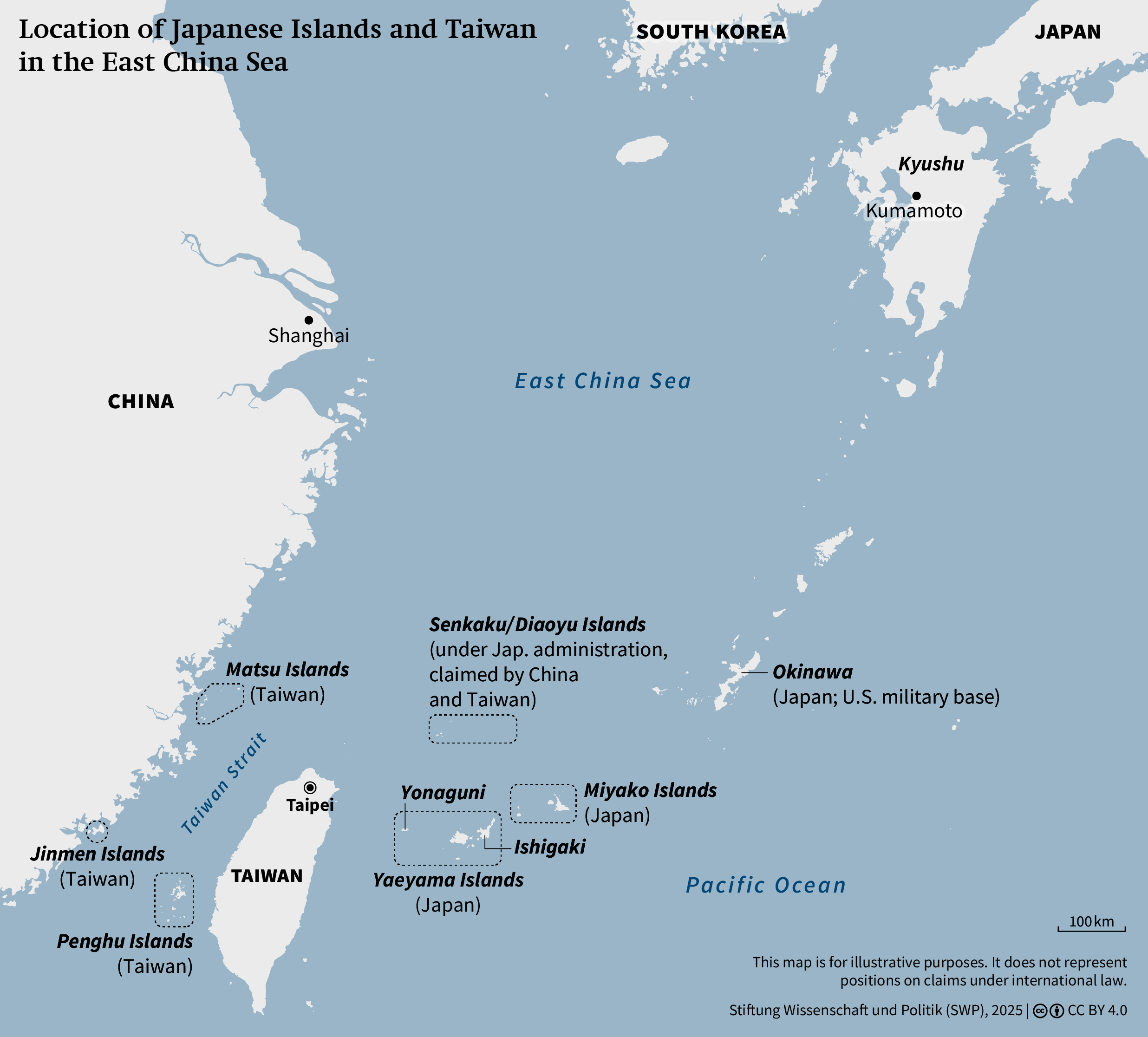
Second, China has sought to expel Japanese fishing vessels as a means of asserting effective control. In 2023 alone, the Japanese Coast Guard recorded 17 such incidents. Overall, Beijing is pursuing a grey-zone strategy in the East China Sea, mirroring its approach in the South China Sea.
Chinese military activities in Japan’s vicinity extend well beyond the Senkaku Islands in both maritime and aerial domains. Exercises and aggressive manoeuvres near Taiwan – just 70 miles from Japan’s nearest island – pose direct security risks. Moreover, China is extending its presence in the Pacific. In May and June 2025, two Chinese aircraft carriers and their fighter jets operated simultaneously near smaller Japanese islands for the first time, demonstrating power-projection capabilities far beyond China’s coast. China has repeatedly provoked Japan directly: In August 2024, a Chinese reconnaissance plane entered Japanese airspace for the first time and in June and July 2025, Chinese fighter jets repeatedly approached Japanese military aircraft, at one point coming as close as 30 meters. Joint Chinese-Russian manoeuvres near Japan have also increased.
In response, Japan has implemented comprehensive security reforms over recent years. Between 2022 and 2025, defence spending rose from JPY 5.4 trillion to JPY 8.7 trillion (from USD 35 billion to USD 56 billion). Military and coast guard presence in the southwestern islands has been expanded. Bases on islands near Taiwan have been upgraded, anti-ship and anti-air missiles deployed, and air defence systems strengthened. In Kumamoto on Kyushu, Japan plans to introduce Type 12 long-range missiles by March 2026 as part of its “counterstrike capabilities”, enabling limited strikes on enemy targets. In tandem with the US, such capabilities also contribute to deterring an attack on Taiwan, reducing the prospects of a rapid victory by potentially constraining China’s operational freedom in the region.
Since 2022, Japan’s Coast Guard has seen similar reinforcement. Ishigaki hosts Japan’s largest base, with 600 personnel patrolling the Senkaku area. Further enhancements are planned, including a new multi-purpose patrol vessel that would surpass existing models of the country’s navy. A comprehensive civil defence plan for the remote southwestern islands – including shelters and evacuation procedures – is also in development, reflecting heightened crisis awareness.
Despite the proximity in which Japanese and Chinese vessels operate, no effective crisis communication exists between the two militaries. Although a hotline between the defence ministries was established in May 2023, it has never been used in a security-relevant incident. According to media reports, Japan has repeatedly attempted to make contact – but without success. Japanese observers attribute this to a lack of clear decision-making authority at the Chinese working level.
Economic Relations in the Shadow of Rivalry
On the surface, rising geopolitical tensions have had little impact on the close trade relations between Japan and China. In 2024, China was Japan’s largest trading partner: In 2024, China was Japan’s largest trading partner, with bilateral trade totalling USD 292 billion and accounting for just over 20 per cent of Japan’s total trade, ahead of the United States (USD 226 billion). Japan, in turn, was China’s third-largest trading partner after the US and South Korea, accounting for 4.8 per cent of China’s total trade. Behind these figures lie mutual dependencies: Japanese firms rely on China for critical supply chains and as a major sales market, while China depends on Japanese technologies, including those necessary for semiconductor manufacturing.
Politically, however, the nature of economic relations has shifted – and this trend predates the Ishiba administration. For decades, economic cooperation was promoted largely independent of recurring political frictions. Japan sought to build mutual trust and anchor China in the multilateral, rules-based order, supporting, for example, its accession to the World Trade Organisation (WTO). This separation of economics and politics began to crumble in 2010 when China used economic dependencies deliberately as a political tool for the first time, restricting exports of rare earths to Japan amid the territorial dispute over the Senkaku Islands. Tokyo similarly viewed China’s 2023 ban on Japanese seafood imports as politically motivated, given that the International Atomic Energy Agency confirmed the safety of the Fukushima water release into the Pacific Ocean.
Since 2010, security concerns have increasingly shaped Japan’s economic policy. Tokyo aims to reduce structural vulnerabilities and critical dependencies on China while preserving the benefits of open trade where possible. The 2022 Economic Security Promotion Act embodies this shift, as it seeks to diversify strategic supply chains, protect sensitive technologies, and boost national innovation capabilities.
Overall, Japan’s approach resembles that of the US but is more calibrated: Measures are not country-specific, cover a narrower scope, and avoid coercive trade tools such as punitive tariffs. Under the Ishiba administration, this line continued, notably through significant public investment in semiconductors and artificial intelligence. In Japanese strategic thinking, innovation and technological leadership create strategic indispensability (senryakuteki fukaketsusei) vis‑à-vis China – shaping Beijing’s cost-benefit calculus and preserving stabilizing channels of economic interdependence.
Shifts are also visible at the corporate level. In 2023, Japanese companies invested approximately USD 135.8 billion in China, accounting for 6.4 per cent of Japan’s total outbound foreign investment stock. In 2015, this share was 8.6 per cent, indicating a decline in Japanese investment in China. A survey conducted by the Japan External Trade Organization in mid-2024 found that only 21.7 per cent of Japanese companies operating in China planned to expand – the lowest share since 2007. Meanwhile, 64.6 per cent intended to maintain the status quo and 13.7 per cent planned to downsize or withdraw.
Multiple factors drive this trend: geopolitical uncertainty, weak Chinese domestic demand, slowing growth, and intrusive regulation. Security concerns are increasingly salient for businesses as well. At least 17 Japanese nationals have been detained in China on opaque espionage charges in recent years and several violent attacks – some targeting children – have underscored growing risks for Japanese citizens.
Rising Mistrust in Society
Growing geopolitical tensions are increasingly mirrored at the societal level. According to a 2024 survey by the Japanese think tank Genron NPO, 89 per cent of Japanese and 88 per cent of Chinese respondents held negative or relatively negative views of the other country. Twenty years ago, these numbers were in some cases below 40 per cent – a dramatic erosion of mutual trust.
The picture is more nuanced when it comes to societal exchange. The number of Japanese citizens living in China declined from roughly 150,000 in 2012 to just under 100,000 by the end of 2024. In 2024, only around 3,000 Japanese students studied abroad in China. In contrast, the number of Chinese residents in Japan has risen significantly in recent years, reaching around 870,000 in 2024. Japan is a highly attractive destination for Chinese students and tourists. At the same time however, Chinese nationals in Japan have increasingly become the subject of domestic political debates. During the July Upper House elections, contentious discussions about immigration and foreign land ownership – topics frequently associated with China in public discourse – were featured prominently.
Historical narratives further entrench mistrust. Since the 1990s, Beijing has promoted nationalist interpretations of history that cast Japan as a principal antagonist. Against this backdrop, political willingness to engage China on historical issues has eroded in Japan. At the same time, conservative politicians, including Prime Minister Takaichi, have called for greater patriotism and a less self-critical approach to history. In the past, visits by Japanese prime ministers to the Yasukuni Shrine, which commemorates those who died in service of Japan including convicted World War II war criminals, have also triggered bilateral frictions with China. In this regard, Tokyo has exercised restraint in recent years: Abe Shinzo was the last prime minister to visit the Yasukuni Shrine in 2013.
In light of societal estrangement and growing bilateral tensions, informal channels of communication between leading politicians in the two countries also appear to have weakened. Advocates of a more open dialogue now risk being portrayed as overly conciliatory. Ishiba, for instance, faced intraparty criticism after easing visa rules for Chinese nationals. These dynamics have led to a structural hardening of the relationship, making efforts to resume dialogue and cooperation more difficult.
China’s Escalation following Takaichi’s Taiwan Statement
The fragility of Sino-Japanese relations has become especially visible since Prime Minister Takaichi Sanae took office at the end of October. Initially, both governments signalled a willingness to engage: Takaichi and Xi met on the sidelines of a multilateral summit and reiterated their goal of building a “mutually beneficial relationship based on common strategic interests” – a formula used since 2007 that now rings largely hollow. Takaichi used the meeting to raise Japan’s security concerns, including China’s activities in the East China Sea.
The mood shifted abruptly in early November. Responding to parliamentary questioning, Takaichi stated that a military escalation over Taiwan could constitute an “existential threat” to Japan. Under Japanese law, such a scenario could justify the exercise of collective self-defence. The context of her remarks suggests she was referring not to the defence of Taiwan itself, but to protecting US forces should Washington intervene – a provision already codified in Japan’s 2015 security legislation. Nevertheless, referencing a Taiwan scenario so explicitly was unusually concrete for a sitting prime minister. Previously, Japan had maintained deliberate strategic ambiguity regarding whether and how it might support the US in a military conflict over Taiwan. Takaichi stressed that her comments did not signal a policy shift and pledged to avoid discussing hypotheticals going forward.
China reacted immediately with a combination of sharp, confrontational rhetoric and targeted economic pressure. The Ministry of Foreign Affairs demanded that Takaichi retract her statement and warned her not to interfere in the Taiwan issue, declaring, “those who play with fire will get burned”. The Chinese Consul General in Osaka, Xue Jian, escalated tensions by threatening Takaichi with decapitation. Beijing also issued a travel warning, claiming there was “significant risk” to Chinese citizens in Japan. Within three days, nearly half a million flight bookings to Japan were cancelled, dealing a significant blow to the Japanese tourism sector. China simultaneously reinstated its ban on Japanese seafood imports. Tokyo’s rapid dispatch of a senior foreign ministry official failed to calm the situation.
Tensions further escalated when Chinese military jets on 6 December apparently directed their fire-control radar intermittently at Japanese fighters that had been scrambled to monitor a large-scale exercise involving China’s Liaoning aircraft carrier between Okinawa’s main island and the Miyako Islands. Japan lodged a protest, labelling China’s conduct as a “dangerous act” and urging measures to prevent recurrence. Both sides blamed each other for the incident, with China claiming its jets had been harassed by Japanese aircraft – an account that Japan rejected. Tokyo also refuted China’s assertion that its fighters had only used their regular search radar rather than fire-control.
Outlook and Implications
There is little indication that the dispute over Takaichi’s Taiwan remarks will be resolved quickly. Overall, Japan-China relations are rapidly deteriorating and marked by mutually reinforcing negative dynamics. Geopolitical rivalry is deepening security tensions, especially as China takes an ever more assertive posture in the East China Sea. Economic cooperation is increasingly shaped by political calculations – and deliberately weaponized by Beijing. Societal and political mistrust is reaching record levels, while long-standing informal channels for dialogue are eroding. The relationship is becoming more fragile, heightening the risk of further escalation.
While Ishiba’s and Takaichi’s policies with China differ primarily in tone, Beijing’s sudden pivot – from cautious rapprochement to open confrontation after Takaichi’s Taiwan statement – is striking. Its swift use of economic pressure fits a broader pattern seen in other cases, most notably Australia, namely alternating between symbolic concessions and coercive measures. Germany and other European countries should take note and scrutinize any apparent progress with China for real substance.
Japan and Germany – and Europe more broadly – share fundamental concerns about China’s assertive behaviour, its disregard for international norms, and its readiness to use economic coercion. This makes mutual solidarity all the more essential when Beijing targets Japan, Germany, or close partners. At the same time, Berlin and Tokyo should deepen cooperation on economic security, critical supply chains, and defence to strengthen their operational resilience and strategic leverage vis-à-vis China. In multilateral forums such as the G7, both Germany and Japan should coordinate more closely – particularly regarding China-related issues.
Kento Fukuta was an intern in the Asia Research Division from April to June 2025. Dr Alexandra Sakaki is the Deputy Head of the Asia Research Division. The authors would like to thank Simona Beckemeier for providing research assistance and Isabella Faulhaber for supporting economic data analysis.
This work is licensed under CC BY 4.0
This Comment reflects the authors’ views.
SWP Comments are subject to internal peer review, fact-checking and copy-editing. For further information on our quality control procedures, please visit the SWP website: https://www.swp-berlin.org/en/about-swp/ quality-management-for-swp-publications/
SWP
Stiftung Wissenschaft und Politik
German Institute for International and Security Affairs
Ludwigkirchplatz 3–4
10719 Berlin
Telephone +49 30 880 07-0
Fax +49 30 880 07-100
www.swp-berlin.org
swp@swp-berlin.org
ISSN (Print) 1861-1761
ISSN (Online) 2747-5107
DOI: 10.18449/2025C52
(Updated English version of SWP-Aktuell 52/2025)