Peace in Crisis: Conflict Management in the Horn of Africa
SWP Research Paper 2026/RP 10, 17.06.2026, 33 Pages
doi:10.18449/2026RP10
Research AreasDr Gerrit Kurtz is Associate in SWP’s Africa and Middle East Research Division.
The author would like to thank Karoline Eickhoff, Anne Koch, Stefan Mair and Denis M. Tull for their helpful comments and suggestions on the draft manuscript. He would also like to thank Mark Schrolle for data analysis and generating one of the figures.
-
The system of international conflict management is in deep crisis. Relevant instruments such as UN peace operations are being withdrawn, normative and power-political preconditions (for example, US-guaranteed international order) no longer apply and all too often agreements have led to the entrenchment of violent authoritarian systems rather than their transformation.
-
This crisis is particularly evident in the Horn of Africa. Neither peace agreements concluded under significant international pressure (as in the case of South Sudan) nor those negotiated between armed actors with virtually no mediation (as in Sudan in 2020) have brought about stability. Rather, governments (such as that of Ethiopia) have regularly exploited peace processes to secure their own rule.
-
More recent mediation processes have been primarily a function of regional rivalries and the diplomatic interests of the external actors involved (as has been the case in Sudan since the current war began in April 2023). If foreign support is available, the parties to the conflict have fewer incentives to make compromises.
-
Because mechanisms for implementing agreements are poorly resourced and receive little political support, there is no inclusive political process following ceasefires to address the root causes of the conflict. Sooner or later, fighting flares up once again.
-
As far as European contributions to conflict resolution in the Horn of Africa are concerned, there are lessons to be learned from this crisis. Europe should neither cling nostalgically to what is a largely defunct system of conflict management, nor should it, out of frustration, adopt approaches dominated solely by security considerations. Instead, it should support civilian peace initiatives, help political economies of violence die out and rethink its own cooperation with governments that exacerbate conflict (such as that of the United Arab Emirates).
Table of contents
2 The System of International Conflict Management
2.1 “Standard approach” to conflicts
2.2 Preconditions and assumptions of previous conflict management
2.3 Changes in structural conditions
2.4 More war, less peace: Crisis-ridden escalation
3 Armed Conflicts and Peace Processes in the Horn of Africa
3.1 Sudan’s Comprehensive Peace Agreement (2005): Model that comes with catch
3.2 South Sudan: Agreements reached under pressure, transition that never ends
3.3 Sudan and South Sudan: Falling entry price for the political marketplace
3.4 Ethiopia: Ceasefire without political process
4 Consequences: How Mediation and Peace Processes Unravel
4.2 Authoritarian instrumentalisation of peace agreements
4.3 Weak monitoring and implementation support
4.4 An increasingly fragile power structure
Issues and Recommendations
Not since the end of the Second World War have there been more armed conflicts than there are today. War, violence, displacement and hunger are shaping the lives of an ever-increasing number of people worldwide.
The Horn of Africa is a global conflict flashpoint. Some of the deadliest armed conflicts of the past decade have taken place or are continuing to take place there: the civil war in South Sudan, the power struggle in northern Ethiopia and the war against the civilian population in Sudan. Estimates suggest that since 2013, more than 1 million people have died in those wars as a consequence – direct or indirect – of violence, hunger and deprivation. Moreover, the war in Sudan has triggered the world’s largest displacement crisis.
At the same time, the current system of international conflict management, in which the United Nations (UN) and regional organisations are the key players, has come under severe strain. After the end of the Cold War, there emerged an international “standard approach” towards dealing with armed conflict – particularly civil wars. That approach includes i) coordinated mediation based on applying both pressure and expertise; ii) an agreement between the main parties to the conflict to share political and economic power and restore the state monopoly on the use of force; and iii) an international implementation structure that has diplomatic support and, in many cases, a multidimensional peace mission. While this has always been an ideal model, many examples of such an approach can be found in the Horn of Africa, in particular.
In South Sudan, there are several international organisations that take various approaches to conflict management: the UN Mission in South Sudan (UNMISS); a body that reports to the Intergovernmental Authority on Development (IGAD) and monitors the revitalised peace agreement; and the committee of five African Presidents (C5) within the African Union (AU). In Sudan, the United Nations – African Union Hybrid Operation in Darfur (UNAMID) remained in place until the end of 2020. Five international organisations – the UN, the AU, IGAD, the European Union and Arab League – are involved in seeking to end the war that broke out in April 2023 between the Sudanese Armed Forces (SAF) and the Rapid Support Forces (RSF). Also involved are the US and various Arab and European states. However, coordination between all these actors is limited. In Ethiopia, under the internationally backed Pretoria Agreement, concluded in November 2022 by the Tigray People’s Liberation Front (TPLF) and Addis Ababa, only a tiny AU observation mission is present. In the case of all three countries, the US, together with its European and regional African partners, has played a leading role in mediating, exerting pressure and providing support.
However, the availability of such conventional instruments of conflict management is dwindling. The UN Security Council frequently fails to reach a political consensus, while there have been no new multidimensional peace missions since 2014 and the aim of mediation efforts is now limited to achieving ceasefires. The resources, patience and leadership to drive subsequent political processes are all lacking among the earlier proponents of the standard approach towards dealing with conflicts, particularly the US.
For the most part, the international conditions and assumptions underpinning this approach are no longer being met. The US has ceased to be the sole hegemonic superpower; rather, there are rival powers that act within shifting arrangements of cooperation. The normative ideals of a “liberal” or at least sustainable peace are finding less support, not only in the US but also in Europe; indeed, it is not unusual for programmes promoting inclusion and diversity to be confronted with downright hostility. Even former advocates of an active international role in conflict management are frustrated by the setbacks in Afghanistan, Mali and Sudan as well as by what they perceive, at least, as the ineffectiveness of corresponding peace efforts elsewhere.
In fact, even relatively comprehensive and inclusive peace agreements have fallen short of expectations when it comes to their practical implementation. At times, they have even contributed to consolidating authoritarian and violent systems. For elites vying for dominance in the state, the economy and society, political violence remains the means of choice in such cases.
Thus, in the Horn of Africa, there is a multifaceted crisis in international conflict management: at the level of the international order, at the level of multilateral institutions and at the level of the political economy of the countries concerned.
This research paper examines the development of this polycrisis in international conflict management through the lens of major conflicts and peace processes in Sudan, South Sudan and Ethiopia. It seeks to answer the question of how such a situation came about at both the global and regional level. While the second Trump administration has exacerbated the crisis-prone trend, the current White House occupant has not caused it. The research paper also examines the approaches to conflict management that have been adopted in the three countries since the conclusion in 2005 of Sudan’s Comprehensive Peace Agreement, which, at the time, many involved in the mediation discourse regarded as exemplary, although its weaknesses are now blatantly evident. Finally, the paper takes a look at what the crisis means in practice for mediation and peace processes in Sudan, South Sudan and Ethiopia.
Germany has invested heavily – both financially and politically – in the multilateral system of conflict management and has benefited from the relative achievements of that system. The Federal Republic’s claim to a seat on the UN Security Council is derived precisely from this commitment to peace, international law and international security. Its export-oriented economy requires a rules-based international order that ensures compliance with such fundamental principles as territorial integrity. Further, European security depends on domestic conflicts in other regions of the world not spreading, whether through terrorism, organised crime or attacks on shipping. And freedom in Germany relies not least on an international system in which egregious violations of international law are, at a minimum, recorded and condemned rather than explicitly or tacitly condoned when a country’s own partners are involved. The crisis in conflict management in the Horn of Africa thus strikes at the very foundations of German foreign policy.
Germany must decide whether it wants to contribute to this crisis by continuing to cut international cooperation budgets and exercise normative restraint or whether it intends to take a proactive role in seeking new ways to end conflicts and foster peace. To this end, it will be important not to be hoodwinked by transactional, profit-oriented mediation approaches. Rather, Berlin should support – at least as a complementary measure – local initiatives aimed at social cohesion, ceasefires and reconciliation. It should also analyse Germany’s own transnational ties with conflict actors and lobby for greater accountability.
The System of International Conflict Management
“Standard approach” to conflicts
During the Cold War, the superpowers viewed civil conflicts primarily through the lens of their respective ideologies. Warring parties received political and military support if their objectives aligned with the worldview of the socialist Soviet Union or the capitalist United States of America. Civil wars usually ended in the military victory of one side.1 The fall of the communist Derg regime in Ethiopia in 1991, which the rebels of the Tigray People’s Liberation Front (TPLF) achieved through the capture of Addis Ababa, signalled the end of one of the last such conflicts during this period.
With the emergence of the unipolar moment at the start of the 1990s, international behaviour changed. The US established – mainly through the United Nations (UN) – what can be described as an international “standard approach” towards civil wars.2 That approach was characterised by three main elements:
-
International mediation between the military and political parties to the conflict based on a (more or less) coordinated mediation mechanism involving international organisations and a number of influential states, which, as a rule, were under US hegemony;
-
An internationally guaranteed peace agreement involving power-sharing between the parties to the conflict, the demobilisation of non-state actors and a commitment to address jointly identified root causes of the conflict through economic development, constitutional reforms and transitional justice, in particular; and
-
An international monitoring and implementation structure for the obligations arising from the agreement; that structure was often linked to a multilaterally mandated peace operation, funds for reconstruction and diplomatic support.
This “standard approach” largely chimed with the academic findings on how armed conflicts can be effectively resolved. According to those findings, such processes must address the root causes of the conflict (such as the marginalisation of a specific group), take all key parties to the conflict into account and be equipped with a robust monitoring mechanism through a third party, usually one or more international organisations.3 Furthermore, it was established that if peace processes actively involve women, they have a greater chance of preventing war from breaking out again and reform plans tend to be more ambitious.4
The most important mediators at the global level were the US as well as, in Africa, the UN, the African Union (AU) and the Intergovernmental Authority on Development (IGAD). In armed conflicts which involved third-party mediation, foreign governments, regional organisations and international organisations were by far the most common facilitators. While the proportion of mediated conflicts in any one year stood at more than 40 per cent in the early 1990s and mid-2000s, that figure has roughly halved since 2015.5
Unlike in the case of interstate conflicts, of which there have been comparatively few since the end of the Cold War, the political separation of the parties to intra-state conflicts tends not to be possible (although physical separation may be possible in cases of regional autonomy). In some interstate wars involving smaller powers, however, the international approach was quite similar because these wars were generally border conflicts between neighbours – for example, the 1998–2000 war between Ethiopia and Eritrea. That conflict ended with the Algiers Peace Agreement following mediation by the Organisation of African Unity (OAU) and the UN; and between 2000 and 2008, the ceasefire was monitored by the UN Mission in Ethiopia and Eritrea (UNMEE).
The standard approach towards conflict resolution emerged under the conditions of US hegemony in the wake of the Cold War.
Accordingly, the following discussion focuses on interstate and intrastate armed conflicts involving at least one state; it does not examine conflicts exclusively between non-state groups, which often take place at the local level.6 Internationalised civil wars, in which foreign governments openly or covertly support the warring parties, are an intermediate form of conflict that has gained considerable significance since 2015. These distinctions become especially blurred in contexts – such as that of the Horn of Africa – in which many borders were drawn under colonial rule, population groups maintain close transnational ties, secessionist movements have led to the emergence of new post-colonial states7 and the legitimacy of national governments is contested, especially in peripheral regions.
Conflict parties define their respective goals and, at times, their very existence as incompatible with one another. They are prepared to pursue their agenda through armed force, whereby non-state armed actors, in particular, constantly face the challenge of maintaining access to military resources. International mediation –according to the most influential conceptual approach – should therefore seek to convince the parties that they cannot win the conflict militarily and will remain locked in a mutually hurting stalemate.8 Furthermore, the parties to the conflict should be able to recognise at least the start of a possible way out through negotiations. In the ensuing negotiation process, this perspective can be expanded by establishing mutual conditions under which it appears attractive to the parties to pursue their interests in the long term without resorting to violence. While objective circumstances (such as the military balance of power) play a role in this process, the most important thing is the perception among the parties involved – or their respective leaderships – that, on the whole, a continuation of the conflict would not be to their advantage. A particular challenge in intrastate conflicts is that this realisation usually depends on a prior escalation in which it is the non-state side that has demonstrated its determination and military capability.9
Agreements do not need to resolve every bone of contention, but they should establish a reliable framework for addressing issues in a non-violent manner. It has proved helpful when implementation is accompanied and supported by monitoring and verification mechanisms.10 The mediators themselves can play a role here, as can multilateral organisations (such as the UN and the AU) – for example, through international peace operations – and representatives of the parties to the conflict. Such implementation mechanisms can establish a structured dialogue between the parties so that the timely fulfilment of mutual obligations can be monitored, delays and violations investigated and sanctions imposed where necessary. Furthermore, these mechanisms can be more inclusive than the agreements – for example, by including civilian members of specific interest groups, representatives of demographic segments (youth, displaced persons, women) and influential figures (such as religious leaders).
Preconditions and assumptions of previous conflict management
The standard approach towards armed conflict since the end of the Cold War has been based on fundamental assumptions and preconditions in three areas: the international distribution of power, the influence of liberal norms and the minimum legitimacy of the parties to the conflict.
It is no coincidence that the standard approach to a negotiated end to conflict emerged under the conditions of US hegemony following the collapse of the Soviet Union. The United States no longer had to keep its military ready for a potential confrontation with a superpower of equal standing, nor did it have to fear any serious military opposition from any other third power when it intervened in a civil war. Such intervention could be largely coordinated with its allies.11 Furthermore, thanks to their political and financial clout, the US and its international and regional partners were able to exercise considerable influence over key multilateral organisations.
If it so desired, the United States could assemble an international coalition that would bring coordinated pressure, incentives and mediation support to bear on an armed conflict. Its domination of multilateral organisations meant that the involvement of alternative negotiating forums, which would have detracted from this approach, could be prevented to a large extent. Decision-making bodies such as the UN Security Council were able to agree on a common approach, provide political support for mediation processes and authorise multidimensional peace operations to monitor agreements and accompany broader political peace processes. States – particularly those from the Global South – were willing to provide troops and police forces for such missions because it allowed them to demonstrate their importance within the US-led international order. Furthermore, troop-contributing countries received international funding for the deployment.12
Mediation approaches to armed conflicts were based on a number of fundamental normative convictions which, at times, dominated the discourse in the US, among its partners and within international organisations. They included the general impulse to resolve conflicts through negotiation rather than bringing about their end by strengthening one side or allowing them to peter out without a formal conclusion.13 It was also argued at the time that state sovereignty should not allow repressive governments free rein to commit massacres against their own populations.14 In the US, Europe and elsewhere, there was political backing to provide financial and political capital for the peace work of international organisations and non-governmental organisations. The idea was to use the end of conflicts as an opportunity to tackle the more fundamental challenges facing the respective society – challenges seen as the root causes of the hostilities – and to support all such steps at an international level.15 The ambitions went beyond merely resolving the “central incompatibilities”16 between the warring parties. Rather, the aim was to address the structural causes of social conflict and the internal distribution of power, some of which were deeply rooted in history.
Ultimately, the international mediation approach was based on the premise that parties to the conflict possess a minimum level of legitimacy to speak on behalf of large parts of the population – whether they are already in possession of such legitimacy or first have to be strengthened to perform this role.17 It is not until this condition has been fulfilled that the parties are able to make credible commitments and implement them, even in the face of resistance from within their own ranks. Invariably, the fundamental challenge was that only armed actors can end wars but only civilian actors can build peace. Thus, the main task of peace processes was to enable civilian actors to change the logic of the conflict. An inclusive architecture that goes beyond the dominant military actors and seeks to involve civilian and marginalised groups (such as displaced persons) would, so the assumption, be capable of overcoming the binary logic of a conflict.18 However, the warring actors have an interest in keeping negotiations as exclusive as possible or involving only those civilian representatives whom they can clearly classify as belonging to their own camp.
These conditions were determined not so much by liberal values as far more by power politics. Generally, they amounted to strengthening state structures with which foreign governments could then interact more easily. Particularly in the wake of the US-led global war on terror but also in contexts of economic cooperation, the standard approach tended to achieve not the opening up of societies but the conclusion of deals between elites. Within the paradigm of stabilising fragile orders, the approach of the British government, for example, was aimed at supporting local agreements that necessarily had to be concluded between the actors who had the greatest influence over security.19 The main objective was to reduce violence in order to pave the way for longer-term change. Meanwhile, it became apparent that even the supposedly liberal approach to peacebuilding contained internal contradictions because conflict resolution, democratisation and market-oriented opening are often at odds with one another.20 If political and economic competition is rapidly established in post-war societies, existing lines of conflict can be reinforced and violence reignited.21 Western governments that supported peace processes frequently adopted a paternalistic attitude when presenting their liberal goals. Those governments were, moreover, prepared to make substantive compromises if their own particular interests – such as limiting migration, combating terrorism or cooperating with allies – were served.22
Changes in structural conditions
The standard approach towards conflicts is in crisis because its underlying assumptions and premises have, for the most part, ceased to be valid.23 This is due not solely to political decisions taken by actors in the US, Europe and international organisations who advocated this approach. It has also been driven by the structural transformation of the international order, international norms and institutions, and – particularly in the Horn of Africa – the political economies of countries affected by conflict. Material power – military, economic and financial – is becoming increasingly dispersed within the international system. The role played by the various dimensions of power in a conflict depends on their distribution within a specific field and a specific region. “Multipolarity” does not adequately describe this pattern.24 Today, unlike in the years after the end of the Cold War, the United States is not in a position of absolute hegemony. In Europe, where both Russia and the US are the key players, the distribution of power is different from that in the Horn of Africa, where China plays a greater role, as do the United Arab Emirates (UAE) and Saudi Arabia. Furthermore, the rivalry between Ethiopia and Egypt, which centres primarily on the waters of the Nile, exercises a certain structuring influence in the region.
Governments in the Horn of Africa are less willing now to be forced into clear-cut alliances and one-sided positionings than they were in the past.
It is clear that governments – and, at times, non-state armed actors – now have a wider choice of financially solvent partners with security interests than they did in the past.25 They are no longer as willing to be forced into clear-cut alliances and one-sided positionings at the expense of third parties. Even the US is less able to impose its ideas about the global order and alliance policy. For example, under the first Trump administration, Washington sought to curb China’s influence in Ethiopia after Abiy Ahmed had assumed office as that country’s prime minister in 2018. Increasingly, it saw the substantial investments of the People’s Republic in Ethiopia, which had been agreed under the previous government of the Ethiopian People’s Revolutionary Democratic Front (EPRDF), as a threat to its own interests. For this reason, it sought to cooperate more closely with Ethiopia on security and economic policy. However, that endeavour failed.26 Abiy opted for closer cooperation with the UAE, which provided financial support for his economic reforms and supplied the Ethiopian government with drones for its war against the TPLF. But from the perspective of the US, the Emirates – with which it cooperates closely – is still preferable to China as a partner for Ethiopia.
As a result of the decline in American hegemony, several powers – different ones in each region – are now in a more competitive relationship with one another, including with regard to their influence in armed conflicts. The other powers, no longer able to rely as much on the US to guarantee their security (or, rather, the US is no longer as able to impose its own agenda), feel compelled to actively pursue their regional interests themselves. Their rivalry fuels conflicts, but they have little incentive to seek compromises among themselves as long as the behaviour of their rivals does not affect their existential interests. Instead, they view the (potentially peace-promoting) engagement of their regional rivals in preventing or ending a conflict through the prism of how it affects both their own power-projection capabilities and security arrangements.27
Extra-regional powers, such as the UAE, Saudi Arabia, and Turkey, often rely more on bilateral approaches or ad hoc arrangements than on multilateral organisations such as the UN or AU, especially as they themselves are not members of African regional organisations. However, short-term mechanisms undermine the development of institutional structures within the AU and beyond.28 This contrasts with the US and Europe, which, in the past, sought to give at least the impression of strengthening the regional initiatives of important states such as Kenya and Ethiopia under the auspices of the AU and IGAD. Furthermore, African states have failed to provide regional organisations with sufficient own resources or ensure their political unity, despite their commitments along these lines.29 Many peace negotiations, such as those aimed at resolving the conflict in Sudan, take place outside multilateral processes, meaning that the expertise and implementation support provided by international organisations in the past are not available to the negotiators.30 The monitoring of peace processes requires the attention of the states involved, but that tends to wane as soon as agreements are concluded. Consequently, such agreements are fragile.
The greater diffusion of power within the international system and the growing interventionism of rival powers are undermining the prospects for peace mediation. Today, the parties to a conflict have a wider choice of external partners, which reduces the influence of individual international mediators. “[Eritrean President] Isais [Afwerki] we could never deal with, but with the leaders of Ethiopia and South Sudan, yes, we had leverage in the past. Now they have a way out,” an international diplomat with many years’ experience commented.31 Those governments are now less dependent on the resources and legitimacy of the US and its Western partners than they used to be.
Alongside the shift in material power, there has been an erosion of the international norms on which the fundamental impulse to end armed conflicts through negotiation was based. Investment in conflict management has declined in countries that were once leaders in this field, such as the UK, South Africa and Ethiopia, owing to isolationism, nationalism and domestic political polarisation.32 European policy is regularly confronted with the contradiction between advocating inclusive conflict resolution and cooperating with authoritarian governments – and, in some cases, even with non-state armed actors such as Libyan General Khalifa Haftar – in order to curb migration.33 The UAE covertly supplies weapons to the Rapid Support Forces in Sudan while publicly presenting itself as a mediator in the conflict there.34 And the US is in violation of the UN Charter’s prohibition on the use of force when (as in January 2026) it abducts Venezuelan President Nicolás Maduro or (as in 2025 and 2026, together with Israel) launches military attacks against Iran.
These international shifts are also evident in the political economy of armed conflicts. Today, weapons, ammunition and military expertise are more readily available, which helps the parties to a conflict sustain their efforts for longer. Furthermore, these parties are less dependent on local support when they are able to count on external assistance, which, in the case of armed groups, can lead to discipline issues and increased violence against the civilian population.35 The risk of fragmentation among the parties to the conflict is increased by governments and armed groups playing external actors off against one another. And transactional agreements heighten the risk of the legitimate representation of individual population groups being fought over – an outcome that can lead to conflicts within those groups and the formation of splinter groups.
More war, less peace: Crisis-ridden escalation
There is no doubt that the standard approach to conflict management had its successes. In the 2000s, the number of armed conflicts involving at least one state fell significantly and more such conflicts were brought to an end than were started.
However, the situation has changed significantly. Since 2015, the number of armed conflicts worldwide has risen rapidly (see Figure 1). This applies, above all, to conflicts involving jihadist groups, with which governments and most of their international partners have, in effect, ruled out the possibility of negotiating.36 Similarly, there has been a steep increase in the number of internationalised civil wars (in which external state actors intervene militarily on one side of the conflict).37 Fewer and fewer armed conflicts are being ended through peace agreements – or through the victory of one of the parties.38 Contrary to the long-term trend since the end of the Cold War, the number of interstate wars has been rising, too, starting with Russia’s war of aggression against Ukraine.39 At the same time, the way in which war is conducted has become more intense: there is more violence against the civilian population and civilian infrastructure, while international humanitarian law and international human rights are increasingly being violated. Moreover, conflicts are becoming more fragmented, forced displacement is on the rise and the gap between humanitarian needs and international solidarity is widening.40
|
Sources: Uppsala Conflict Data Program (UCDP), UCDP/PRIO Armed Conflict Dataset (Version 25.1) (Uppsala: Department of Peace and Conflict Research, Uppsala University, 2025), https://ucdp.uu.se/; Shawn Davies, Therése Pettersson, Margareta Sollenberg and Magnus Öberg, “Organized Violence 1989–2024, and the Challenges of Identifying Civilian Victims”, Journal of Peace Research 62, no. 4 (2025), 1223‑‑40; Nils Petter Gleditsch, Peter Wallensteen, Mikael Eriksson, Margareta Sollenberg and Håvard Strand, “Armed Conflict 1946–2001: A New Dataset”, Journal of Peace Research 39, no. 5 (2002), 615–37; Joakim Kreutz, “How and When Armed Conflicts End: Introducing the UCDP Conflict Termination Dataset”, Journal of Peace Research 47, no. 2 (2010), 243–50. |
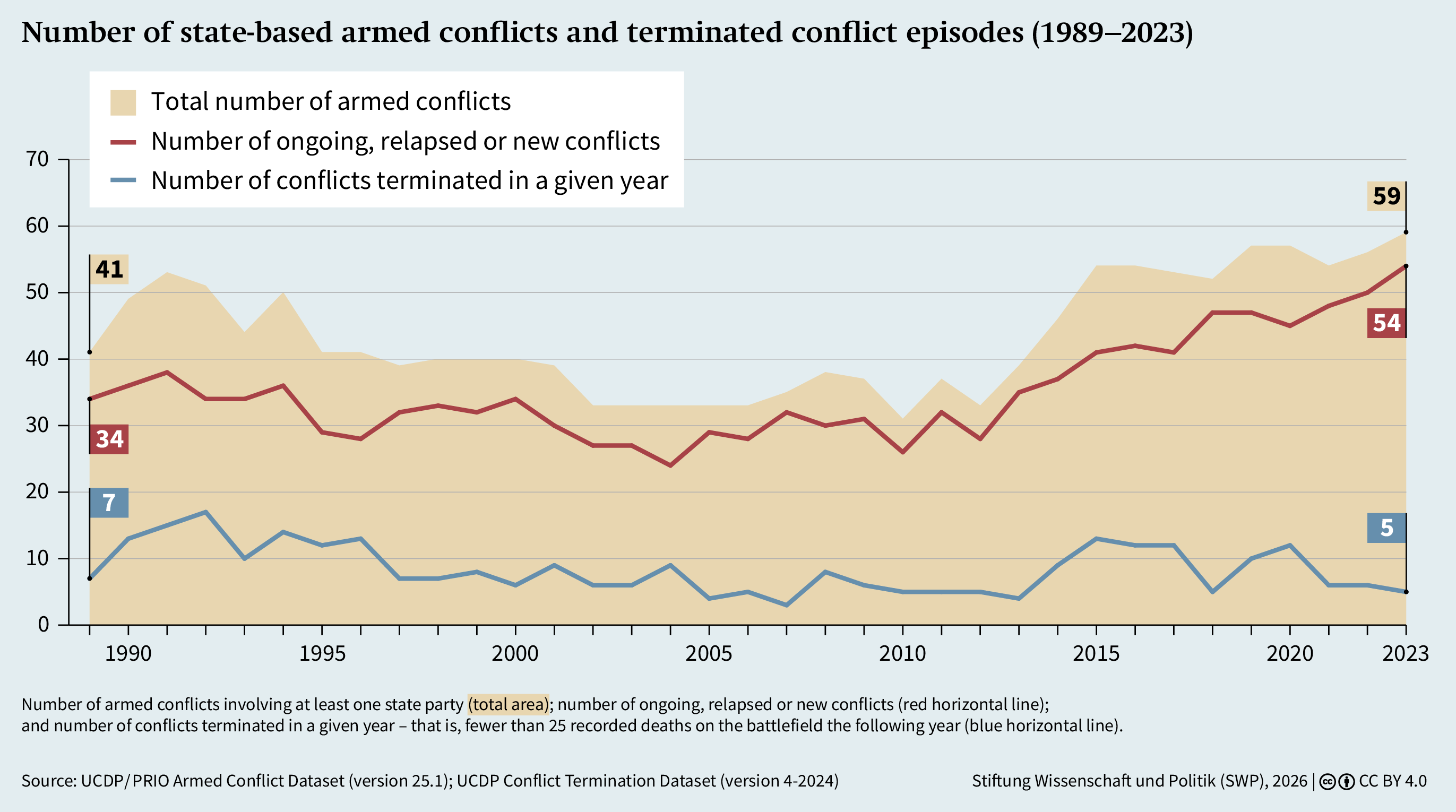
There are many reasons for the growing global incidence of war. But what is clear is that, today, the instruments of the standard approach are being used less and are not as well as equipped or are scarcely available at all. The UN Security Council, formerly the centre of global decision-making on armed conflicts, is meeting less frequently and adopting fewer resolutions: in 2025, there were just 44, the lowest number in more than 30 years (in 2016, 77 resolutions were passed). Moreover, only 61 per cent of those resolutions were adopted unanimously (compared with an average of just under 84 per cent between 2014 and 2023).41 Thus, political consensus within the UN Security Council – a prerequisite for supporting mediation initiatives, agreements and their implementation – is becoming increasingly difficult to achieve.
At the same time, the Security Council is increasingly withdrawing its most important instrument – the peacekeeping mission – often under pressure from host countries, such as Mali and Sudan. The number of military and police personnel deployed in UN peace operations peaked between 2010 and 2015; since then, it has halved (from around 98,000 at the end of 2015 to some 49,000 at the end of 2025).42 The Council’s last new multidimensional peacekeeping mission was deployed in 2014 (in the Central African Republic).
In addition, governments that were among the main funders of conflict management in the past have scaled back their spending in this area. This is likely due to a combination of factors: the general need to economise owing to rising defence expenditure in Europe, political disillusionment in the face of the failure of large-scale international interventions such as in Afghanistan and a growing ideological hostility towards peace work, which is emanating, above all, from right-wing nationalist movements.
Agreements are increasingly aimed at achieving only a ceasefire, as more substantive accords appear to be out of reach.
Since peaking in 2018, funding available for peacebuilding through official development assistance (ODA) has fallen significantly.43 The sector is dominated by a handful of major donors and the cuts made by two of them – the UK and the US – had a correspondingly severe impact up to 2023 (the UK reduced its ODA expenditure on peacebuilding by 75 per cent between the periods 2014–16 and 2022–24). Meanwhile, Germany, the largest donor in this area, has begun to reduce its spending, too.44 Furthermore, cuts by the world’s leading donors to development cooperation, humanitarian aid and the United Nations system are hitting the poorest countries and conflict-affected states particularly hard.45
Similarly, there has been reduction in funding for multilateral mediation. Between 2022 and 2025, the budget for the diplomatic work of the UN Secretariat fell by 48 per cent. And in 2025, the UN Department of Political and Peacebuilding Affairs (UN DPPA) received just over half (US$18.7 million) of its planned additional budget.46
The quality of conflict management has changed, too. Even if there has never been a “golden age” in this field, the requirements for the success of peace processes, as identified in the academic literature, are increasingly at odds with the actual conditions under which those processes take place.47 When agreements on ending armed conflicts have been reached in recent years, they have rarely gone beyond – either in substance or in practice – a ceasefire and the sharing of power among the groups involved. Indeed, whereas the ceasefire was once an intermediate step towards a (somewhat) comprehensive peace agreement designed to address the root causes of the conflict, today it is the ceasefire itself that is increasingly becoming the goal, as more substantive accords appear to be out of reach.48
While advocates of a “liberal peace” may expect that the root causes of a dispute can be addressed following the conclusion of an agreement, this has often proved not to be the case. Armed conflicts predominantly take place within the boundaries and with the participation of authoritarian states. Their approach to conflict management is based not on dialogue and the balancing of interests but, primarily, on restricting the means or economic incentives of armed resistance when their opponents cannot be defeated by force alone. Thus, the motto here is: repression, not transformation.49 Many agreements institutionalised what were main causes of the conflict and embedded them in a new political and legal framework that, at best, served only to contain the conflict.50 Thus, the underlying power relations remained in flux and had to be renegotiated at every stage of implementation, at times amid renewed outbreaks of violence.
The Taliban’s seizure of power in Afghanistan in 2021 and the forced withdrawal of UN troops from Mali in 2023 left the sobering impression that international interventions had failed not least because of their own ambitions.51 That perception fails to recognise that the civilian approach to conflict transformation was underfunded in both cases and took a back seat to foreign policy priorities such as counter-terrorism and the short-term stabilisation of local elites.52
It is because of all these developments that the system of international conflict management – that is, what to date has been the standard approach, above all (though not exclusively), to ending civil wars – finds itself in crisis. There are four dimensions to this current state of affairs:
-
The reduced availability of key instruments (multilateral mediation, power-sharing agreements, multidimensional peace missions);
-
The reduction in financial resources allocated to those instruments as well as within the broader nexus of peacebuilding, development cooperation and humanitarian aid;
-
The dwindling political consensus and coherence among leading states in international organisations (such as the UN and the AU); and
-
The declining appeal of earlier conflict management approaches (based on deals being made with elites) as a result of the failure of the expected liberal transformation to materialise and the frequent renewed outbreaks of violence or consolidation of authoritarian power
Since the second Trump administration took office in January 2025, the crisis has only deepened further. The current US government has abolished the US Agency for International Development (USAID) and radically cut both funding and in-house expert positions for civilian conflict management. Moreover, it has refused to pay its mandatory contribution to the United Nations and severely curtailed the number of troops it contributes to UN peacekeeping missions. As a result, all UN peacekeeping missions were forced to cut their staff by 25 per cent by the end of 2025.53 Under President Trump, the US continues to serve as an active mediator in armed conflicts; however, it does so largely without diplomatic expertise and mainly in pursuit of its own economic interests, as demonstrated by negotiators such as Steve Witkoff and Jared Kushner.54
While, until now, peace negotiations have invariably involved a transactional give and take, the Trump administration relies on coercive measures and agreements that are reached as quickly as possible and have as high a profile as possible, so that it is able to detract from the fact that, in some cases, violence persists – as in the east of the Democratic Republic of the Congo, where the US is mediating between that country’s government and Rwanda.55 And with its “Board of Peace”, the US has created an institution with global ambitions in which Trump alone has a personal veto – unlike in the UN Security Council. Thus, under the current president, Washington has become a determined opponent of what was once the standard approach to armed conflict and, in particular, of the liberal ambitions associated with that approach.56
Armed Conflicts and Peace Processes in the Horn of Africa
In recent decades, the Horn of Africa has been a global conflict flashpoint. Accordingly, the instruments of the standard approach to armed conflict have been deployed in this region on numerous occasions. In their post-colonial history, all IGAD member states57 have experienced at least localised violence while many have seen civil war at the national level or been engaged in conflicts with their neighbours. But the standard approach has had a particular impact in Sudan, South Sudan and, to a somewhat lesser extent, Ethiopia. Thus, the focus below is on the conflicts and peace processes in these three countries (see Figure 2).
The main challenge here is that the armed violence has systemic roots. Statehood, national identity and the distribution of power along ideological, ethnic, social or religious lines are all highly contested. Yet, even under the standard approach, conflict management has been almost exclusively transactional in practice and thus has failed – at least for the foreseeable future – to create space for the transformation of the conflicts.58 Consequently, the peace processes in question are especially dependent on the conditions under which they emerged being maintained. Where parties to a conflict have agreed to a settlement under pressure, through the help of international expertise and/or with the prospect of certain (financial or political) incentives, any change in those circumstances jeopardises both the sustainability and the stability of this type of conflict management.
A key task for states in the Horn of Africa is to manage structural transformation processes in such a way that they do not collapse under armed violence, displacement or economic upheaval. To date, these processes have included the change in the elite in Ethiopia (from the TPLF to Prime Minister Abiy Ahmed’s Prosperity Party), the transformation of the security sector in all three states (in each case, from the decentralisation to the centralisation of the monopoly on the use of force) and the shift in the political economy (from the exploitation of natural resources such as oil and gold towards an employment-oriented macroeconomy based on a broad range of sectors).
In the case of armed conflict, restoring the status quo ante or maintaining the status quo is generally not an option, as neither would bring (long-term) stability. International conflict management, however, assumes – implicitly or explicitly – that the initial governance conditions could be made stable again. It also assumes that the parties to the conflict possess a minimum degree of legitimacy, which is increasingly not the case in Sudan, South Sudan and Ethiopia owing to the fragmentation of armed groups, the support they receive from abroad and the kleptocratic enrichment of elites.
Sudan’s Comprehensive Peace Agreement (2005): Model that comes with catch
So far, no peace agreement in the Horn of Africa has had an impact comparable to that of the Comprehensive Peace Agreement (CPA), which was concluded in January 2005 between the government in Khartoum, controlled by the National Congress Party (NCP), and the south Sudanese rebels of the Sudan People’s Liberation Movement/Army (SPLM/A). The CPA brought an end to the Second Sudanese Civil War, which had begun in 1983 with a mutiny by Sudanese army units. In many respects, it exemplifies the standard approach to armed conflict in the Horn of Africa. Both in their structure and organisation, subsequent peace processes in the region drew on this agreement, 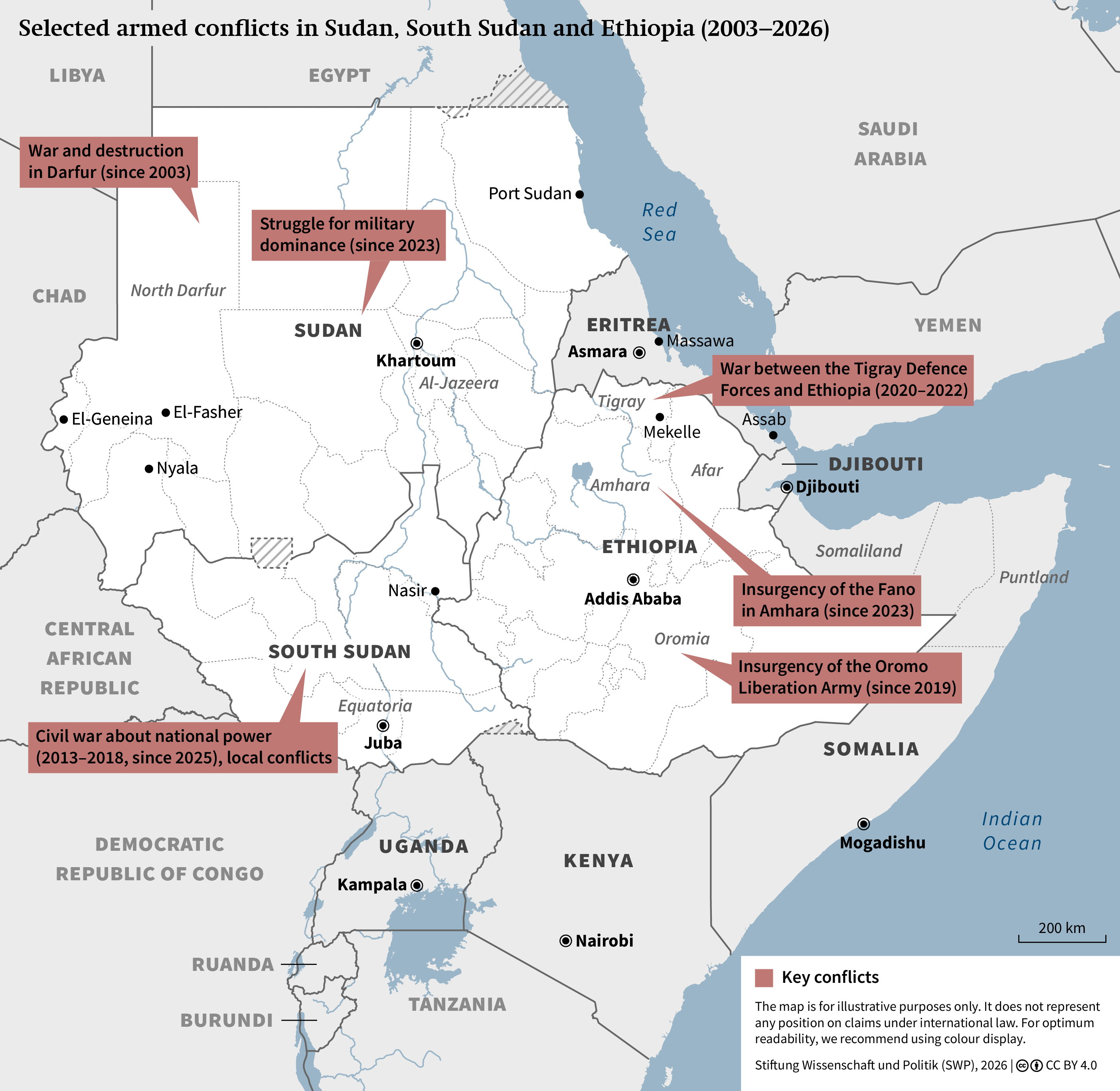 even though they took place under vastly different circumstances.
The negotiation process was led by IGAD and later supported by the US, the UK and Norway (the Troika). It began in March 1994 and lasted for more than a decade. During this period, the negotiating parties accepted the political parameters that were to serve as guiding principles: the fundamental unity of the State of Sudan, coupled with both the right to self-determination for the southern part of the country following a transitional period and the separation of state and Islam in the south.59 A separate ceasefire and a small international monitoring mission brought about an end to the fighting in (though not beyond) the particularly contentious region of the Nuba Mountains. In Kenyan General Lazaro Sumbeiywo, the process had an experienced and capable chief mediator who could count on the more or less unanimous support and mandate of IGAD. With their respective networks and capacities, the members of the Troika were closely involved in the negotiation process and repeatedly exerted pressure on the negotiating parties. Later, the United Nations Security Council established a multidimensional, civilian-military UN mission in Sudan (UNMIS) to support the implementation of the CPA. “It was, in many ways, the perfect process,” an international diplomat who was involved at the time commented.60
Among other things, the CPA contained provisions on security issues, the sharing of political power and the distribution of economic revenues. The south Sudanese rebels were given a stake in the national government and granted control of the regional government in Juba. At the same time, the agreement went hand in hand not only with a transitional constitution but also with the promise to democratise and pluralise the country, which, for the leader of the SPLM/A, John Garang de Mabior, was paramount to reflect the spirit of a “new Sudan”.
Ultimately, the CPA succeeded in bringing about an end to the armed conflict. The peace process survived the death of John Garang (in a helicopter crash), which occurred just six months after the agreement had been signed in January 2005. An independence referendum in the south of the country, provided for in the CPA, took place six years later and proceeded largely peacefully. And immediately thereafter, in July 2011, Khartoum recognised the new state of South Sudan.
The success of the CPA was based on favourable factors that worked together at various levels: local reconciliation between the Dinka and Nuer (the two largest ethnic groups in the south), the relative unity of the respective negotiating parties (which had either eliminated or integrated their internal opponents), the unanimous support of Sudan’s neighbouring states and strong US leadership.61 Furthermore, the increase in Sudanese oil revenues at the time helped bolster the implementation of the CPA, as it enabled Khartoum and Juba to secure the consent of key urban elites and armed groups through financial incentives.62 There was “neither victor nor vanquished”, as the South Sudanese intellectual Peter Adwok Nyaba later wrote.63
These enabling factors were not present in later conflicts (see Figure 3), such as that in the Sudanese region of Darfur.64 Nor could the option of an independence referendum be applied to systemic conflicts. Although the CPA was “comprehensive” in the sense that it covered not just a ceasefire and security arrangements but also political and economic aspects, it was not inclusive. Civilian political parties were no more directly involved in it than were other armed groups in the north and south of the country; in fact, they went on to conclude their own agreements with the governments in Khartoum and Juba.65 The fundamental problems of the political system in Sudan, which already existed back then, were narrowed down to a north-south conflict that appeared to have been resolved with the secession of the south. At the same time, the CPA reinforced the idea of hegemonic political movements, such as the NCP in the north and the SPLM in the south. The then coalition government, which comprised the NCP and the SPLM, organised the 2010 elections in such a way that those smaller parties that did not boycott the vote altogether had little chance of success. Thus, the implementation of the CPA showed that, in practice, a “liberal peace” often amounted to simply safeguarding the interests of the elite.66
South Sudan: Agreements reached under pressure, transition that never ends
The approach to conflict mediation in Sudan remained largely unchanged when civil war broke out in South Sudan in December 2013. In accordance with the principle of subsidiarity, IGAD served as the central multilateral framework and appointed three mediators, with Ethiopia’s Seyoum Mesfin as chief negotiator. The UN and AU supported the process, as did the Troika states and the EU. However, the mediation was hampered by the fact that the IGAD member states were pursuing different objectives. Uganda and Sudan went so far as to provide unilateral military support to the rival parties to the conflict. And while the government of South Sudan participated in the numerous IGAD summits on conflict resolution, its opponent, the SPLA/M-in-Opposition (IO), led by former Vice-President Riek Machar Teny Dhurgon, did not.67
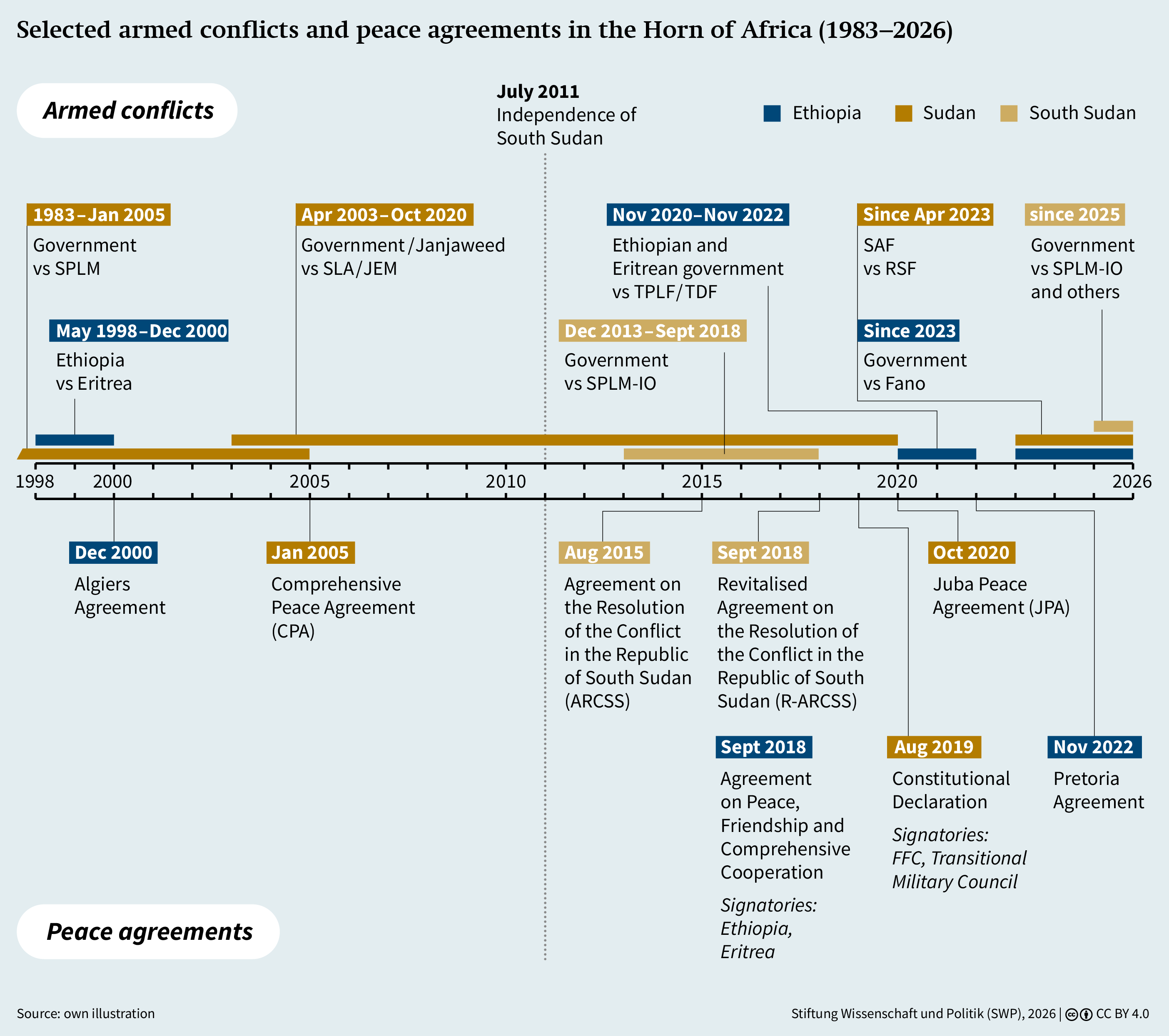
The Agreement on the Resolution of the Conflict in the Republic of South Sudan (ARCSS) was concluded only after the US had exerted considerable pressure. That pressure was most intense in July 2015, when then President Barack Obama chaired a regional summit. South Sudanese President Salva Kiir made no secret of his reluctance to sign the agreement, which he did in August 2015 only after causing a delay and attaching unilateral conditions. In July 2016, the renewed Kiir-Machar government of national unity collapsed and widespread violence broke out in Juba and other parts of the country. The revitalised peace process of 2017–18 was led initially by IGAD and supported by the Troika. However, it did not reach a conclusion until after the negotiations had been moved from Addis Ababa to Khartoum, where Sudan and Uganda – as the neighbouring states with the strongest vested interests in and a major commitment to South Sudan – assumed the lead role. Sudanese President Omar al-Bashir and his Ugandan counterpart, Yoweri Museveni, negotiated personally with Kiir and Machar in Khartoum and at the same time exercised decisive influence over the smaller negotiating partners.68
Thus, the two main peace agreements in South Sudan – the ARCSS of 2015 and the R-ARCSS of 2018 – were reached through significant political pressure from the US and South Sudan’s two most important neighbours. But these actors ceased to wield their influence after the signing. As for the parties to the conflict, they had little incentive to assume responsibility for the full implementation of the respective agreements, which, owing to their constant feet-dragging, has been repeatedly delayed. Since the formation of a government of national unity in Juba in 2020, the transition period, which is slated to end with elections, has been extended twice, each time by two years (most recently to the end of 2026).
Sudan and South Sudan: Falling entry price for the political marketplace
A different approach emerged from the mediation efforts in Sudan and South Sudan, which did not take place as a result of foreign pressure. Rather, those efforts reflected the militarised political economy of the two countries – that is, the “political marketplace” in which politico-military entrepreneurs trade their respective loyalty.69 The currency of this marketplace is money, on the one hand, and any material advantage arising from access to positions, licences or privileges, on the other. Although violence is bad for business, it is nevertheless often used as a tool to assert own interests, communicate resolve or close ranks.70 Such forms of behaviour have consequences for the definition of war and peace from the perspective of the “entrepreneurial” elites:
For the leading actors in a political marketplace, “peace” is neither an end to political violence nor the creation of a safe environment for citizens to conduct their lives without fear. Rather it is specific reconfigurations of violence, so that it is not the primary instrument for political transactions between them, and it is a political deal that gives them external legitimacy, such that subsequent violence does not count as “armed conflict” and threaten that legitimacy.71
The agreements concluded – including the 2006 Darfur Peace Agreement (DPA) – involved only weak splinter groups of armed factions, as they were the actors that stood to reap gains in the form of government positions, legitimacy and access to resources. Those groups used violence as a bargaining tool to ensure better access to such benefits. By helping the leaders of the groups to secure political posts and their members to draw salaries, the agreements strengthened loyalty to the leadership.72 In South Sudan, moreover, the government concluded agreements with splinter groups of armed factions in order to further fragment and weaken them.73
Sudan’s long-time ruler Omar al-Bashir was ousted in April 2019; and some 18 months later, in October 2020 (during the transitional period), the government concluded the Juba Peace Agreement (JPA) with a number of armed groups. South Sudan had brokered the accord without the involvement of other international mediators. Once again, it was an agreement reached with the weaker of the armed groups. The JPA empowered those actors by appointing their leaders to high-ranking government positions.74 With its broad regional coverage,75 the JPA appeared to overcome a weakness of earlier agreements such as the CPA or DPA – namely, that accords with armed groups in one region increased the incentives for violence in another region.
While the wider scope of the agreement was hailed as a success by those involved, it masked the fact that signatories from the north and centre of the country had been virtually unknown prior to the negotiations.76 Signatory groups from Darfur and Blue Nile State had only troops in exile in Libya or a few hundred on Sudanese soil. As for the two groups that controlled significant areas of Central Darfur and in the Nuba Mountains – the faction of the Sudan Liberation Army (SLA) led by Abdelwahid al-Nur and the faction of the SPLM/A-North headed by Abdelaziz al-Hilu, respectively – they refused to join the process.
Ethiopia: Ceasefire without political process
Yet another approach is evident from the Pretoria Agreement, which the Ethiopian government concluded with the TPLF in November 2022 to end the war in the north of the country. The African Union took the lead as mediator, deploying its Special Envoy Olusegun Obasanjo. But in reality, it was Washington – alongside the EU – that played a particularly active role here. During the war, the US flew high-ranking representatives of the two sides to several secret meetings outside Ethiopia.77 AU mediation put on speed only once then Kenyan President Uhuru Kenyatta became involved. Later, Kenyatta was part of a three-strong AU mediation team, together with Obasanjo and former South African Vice-President Phumzile Mlambo-Ngcuka. Neither Eritrea nor those forces from the Amhara region in northern Ethiopia that had performed a significant role during the war on the side of the Ethiopian army were involved in the negotiations.
No real willingness to address the root causes of the conflict or account for war crimes is evident in the Pretoria Agreement.
The Pretoria Agreement was, first and foremost, a cessation-of-hostilities agreement that included security arrangements. Thus, it was not a “comprehensive” agreement. It made no reference to the causes of the conflict, while liberal elements, such as the investigation of war crimes, were mentioned only in passing. The agreement guaranteed the restoration of federal control over the Tigray region and provided for the gradual disarmament, demobilisation and reintegration of the Tigray Defence Forces (TDF).78 Although Tigray was to be represented in the national parliament, which necessitated by-elections, there were no provisions for the TPLF to participate in the national government. This reflected the weak military position of the TDF, which, at the time of the negotiations in Pretoria, was on the verge of losing control of the regional capital, Mekelle, to the Ethiopian armed forces.
The Pretoria Agreement brought the hostilities in Tigray to a swift and effective conclusion; the Ethiopian government and the TDF exercised direct control over their conventionally organised troops. The government ended Tigray’s physical isolation and restored basic services such as electricity, the internet and banking. However, the political process that the agreement had, in fact, envisaged between the TPLF and the national government did not take place in the planned form.79 Moreover, the government took no action against the continued stationing of Eritrean troops on Ethiopian territory close to the joint border of the two countries. The western part of Tigray, which Amharic militias had occupied in the first weeks of the war and from which they had expelled around one million people of Tigrayan origin, remained a bone of contention between the Tigray and Amhara regions. Many of the displaced people were still living in camps several years after the agreement had been reached, which put Tigrayan society under constant strain.
Consequences: How Mediation and Peace Processes Unravel
In the practice of conflict management in Sudan, South Sudan and Ethiopia, both the changes in the international environment sketched out above (declining US hegemony, growing activities of rival powers, erosion of universal norms) and the evolution of the political economy of armed conflicts (greater fragmentation, less legitimacy) are evident. These developments can be observed in the three elements of the standard approach to dealing with armed conflict: mediation, agreements and implementation support. As a result, the political marketplace at both the regional and national level is becoming less binding and more complex, making ever greater demands of governments in the Horn of Africa that are intent on ensuring their own survival.
Competitive mediation
The more external actors are involved in a conflict, the more difficult it is to bring that conflict to an end. Mediation activities under the standard approach tend to focus on the direct parties to the conflict and less on the external actors who stand behind them, especially when the latter do not act openly. The US and Europe, both of which played an important role in the Horn of Africa in the past, have their own particular interests but are now concentrating strategically on other geographical priorities, not least the challenges posed by China and Russia. For this reason, they are seeking to strengthen individual states in the region or international organisations such as the AU so that these actors can take on mediation tasks. However, this endeavour has been only partly successful. Not only are the rivalries between external powers reflected in the field of mediation, including over the preferred institutional forum; international organisations are also competing among themselves for resources and support from their own member states. This struggle for visibility and relevance pits the external actors against one another.
In the conflicts in Sudan, South Sudan and Ethiopia, it was the case that neighbouring states in the Horn of Africa and regional powers from the Middle East had their own interests (and favoured parties) at heart; thus, those interests were brought to bear in their mediation efforts. There is no doubt that such mediators are able to exercise influence over the parties to the conflict. In South Sudan, the joint high-level engagement of the rivals Sudan and Uganda led to the revitalised agreement of 2018 – a type of accord that, until now, has not been possible in Sudan. In September 2025, the US brought together the most important Arab supporters of the two main parties to the conflict (the Sudanese Armed Forces [SAF] and the Rapid Support Forces [RSF]) – namely, the UAE, Egypt and Saudi Arabia – in a new joint mediation format (the Quad).80 For those three countries, however, it appears that their respective relations with the US were a more important reason for participating in the format than the pursuit of a balance of interests. In any case, they stepped up their respective military support for the SAF and the RSF.81
In some important respects, the agenda of these middle powers differed significantly from the objectives pursued by Washington, Europe and international organisations.82 Then US Special Envoy Jeffrey Feltman regularly consulted with his colleagues from other countries during the war in northern Ethiopia. According to him, they were all agreed that Ethiopia’s stability was important but came to different conclusions from that of the Americans: “The Chinese, the Emirates and Turkey were of the view that Abiy’s defeat of the Tigrayans would stabilise the country. Whereas we were of the view that the war was destructive and a distraction from the larger governance challenges. Our diagnosis was the same, our prescriptions quite different,” Feltman said.83 During the war, Ethiopia received drone deliveries from the UAE, Turkey and Iran, which enabled its armed forces to repel a TDF offensive towards Addis Ababa in autumn 2021.84 Although this military support did not lead to the total victory of the Ethiopian armed forces, it did strengthen Abiy’s government for the subsequent negotiations, in which neither the UAE nor Turkey nor Iran were involved.
In the Sudan war, the African Union claimed a leading role as mediator but failed to live up to expectations.
The US, the UN and the EU were all counting on the African Union to take a leading role as mediator – at least in public. As Ethiopia is the host country of the AU headquarters and wields considerable influence over the organisation, Addis Ababa was able to fend off scrutiny for a long time. In the end, however, the Pretoria Agreement was concluded under the aegis of the African Union. It is probable that the (relatively limited) external support for the TPLF (from across the border with Sudan) was a contributing factor to this success.
It proved significantly more difficult to establish a unified platform for mediation efforts in the Sudan war, which has been ongoing since April 2023. While the AU, which had made a rhetorical claim to playing a leading role, created several mechanisms intended to facilitate both coordination among states and direct mediation, they all fell short of expectations owing to a lack of resources, capacity, expertise and coherence. Beyond a few joint meetings, the organisation was unable – despite earlier assertions to the contrary – to establish a political process involving representatives of political parties, civil society and armed movements (but not the SAF or RSF) that would have complemented the security-oriented track initiated by the US and Saudi Arabia. Sudanese participants complained that their voices had barely been heard and that they had received no feedback from the AU mediation panel for months following the initial consultations.85
Moreover, the AU high-level panel on Sudan, which was led by the Ghanian diplomat Mohammed ibn Chambas, seemed at times to be more intent on negotiating a truce than organising the political process intended to lay the foundations for a transitional arrangement that would follow a ceasefire. As a result, it tended to be in competition with intergovernmental mediation efforts. Nor did it help that the chair of the AU Commission, Mahmoud Ali Youssouf, openly supported the approach of the SAF,86 even though the latter did not accept the AU as mediator. – Ever since the military coup in Sudan in October 2021, Sudan had been suspended from the organisation. For his part, then UN Special Envoy Ramtane Lamamra attempted to organise indirect talks between the conflicting parties (the SAF and the RSF). While neither Lamamra nor Chambas87 performed their roles on a full-time basis, they hindered not only each other’s efforts but also competed with the initiatives of other member states such as Egypt.88
Among the multilateral actors, the rivalry over resources, legitimacy and dominance was so intense that an entire series of international meetings was focused on improving coordination between those actors and with key states. They included the meetings of foreign ministers in Paris (2024), London (2025), Berlin (2026) and New York (2023, 2024 and 2025) as well as consultations between the multilateral organisations in Djibouti, Nouakchott and Brussels. It was not until the EU had joined the mediation process at the end of 2025 and, together with the AU, the UN, IGAD and the Arab League, established a “Quintet” of multilateral organisations for Sudan that a more precise process design emerged. It thereby became clear that the subsidiarity of regional organisations vis-à-vis international organisations does not necessarily mean that the one cannot also cooperate with the other. However, international organisations have different capacities and mandates, just as the respective dominant member states differ from one another. This means that maintaining the coherence of a coalition like the Quintet is an uphill battle.
Authoritarian instrumentalisation of peace agreements
The agreements that the governments of Sudan, South Sudan and Ethiopia concluded with their armed opponents came about primarily because those accords offered incentives to the governments – and, to a certain extent, to their counterparties as well – to consolidate power resources. Such consolidation even went as far as to lay the foundations for new armed conflicts in which former opponents became allies against third parties. Thus, the interest in concluding an agreement is often tactical, the aim being to improve one’s own position of power through the agreed arrangements and, if necessary, through renewed hostilities.89
Ethiopia
In 2018, after Abiy had assumed the office of prime minister, the Ethiopian and Eritrean governments agreed to resolve the differences that had existed between them since the end of the 1998–2000 war. Specifically, Abiy recognised the 2002 ruling of the international boundary delimitation commission that had been established following the Ethiopian-Eritrean Algiers Agreement; under that ruling, several territories previously claimed by Ethiopia had been awarded to its northern neighbour. In 2019, Abiy received the Nobel Peace Prize for the easing of bilateral tensions with Asmara and for the democratic reforms that had taken place in his own country.
However, the rapprochement between Ethiopia and Eritrea led to only a brief improvement in the situation in the border region. Within just months, Asmara had closed the border crossings again. It later transpired that the cooperation between the two states had been motivated primarily by the desire to eliminate a common enemy of Abiy and Eritrean President Isayas – namely, the TPLF. Eritrea trained tens of thousands of members of an Amharic militia that went to war against the TPLF in November 2020 alongside Eritrean and Ethiopian troops.90 The TPLF had contributed to the escalation of the situation by holding unauthorised regional elections and ambushing the Ethiopian armed forces in the Tigrayan capital, Mekelle. What followed was an extremely bloody, internationalised civil war; all parties to the conflict have been accused of serious war crimes.91 For its part, the Ethiopian government sealed off access to the Tigray region, where hundreds of thousands of civilians are believed to have died as a result of the ensuing shortages.
The Pretoria Agreement, which had established a ceasefire between the TPLF and the Ethiopian government, paved the way for a new armed conflict – this time through an insurgency by Fano rebels92 in Amhara who had previously fought alongside the army in Tigray. Ethiopia’s relations with its former military ally Eritrea deteriorated because Asmara considered itself affronted by the Pretoria Agreement.93 Finally, the delayed implementation of key elements of the agreement fuelled a rift within the TPLF, which in the summer of 2024 led to an open split among leading members between those around the then president of the Tigray interim regional administration, Getachew Reda, and the remaining party leadership.94 Thereafter, ties between Eritrea and the section of the TPLF now controlled by “hardliners” deepened, while relations between these two actors and the Ethiopian government cooled significantly once again.
Sudan
In Sudan, the 2020 Juba Peace Agreement strengthened the position of the security forces in the civilian-military transitional government. The inclusion of the JPA signatories in this arrangement altered the balance of power, making it easier for the security forces to remove the civilian component of the transitional government through a coup in October 2021. Shortly beforehand, some of the JPA groups had supported a rally calling for the establishment of a military government. In addition, following the signing of the JPA, there was an increase in the number of attacks on camps for internally displaced persons in Darfur; with the exception of the RSF, the Arab militias responsible for those attacks had not been party to the agreement.95
The October 2021 coup intensified the power struggle within the security sector, which led to open warfare in April 2023. During that armed conflict, some JPA signatories allied themselves with the army and others with the RSF, whereby each group drew on troops that had been newly recruited in the meantime.96 For example, Malik Agar, the leader of a small splinter group of the SPLM-North in Blue Nile State, became deputy chairman of the Sovereignty Council (Sudan’s collective presidency) at the start of the war, succeeding RSF leader Mohamed Hamdan Dagalo. Minni Minnawi’s faction of the SLA provided the main ground forces on the side of the Sudanese armed forces in Darfur, after Minnawi himself had become governor of the region under the JPA.
South Sudan
The revitalised 2018 peace agreement entrenched South Sudan’s extremely corrupt system of political patronage.97 Although a government of national unity was formed two years after the conclusion of that accord, many of its elements were not implemented. Whoever seeks to participate in political processes in South Sudan and secure a good deal for themselves tends to take up arms. In doing so, they make clear their importance to a more senior authority as well as to the community they claim to represent.98 Although the opposition was weakened by the extensions to the transitional period, it nevertheless continued to cling to the R-ARCSS because of the fixed quota of positions it guaranteed. The SPLA/M-IO under Riek Machar had no interest in renegotiating the agreement as the group had lost so much influence since the conclusion of the R-ARCSS that it would probably have received fewer posts.99
For its part, the South Sudanese government went about poaching commanders from opposition movements, who were then required to fight against their former comrades.100 By doing so, it was able to portray some of the armed clashes as “intra-oppositional” in order to preserve the “fiction that the peace agreement is holding”.101 In 2025, in his efforts to undermine the power-sharing arrangement, President Kiir went so far as to place First Vice-President Riek Machar under house arrest and have him charged with high treason. His calculation paid off, as there were no international consequences beyond rhetorical protests. At the end of 2025, the fighting escalated between the SPLA/M-IO and the South Sudanese government army, with the latter consistently presenting itself as the defender of the peace agreement.102
What the processes under the Pretoria Agreement, the JPA and the R-ARCSS all had in common was that, essentially, the non-state parties to the conflicts suffered military defeat, which is why observers spoke of their de facto subjugation, particularly in the cases of Ethiopia and South Sudan. Through integration into a national government (in Sudan and South Sudan) or regional government (in Tigray), former warring parties were forced into executive responsibility, which reduced their potential for opposition. At the same time, the agreements weakened the support for these groups from among the population, which had not seen any significant improvement in living standards. In general, power-sharing was used as a tool to divide those involved or to forge alliances against third parties, as in Sudan. In other regions, power-sharing arrangements have often contributed to security and the rule of law,103 but in the Horn of Africa they have frequently served only to consolidate authoritarian rule. And that does not bring lasting stability.
Weak monitoring and implementation support
The implementation mechanisms of the R-ARCSS, the JPA and the Pretoria Agreement differ in terms of scope, mandate, resources and duration (just as the agreements themselves differ). In the case of all three agreements, however, the consequences of the increasing fragility of the international conflict management system manifest themselves in similar ways. An important factor is how the parties to the conflict and the international facilitators of a peace process monitor the implementation of agreed commitments, sanction violations and seek to resolve outstanding disputes and structural causes of conflict.
US mediation diplomacy under Trump is concerned primarily with securing public commitments from the parties to the conflict
International support requires corresponding capacities and resources. Fundamentally, the UN Mission in South Sudan (UNMISS), one of the largest multidimensional UN peacekeeping missions, had more options than its purely political counterpart in Sudan (UN Integrated Transition Assistance Mission in Sudan, UNITAMS) or even the AU’s Monitoring, Verification and Compliance Mechanism (MVCM) in Ethiopia, which consisted of just twelve people. In South Sudan, both UNMISS and the Reconstituted Joint Monitoring and Evaluation Commission (RJMEC), which comprises high-level representatives from the government, the opposition and international partners, reported on the status of implementation (RJMEC is under the authority of IGAD, not the UN). UNITAMS briefed the UN Security Council on the implementation of the JPA;104 in addition, its members (as in the case of South Sudan) were able to count on the regular reports of an expert panel operating under the UN’s own sanctions mechanism. No such arrangements existed in Ethiopia – the MVCM reported exclusively to the AU and did so behind closed doors.
It is to be expected that where parties to a conflict enter into an agreement primarily for tactical reasons, that accord will be either implemented only with a delay or openly violated. Some of the mechanisms mentioned above publicly highlighted such cases, at least in Sudan and South Sudan. In 2025, both George Aggrey Owinow, the chair of RJMEC, and Nicholas Haysom, the then head of UNMISS, warned of the complete collapse of the South Sudanese peace agreement and a return to civil war.105 However, there were no consequences beyond rhetorical criticism from individual UN member states. Nor were there political majorities within the UN, AU or IGAD to impose more sanctions for violations of the three agreements. Following the extension of the MVCM mandate in June 2023, the AU Peace and Security Council took no further decisions regarding Ethiopia whatsoever. A report commissioned by the AU itself states that, in the absence of guarantor powers, the AU Commission was hardly in a position to persuade the parties in Ethiopia to resolve the outstanding issues of the return of internally displaced persons and the withdrawal of non-federal troops.106
Under the second Trump administration, US mediation diplomacy has assumed a performative orientation. The primary focus is on securing public commitments from the parties to the conflict. Mechanisms designed to support the implementation of peace agreements play only a secondary role. However, when such mechanisms are weak and there are virtually no political processes to resolve outstanding issues, the likelihood of a renewed outbreak of violence increases.
An increasingly fragile power structure
A consequence of competitively brokered, transactional agreements that have a weak implementation framework is that they become part of the political power games of the parties to the conflict. These processes of authoritarian consolidation follow a zero-sum mindset and the logic of (at least political) survival. In theory, such consolidation could, at a minimum, foster a negative peace, that is, the absence of armed violence. But for this to happen, the respective ruling elite would have to be able to fully assert itself against its challengers – something that it is often not strong enough to do. Alternatively, the respective rulers seek to maintain a balance between their own political and military forces, on the one hand, and potential rivals, on the other, in such a way that they remain sufficiently strong in relative terms. Violence continues to be a frequent means of choice in political disputes. However, authoritarian rulers are not immune to miscalculations and that means major military conflicts can still arise. Thus, the agreements under discussion here do not achieve even the minimum objective of stability, despite, perhaps, temporarily limiting or ending armed violence.
In Sudan, for example, RSF leader Dagalo courted the armed groups that were not party to the constitutional document agreed in August 2019 by the Transitional Military Council and the Forces for Freedom and Change (FFC) civilian movement. The armed groups that had signed the JPA helped Dagalo widen the rift with the civilian component of the transitional government. However, the 2021 military coup, which those armed groups supported, ended up intensifying the power struggle within the security sector. Later, the main JPA signatory groups joined the war against the RSF on the side of the army.
In Ethiopia, the Pretoria Agreement led to a split within the TPLF, the main domestic political rival of Prime Minister Abiy’s Prosperity Party. After the war, Abiy prevented TPLF leader Debretsion Gebremichael from becoming president of the Tigray Interim Regional Administration and instead backed Getachew Reda, who had led the TPLF delegation to the negotiations in Pretoria. But Getachew was unable to stand up to his rivals within the party, not least because he had failed to restore Tigray’s territorial integrity and facilitate the return of displaced persons to the occupied territories. For that to have been achieved, Abiy would have had to assert himself against the local Amharic militias, which, however, he had wanted to retain as allies because other Fano militias had turned against his government from August 2023 onwards. Therefore, Abiy implicitly accepted that the “old guard” around Debretsion would gain the upper hand in the Tigrayan power struggle when, in March 2025, it staged a coup against the transitional government in Mekelle. But the TPLF went on to establish increasingly close ties to its former wartime adversary Eritrea, which had similarly been growing more and more dissatisfied with Abiy since the Pretoria Agreement. The prime minister threatened Asmara with plans for Ethiopian “access to the sea”. Whether intentional or not, the situational alliance between the TPLF and Eritrea may deter the Ethiopian government from starting another war but could also serve as a pretext for further hostilities.107
As it turns out, there are almost no lasting alliances – at either the national or regional level – but rather ad hoc coalitions. Agreements do not lead to reconciliation among the elites; instead, they pave the way to a reassessment of positions within the political marketplace. Holding one’s ground there requires a great deal of experience and entrepreneurial skill. The more fragmented the political landscape and the more evenly balanced the power of the key players, the more difficult it becomes to assert oneself. Relations between two sides can differ depending on the issue or the constellation, and that makes consistent action virtually impossible.
The current changes in the regional and international order are exacerbating this state of affairs. As long as the political systems in the region lack legitimacy and integrity, governments will struggle to win the support of broad sections of the population. Local political entrepreneurs who deploy violence can, in turn, exploit rivalries – at both the regional and global level – for their own ends. At the same time, external support for parties to the conflict is more widely available today than it was when the CPA was concluded in 2005. Normative and institutional erosion makes it easier for parties to the conflict to obtain mercenaries, weapons, funds and other resources without having to fear (effective) sanctions.108 They can afford to take greater risks in their political calculations. Moreover, innovations such as armed drones have reduced the costs of waging war for those actors who gain access to such technologies.109 This further increases the complexity of the political marketplace and enhances the danger of miscalculating.
Fragile and fleeting partnerships, a “divide and rule” style of politics and the permanent availability of the means of violence entail considerable risks. The political entrepreneurs in the Horn of Africa cannot fully control those risks and must constantly adapt to shifting power dynamics at both the national and regional level. At times of uncertainty, mere survival becomes the overriding political goal – as ever-shorter time horizons hamper long-term development.
Conclusions and Recommendations
The system of international conflict management is under strain around the world. The pluralisation of the global order and the erosion of international norms are undermining its long-standing foundations. Multilateral institutions such as the UN and the AU are divided and under-resourced, while extra-regional powers (such as the Gulf monarchies involved in the Horn of Africa) are pursuing competing economic, geopolitical and ideological interests and fuelling conflicts through political, military or financial means. Warring parties have fewer incentives to engage in compromise when they can count on external support. And insofar as agreements to end a conflict still exist, they tend to be superficial and short-lived.
In the Horn of Africa, these global developments are taking place against the backdrop of a region in upheaval. Ethiopia has shifted from being an anchor of stability to serving as a source of instability. At the same time, it is largely failing in its role as mediator; and that, in turn, is weakening the regional organisation IGAD, which, traditionally, has been strongly influenced by Addis Ababa. Kenya is able to assume the mantle of benevolent mediator to a limited extent only, as it is grappling with domestic political challenges and is itself entangled in regional dynamics, particularly regarding Emirati support for the RSF in Sudan.110 Conflict actors in the Horn of Africa do not pursue a long-term vision; rather, they tend to act opportunistically. This means that, at times, both governments and non-state armed groups have to adapt their tactics and choice of cooperation partners at breakneck speed in order to ensure their own survival.
These conditions, which have led to the crisis in the standard approach to international conflict management, are not only set to persist but will likely intensify in the short and medium term. The US and its current European and regional partners will become ever more unwilling and unable to coordinate unified mediation processes through incentives and the necessary pressure; they will also increasingly struggle to reach agreements that are inclusive or thematically comprehensive. Similarly, there will be a growing failure to equip and empower implementation structures in such a way that agreements can be enforced even in the face of resistance and spoilers. The Trump administration is pursuing a mediation approach that relies heavily on personal networks, coercion and the business interests of the mediators; and, at times, the US approach is focused primarily on the performative effect.111 More than ever before, mediation is becoming a function of regional diplomacy between the states involved, while the subject of the conflict, the affected populations and the effectiveness of measures on the ground are being pushed into the background.
Right now, there is no sign of a new, coherent model of international conflict management. On the contrary, experience in the Horn of Africa in recent years shows that initiatives are increasingly being launched on an ad hoc basis, whereby mediators come and go and partnerships are volatile, institutional backing uncertain and, more often than not, ambitions limited. Transient successes are possible, as demonstrated, for example, by the Ankara Declaration, which Turkey (with low-profile support from the EU) brokered between Ethiopia and Somalia in December 2024.112 But while that framework prevented a potential armed escalation between the two states, Ethiopia continued to insist on its own territorial access to the sea and later shifted its approach to achieving that goal no longer via Somaliland (which had infuriated Mogadishu) but (with increasing threats) via Eritrea.113
Countries, like Germany, that have invested more than most in the existing system of multilateral conflict management should not underestimate the seriousness of the crisis in which that system now finds itself. Neither nostalgia nor frustration is helpful in this context. Peace processes have never been as linear as some may have assumed, but this does not mean that the fundamental insights on how to achieve a sustainable peace are wrong. A ceasefire alone will not suffice if the drivers of the conflict (that is, the main bones of contention, such as the distribution of the means of power, armed violence and finance) persist. Nor will a narrowly defined power-sharing agreement between the existing political and military elites be sufficient as long as it is not possible to curb armed violence as the means of choice. Rather, what is needed is a form of conflict management that recognises existing power structures while simultaneously creating an environment in which the authoritarian elites, equipped with their means of armed violence, eventually lose influence and non-violent conflict resolution is strengthened.
There is no doubt that Germany can make constructive contributions – not least through the EU – to resolving conflicts in the Horn of Africa and elsewhere. The realisation that previous assumptions regarding the institutions, mechanisms and norms of conflict management no longer apply is a good starting point. In addition, the German government should clarify, not least for itself, what its ambitions and objectives are regarding international conflict management outside Europe. Berlin has taken several measures that signal a departure from previous approaches to conflict management, including the significant cuts to the budgets for international cooperation (development cooperation, humanitarian aid and peacebuilding) and the abolition of the Department for Crisis Prevention, Stabilisation, Peacebuilding and Humanitarian Aid within the German Federal Foreign Office. A similar signal is being sent by the focus on geopolitical competition and curbing migration. Thus, a country that until now has been a leader in this field risks exacerbating the crisis of the international conflict management system.
If the German government wants to play a constructive role in the Horn of Africa aimed at preventing violence against the civilian population, ending conflicts and promoting peace, there are a number of steps that can be recommended.
-
Germany should provide targeted support for local initiatives that seek to promote social cohesion, protection against armed attacks and engagement with armed actors at the local level. In Sudan, for example, Emergency Response Rooms and women-led aid networks are, in effect, already performing governance tasks by providing medical care and food and organising the internal evacuation of particularly vulnerable individuals. In doing so, they are helping make the population more resilient against recruitment and polarisation by the parties to the conflict.114 Committees of active citizens, traditional authorities or merchants have, in some cases, been able to negotiate local ceasefires in Sudan that have lasted months.115 However, international donors such as Germany have long struggled to find effective and efficient funding channels for such local initiatives (as a rule, they have been able to do so only via international non-governmental organisations).116
-
In a context in which reconciliation, transitional justice and other transformative approaches are increasingly being pushed to the background, it is still possible to deprive the parties to the conflict of some of their economic and financial resources, military support or political legitimacy. Accountability is not only morally imperative but also necessary for practical reasons – and that is the case both within the affected countries and at the transnational level. Among other things, the conflicts in Sudan, South Sudan and Ethiopia are fuelled by corruption networks, money laundering, irregular financial flows and economic enrichment.117 There should be more emphasis on curbing the international dimension of those conflicts. For example, the investigative capacities of the EU and other relevant organisations should be strengthened so that evidence for the imposition of sanctions can be gathered without having to rely as much on individual diplomats. Here, it is a matter not only of sanctions against individuals being applied across the board but also of regulatory options being utilised – for example, regarding trade with exposed states such as the UAE. German arms exports to countries such as the UAE and Egypt, which provide military support to parties to the conflict in Sudan, should be restricted.
-
Germany should encourage the EU to organise political processes that go beyond the initiatives of other mediators, most of which tend to have a narrow focus on ceasefires. To this end, the EU should cooperate with the UN, in particular, as well as with other multilateral organisations such as the AU and IGAD. It should also offer its own capacities and political leadership; for example, mediation experts from the EU could be made available. Such processes should not overlook the heterogeneity of the parties to the conflict. If negotiations are to be held on the political parameters of a settlement in the event of a ceasefire, it should be ensured, given the complex constellations involved, that all actors are taken into account, especially those who could disrupt agreements or are needed to set political processes in motion. In this vein, an important approach remains to insist on negotiating delegations that include women and young people.
-
Neither Germany nor the EU will be able or willing to act as the main mediator in the Horn of Africa. Both lack the mandate and sustained commitment to do so – for them, European security takes precedence over any other issue. However, Germany should advocate for Europe to adopt a coordinated position on the armed conflicts in the Horn of Africa and how to address them. This should include drawing up the minimum conditions for (financially and politically) supporting US-led processes, for example. At the same time, the EU should develop smaller confidence-building measures as well as implementation mechanisms for third-party ceasefire agreements by utilising its own contacts with the affected population and the parties to the conflict. In Sudan, the EU initiative to protect critical civilian infrastructure is already performing such a function, as the US-led Quad is not aiming to establish an implementation mechanism of its own.
-
Germany should once again start investing more heavily across the entire spectrum of international cooperation and should reverse the austerity measures introduced in the areas of development cooperation, humanitarian aid and stabilisation. After all, compared with other expenditure, these areas offer only limited potential for consolidating the federal budget.118 At the same time, the relevant ministries should make a greater effort to create real synergies across the triple nexus of these approaches.
-
Within the framework of its own decision-making system, the German government should ensure that the conflicting objectives and potential geopolitical opportunity costs of its own engagement are harmonised to the greatest possible extent. This includes discussing foreign, security and foreign trade policy in relation to all neighbouring states in the entire Red Sea region – and not just in the Horn of Africa. The German government’s National Security Council should be ideally suited to perform this task, if it gets the relevant broad expertise. Regional meetings of German diplomatic missions from the Horn of Africa and the most important non-regional states – similar to those that have already taken place – can make a contribution, too.
Finally, the German government and all German actors entrusted with conflict management and peacebuilding in the broader sense should lobby for political and financial capital to be invested in these objectives. Some diplomatic initiatives must remain confidential; but, wherever possible, it is important to speak about one’s own engagement in a transparent, comprehensible and results-oriented manner. To date, the German government’s communications have been focused on supporting US-led initiatives, such as the Quad, rather than prioritising European projects. Adjusting this approach could help generate stronger domestic political support for peace efforts.
Abbreviations
|
ACAPS |
Assessment Capacities Project |
|
ARCSS |
Agreement on the Resolution of the Conflict in the Republic of South Sudan (2015) |
|
AU |
African Union |
|
CPA |
Comprehensive Peace Agreement (2005) |
|
DPA |
Darfur Peace Agreement (2006) |
|
EPRDF |
Ethiopian People’s Revolutionary Democratic Front |
|
EU |
European Union |
|
FFC |
Forces of Freedom and Change |
|
IGAD |
Intergovernmental Authority on Development |
|
JEM |
Justice and Equality Movement |
|
JPA |
Juba Peace Agreement (2020) |
|
MVCM |
Monitoring, Verification and Compliance Mechanism |
|
NCP |
National Congress Party |
|
OAU |
Organisation of African Unity |
|
ODA |
Official development assistance |
|
OECD |
Organisation for Economic Co-operation and Development |
|
PP |
Prosperity Party |
|
PRIO |
Peace Research Institute Oslo |
|
R-ARCSS |
Revitalised Agreement on the Resolution of the Conflict in the Republic of South Sudan (2018) |
|
RJMEC |
Reconstituted Joint Monitoring and Evaluation Commission |
|
RSF |
Rapid Support Forces |
|
SAF |
Sudanese Armed Forces |
|
SLA |
Sudan Liberation Army |
|
SPLA/M |
Sudan People’s Liberation Army/Movement |
|
SPLA/M-IO |
Sudan People’s Liberation Army/Movement-in-Opposition |
|
TDF |
Tigray Defence Forces |
|
TPLF |
Tigray People’s Liberation Front |
|
UCDP |
Uppsala Conflict Data Programme |
|
UN |
United Nations |
|
UNDP |
United Nations Development Programme |
|
UNITAMS |
United Nations Integrated Transition Assistance Mission in Sudan |
|
UNMEE |
United Nations Mission in Ethiopia and Eritrea |
|
UNMIS |
United Nations Mission in Sudan |
|
UNMISS |
United Nations Mission in South Sudan |
Endnotes
- 1
-
Barry R. Posen, “Civil Wars & the Structure of World Power”, Daedalus 146, no. 4 (2017), 167–79.
- 2
-
Richard Gowan and Stephen John Stedman, “The International Regime for Treating Civil War, 1988–2017”, Daedalus 147, no. 1 (2018), 171–84.
- 3
-
Barbara F. Walter, Committing to Peace: The Successful Settlement of Civil Wars (Princeton, N.J.: Princeton University Press, 2002).
- 4
-
Jana Krause, Werner Krause and Piia Bränfors, “Women’s Participation in Peace Negotiations and the Durability of Peace”, International Interactions 44, no. 6 (2018), 985–1016, doi: 10.1080/03050629.2018.1492386.
- 5
-
Calculations based on Allard Duursma et al., Introducing the Peace Observatory: Peace Negotiations in Armed Conflicts, 1989–2023 (2025), https://allardduursma.com/uploads/peace-observatory-introduction.pdf. All URLs in the footnotes of this research paper were last accessed on 21 April 2026.
- 6
-
This is in accordance with the definition of “state-based conflicts” by the Uppsala Conflict Data Program (UCDP) and the Peace Research Institute Oslo (PRIO); see UCDP/PRIO Armed Conflict Dataset Codebook Version 25.1, compiled and updated by Therese Pettersson (2025), 4f., https://ucdp.uu.se/ downloads/ucdpprio/ucdp-prio-acd-251.pdf.
- 7
-
Such was the case of Eritrea in 1993 and South Sudan in 2011. Somaliland declared its independence in 1991 and has since pursued its own state-building process, but to date it has been recognised as an independent state under international law by just one UN member state (namely, Israel in December 2025).
- 8
-
I. William Zartman, “Understanding Ripeness: Making and Using Hurting Stalemates”, in Contemporary Peacemaking. Peace Processes, Peacebuilding and Conflict, ed. Roger Mac Ginty and Anthony Wanis-St. John, 3rd ed. (Cham, 2022), 23–42.
- 9
-
Ibid., 32ff.
- 10
-
Paul Williams and Alex J. Bellamy, Understanding Peacekeeping, 3rd ed. (Cambridge, UK, and Medford, MA, 2021).
- 11
-
Posen, “Civil Wars & the Structure of World Power” (see note 1), 169.
- 12
-
Williams and Bellamy, Understanding Peacekeeping (see note 10), 262f.
- 13
-
For the latter perspective, see Edward N. Luttwak, “Give War a Chance”, Foreign Affairs 78, no. 4 (1999), 36–44, doi: 10.2307/20049362.
- 14
-
See Kofi Annan, “Two Concepts of Sovereignty”, The Economist, 18 September 1999.
- 15
-
Giulia Piccolino, “The Resolution of Civil Wars: Changing International Norms of Peace-Making and the Academic Consensus”, Civil Wars 25, no. 2–3 (2023), 290–316.
- 16
-
Peter Wallensteen, Understanding Conflict Resolution, 4th ed. (Los Angeles, 2015), 8.
- 17
-
Hans-Joachim Giessmann and Oliver Wils, “Seeking Compromise? Mediation through the Eyes of Conflict Parties”, in Berghof Handbook for Conflict Transformation, ed. Beatrix Austin, Martina Fischer and Hans-Joachim Giessmann (Opladen and Framington Hills, 2011), 188, https://berghof-foundation.org/library/seeking-compromise-mediation-through-the-eyes-of-conflict-parties.
- 18
-
Sara Hellmüller, “Broadening Perspectives on Inclusive Peacemaking: The Case of the UN Mediation in Syria”, Third World Quarterly 45, no. 5 (2024), 963–80, doi: 10.1080/01436597.2023.2299802.
- 19
-
Stabilisation Unit, The UK Government’s Approach to Stabilisation. A Guide for Policy Makers and Practitioners (London, 2018), https://www.gov.uk/government/publications/the-uk-governments-approach-to-stabilisation-a-guide-for-policy-makers-and-practitioners.
- 20
-
Séverine Autesserre, “International Peacebuilding and Local Success: Assumptions and Effectiveness”, International Studies Review 1, no. 1 (2017), 114–32; Oliver P. Richmond, Edward Newman and Roland Paris (eds.), New Perspectives on Liberal Peacebuilding (Tokyo and New York: United Nations University Press, 2009).
- 21
-
Roland Paris, At War’s End: Building Peace after Civil Conflict (Cambridge: Cambridge University Press, 2004).
- 22
-
See Benjamin Zyla, “The International Peace- and State-Building Intervention in Afghanistan: Distilling Lessons to Be Learned”, Ethics & International Affairs 39, no. 1 (2025), 3–25, doi: 10.1017/S0892679425100026.
- 23
-
Richard Gowan, “The Treatment of Civil Wars in a Fragmenting International Order”, Global Governance: A Review of Multilateralism and International Organizations 30, no. 2 (2024), 203–13.
- 24
-
Ole Wæver, “Polarity Is What Power Does When It Becomes Structure”, in Polarity in International Relations, ed. Nina Græger et al. (Cham, 2022), 34, 36.
- 25
-
Fonteh Akum and Denis M. Tull, Strategic Competition and Cooperation in Africa, Megatrends Policy Brief no. 13 (Berlin: Stiftung Wissenschaft und Politik, 2023), https://www.swp-berlin.org/publikation/policy-brief-13-strategic-competition-and-cooperation-in-africa.
- 26
-
Harry Verhoeven and Michael Woldemariam, “Who Lost Ethiopia? The Unmaking of an African Anchor State and U.S. Foreign Policy”, Contemporary Security Policy 43, no. 4 (2022), 622–50.
- 27
-
Posen, “Civil Wars & the Structure of World Power” (see note 1), 174.
- 28
-
Malte Brosig and John Karlsrud, “How Ad hoc Coalitions Deinstitutionalise International Institutions”, International Affairs 100, no. 2 (2024): 771–89, doi: 10.1093/ia/iiae009.
- 29
-
In 2025, international donors contributed around 58 per cent of the AU’s total budget. “The Funding of the AU from Member States Is a ‘Farce’, Mo Ibrahim”, Amani Africa, 10 June 2025, https://amaniafrica-et.org/the-funding-of-the-au-from-member-states-is-a-farce-mo-ibrahim/.
- 30
-
Richard Gowan, “The Twilight of International Peacemaking Institutions?” (Brussels: International Crisis Group, 24 July 2025), https://www.crisisgroup.org/global/twilight-international-peacemaking-institutions.
- 31
-
Author’s telephone interview with international diplomat, 26 August 2025.
- 32
-
In 2020 Ethiopia was the largest contributor of troops to UN peacekeeping missions, but by 2025 – with around 77 per cent fewer troops – it had slipped to 11th place. UN Department of Peace Operations, Troop and Police Contributors, https://peacekeeping.un.org/en/troop-and-police-contributors.
- 33
-
Wolfram Lacher, The Political Fallout of European Migration Policy in Libya. Consolidating the Detention System, Empowering Warlords and Provoking Backlash from the Libyan Public, SWP Comment 41/2025 (Berlin: Stiftung Wissenschaft und Politik, September 2025), doi: 10.18449/2025C41.
- 34
-
Gerrit Kurtz, Wolfram Lacher and Stephan Roll, The Destabilising Role of the United Arab Emirates in African Conflicts, SWP Comment 19/2026 (Berlin: Stiftung Wissenschaft und Politik, May 2026), doi: 10.18449/2026C19.
- 35
-
Jeremy M. Weinstein, Inside Rebellion: The Politics of Insurgent Violence (Cambridge and New York 2007).
- 36
-
Magnus Lundgren and Isak Svensson, “The Surprising Decline of International Mediation in Armed Conflicts”, Research & Politics 7, no. 2 (2020), doi: 10.1177/2053168020917243.
- 37
-
Denis M. Tull and Wolfram Lacher, “Konflikte ohne Bearbeitung”, Internationale Politik, Special Issue no. 2 (2025), 26–29.
- 38
-
Jason Quinn and Matthew Hauenstein, “Global Termination and Recurrence Macro Trends: A Follow-Up to Licklider and Dixon”, Civil Wars 25, no. 2–3 (2023), 268ff.
- 39
-
International Institute for Strategic Studies, The Armed Conflict Survey 2025 (London, 2025), 5–8.
- 40
-
Aljoscha Albrecht and Judith Vorrath, New Wars 2.0. Massive Violence against Civilians in Ongoing Armed Conflicts Demands a Political Rethink, SWP Comment 40/2025 (Berlin: Stiftung Wissenschaft und Politik, September 2025), doi: 10.18449/2025C40.
- 41
-
“In Hindsight: The Security Council in 2025 and the Year Ahead”, Security Council Report, 30 December 2025, https://www.securitycouncilreport.org/monthly-forecast/2026-01/in-hindsight-the-security-council-in-2025-and-the-year-ahead.php.
- 42
-
UN Department of Peace Operations, Monthly Summary of Military and Police Contributions to United Nations Operations, 31 December 2025, available at UN Department of Peace Operations, Troop and Police Contributors, https://peacekeeping. un.org/en/troop-and-police-contributors.
- 43
-
Here and on the other figures in this paragraph: Melissa Li, Maximilian Biller and Philipp Rotmann, Peace and Security Aid in Crisis (Berlin: Global Public Policy Institute, 2025).
- 44
-
Funding under the (narrower) heading in Section 05 of the federal budget (“Crisis prevention, stabilisation and peacebuilding, climate and security policy”) fell by some 39 per cent from €574 million in 2022 (actual) to € 353 million in 2026 (target).
- 45
-
Organisation for Economic Co-operation and Development (OECD), Cuts in Official Development Assistance: OECD Projections for 2025 and the Near Term, Policy Brief (Paris, 2025), https://www.oecd.org/en/publications/cuts-in-official-development-assistance_8c530629-en/full-report.html.
- 46
-
UN Department of Political and Peacebuilding Affairs, “Multi-Year Appeal 2023–26”, 31 December 2025, https://dppa.un.org/en/funding.
- 47
-
Piccolino, “The Resolution of Civil Wars” (see note 15), 309.
- 48
-
Linda Kinstler, “Why Wars Don’t End Anymore”, New York Times, 8 August 2025, www.nytimes.com/2025/08/08/ magazine/ceasefires-peace-gaza-ukraine-thailand.html.
- 49
-
David Lewis, John Heathershaw and Nick Megoran, “Illiberal Peace? Authoritarian Modes of Conflict Management”, Cooperation and Conflict 53, no. 4 (2018), 492, doi: 10.1177/0010836718765902.
- 50
-
Christine Bell and Jan Pospisil, “Navigating Inclusion in Transitions from Conflict: The Formalised Political Unsettlement”, Journal of International Development 29, no. 5 (2017), 576–93.
- 51
-
Roger Mac Ginty, “The Liberal Peace Is Over and It Is Not Coming Back: Hybridity and the Emerging International Peace System”, Third World Quarterly (2025), 1–20, doi: 10.1080/01436597.2025.2559376.
- 52
-
German Bundestag, Interim Report of the Enquete Commission on Lessons from Afghanistan for Germany’s Future Networked Engagement, Bundestag Paper 20/10400 (Berlin, 19 February 2024), https://dserver.bundestag.de/btd/20/104/2010400.pdf; Denis M. Tull, Lessons to Be Learned: Germany’s Crisis Management in Mali (2013–2023), SWP Research Paper 18/2024 (Berlin: Stiftung Wissenschaft und Politik, December 2024), doi: 10.18449/2024RP18.
- 53
-
“Funding Crisis Forces Deep Cuts to UN Peacekeeping Missions”, UN News, 16 October 2025, https://news.un.org/en/ story/2025/10/1166122.
- 54
-
David E. Sanger and Anton Troianovski, “Trump Bets on Diplomacy Without Diplomats”, in The New York Times, 17 February 2026, https://www.nytimes.com/2026/02/17/ us/politics/trump-witkoff-kushner-diplomacy.html.
- 55
-
Johannes Thimm, Systemsprenger – Donald Trump und die Erosion der Demokratie in den USA, SWP-Studie 2/2026 (Berlin: Stiftung Wissenschaft und Politik, January 2026), doi: 10.18449/2026S02.
- 56
-
Gerrit Kurtz, “A Sustainable Commitment to Peace in an Age of Transient ‘Deals’”, in With, Without, Against Washington: Redefining Europe’s Relations With the United States, ed. Barbara Lippert and Stefan Mair, SWP Research Paper 5/2026 (Berlin: Stiftung Wissenschaft und Politik, March 2026), 39–42, doi: 10.18449/2026RP05.
- 57
-
Djibouti, Eritrea, Ethiopia, Kenya, Somalia, South Sudan, Sudan and Uganda.
- 58
-
Sharath Srinivasan, When Peace Kills Politics: International Intervention and Unending Wars in the Sudans (London, 2021).
- 59
-
John Young, The Fate of Sudan: The Origins and Consequences of a Flawed Peace Process (London and New York, 2012), 95.
- 60
-
Author’s telephone interview with international diplomat, 26 August 2025.
- 61
-
Johan Brosché and Allard Duursma, “Hurdles to Peace: A Level-of-Analysis Approach to Resolving Sudan’s Civil Wars”, Third World Quarterly 39, no. 3 (2018), 560–76, doi: 10.1080/01436597.2017.1333417.
- 62
-
Alex De Waal, The Real Politics of the Horn of Africa: Money, War and the Business of Power (Cambridge, 2015), 84.
- 63
-
Peter Adwok Nyaba, South Sudan. The State We Aspire To, 2nd ed. (Wanneroo, 2016), 10 (translated by the author).
- 64
-
Brosché and Duursma, “Hurdles to Peace” (see note 61).
- 65
-
Edward Thomas, “The Past & Future of Peace”, in The Sudan Handbook, ed. John Ryle et al. (Nairobi: Rift Valley Institute, 2011), 301.
- 66
-
Young, The Fate of Sudan (see note 59).
- 67
-
Laurie Nathan, Foxes Guarding the Henhouse? The IGAD Mediation for South Sudan, 2013–15 (Notre Dame, IN: University of Notre Dame, 2024), https://curate.nd.edu/articles/ report/Foxes_Guarding_the_Henhouse_The_IGAD_ Mediation_for_South_Sudan_2013-15/27392769/1.
- 68
-
Eli Stamnes and Cedric de Coning, The Revitalised Agreement on the Resolution of the Conflict in the Republic of South Sudan (R-ARCSS), FAIR Case Brief no. 6 (Oslo: Peace Research Institute Oslo, 2022).
- 69
-
De Waal, The Real Politics of the Horn of Africa (see note 62).
- 70
-
Alex de Waal, Benjamin Spatz and Aditiya Sarkar, Situating the Contribution of the Political Market Framework to Peace Processes (Edinburgh: Peace and Conflict Resolution Evidence Platform, 2023), 10.
- 71
-
Ibid., 4.
- 72
-
De Waal, The Real Politics of the Horn of Africa (see note 62), 26f.
- 73
-
See International Crisis Group, South Sudan’s Splintered Opposition: Preventing More Conflict, Africa Briefing no. 179 (Juba, Nairobi and Brussels, 25 February 2022).
- 74
-
Geibril Ibrahim, the leader of the Justice and Equality Movement (JEM), became minister of finance and Minni Minnawi, the head of the Sudan Liberation Movement (SLA-MM), was appointed governor of the Darfur region. In total, the signatory groups were allocated a quarter of cabinet posts.
- 75
-
The JPA contained protocols for Darfur, South Kordofan and Blue Nile, Eastern Sudan, Central Sudan and Northern Sudan.
- 76
-
Some observers referred to the JPA as “payroll peace on steroids”. Willow Berridge et al., Sudan’s Unfinished Democracy: The Promise and Betrayal of a People’s Revolution, African Arguments (London, 2022), 120.
- 77
-
Tom Gardner, The Abiy Project: God, Power and War in the New Ethiopia (London, 2024).
- 78
-
The TDF was formed during the war, drawing on Tigray’s regional security forces, defectors from the Ethiopian army and a large number of new recruits. It had a broader political base than did the TPLF. As part of the peace process in the wake of conclusion of the Pretoria Agreement, senior military officials from the TDF and the Ethiopian army met in Nairobi to negotiate the details of security issues.
- 79
-
Pan-African Agenda, Three Years into the Pretoria Agreement: Where Does It Stand? The Pretoria Agreement Implementation Report (Oakland, 2026).
- 80
-
Egypt, Saudi Arabia, United Arab Emirates, United States of America, “Joint Statement on Restoring Peace and Security in Sudan” (Washington, D.C.: US Department of State, 12 September 2025), https://www.state.gov/releases/ 2025/09/joint-statement-on-restoring-peace-and-security-in-sudan/.
- 81
-
“Saudi Arabia Arms Deal for Sudan, a New Engagement”, Ayin Network, 10 February 2026, https://3ayin.com/en/saudi-arabia-/; Jared Malsin, Benoit Faucon and Robbie Gramer, “How U.A.E. Arms Bolstered a Sudanese Militia Accused of Genocide”, The Wall Street Journal, 28 October 2025, https://www.wsj.com/world/how-u-a-e-arms-bolstered-a-sudanese-militia-accused-of-genocide-781b9803.
- 82
-
Mateja Peter and Haley Rice, Non-Western Approaches to Peacemaking and Peacebuilding, PeaceRep (Edinburgh, 2022).
- 83
-
Author’s online interview with Jeffrey Feltman, 15 September 2025.
- 84
-
Declan Walsh, “Foreign Drones Tip the Balance in Ethiopia’s Civil War”, The New York Times, 20 December 2021, https://www.nytimes.com/2021/12/20/world/africa/drones-ethiopia-war-turkey-emirates.html.
- 85
-
Author’s background conversation with Sudanese politician in Nairobi, November 2024.
- 86
-
“The Chairperson of the African Union Commission Welcomes Sudan’s UNSC Peace Initiative, Calls for Comprehensive Dialogue and International Support”, press release, Addis Ababa, 30 December 2025, https://au.int/en/ pressreleases/20251230/auc-chairperson-welcomes-sudans-unsc-peace-initiative-calls-dialogue.
- 87
-
Chambas continued to serve as the African Union High Representative for Silencing the Guns.
- 88
-
Abdul Mohammed, Mediation Fiddles as Sudan Burns, Sudan Transparency and Policy Tracker, 2025, https://sudantransparency.org/mediation-fails-as-sudan-bleeds/.
- 89
-
See de Waal, Spatz and Sarkar, Situating the Contribution of the Political Market Framework to Peace Processes (see note 70).
- 90
-
Martin Plaut and Sarah Vaughan, Understanding Ethiopia’s Tigray War (London, 2023).
- 91
-
Report of the International Commission of Human Rights Experts on Ethiopia, UN Doc. A/HRC/54/55 (Geneva: United Nations, 2023).
- 92
-
Informal militias pursuing local Amharic interests. The Ethiopian government’s announcement that it was going to demobilise the formal Amharic regional forces led to the outbreak of war in Amhara in 2023. Numerous members of the regional security forces joined the Fano militias at that time.
- 93
-
Gerrit Kurtz, Sustaining Peace in Ethiopia. The end of the war in the North should be the prelude to fundamental governance reforms, SWP Comment 14/2023 (Berlin: Stiftung Wissenschaft und Politik, March 2023), doi: 10.18449/2023C14.
- 94
-
Gerrit Kurtz, “Power Struggle in Tigray”, African Arguments, 29 October 2024, https://africanarguments.org/2024/10/ power-struggle-in-tigray/.
- 95
-
Gerrit Kurtz, The Spoilers of Darfur. Sudan’s protracted political crisis and the intensifying violence in Darfur are closely connected, SWP Comment 53/2022 (Berlin: Stiftung Wissenschaft und Politik, August 2022), doi: 10.18449/2022C53.
- 96
-
UN Panel of Experts, Final Report of the Panel of Experts on the Sudan, UN Doc. S/2022/48 (New York: UN Security Council, 2022), https://docs.un.org/en/s/2022/48.
- 97
-
Joshua Craze, Pay Day Loans and Backroom Empires: South Sudan’s Political Economy since 2018, Briefing Paper (Geneva: Small Arms Survey, 2023).
- 98
-
UN Panel of Experts, Final Report of the Panel of Experts on South Sudan (2021), UN Doc. S/2022/359 (New York: UN Security Council, 2022), 2, https://docs.un.org/en/s/2022/359.
- 99
-
Gerrit Kurtz, “Hier herrscht ein Krieg mit System”, Zenith, 3 February 2026, https://magazin.zenith.me/de/politik/ eskalation-der-gewalt-im-suedsudan.
- 100
-
UN Panel of Experts, Final Report of the Panel of Experts on South Sudan (2021) (see note 98).
- 101
-
Joshua Craze, “Is This the End of the Peace Process?”, African Arguments, 28 March 2025, https://africanarguments. org/2025/03/is-this-the-end-of-the-peace-process/.
- 102
-
“‘We Are Not at War’, South Sudan Says”, Radio Tamazuj, 27 January 2026, https://www.radiotamazuj.org/ en/news/article/we-are-not-at-war-south-sudan-says.
- 103
-
Caroline A. Hartzell and Matthew Hoddie, Power Sharing and Democracy in Post-Civil War States: The Art of the Possible (Cambridge: Cambridge University Press, 2020).
- 104
-
UNITAMS also chaired the Permanent Ceasefire Commission in Darfur, which was established under the JPA.
- 105
-
UN Security Council, Meeting Records, 9980th Meeting, UN Doc. S/PV.9980 (New York, 2025); idem, Meeting Records, 9898th Meeting, UN Doc. S/PV.9898 (New York, 2025).
- 106
-
Lessons Learned Report from the AU-Led Peace Process for the Tigray Region of Ethiopia (Addis Ababa: African Union, 2025).
- 107
-
“Africa’s Most Secretive Dictatorship Faces an Existential Crisis”, The Economist, 2 October 2025, www.economist.com/middle-east-and-africa/2025/10/02/ africas-most-secretive-dictatorship-faces-an-existential-crisis.
- 108
-
Julia Fath, Wolfram Lacher and Ann-Marie Verhoeven, “The Changing Face of Foreign Intervention in African Conflicts”, in Leverage and Limits: What African Actors Make of the New Multipolarity, ed. Christine Hackenesch, Tobias Heidland and Denis M. Tull, Megatrends Africa, Working Paper 21 (Berlin: Stiftung Wissenschaft und Politik, October 2025), 13–21, doi: 10.18449/2025MTA-WP21.
- 109
-
Gerrit Kurtz, Wolfram Lacher and Denis M. Tull, The Myth of the Gamechanger: Drones and Military Power in Africa, Megatrends Afrika, Policy Brief no. 33 (Berlin: Stiftung Wissenschaft und Politik, March 2025), doi: 10.18449/ 2025MTA-PB33.
- 110
-
Ruben De Koning, “Contested Corridors. The Illicit Transnational Supply Chains Sustaining Sudan’s Conflict”, Global Initiative against Transnational Organised Crime, 20 November 2025, https://globalinitiative.net/analysis/the-illicit-transnational-supply-chains-sustaining-sudans-conflict/.
- 111
-
Kurtz, “A Sustainable Commitment to Peace in an Age of Transient ‘Deals’” (see note 56).
- 112
-
“Ankara Declaration by the Federal Democratic Republic of Ethiopia and the Federal Republic of Somalia facilitated by the Republic of Türkiye”, Republic of Türkiye, Ministry of Foreign Affairs, 11 December 2024, https://www.mfa.gov.tr/etiyopya-federal-demokratik-cumhuriyeti-ve-somali-federal-cumhuriyeti-nin-ankara-bildirisi.en.mfa.
- 113
-
International Crisis Group, Ethiopia, Eritrea and Tigray: A Powder Keg in the Horn of Africa, Africa Briefing no. 210 (Brussels and Nairobi 2026), https://www.crisisgroup.org/ brf/africa/ethiopia-eritrea/b210-ethiopia-eritrea-and-tigray-powder-keg-horn-africa.
- 114
-
Malaz Emad, “As Sudan Army Gains Drive Mass Returns, Mutual Aid Groups Begin to Rebuild”, The New Humanitarian, 30 April 2025, www.thenewhumanitarian.org/ news-feature/2025/04/30/sudan-army-gains-drive-mass-returns-mutual-aid-groups-begin-rebuild.
- 115
-
UNDP Sudan, Bridging Divides. Local Peace Initiatives in Sudan (Port Sudan: UN Development Programme and Voluntas, 2025).
- 116
-
This is starting to change. At the third international Sudan conference in April 2026 in Berlin, Germany, the UK and the EU promised to support ERRs and other grassroots actors more effectively, at least in their humanitarian work.
- 117
-
See “The RSF’s Business Network in the UAE”, The Sentry, October 2025, https://thesentry.org/wp-content/ uploads/2025/09/SudanRSF-TheSentry-Oct2025.pdf; Commission on Human Rights in South Sudan, Plundering a Nation: How Rampant Corruption Unleashed a Human Rights Crisis in South Sudan, UN Doc. A/HRC/60/CRP.5 (Geneva: UN Human Rights Council, 16 September 2025); Claire Wilmot and Ashenafi Endale, “A Crisis of Colossal Scale”: The Illegal Gold Rush Tearing Ethiopia Apart (The Bureau of Investigative Journalism, 13 November 2025), https://www.thebureauinvestigates.com/ stories/2025-11-13/inside-ethiopias-illegal-gold-trade.
- 118
-
The shares of total expenditure in the 2026 federal budget are as follows: humanitarian aid 0.2 per cent; crisis prevention, stabilisation and peacebuilding, climate and security policy 0.07 per cent; and the budget of the Federal Ministry for Economic Cooperation and Development 1.92 per cent.
This work is licensed under CC BY 4.0
SWP Research Papers are peer reviewed by senior researchers and the executive board of the Institute. They are also subject to copy-editing. For further information on our quality control procedures, please visit the SWP website: https://www.swp-berlin.org/ en/about-swp/quality-management-for-swp-publications/.
SWP Research Papers reflect the views of the author(s).
SWP
Stiftung Wissenschaft und Politik
German Institute for International and Security Affairs
Ludwigkirchplatz 3–4
10719 Berlin
Germany
Phone +49 30 880 07-0
Fax +49 30 880 07-200
www.swp-berlin.org
swp@swp-berlin.org
ISSN (Print) 2747-5123
ISSN (Online) 1863-1053
DOI: 10.18449/2026RP10
(English version of SWP‑Studie 10/2026)