Anti-Migration Protests in South Africa: Winning Votes on the Backs of the Most Vulnerable
Megatrends spotlight 79, 06.08.2026
Xenophobic violence is escalating across South Africa. Melanie Müller examines who is behind the protests, how hardship is being exploited, and why the government is responding with stricter migration policies.
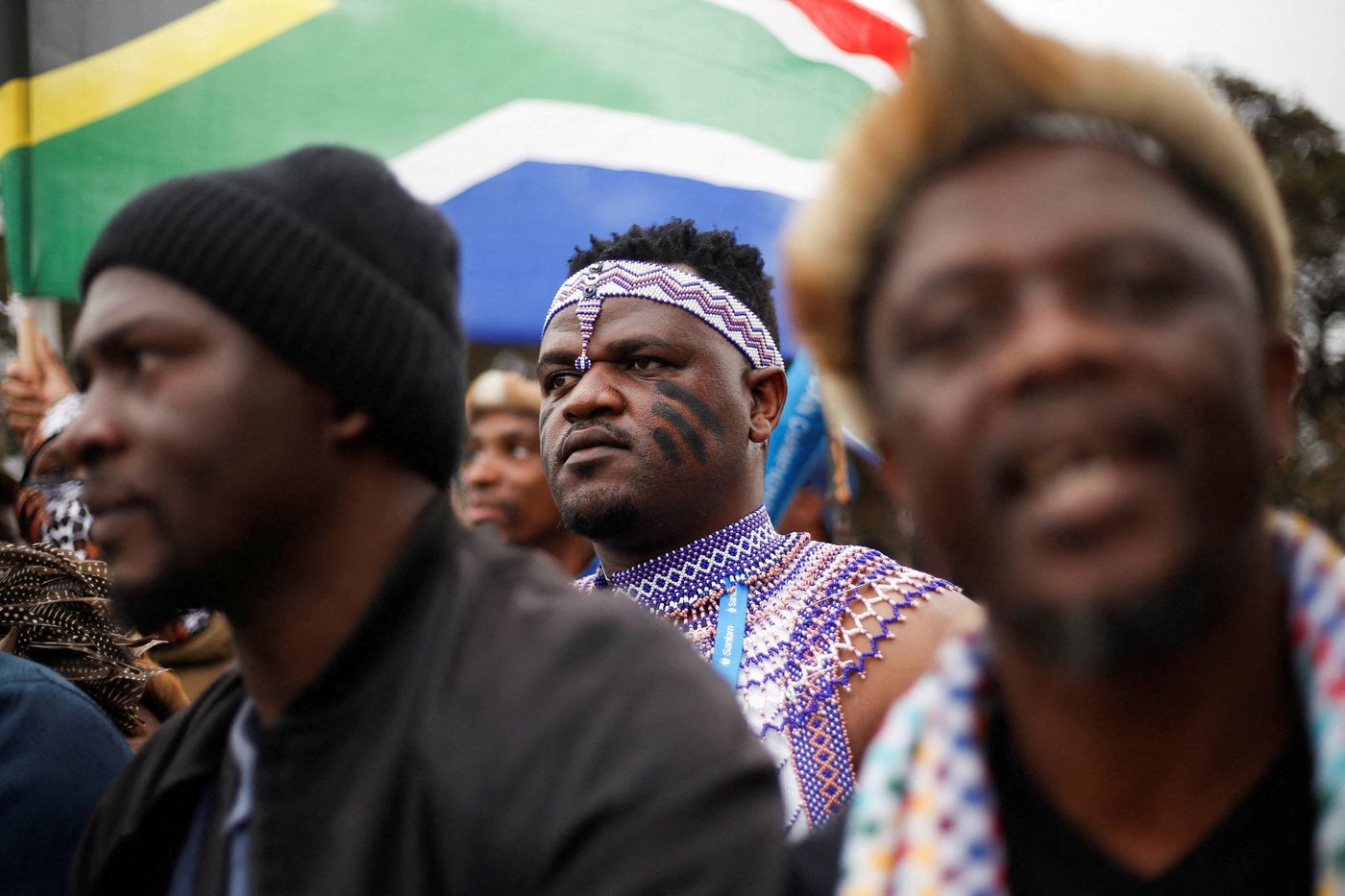
Participants in an anti-immigration demonstration on the date of the unofficial deadline set by anti-immigration groups for undocumented migrants to leave South Africa, Durban, South Africa, 30 June 2026.
© picture alliance / REUTERS | Rogan Ward
In recent months, xenophobic protests in South Africa have repeatedly turned violent, with mob attacks on migrants and a number of deaths. Anti-migrant groups have taken the law into their own hands, threatening people and demanding to check their identity documents and residency status. Various groups, including the key players March and March and Operation Dudula, declared a deadline of 30 June 2026, by which immigrants without valid papers were to leave the country. They were deliberately vague about what would happen to them otherwise.
The atmosphere was very tense in the run-up to 30 June: a coalition of more than 160 organizations condemned the protests and called for migrants to be protected. Employers asked staff born outside South Africa to work from home for their own safety. The police showed a heavy presence and made more than 900 arrests.
Although major escalation was averted, 120 protests were held on 30 June, accompanied by multiple outbreaks of violence. Their threats have had the desired effect: many migrants – including those with residence permits – have fled the country. Many of those who remain are living in fear. The anti-migrant groups have announced ongoing protests every Thursday until the local and municipal elections on 4 November. They leave no doubt as to the duration of their campaign: “until they’re gone”.
Unemployed, Homeless, No Electricity: Precarity Catalyses Political Mobilization
Violence against migrants in South Africa is nothing new. In 2008, 62 people were killed during xenophobic protests, and unrest broke out again in 2015 and 2019. The xenophobic movement has changed and developed since 2022, and became a nationwide phenomenon during this election year. There is good reason to believe that this is not simply a grassroots movement: at least in part, the protests are being orchestrated to stir unrest for political ends.
The anti-migrant groups seek to mobilize less-educated young people living in precarious circumstances, who face difficulties labour market. They argue that migrants take jobs away from South Africans in a situation where work is already scarce. While the official unemployment rate stands at 32 per cent, for young people aged between 15 and 24 it exceeds 60 per cent. Many are disappointed with the record of the African National Congress (ANC), which promised an economic transformation following the end of apartheid but is felt to have fallen short in important aspects.
The mood of dissatisfaction extends beyond the labour market. High crime rates and poor access to services such as housing, water and electricity give rise to frequent protests over the perceived failures of local government. This is particularly true in the most deprived areas, where people live in overcrowded housing, often with shared standpipes and long waits for medical treatment.
Under such conditions, immigration often exacerbates the sense of competition over resources. That perception persists even though the three million officially registered migrants account for only 5.1 per cent of the population. Even if undocumented migrants are included, the proportion is not particularly high in international comparison. Studies also identify positive economic effects of migration and cannot confirm the widely discussed link between migration and crime.
Protest, Xenophobia, Violence
The reasons for South Africa’s difficulties are complex, as are the causes of the dire living conditions of the poorest. Yet the groups organizing the protests – such as March and March and Operation Dudula – simply blame the migrants. Their campaigns are having an impact, with studies showing that growing reservations over immigration.
Operation Dudula was founded during the Covid pandemic and registered as a political party in 2023. “Dudula” is isiZulu for “to force out”. The group calls for the deportation of migrants without residence permits and for jobs to be given preferentially to South Africans. Attacks on migrants by members of Operation Dudula have been documented. They have driven foreigners from their homes, blocked their access to hospitals and schools, and intimidated informal traders.
March and March was founded in 2024. It operates similarly to Operation Dudula, but has greater reach on account of its founder. Jacinta Ngobese-Zuma is a radio presenter with more than 168,000 followers on Instagram, where she presents herself as a concerned mother and citizen and regularly posts videos about actual acts of violence (supposedly) committed by migrants. March and March describes itself as a “civil society movement”. Its narrative is that “we” are taking matters into our own hands in response to political failure.
Instrumentalization and Push-back
Social media plays a central role in these mobilizations. Analyses by Murmur Intelligence show that an online anti-migrant network has been mobilizing on social media for the past six years. The nature of the communications suggests that this is a coordinated campaign aimed at instrumentalizing the algorithms to disseminate anti-migration narratives.
Despite regular assurances to the contrary, there are doubts about the political independence of March and March. Research by the investigative journalism network amaBhungane shows that donations to March and March are channelled through a private account held by Nozibusiso Khambule, who is part of former President Zuma’s family circle. Various South African media outlets are debating whether the xenophobic campaigns are receiving foreign funding. There is also speculation about Russian influence, given Jacob Zuma’s close ties to Vladimir Putin, or Israeli influence because of South Africa’s case against Israel at the ICJ. But so far, no evidence has been provided.
The anti-migrant groups’ close ties to Zuma’s party, Umkhonto weSizwe (MK), have fuelled fears of widespread violent unrest could break out, as occurred in KwaZulu-Natal (KZN) and Gauteng in 2021 following Zuma’s arrest on charges of corruption and state capture. Back then, too, the disaffected were mobilized via social media. KZN is both the home province of Zuma, who was formerly a member of the ANC, and the region where March and March was founded. To this day, it is the area where the most anti-migrant protests are held – frequently with the support of MK politicians.
These ugly developments have elicited a civil society response. In 2025, four organizations filed a suit before the South African High Court, seeking orders against members of Operation Dudula for their violent actions against migrants and against the South African government for its failure to act against xenophobic violence. The plaintiffs included local grassroots movements representing informal traders, residents of informal settlements and other groups. They explicitly advocated for the rights of migrants and stood in solidarity with the economically marginalized.
The High Court’s relatively comprehensive judgement of November 2025 emphasized that human rights apply even to those who do not hold citizenship or a residence permit. It ordered members of Operation Dudula to refrain from harassment, persecution and hate speech. The court also ordered the government to implement the 2019 National Action Plan to Combat Racism, Racial Discrimination, Xenophobia and Related Intolerance, to establish an early-warning system for xenophobic hate crimes, and to publish the relevant data.
Tighter Migration Policy with Consequences for the Entire Region
Although the High Court paved the way for the government to strengthen migrants’ rights, South Africa’s ten-party Government of National Unity (GNU) has focused its response primarily on tightening its migration policy. The Comprehensive Approach to Migration Management provides for deportations, tighter border controls, voluntary return programmes and measures to combat the employment of undocumented migrants. In order to strengthen the rule of law in the immigration sphere, the government intends to combat corruption. The cabinet’s decisions do not include measures to curb xenophobic attacks or strengthen migrants’ rights, although the government does say it intends to investigate the underlying causes of the unrest. On the other hand, President Cyril Ramaphosa (ANC) and various government ministers have consistently condemned the violence.
The upshot, notwithstanding, is a significant tightening of migration policy. The ANC fears losing even more votes this year than it did in 2024, when it was forced to form a coalition with other parties for the first time since the end of apartheid. The second-largest party in the coalition, the Democratic Alliance (DA), heads the Ministry of Home Affairs, where it aims to demonstrate its suitability to govern. It has also announced that it will implement the reforms. The coalition is also under pressure from within its own ranks: the right-wing Patriotic Alliance holds one ministry and is pushing for tougher measures on immigration.
In mid-July, the South African government hailed the deportation or repatriation of 53,000 people as a success. Many of them to neighbouring countries such as Zimbabwe, Mozambique and Malawi, where socio-economic conditions are far worse than in South Africa. It is questionable whether this policy will contribute to greater security in the region. Instead, it could well lead to a deterioration in the economic and political situation in neighbouring countries.
An Issue for German and European Cooperation?
As it happens, the German and South African governments are both dealing with vocal and well-organized anti-migration movements, and intense pressure to act on immigration. Both countries face the challenge of balancing immigration policy with protection of migrants. So there are good grounds for a collaborative approach. For instance, an exchange between policy-makers within the framework of the “strategic partnership” on how to deal with xenophobic and ultimately anti-democratic movements could prove fruitful. The outcomes of such an exchange could also provide inspiration for other countries.
South Africa already cooperates with the EU in the field of migration, so there are also opportunities for exchange on how to manage migration while upholding human rights standards. Given the growing impact of South Africa’s migration policy on neighbouring states such as Zimbabwe, Mozambique and Malawi, stronger regional cooperation appears particularly sensible.
Germany and the EU could, for example, work together with the IOM and regional partners to support sustainable reintegration of returnees, thereby at least mitigating the of the worst consequences.
Dr Melanie Müller is a researcher and deputy head of the research division Africa and Middle East at the German Institute for International and Security Affairs (SWP).